
Recently Bob has been extremely annoyed about science. Not only does she have to do it all the time for her job, but being quite good at it means she has to put up with noticing everyone else being really bad at it.*
Take Indiana Jones for example. He is terrible at science (yes, archaeology is a science). That is absolutely not how you go about retrieving artefacts for a museum, Dr Jones. For one thing your fieldwork methodology is disastrous, and for another your insistence on removing artefacts from their research site and country of origin in order to put them in American museums is deeply problematic! How many ethics forms did you have to fill out for this shit? You’re almost as bad as Brendan Fraser in The Mummy stomping through delicate dynastic tombs or Richard Attenborough breeding dinosaurs for funsies in Jurassic Park. Disgusting.

Unfortunately, this kind of unscientific madness does make for better games and adventures. (Not that we haven’t tried to make the scientific method fun, too!). Enter Tobago, where we find ourselves ransacking an island for its treasures once more. At least this time the island won’t get completely destroyed, but we may still piss off some island spirits enough to get cursed.
Tobago takes place on a beautiful, sunny island. As a treasure hunter noble archaeologist you have presumably scraped together the funding to conduct research there in lieu of going on an actual holiday to somewhere you can relax. But that’s ok! There are sandy beaches, roaring waterfalls, and picturesque mountain ranges. The native peoples follow a rural lifestyle, living in huts and maintaining enormous stone idols (which Facebook amusingly recognises as faces if you photograph them) and surprisingly huge palm trees. None of which you will have a chance to explore as you dash madly around the island trying to find treasure.
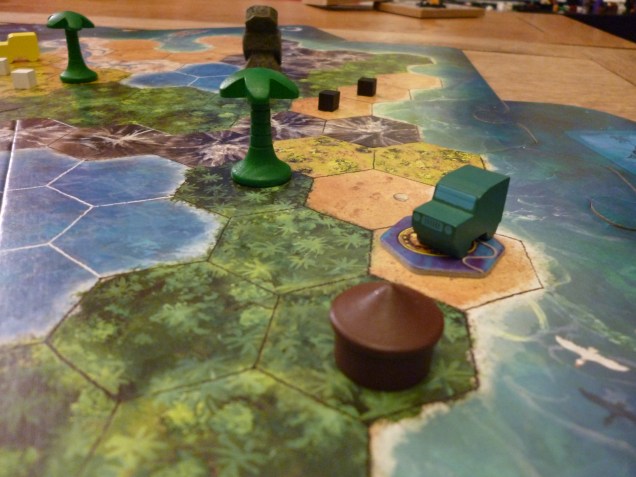
Bob’s friendly robot boyfriend introduced this game to her as “a backwards deduction game”. The idea was that she kind of sucks at deduction games, so maybe this will finally be her chance to shine (spoiler: it wasn’t).
 There are four treasures up for finding at any one time: brown, grey, white, and black. There will be more hidden around the island, ultimately, but presumably you only have enough room for four maps at once, the rest of your pockets being filled with snacks and maybe a board game to pass the time. To find one of these four you will gradually hone in on their location by playing cards which eliminate possible locations until only one remains. The treasure is then dug up and shared out among not only those who dug it up, but also those who contributed to discovering its location (because, of course, researchers share academic credit).
A turn mainly consists of either tootling around in your Jeep** or contributing some kind of map card from your hand to one of the treasures, narrowing down the possibilities of where that treasure could be.
As long as you eliminate at least one feasible location from a treasure’s dig site each time, you can contribute as many times as you like. Sometimes it can make you seem a bit less Indiana Jones and more like the lab intern who could be easily replaced by a monkey wearing a robot suit, but who has managed to involve themselves in so many projects that no one can get rid of them.
Suppose we have the brown treasure pile, and we know so far that this treasure is within two hexagons of the largest island forest. Here, someone might yell:
Chris: Right! I’m contributing to finding this treasure. It’s… not in a lake!
Everyone else: But… there was only one small chance of it being in the lake anyway.
Chris: SHUT UP, I HELPED.
We were forced to refer to Chris as Captain Unhelpful for the rest of the game, as he continued to make that kind of contribution.
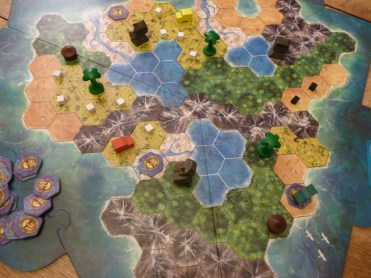 The game doesn’t encourage you to be unhelpful to your expeditions. In fact, it does quite the opposite. Every time you help narrow down the location of a treasure you’ll get a bit more of a share of that treasure. Or, as we call it, “put another finger in the pie”. You’ll want to have your fingers in a variety of pies, particularly earlier in the game, to get yourself a lot of treasures, and the quicker those treasures are found then the quicker you can stick some new fingers into some new pies, you see. Pie treasure for everyone.
But beware! Instead of delicious golden pie and chips you might instead dig up a portion of double wank and shit chips.***
 In a startling return to scientific inaccuracy, there’s a chance that the treasure you discover could contain some horrible curses, which can only be protected against with magical amulets or appeased by giving up your greatest treasure (in-game treasure though, obviously. You needn’t be prepared to offer up your firstborn just to play). As soon as a curse comes up then there’s no more of that treasure for anyone, no matter how many of the fingers you had in that pie. That’s why it’s best to not keep all your
 eggs in one basket fingers in a single pie!
There are only two curse cards in the treasure deck, and the game ends when the deck runs out. This meant that the game we were playing as we wrote this review managed to get pretty tense as curse card after curse card failed to appear.
We ended up with a pretty unusual Tobago game, in which suddenly nobody really wanted to collect any treasure, because of the near certainty of suddenly turning into a stinking, curse-ridden turd pie from which it would be impossible to extricate our fingers.

This might ruin the otherwise pleasingly dry play experience, but it does add some excellent tension, of the type that would make Lizzy shout ‘Jeepers Creepers!’****
 There’s something really satisfying about a game of Tobago. Not just working out locations of treasures, but also the gameplay more generally is rather nice. Those mysterious, giant stone heads that we mentioned at the beginning of the game will spurt out delicious amulets now and again, which make it worth pootling about in your Jeep a little more to collect them. They can enable you to double up some moves and work out some pretty tasty combos, as well as just saving you from the worst effects of the curse cards.
You can also employ some sneaky tactics in which you don’t just narrow down the location of a treasure and go and collect it, but actually cunningly narrow down the treasure so that you’re already standing on it. This impressive move was pulled more than once in today’s Tobago adventure (-“I love it when things are under my butt!” (Bob, 2016) ).
Lizzy was actually pretty impressed to find that Chris had Tobago in his board game collection, even though the collection itself is rather vast. There was a period when Tobago was out of print and you couldn’t get hold of it other than by paying some pretty extortionate prices. Luckily it’s been reprinted, but the price to pay for that is a few awfully printed pieces. Still worth it, but we’ll always be envious of those with a more original copy.

In a dramatic ending, the final curse of the day was luckily avoided, as each dishing out of treasure requires one more treasure card than there are people to collect it. Having convincingly earned the biggest pile of coins, Lizzy has learned to hide under the table and shout ‘if you can’t see me, you can’t say I look smug!’ It’s nice that she’s learning. Bob usually throws things at her otherwise.
The winner this week is science. But also, as usual, Lizzy.
* She sometimes blogs about this kind of thing instead of board games. Madness.
** We think it looks more like a bus but bear with us, there’s a pun about Jeeps waiting up ahead that we need to get to.
*** With apologies to The Thick of It
**** It absolutely didn’t. She thought up that pun really early on but wanted it put in at an opportune time. This was the best we could do. Sorry.

 The cards are a range of colours numbered 1-5. Effectively, what you want to do is put down sets of the same colour, starting with 1 and ending at 5. Simple. Except, you know, that bit where you don’t know what cards you have. Your turns are a battle between putting down your own cards if you think you’ve figured out what they are (or even sometimes if you haven’t! You maverick!) and giving very limited bits of information to one of your team-mates.
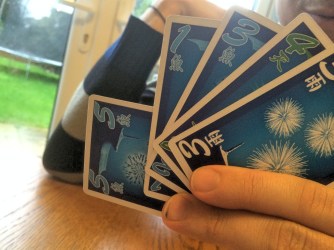


 To make matters worse, the amount of times you’re allowed to give out information is limited by a bunch of clock-faced tokens. When you run out of those tokens then you have to either gamble and play a card, or discard a card to regain a token. As if the pressure of running out of cards and ending the game isn’t bearing down upon you enough already.



 … Which of course was interrupted when someone knocked over a glass of cider, prompting a chorus of ‘noooooooo’s and scrabbling to save the cardboard bits. This summoned the very lovely barmaid who said that we sounded like a chorus of angels. Aw shucks. Loveliest thing anyone has ever said to us.
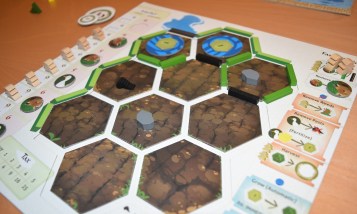
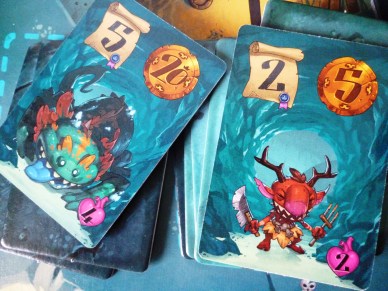 On the other side of the board is the sea, on which are placed six stacks of nine tiles. You must ‘dig’ through these tiles in the search for the fabled Stones of Legend, clearing rockfalls and battling monsters along the way. As you go deeper into the stacks the monsters get tougher but the rewards become greater. Sure you might find a creepy sea-bat-dragon, but you might also find a very valuable glowing-eyed Tiki icon. If you come across a monster while digging it will beat you up and send you to the hospital, causing one of your workers to be out of action for the next turn. Luckily you can also ‘survey’ as an action, which means looking at the top three cards in a stack to figure out if that mess is worth your time.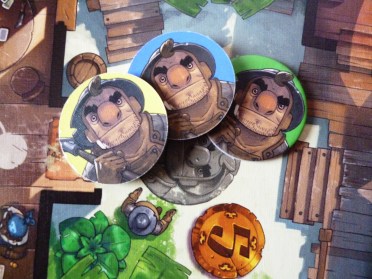
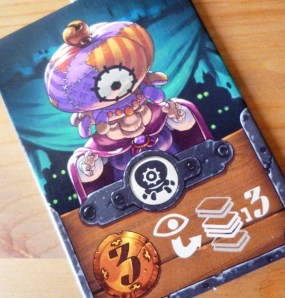


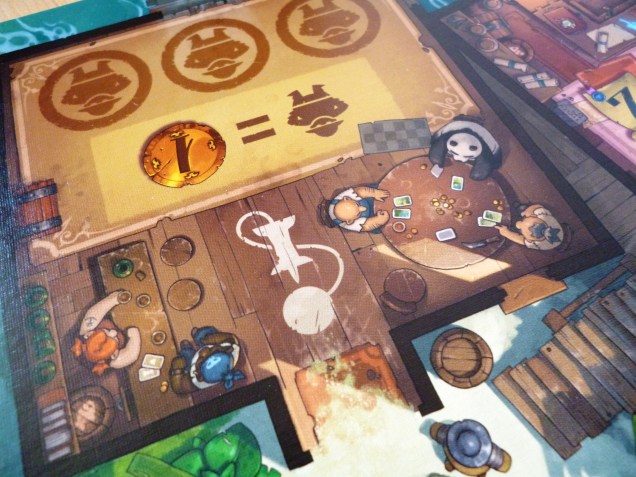




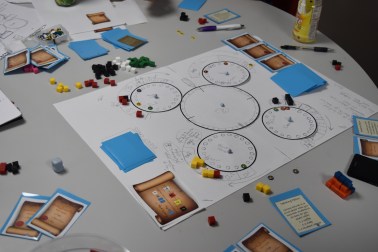
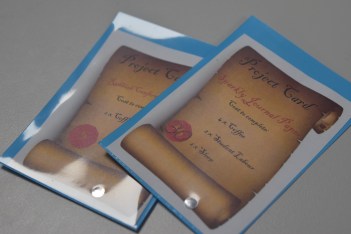 After much tweaking, the first play test actually went well! They came out with a better functioning game (would’ve sucked if it had just got worse) and so they were able to turn their attention to the graphics and other features that needed work. By the end of Saturday evening they had a range of fully written and themed cards ready for use, and had worked out what they wanted the board to end up looking like.







 Simply, your hidden worker-placement decisions affect what your opponents are able to do and vice versa. The upshot is that you make some choices by predicting your opponents’ strategy. The galaxies laid out in front of your frenemies are absolutely not hidden information, so a good peeping should at least give a hint as to their intentions, if not the results of their dice-rolls.
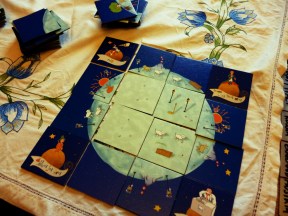








 Misery Farming