Liguria: Pimp my Cathedral

Pairs well with: Grog for your long sea voyage.
Traitor Rating: 2/10 daggers in the back.

DSC_0655

Board-gamers are a picky lot. Contrary to popular belief, when presented with a game which has a tonne of bright colours, a million pieces, and a theme along the lines of ‘the ultimate zombie werewolf death match apocalypse’, they do not get so excited they hyperventilate. What actually happens is that they take one look at the box and think ‘I’m not four’, ‘Please stop trying so hard’, or ‘for the love of God, pitching monsters against one another and using that many adjectives doesn’t make a game good, invest some of that energy into the actual game’.*

What a lot of people don’t understand is that board-gamers like dry, intricate and deeply boring themes. Euro-themes. Agriculture and shipping. Because that is what makes a really great game: enough theme to feel involved and immersed in a different environment, but enough structure and room for strategy to feel satisfying. An unfortunate by-product of this is that when we try and describe a very good game to someone else, it always winds up sounding like the most tedious thing in the universe.

‘Hey, have you played Paper Mills of Liechtenstein yet? No? You really should, it’s about working in a paper mill where you need to make sure the colour and consistency of the paper pulp is exactly right.’

Or,

‘Ermeghherdd I just played Sacrificial Canaries! I am totally the best at loading pieces of tin onto a cart and then getting a horse to pull it up the mine shaft. It only took three hours, it was amazing.’

Liguria falls into this category. It’s a game about paint samples and financial planning. You go travelling from port to port collecting different coloured paints, which you then bring back to your own port in order to paint your cathedral. But trust us guys, it’s a great game.

‘Have you realised that re-painting a cathedral in 16th century Italy would probably have the modern equivalent of Pimp my Cathedral… I would probably watch that.’

Each player represents a port, and has their own ship. During12268901_10156309277145085_1530353084_o_Fotor a turn tiles will be selected at random from a bag and placed in a line in the centre. The players then have the option of selecting how many of the tiles they want to pick. The fewer tiles you opt to pick up means the closer to the beginning of the turn order you will be when resolving actions, and so will be more likely to get a good pick.
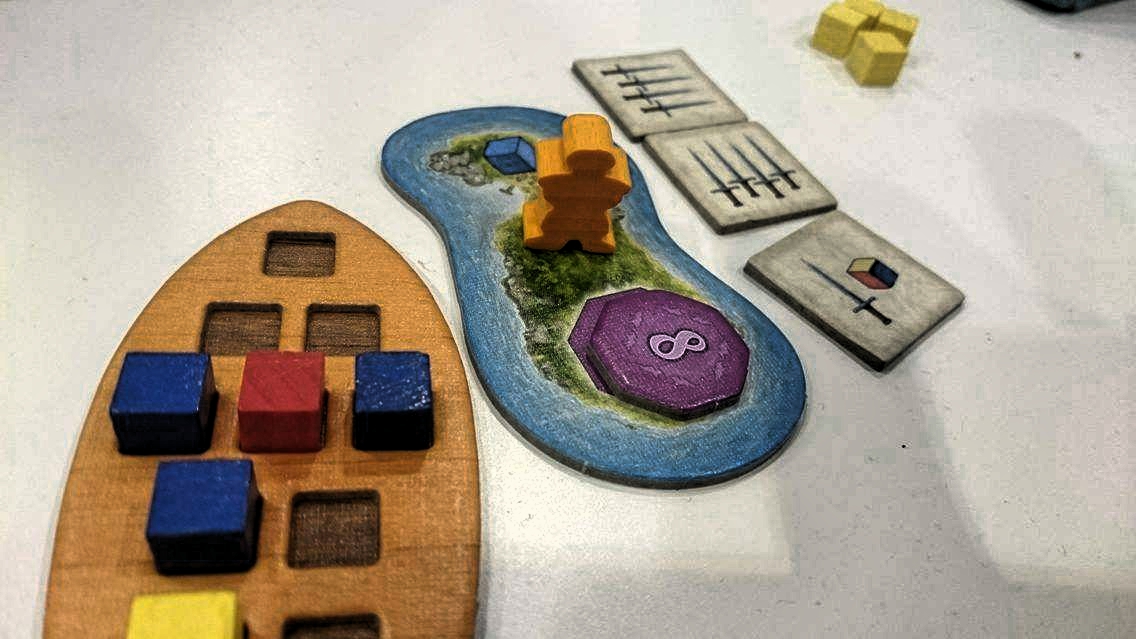
The layout has a little port and boat in front of each player, and all of the players sitting in a little circle, connecting it up. This is actually a pretty damn nifty alternative to the usual method of, you know, just sharing a board. You get to sail your little boat around your little circle of friends and it means you can be pretty flexible with table-space. More importantly, it means you can have fun pretending to be a bit of a child and sailing your boat along the table and making noises.

“CHOO CHOO!”
“That’s not a boat noise, Lizzy.”
“You can’t tell me what to do!”

The boats also have that really pleasant double-cardboard kind of makeup, where you can fit little cubes neatly inside them. What’s not to love?

CHOO CHOO
CHOO CHOO

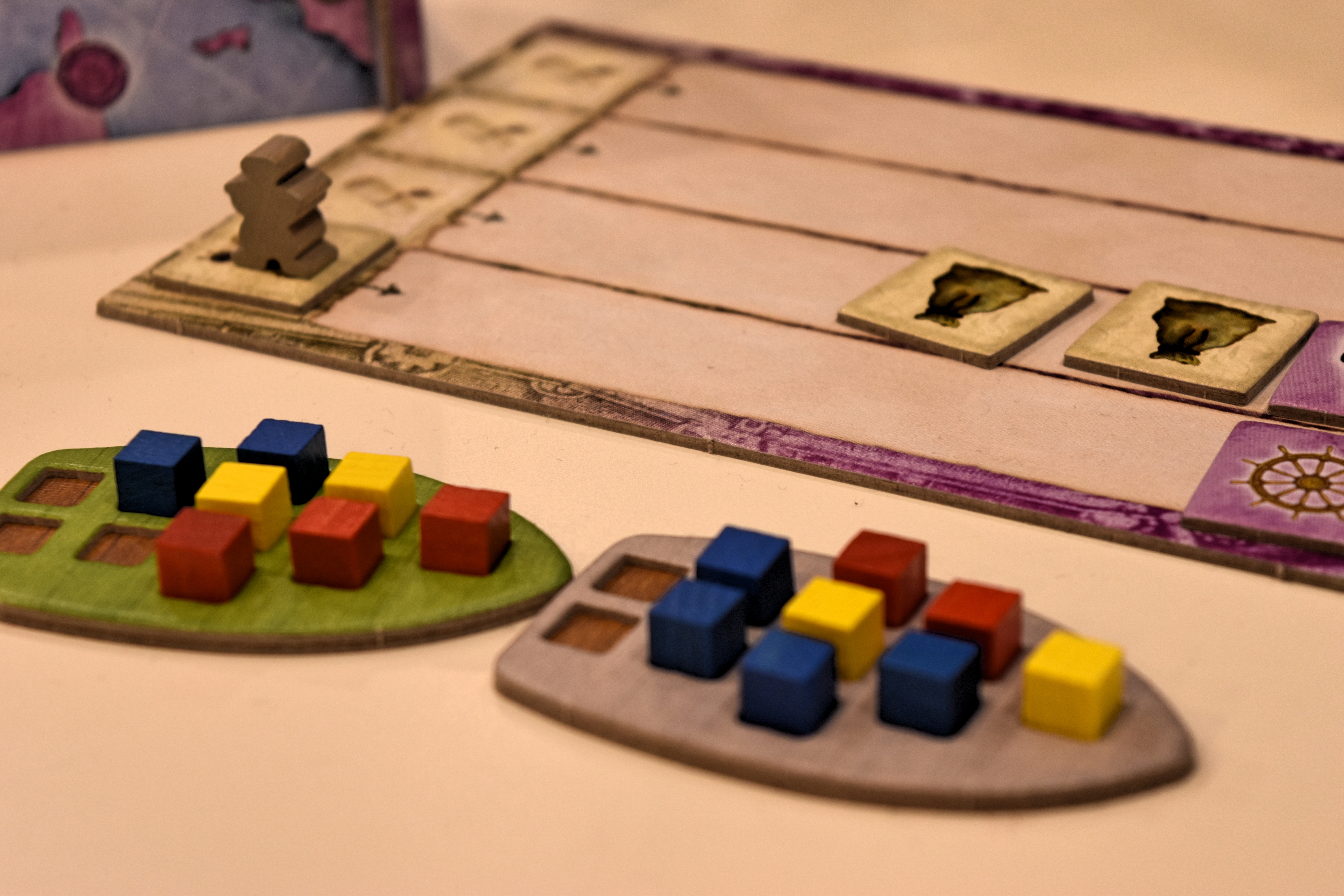
The tiles have a number of different icons: buildings, churches, daggers, paint contracts, scrolls, collection bags and helms. Most of the tiles you build in your town (your board) and provide you with a range of benefits: buildings provide victory points, helms provide an extra movement to your ship etc.

The idea is to build up a good range of tiles which help you to get the most paint. You will only receive victory points for paint if you have a tile asking for certain types. It’s all about the paint, man.
dsc_0417_Fotor

‘I don’t understand it, there are only three types of paint colour in this game but I’ve still managed to collect only blues and can’t fulfil any of my paint contracts. What is this? Why am I so bad at paint?’

‘Our ports must have some serious artists living in them because I’m pretty sure even Michelangelo couldn’t paint a cathedral with only three primary colours and make it look like a 3 year old child hasn’t gotten carried away with some marker pens’

dsc_0418_FotorAfter the tile selection phase there is a card phase. Each turn, three cards are laid out which will have a number at the top, and an action below. In most cases the action will be something similar to ‘three boat movements’ or an anchor which allows the boat to stop and start. The number at the top of the card is important because you’ll be adding all of these at the end of the game. Some are negative, some are positive, and if at the end of the game you end up with a total that is negative you will immediately lose a whole bunch of victory points. It’s kinda brutal.

Sure does teach you how to manage your finances in real life better though.

DSC_0657

The final stage of a turn is where players may move their boats and pick up paint. There are several islands scattered between the ports and these offer temping treats such as extra paint and victory points. Once you dock at another player’s port you collect as much paint as your boat allows and then sail back to drop it off at your own. Unlike other shipping games like Puerto Rico and Le Havre your boat can stay out as long as it wants instead of having to return in the same turn. This gives the game more of an authentic feel sailing from place to place in a long sea voyage that eventually results in returning home with a butt-load of paint.
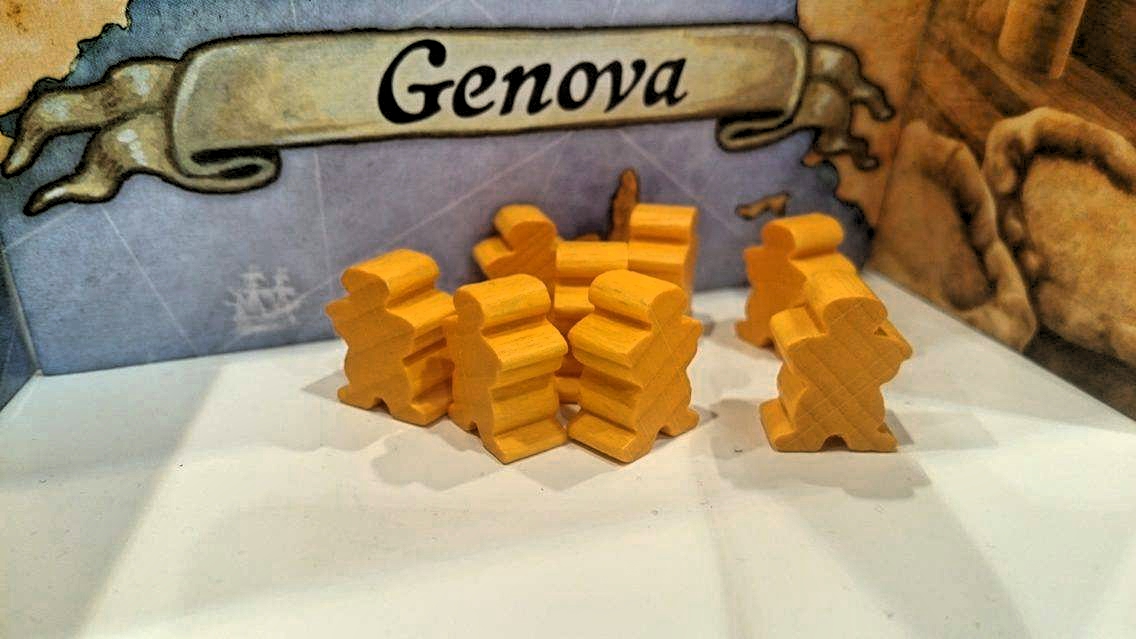
Conspiring to win
Conspiring to win

The turn begins again by drawing and laying the tiles. The game ends when the tiles run out. Simple. Go and paint your cathedral, kids.

Another thing worth mentioning is some different strategies – in this game it is not, in fact, actually all about the paint. This is fortunate because a lot of our friends are Warhammer 40K-obsessed nerds who could bring more paint to the table than you’d need to cover a fleet of cathedrals – we wouldn’t stand a chance.

Scrolls, for example, add an interesting diplomacy twist: when a player docks at another’s port they may place a scroll tile on any track of that player’s board. That means at the end of the game the player who owns the scrolls gets 2 victory points per tile in that track.

I'm here to steal all of your hard earned points. Thanks bye.
I’m here to steal all of your hard earned points. Thanks bye.

Briony has basically mastered this game, and instead of collecting paint she simply swans about collecting scrolls then sails from port to port being incredibly diplomatic and partaking in everyone else’s victory points at the end of the game.

Lizzy, on the other hand, wiped the cathedral floor with everyone in the first game just by getting highly into the building-points game. Ka-pow!

We haven’t met anyone who hasn’t liked this game. It was actually the first game we played at Essen, chosen only because as everyone streams into the hall for the first time there is a manic rush to sit at the nearest game and play it. We thought that Queen Games would provide us with some good reliable fun, and it did! Liguria was just suitably close to the door and we got to experience paint like never before. Excellent work all round.

Un-pimped cathedral
Un-pimped cathedral

The fact that the game is pretty relaxing and not stressful at all is another thing it has in its favour compared to other similar games.** Ship some paint, have a nice time. Shh, shh, just don’t think about having a load of cards with negative numbers, you’ve still got time to sort that out.

At the end of the day, or indeed your long sea voyage, you can take comfort in the fact that however badly your game has gone your cathedral will get painted and the citizens of your town will be all the happier for it.

*This is such a persistent problem that sometimes we’ll see a game and be so put off by the theme that we won’t give it a solid chance. The Possession is basically Evil Dead in game form and at first appears to rely heavily on gumpf like zombies and girls who look like they belong in The Ring, but is actually a solid, well-balanced game with some unique features and clever mechanics.

** Bob’s friendly robot boyfriend found it incredibly stressful, but then he is terrible at financial planning.

Steampunk Rally: A Rally Good Game!

Pairs well with: Gin on rough terrain (the rocks)
Traitor rating: 4/10 “I could race… or I could screw over Lizzy…” – (everyone)

DSC_0619_Fotor

Each member of the Misery Farm had several favourite games to come out of Essen 2015. When pressed, all you can get out of us tends to be a pretty diplomatic and squirmy answer, along the lines of “well I loved so many of the games, I couldn’t possibly choose!” or “can’t I just say that I love all of them?” or “I CAN’T FREAKING DECIDE, LEAVE ME ALONE ALREADY”. We’re told this is similar to how some human adults feel about their children.

But if we were pressed to decide on a top list of games then we could probably all agree that Steampunk Rally has a pretty damn high spot. It’s one of the games we all actively sought out after Bob enticed a group of us in with her description:

DSC_0617_Fotor“Guys! We need to play Steampunk Rally next. It’s like the hipster Wacky Races, but you get to play as Marie Curie! Only she’s a ROBOT!”

Sold! Literally.

Now we’ve brought (several copies of) the game back to our humble homes the excitement hasn’t worn off.

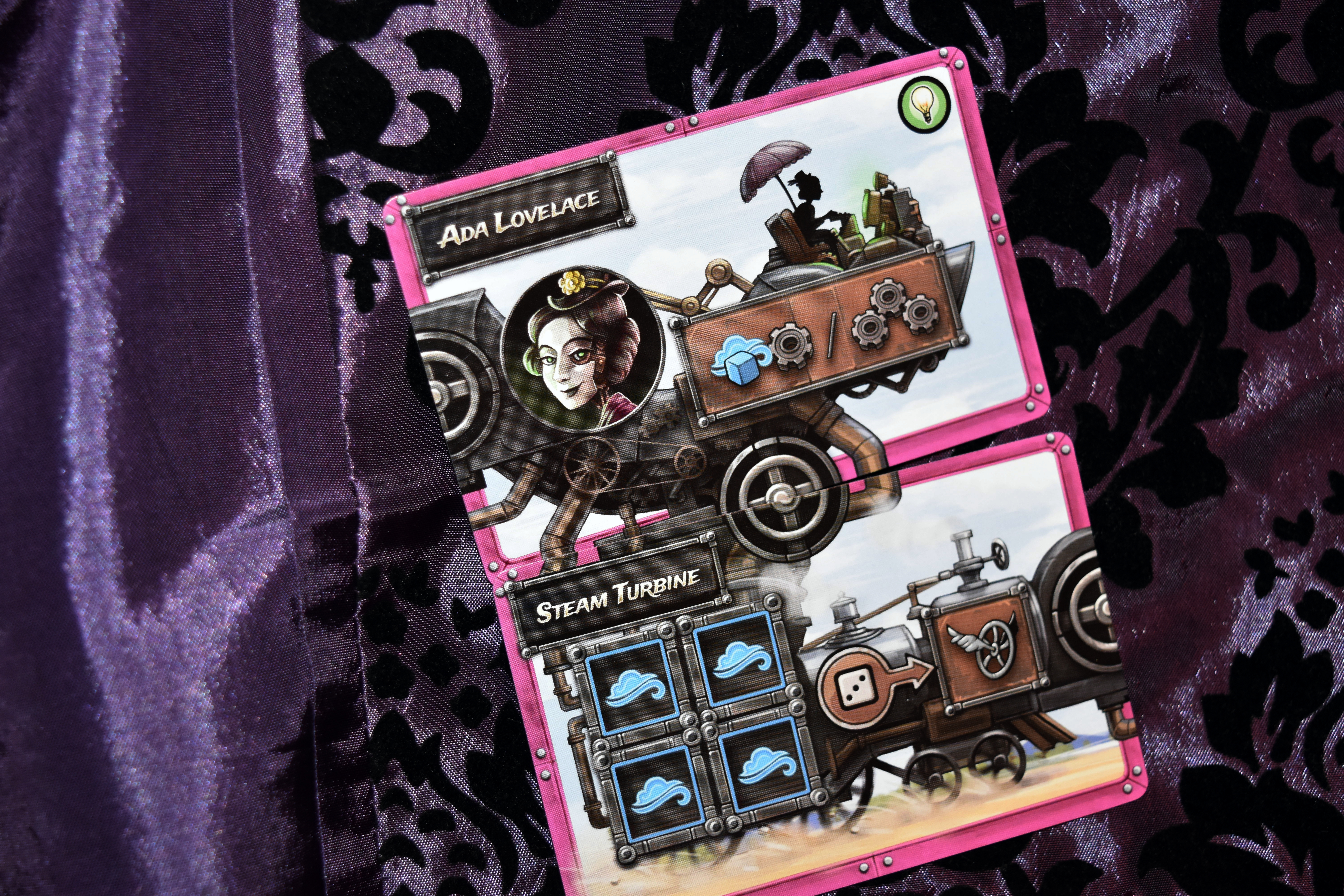
To start off with, have we mentioned the characters? There are sixteen to choose from, all based on some of the coolest inventors that history has to offer. If you want a team of badass lady-racers (which you know very well your team of badass lady-journalists do), then you actually have a whole range of options! That’s right, A RANGE of female characters!

DSC_0647
Science!

This evening we plummed for Bob as Ada Lovelace, Briony as Marie Curie and Lizzy as Hertha Ayrton. Briony had conveniently hosted a steampunk Hallowe’en party in her house a few days beforehand, and being the cool kids we are we grabbed a few spare steampunky goggles strewn around and got our race on!

Each player gets their little chosen inventor card plus an additional unique card which, together, make up the start of your brilliant machine, which you’ll add bits to as the race goes on via a little valve symbol that lets you know more bits of machine can go there. Being the snazzy and intelligent inventors that you are you can easily unscrew some bits here and there and rearrange your machine as you go along, so you don’t need to worry too much about the order of placement (take that Galaxy Trucker!).

DSC_0624_FotorThe aim of the game is to win the race. You win the race by crossing the finishing line first.* Sounds simple and familiar so far, right? Racing 101. Oh! Also, you’re racing in a giant machine that’s constantly rearranging, powering up, and occasionally exploding – more on that later.

Brimming with overconfidence, having not actually played since the trial rounds at Essen, we opted to play on the super-fancy FUTURISTIC HOVERDROME. More danger, but we could handle it. Robot power! Plus the map is a bit randomised at the beginning, which is always a bonus.

DSC_0613An actual turn consists of a few different phases, which each person does at once 7-wonders-style (or does slowly and in turn order if you haven’t figured out the rules yet, or if you just want to show off your rad moves). The first of these involves taking a card from a selection and passing the rest on. Here’s where you’ll use some of these cards to add bits on to your machine! Propellers, rocket boosters, a forcefield… should we chuck a time machine on there? Yeah, why not!

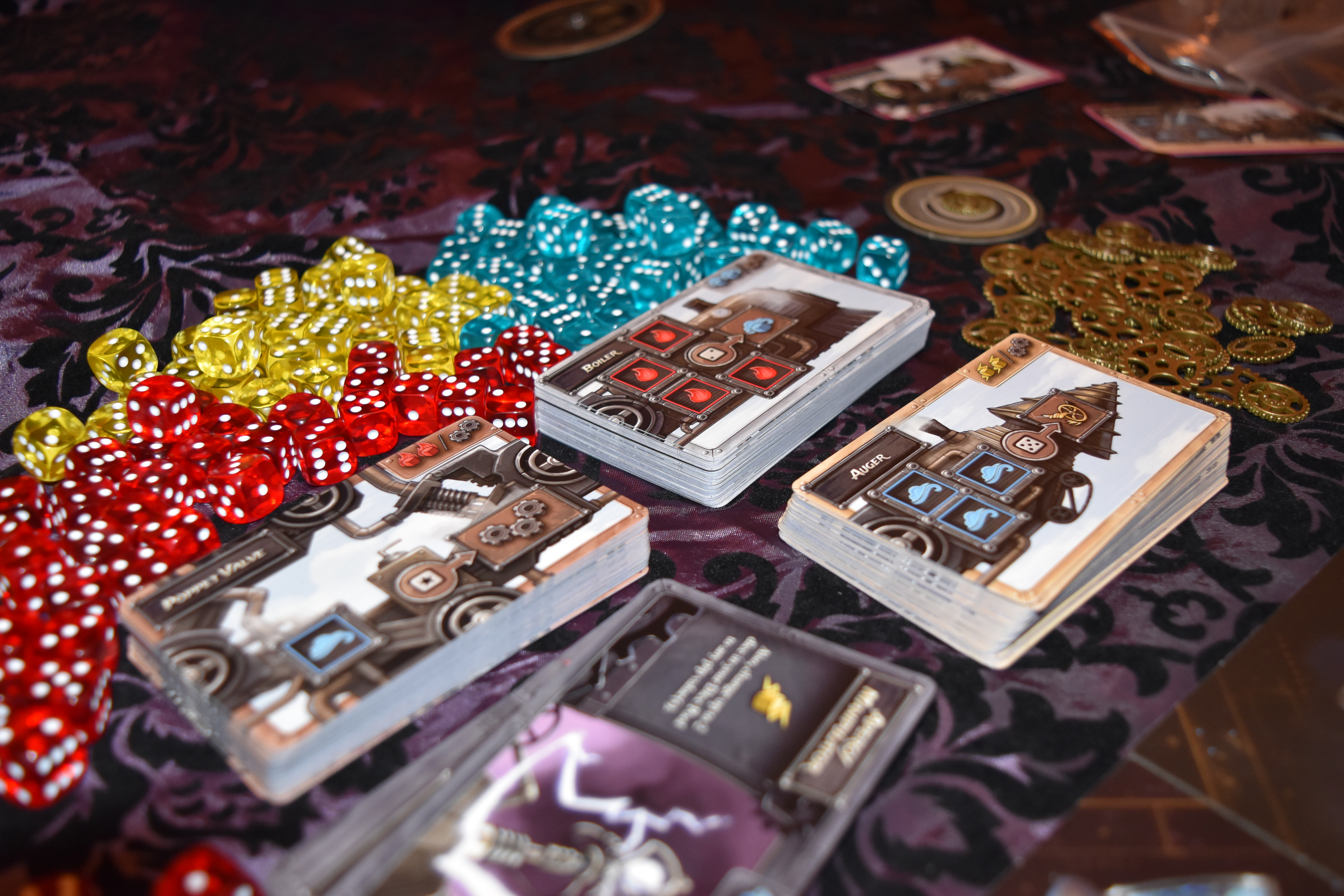
But the machine you’re building isn’t just about cool gadgets and aesthetics, it’s a beautiful, smoothly-running *cough* mechanism that uses water, electricity and fire power (dice of different colours) to bolster your machine’s defence or SPEEED madly along the track.

DSC_0630_FotorLater in the round is the racing phase! Here you roll the dice you’ve generated that turn and see how much power (how many little winged-wheel symbols) you’ve managed to generate. The misery farmers were off to a flying start! Each of us racing ahead with some efficiently running robot monstrosities, producing the dice and throwing them madly into the machines.

Oh, remember that bit earlier where we glossed over the bit where your machines can explode?

Yeah. Here that comes.

The final phase of a round is a ‘damage phase’, where you calculate all the damage you’ve taken from the terrain you’ve just hastily and cockily rattled across.

“Oh, oh shit. I think I raced a bit too far ahead.”
“Oh crud, me too. Ohhhh no.”

The exploding machinery is probably the most unique mechanic of Steampunk Rally. For each damage you take which you haven’t defended yourself against, a part of your machine (of your choice) will explode and fall off. This can be a useful tactic at some points- sometimes it might just be worth losing some outdated bits of your machine for the chance to speed a bit further ahead. Maybe the force of the explosion is propelling you ahead a bit? Who knows!

But uh, what happens if you take more damage than you even have bits of machine? Back into last place you go.

Every single one of us had, despite being nominally-competent adult human beings, miscalculated the damage we’d take and exploded our machines completely. On the very first round.

“Guys. Guys. Can we just… maybe…”
“Pretend none of this happened?”
“Yeah!”
“Start over?”
“Yep.”
“PRACTICE ROUND OVER, GUYS. NOTHING TO SEE HERE.”

We definitely owed it to the great inventors that we were representing to pretend that that was a practice round and start over. Nobody wants that kind of a disgrace on their shoulders.

THE RACE BEGINS AGAIN!

DSC_0626_FotorSlightly more careful this time, the team of badass lady-racers (or just ‘badass racers’, if you will) had a much more successful second attempt at a race.

The theme is excellently done, as you can tell from our enthusiasm over the characters. Marie Curie has a brilliant robot body because of the radiation poisoning done to her flesh one, but this just makes her even more hard-core than she was already. Which is tough, because Marie Curie is pretty hard-core even in puny human form. Lovelace is also a robot, having downloaded her consciousness into a robot casing.

The depth of the machine parts is also great. You can build some pretty bizarre and beautiful machines!

DSC_0629
Boom.

“I’m becoming a weird spider-tree with legs! FEAR ME!”

“Argh! I keep wanting to attach a penny-farthing to my machine but there’s never room!”

“KAPOW! Oh no, my galvanised brakes!”
“Oh no, you’ve lost your galvanic brakes!”
“Galvanic! That’s what I said.”

Impressively, it also plays with up to eight players. But it does this while still being strategic, rather than a game of luck. You can fit the same amount of players as Camel Cup, for example, but actually involves some skill and planning.
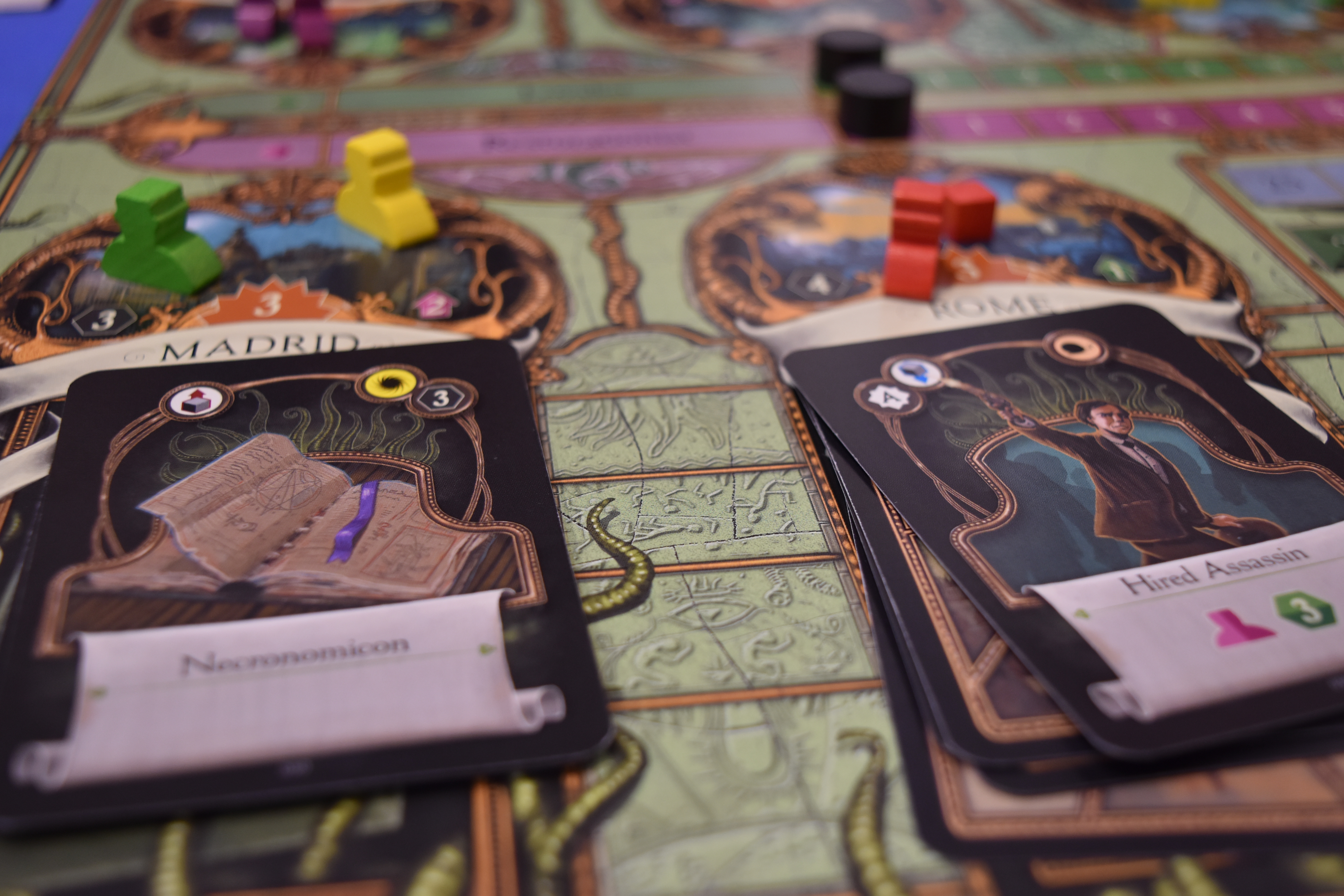
Briony’s playing a giant-machine tactic. Unfortunately, she seems to have got a little bit carried away with building something beautiful and forgotten that she’s actually taking part in a race. Lizzy, going for a “try to win” strategy, keeps losing her galvanised galvanic brakes, but the lack of stopping power definitely seems to be playing in her favour, and she’s speeding to victory.

That's a damn impressive machine, Briony, but it doesn't appear to be going anywhere...
That’s a damn impressive machine, Briony, but it doesn’t appear to be going anywhere…

The way that the phases work together is good for a larger number of players, so you’re not spending too much time waiting for other people to make their moves. But there’s definitely something lost when everyone races together, and it has a bit less of an exciting or sociable feel to it when you don’t get to watch everyone else’s smoothly running machines creating the perfect amount of water for their steam machines and then trudging along, or completely misjudging their power, going too far and falling in a hole. We prefer doing that part of the game one at a time, so we get to watch each other’s’ triumphs and disasters as they unfold.

Speeding to victory
Speeding to victory

The game is a winner both on theme and gameplay. It’s a great game to get your friends excited, and although there are certainly games that are more in depth, more strategic, and more ridiculous, it plays a pretty good role in our board game collections.

Of course, as always, the real winner is board games. And Lizzy.

*You can also cross the finishing line at the same time (on the same turn) as someone else, but then it’s about how far over the line you get. It’s not literally a case of who moves their character over the line first winning, because that would be madness of a different kind.

T.I.M.E. Stories: Sherlock Holmes meets Groundhog Day

Pairs well with: A nice cup of tea to help you think.
Traitor Rating: 1/10. It’s a co-op game, but accidents do happen…

What with it being Halloween and all, you might think that we at the Misery Farm would have prepared something special for you. After all, we are three alternative-type ladies and Halloween is basically Christmas for goths.

Well, we don’t. At least, not something especially spooky/Halloween-y. Sure the scenario we’ll be reviewing is set in an insane asylum and there are a few cases of [deleted] as well as terrifying [deleted] to be dealt with but it’s not, as such, a horror game. What this game is, is excellent. Bob cannot remember the last time she enjoyed a game so much on so many levels. The problem is trying to review it without giving away any spoilers, but we’ve done our best. This review is of the base game and introductory scenario, and all specific references and photos should be of game parts already explicitly mentioned or shown in the rulebook. If you spot a rogue plot point then let us know asap and we’ll shut it down.

painting
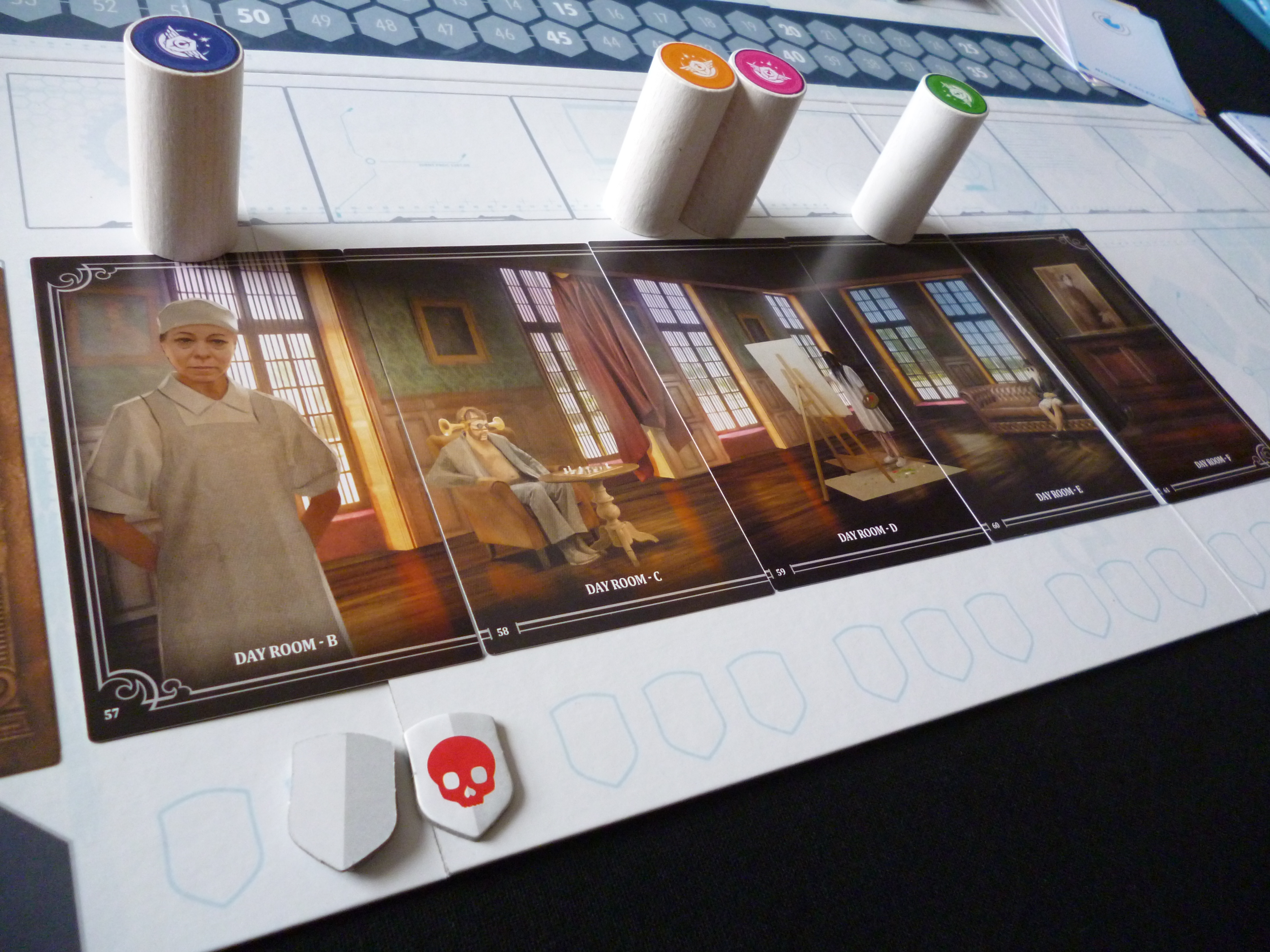
We can’t tell you what this girl’s painting, or why that guy is wearing a plague mask but… yeah.

With all that said, on with the review!

TIME Stories is a co-operative exploration-slash-puzzle solving game. If you’ve played games like Sherlock Holmes: Consulting Detective (which, by the way, is possibly one of the greatest puzzle games of all time), Tragedy Looper, or even an old school ‘GO TO LOCATION’-type MUD game then you’ll be acquainted with the format. TIME Stories perfects the genre in board game form. It’s a tabletop RPG with combat elements, it’s a strategy game, it’s an item-collecting, clue-solving meta-gaming puzzler. Most importantly, it does all these things well. Now, before we get going you should know that this is a scenario-based game. Essentially you buy the base game (which comes with an introductory scenario) and all subsequent scenarios must be bought as expansions. This has led some people* to declare it a waste of money and clearly a scam. They are wrong. It is a beautiful game and well worth the cash. Just don’t play it with two people. You want it to be a team experience.

P1020953

You play as a time detective. It’s probably got a fancier name than that but that’s basically what you are. You live in the future where time travel has totally been invented but people keep fucking around with it, creating time anomalies that threaten to break the space-time continuum and kill the whole wide universe! Luckily you’re part of a noble special-ops firm dedicated to going back in time and fixing the problems before they happen. Each game scenario is one of these time adventures.

Wallpaper-Terminator-robot-T-800-photo
‘Sounds familiar!’

The problem is that while you can go back in time to a location, you do not necessarily know what the problem is going to be or how to solve it. You have to follow clues, question suspects, and basically behave like the nosiest PI ever hired.

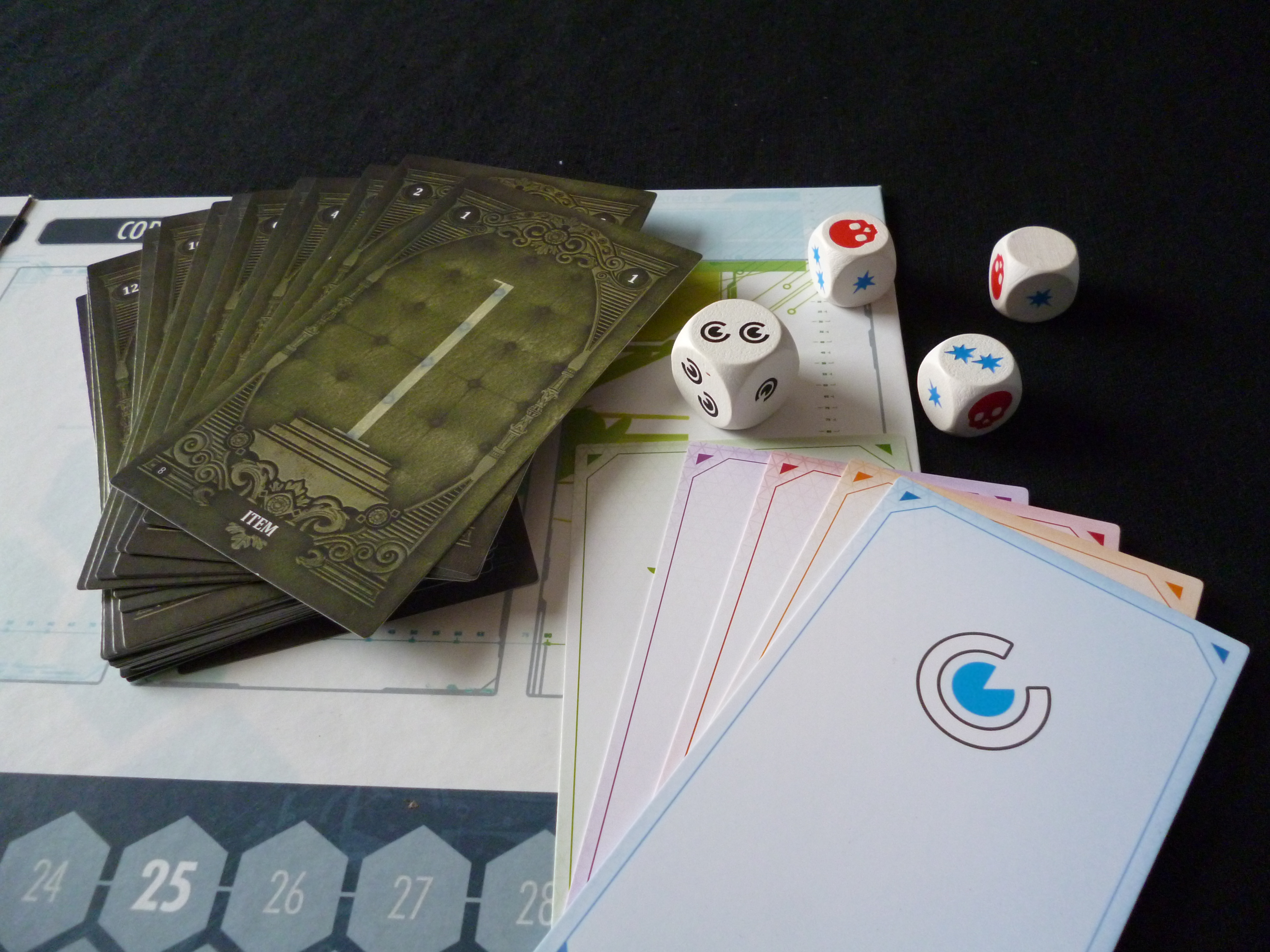
P1020965There are a few other minor *cough* challenges.  Firstly, your body does not go back in time with you. Instead, your consciousness inhabits a local ‘receptacle’ (unfortunate human) which you control like a hideous meat puppet. In the first scenario, Asylum, you are sent to investigate an old-timey mental asylum. Unfortunately the only bodies available to you are those of patients, and patients are not usually given free run of the sanatoriums where they have so thoughtfully been placed. Your consciousness also suffers from whatever debilitating mental condition has had them incarcerated in the first place, such as crippling [deleted] and hideous bouts of [deleted]. Sometimes you can turn these to your advantage, however, with careful use of [deleted] and doses of [deleted]. Choosing your receptacle wisely in a way that helps the team is part of the game for sure.

P1020960
Some nice people.

The second problem is that it takes a vast amount of energy to both send you back in time and keep you there. As such you only have a limited amount of time to complete your mission, otherwise you get transported back to the future (hey-oh!). Exploring, moving, taking actions, etc. all use up valuable time, and if you don’t solve the problem in your allotted time then you get in trouble with your superiors. Luckily they are quite willing to send you back again to have another crack at it. The aim of the game is to try and fix the temporal anomaly in the lowest-possible number of runs. The faster you do it, the more points you get and thus earn some [deleted].
P1020961Of course, if you finish the game quickly and efficiently you miss a lot of what it has to offer. This game has loads of branching paths. Not so many that it becomes heavy and messy but enough that to explore every aspect would definitely be a challenge within the time frame. Bob was sceptical at first, expecting that the format of ‘do and then re-do’ would simply turn into a game of ‘follow the leads as efficiently as possible, rinse, repeat’. This would suck, and probably result in a quarterbacking** problem. Luckily, TIME stories is actually very good and neatly side-steps this issue. Each run was completely different both in storyline and format.

The first run was a game of exploration. Talking to people, making mistakes, and collecting P1020962whatever clues we could. Two red herrings and a violent [deleted] later, we found ourselves back in the future, being reprimanded by our commander (confusingly also named Bob).  The second run revealed a whole new, previously unsuspected line of clues. There are layers to this game, man. This time we went deeper, coming so close to the end and then… promptly causing a temporal anomaly. Whoops.

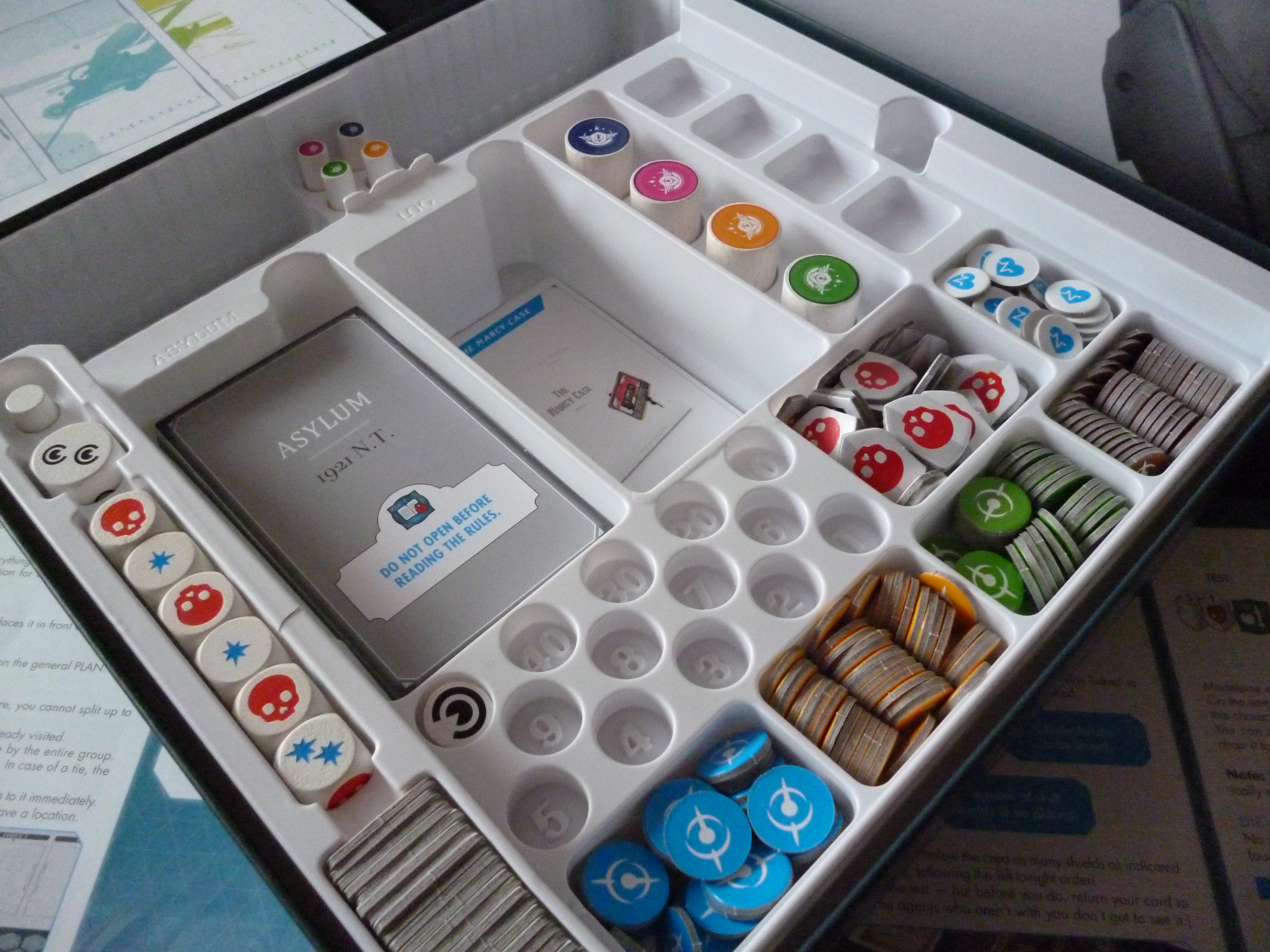
By this time nearly 4 real-time hours had passed, and we needed to stop. This was when TIME Stories traversed from ‘fun’ to ‘incredibly well thought-out and borderline-genius’ in Bob’s eyes. The creators know that you might not have time to play a 6-hour game in one sitting, but that you also won’t want to lose your place in your scenario. As a solution, the box comes with what is essentially a manual ‘save game’ set-up. You can carefully place your receptacles, clues, and various tokens and whatever in special little holsters in the box, ready for another go at a later date. The board even clips in so that everything is kept in stasis. Absolutely shitting brilliant.

LOOK AT IT
LOOK AT IT

Our final run had to be efficient, business-like, yet not forgetting to visit any necessary locations to gather important clues and items. We completed the game with not a single death on the team and in good time, which earned us a decent rank and… you’ll have to find out what else for yourself. But you should know that it’s so cool Bob almost died.

P1020966
We highly recommend you keep notes!

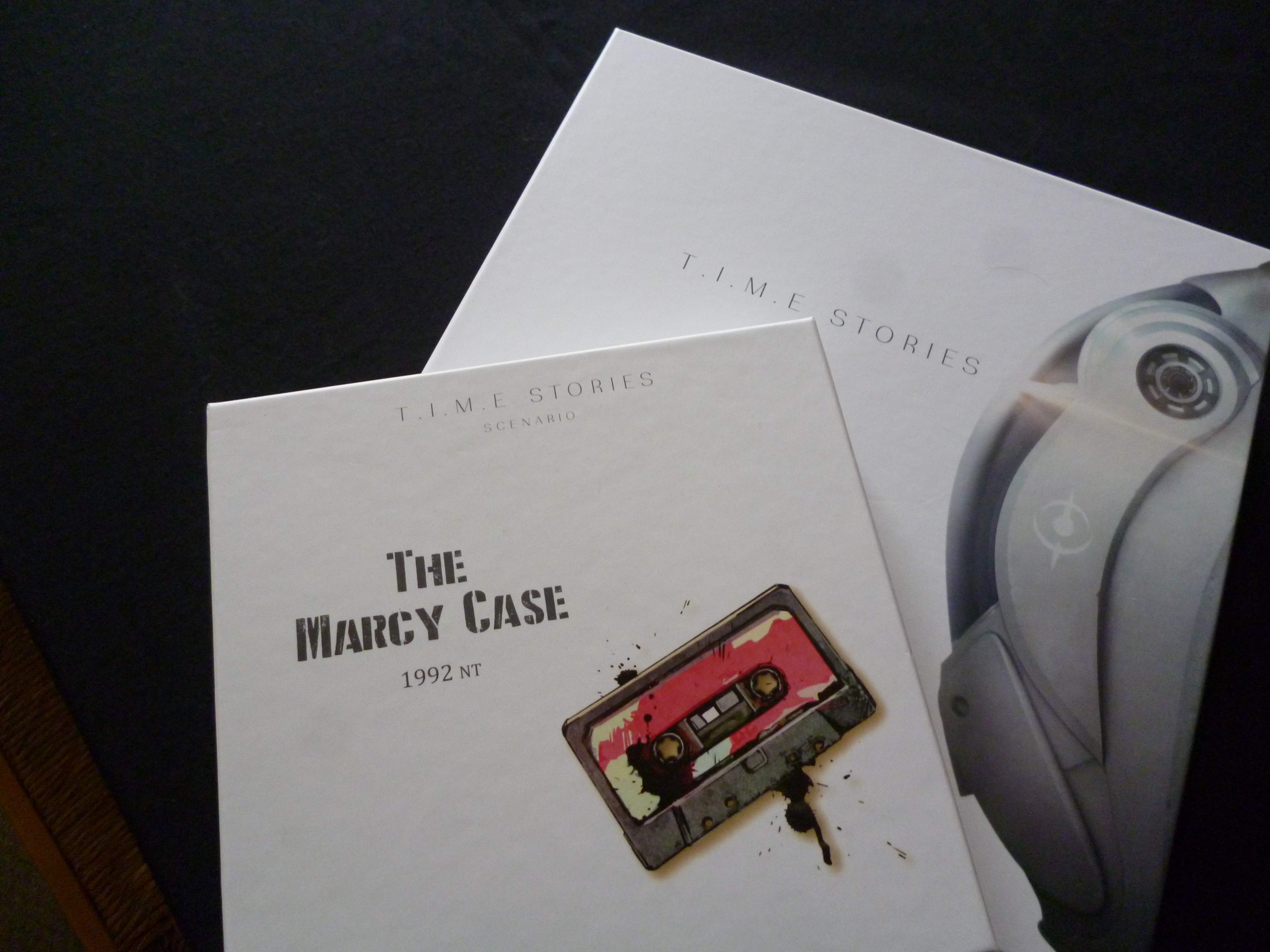
We are very excited to play further scenarios. Unfortunately, currently only The Marcy Case (a period drama set in 1992) is available, but future instalments should be out soon. Additionally, there is something to be said for playing the same scenario twice with different friends, just to see if they uncover more of the game than you did, as well as all the myriad ways they might fuck it up.

So many ways to fuck up and die.
So many items, so many ways to fuck up and die.

* Including Misery Friends who shall remain unnamed but who are pictured in our previous post.

**For those not down the lingo, this is when someone (usually a more experienced player) basically takes charge in a co-op game and tells everyone else what to do. It’s pretty irritating.


Pictures this week are by Bob. Which is why they’re terrible.


7 Wonders Duel: WONDERing whether to play?

Pairs well with: Coffee and aspirin.

Brutus scale: 8/10. This is because it’s a two player game that pitches you against an opponent. As with 7 Wonders, someone may be more placid or war-y than the average.

Sunday morning has been a rather slow start for Briony. She and her punk boyfriend Pat were screamingly hungover after celebrating Gord’s (from team Misery during Essen) birthday the night before. Logically they decided that now was probably the most opportune moment to re-play through the games Briony had bought at Essen*. It had to be done. Enough time had elapsed since returning to forget what board gaming was like at a convention**, and be able to put the new purchases into a living room setting. A living room now filled with blankets, coffee, painkillers, cheese toasties, and the occasional ‘Oh god my head, why is it so fucking bright?’ became the domain of Call of Chthulu’s lesser known Ancient one: The seething mass of fleece blankets whose singular goal was to play some games.

The seething fleece mass: Evade roll (-1). If approached without coffee loose 2 sanity.

The first game of the morning was 7 Wonders: Duel***. This was the first game that Briony bought during Essen. In fact she bought it probably about 23 minutes after the gates first opened. In hindsight she was utterly right, and around 66% of team Misery also ended up buying the game before the end of the convention. Bob, it should be said, is not included in this number. Bob thought it was a bit unnecessary and not particularly rewarding. She’s generally considered to be wrong, though. Shush Bob!

DSC_0491

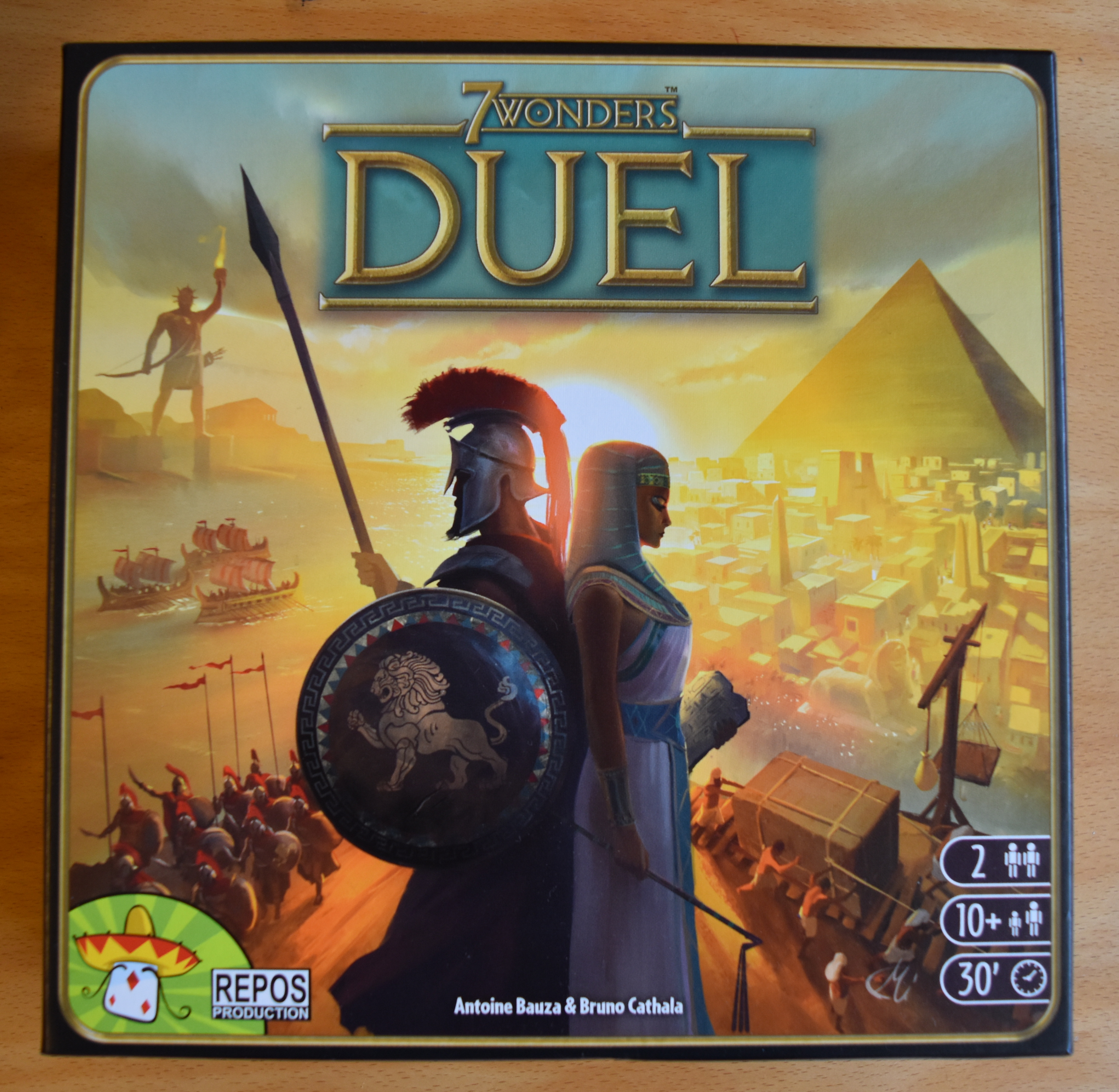
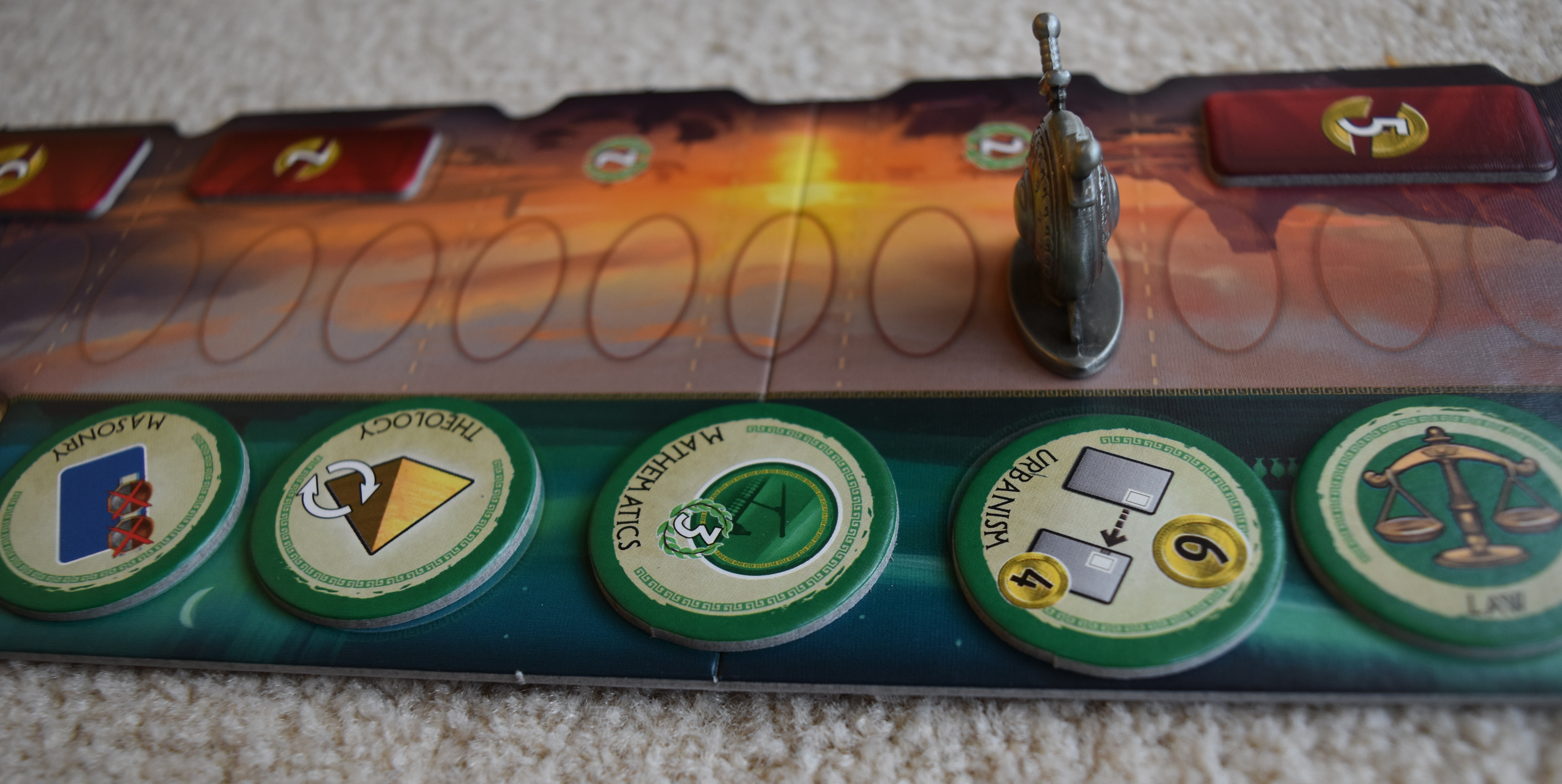
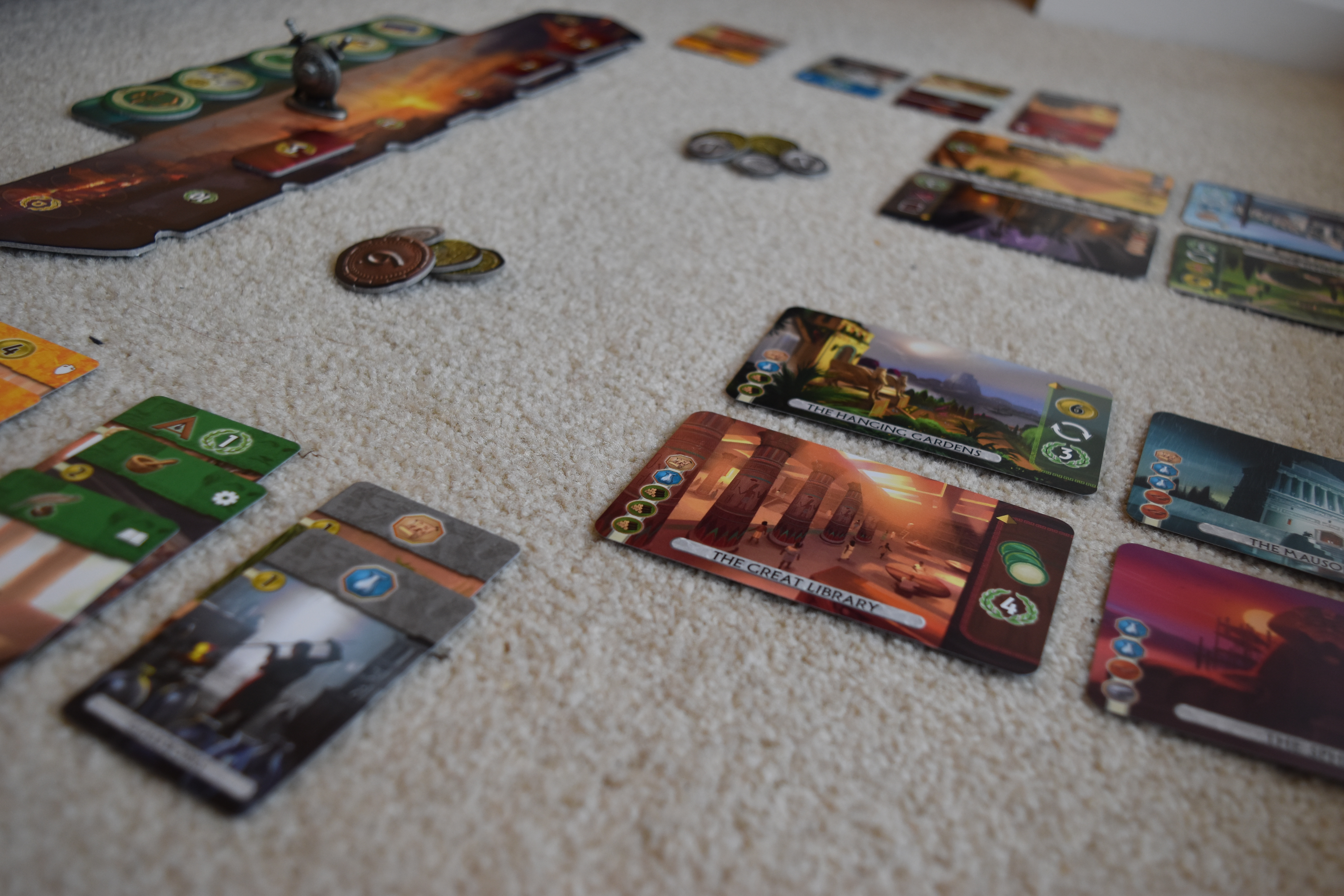
7 Wonders: Duel is simply a two player version of 7 Wonders. It does what it says on the tin. The game is so good is because it actually looked at some feedback from 7 Wonders, such as ‘how the fuck does one score science without an app’, and actually addressed the problems. Consequently there is now a ‘research system’ in place for science, which means that if a player builds two science cards with the same symbol at the top they unlock a piece of research, i.e. picking a token. Tokens have a whole range of perks that span from straight up victory points, to making your wonders significantly cheaper to construct. Obtaining all 6 different symbols of the science cards straight up wins the game there and then, meaning that no other points are counted at the end. This gives science an edge that it previously didn’t have in 7 Wonders, even though it was a useful mechanic for generating a tonne of points at the end of the game.

DSC_0495

‘This is the third research token you’ve got… are you researching how to be an asshole opponent?’

‘My major is how to be a dick, minoring in winning this game. You should turn up to class more often. Burrrrrrn.’

DSC_0496Moreover on the topic of addressing the weaknesses of 7 Wonders there is now no longer a war at the end of each era. Instead, there is a war meter which rises or falls when a player plays a military card. The meter is split into several stages which rack up victory points for the player pushing it up and negative consequences for the opponent. In a similar way to science, military domination now has the ability to straight up win the game if the marker is pushed to the end of your opponent’s side of the meter.

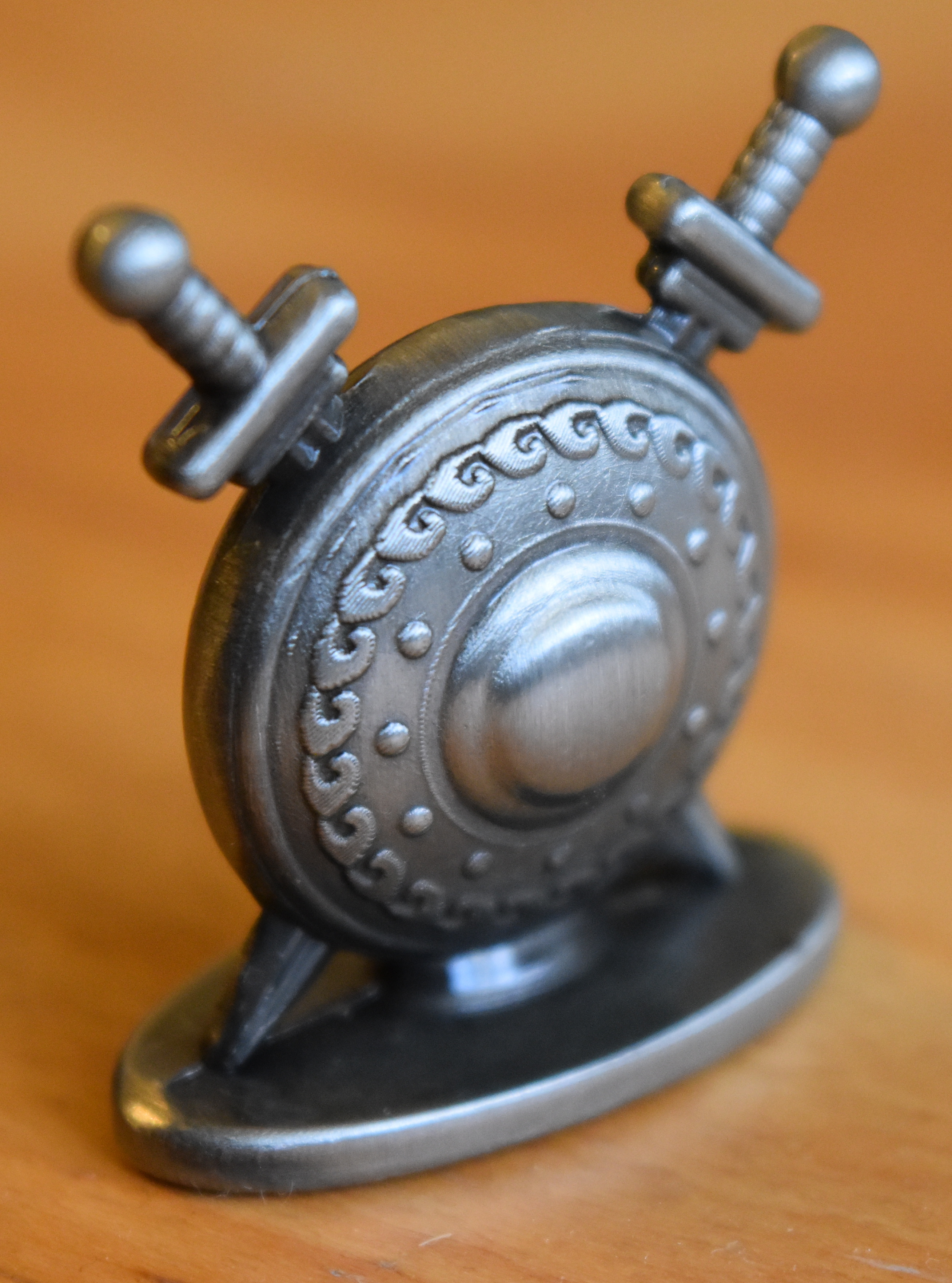
DSC_0493The special Essen edition of this game came with a pewter war meter marker which Briony lost while wandering around the convention centre in a haze of excitement. Fortunately the lovely people at Repos Games gave her another free of charge without even correcting her terrible broken German.

As the game is now two player the trading mechanic has had to change a little bit. Instead of being able to pay adjacent players for their resources, you instead pay the bank (which stocks everything apparently). If your opponent already has the resource you need you must pay the bank even more to be able to use that resource. It’s sort of reminiscent of the current European banking crisis. It turns out that the banker’s ridiculous money bonuses may have roots in hoarding all of the brown resource cards…

The final big change that Duel has compared to vanilla 7 Wonders is that each player has the ability to build up to four wonders each. Four whole wonders! That’s a lot of wonders. In reality most civilisations thought ‘eh, that’s probably enough wonder’ after one or two, but in this game you don’t have to let reality hold back your dreams.

The answer is always 'more wonders'.
The answer is always ‘more wonders’.

The great thing about this is you get to choose which wonders you’d like the opportunity to build at the very beginning of the game. Obviously you select in turn order so that one player doesn’t get all of the wonders they really want, but does offer a lot more flexibility from the original selection of races/civilisations in 7 Wonders. In addition to the pewter war marker, the special edition version of Duel from Essen also came with an extra playable card: the Messe****. The modern building has been painted as if it were 100BC making it a lovely addition to the selection.

As ever all of the artwork is stunning – this is one of the best things about 7 Wonders, and we’re all exceptionally happy that they decided to continue with it. Team Misery played a couple of drawing games while in Essen*****, and it’s safe to say that we absolutely could not be trusted to design anything as lovely as the 7 Wonders and Duel artwork.

12033012_10100675778688752_9030849820413802929_n

Finally, there are three eras to the game, as in 7 Wonders. Each era has a different card layout where each player takes turns in selecting unlocked (face up) cards. Once a card is taken it may unlock a card underneath it and it is turned face up. This brings some new Brutus mechanics to the game where you could discard something in your turn that you know your opponent wants or needs. Pat inflicted this on Briony several times during their Sunday morning play-through as she came close to winning with science twice. Briony preferred to imagine this as a disappointing part of history where the feared and trade-incompetent Pat the Lesser was forced to burn all of the books in the empire.

DSC_0498If you liked 7 Wonders then give this game a go. It’s extremely close to the original game, sticking to all of the bits that you know and love, while being much faster to play. It irons out the (admittedly minor) kinks from the original game, and brings some subtle but novel expansion to the theme and mechanics. Even Briony and Pat, hungover and annoyed at being dicked over by one another, still really enjoyed the second play-through.

*And sneakily on Amazon while in Essen. Always compare prices.

**Hot, sweaty, and always in a rush to find the next game.

*** Yes, we know Shut Up and Sit Down JUST reviewed this. They’re always one step ahead of us, the sneaky bastards. What can we say, they have a much higher budget. http://www.shutupandsitdown.com/blog/post/review-7-wonders-duel/

****This is the name of the convention centre that Essen Spiel is held in.

*****We highly recommend ‘A Fake Artist Goes to New York’, winner of the Misery Farm’s distinguished ‘Why the hell did anyone pay £20 for what is essentially a pad of paper and some tiny pens…. Oh wait that’s why, this is hilarious’ award 2015. Play it in the pub.

Misery Farm on the Road: Essen Spiel 2015 Day 4 Field Report

Exhaustion looms, but we’re still truckin’. On the final day of Essen Spiel 2015 we offer some final play-throughs and insights, including our considerations for Children’s Game of the Year.

Bob starts the day late, and hungry. The sheer number of games she and Chris have purchased has completely overwhelmed even her giant suitcase and they’ve had to rope in the aid of Friends With Cars to help lug twenty-something board games back to England. Additionally, Saturday night sushi had been completely de-railed when the previously-awesome all-you-can-eat sushi place failed epically in its mission to, you know, serve sushi to hungry gamers*. Deeply disappointing stuff. It took a generous liver-sausage roll and slice of pleasingly stodgy cake to fortify her for the day’s first mission: get Naïade to sign stuff, take a selfie, and draw us a picture.

CRBpZnvWUAATBfD

Mission success, though with many a concerned look. Naïade  is very French, and as such does not understand enthusiasm.

Day 4, game 1: A Study in Emerald
Sanity or victory points.. sanity or victory points..

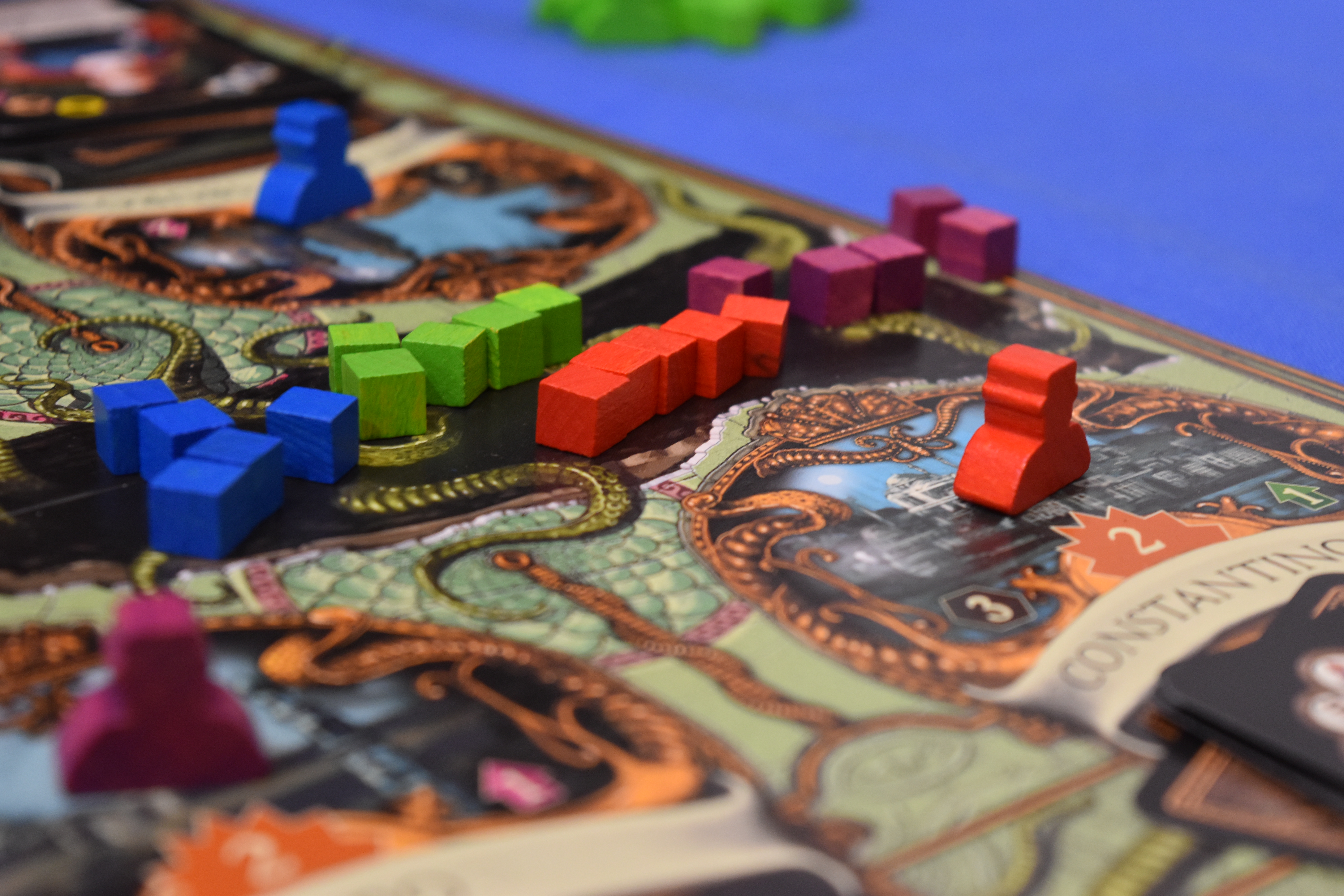
First actual game of the day was the second edition of A Study in Emerald. The game is based on Neil Gaiman’s cult short story of the same name, which is set in an alternate Lovecraftian nineteenth century in which the royal family have been replaced by Great Old Ones. Sherlock Holmes is there, along with a number of figures from history and fiction. In the game, you play (secretly) as either a Loyalist, faithful to the ‘royal family’, or a Restorationist commie intent on bringing down Britannia as we know and love her. The board is divided into locations which allow certain actions with varying ease, as well as a draw pile of cards. It’s effectively worker placement combined with deck-drawing mechanics, to reasonably solid effect.

DSC_0438Bob liked it, Briony didn’t. It may be that Bob really wanted to like it as she’d bought it on day one and it had sold out, but equally it’s possible that Briony hated it due to being hungry combined with a shockingly poor game demonstrator explaining the rules**. Certainly it’s simpler than the ‘glorified beta test’ original, and much cheaper and cleaner to boot!

Team Misery divided, and wanting everyone to know about it.
Team Misery, divided and wanting everyone to know about it.
day 4, Game 2: M.U.L.E.

Next, Bob and Lizzy tackled M.U.L.E., the boardgame based on the 1983 Commodore 64(?) game. It is absolutely charming. It starts off as a farming/resource management game set on an unexplored planet called Irata, where all you have for company is a robot-mule worker and your fellow explorers. Then suddenly there’s a capitalist market-trading mechanic and a magic money-generating Wampus and a mystical mine of purple crystals which change value in each game round. The board is busy but in a very Stonemaier-Games way in that all the initially-confusing symbols are actually there to clarify any potential misunderstandings and remind you of available actions. The winner is the Bob with the most space gold, while the loser is the Lizzy who has forgotten what their plan was to maximise their resources.

After that economic thrill ride any form of grown-up game seemed an impossible task. Our brains were just too full to absorb any further information such as ‘rules’ or ‘strategy’ or ‘tasks’, so we took refuge in Push-a-Monster, the award-nominated children’s game of monster-crowding. It’s very simple: try to fit your monster on an already-crowded monster platform, without knocking any monsters off the platform. If you knock a monster off, it gets hurt and has to go to monster hospital, so everyone else gets a point. Best of all is the lack of numbered scoring. No one needs that shit. Instead the monster-points are different sizes so the player with the longest string of monster-points wins. The illustrations are adorable to boot; one of the monsters makes exactly the face that Bob’s robot boyfriend makes when he wants to not be part of the Misery Farm.

10505414_10152401408286161_9040811379626614324_n (1)
Stop. Including. Me.

Two refreshing, addictive little games later and we were ready for more. Not before stopping by the HABALINK stand though, where we found a strong best kid’s game contender in Treasure of the Thirteen Islands. In this tactical children’s game, you explore treasure islands by navigating with your finger, then attempting to follow the route blindfold on a grooved board. If your little airship falls into a groove, you get stuck! If you find treasure, you win! It’s adorable and at least one person bought it.

day 4, game 3: Cash and Guns

Somehow we next managed to grab an eight-person table for Cash n Guns, which was promoting its fresh expansion, a special-edition Cthulhu character with a tommy-gun, and foam Uzi machine guns. The expansion was rapidly scorned as unnecessary, as Cash n Guns is perfectly fun without any extraneous bullshit, and plenty of shoosty fun followed.

Meanwhile, Bob secured a game of ‘Acquire Giant Sausage’, which she promptly then lost by dropping half of it on a surprised passer-by. Strong work, Bob.

CQ9NwHVWwAAxSr7
Pictured: Large sausage.
Day 4, Game 4: Architect
The road to victory. Deed-filled victory.

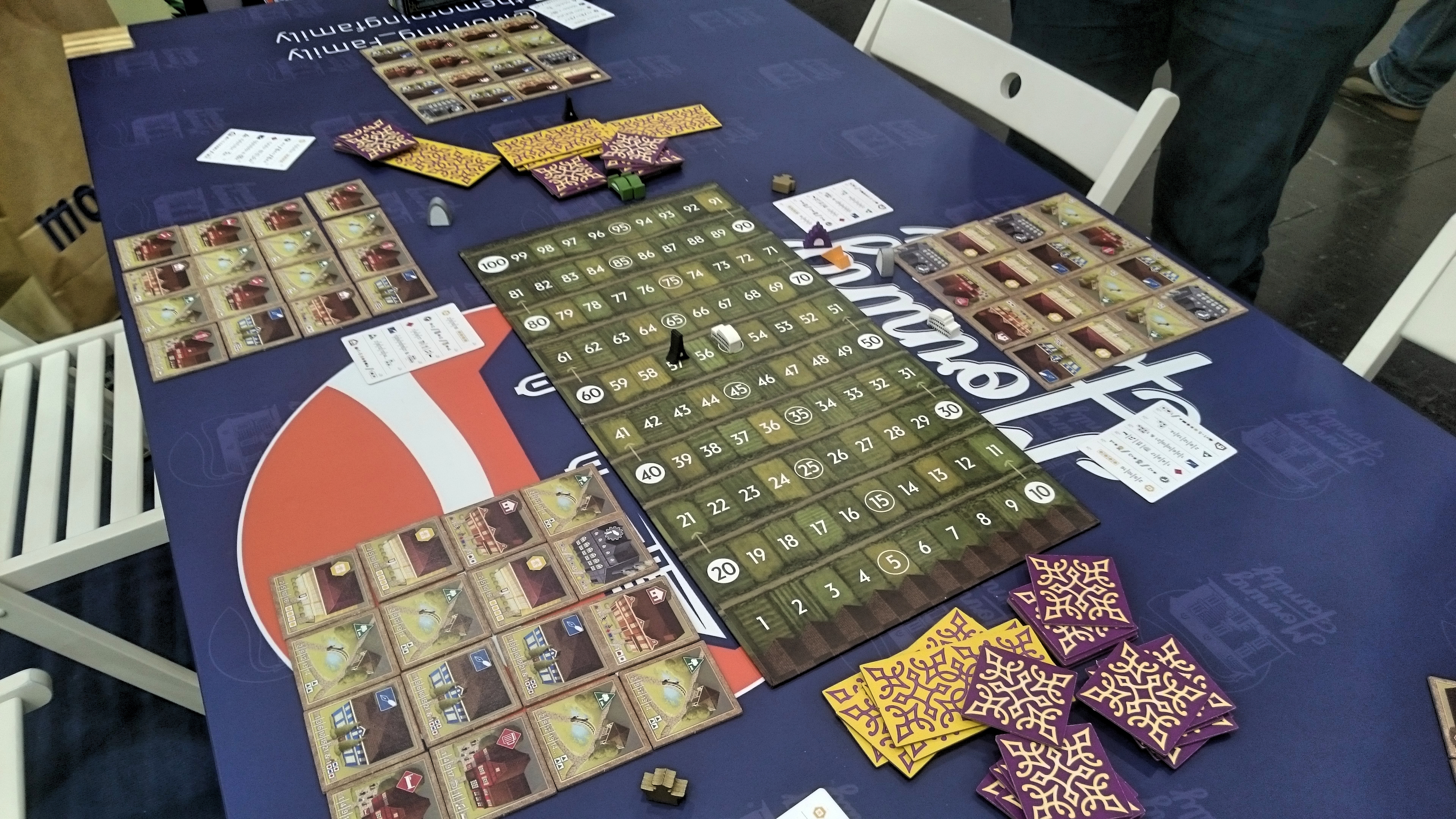
Briony and co., after being fairly disappointed by the experience of A Study in Emerald went and found a solid worker placement game. Architect fully ticks all of the boxes of worker placement, gasping drought, and being an intricately themed board game. Awesome. In this game you represent a travelling band of folk with different and useful jobs forming a caravan. The caravan travels around small villages and towns in a miscellaneous medieval European region, with a castle located in the centre. The band of travellers must fit the requirements of the specific village/town to be able to build or repair buildings generating prestige points.

Prestige points must be generated to go up each level of the victory track, which will eventually allow a player to win the ultimate prestige from the castle and win a contract. Or something. Honestly we needed a little more coffee to follow the broken English rules, but the game was fun regardless.

DSC_0450There are a nice number of mechanics in this game – the most unique of which is the ‘worker star’. Workers which you buy have different careers which are denominated by the numbers around the corner. After using them to build something you twist the worker around, showing a different number. Throughout a worker’s career their numbers go down, sometimes plummeting to zero if they’re going through stuff, maybe their wife left them or something.

The actions you are able to fulfil are dictated by the worker star also. But in the end, this game is about generating enough build points to get the castle’s favour. Fortunately the whole team was in agreement that this game was fun, quick, and exactly what we needed at that time during the day.

DSC_0445

day 4, game 5: Elysium

So this was the final game of Essen. Sad times. A band of team Misery longingly searched the halls looking for an empty table where they were able to play a game on their ‘to play’ list, and much to their delight found a free table for Elysium.

DSC_0453

The game is card based, and is heavily focused upon mythology. For anyone who likes 7 Wonders, boy is this your game. Half of the table was excited about its similarity, while the other half was excited because of its twist and difference from 7 Wonders. It ticks both boxes. In fact it won an award at Essen this year (and yet only two gaming tables! Why, Essen, why?!). Instead of representing a nation (as in 7 Wonders), you are a demi-god striving to generate enough myths about yourself to advance to becoming a full God. You have two areas where you may play cards: the mortal realm, and the immortal realm.

DSC_0451Each game plays with 5 gods, and there are 8 in total in the box so there’s variation, replayability and excitement! Your humble misery farmers/demi-gods played with Zeus (a classic), Aphesites (god of metal and hammers, stuff), Athena (owls, wisdom and the Hogwarts postal system), Ares (WAR hurr!) and Dickseidon (aka Poseidon but for serious, this guy is a dick and all his cards are dicks and the illustrations on his cards are dicks and his dick-in-ear scale is measured in kilotonnes).

The game plays out over 5 turns split into 3 phases. First is the ‘Agora’ (or ‘marketplace’. Yeah this game has got its Greek down, yo). This was helped by Lukacs, our excellent and friendly game demonstrator (helpful as we cannot read German rules). After that you move some cards into their immortal realms where their effects disappear but become sets (either by colour or number) and lastly the usual maintenance.

Screw your mortal resources, we need only pillars.

The cards have different coloured symbols relating to 4 actual, physical, coloured columns that each player has on their board. To take a card from the ‘Agora’ a player must have the relevant coloured column. Each card has effects, as you would expect – some of these affect only the player while others affect the player and the others players (not as good, obvi) You can also destroy whole coloured columns with barely an evil laugh. Dickseidon’s cards on the other hand usually do not affect the player but dick over other players (such as losing gold, victory points, discarding cards etc). This game is highly recommended, especially for anyone who likes 7 wonders, mythology and Dickseidon.

Rounding up the day

Finally we retired to a nearby hotel lounge, where our easily-bored but deeply punk friend Pat had secured a few big tables and crates of beer. Codenames, Potion Explosion, and Microfilms*** were all brought out and played to great enjoyment. Codenames remains an instant classic while Potion Explosion is shameless fun, and not just because Lizzy is hilariously bad at it. Microfilms needs… a more thorough explanation than we received. A cousin of [redacted], it relies heavily on keeping your cards secret, so if you don’t understand it you can’t ask what your cards mean. It has potential as a quick three-person game though, and our version comes with highly-professional art!

This weekend (FOUR DAYS IS NOT A WEEKEND -ed.) has been beyond intense, but extremely fun. Really we need to add ‘get enough sleep’ to our survival tips, but somehow between the beer, boardgames, and bratwurst that seems to be impossible. Besides, who needs that stuff when you’ve played upwards of 20 different games in four days? Especially when you’ve been playing with friends as good as ours.

We’d like to extend our thanks to the friends who came with us and made this trip as mad and brilliant as it was: Pat, Chris, Martin, Emma, Sina, Dave, Sam, Charlie, Gord, Mac, and The Reading Boardgames Social guys.** Final thanks to all the wonderful game creators, illustrators, vendors and demonstrators who work so hard and put up with the manic excitement of nerds like us. We’ll see you next year.

*Red Sun sushi, you guys make some delicious food but dear god expecting us to wait an hour for each of five courses is insane. We’re sorry we had to sic Bob and her mediocre German on you, making a complaint was physically painful to our English sensibilities.

** She also strongly dislikes deck building games due to unfortunate circumstances in her earlier years. It’s amazing how difficult it is to like a game again after you’ve cursed it to Hades for a truly terrible experience.

***On a side note, Microfilm has a character that looks hella like Briony. Is she really a Misery Farmer, or is she really the American spy?

Spy-Bri
Spy-Bri

Misery Farm On The Road: Essen Spiel 2015 Day 3 First Reports

Our third Essen report comes from the well-rested Lizzy, who, on the way out to get some dinner on Night 2, accidentally fell asleep instead and so is actually pretty well-rested. Incredibly rare for a board game convention, where sleep is normally a very limited resource, only available when you’ve run out of beer and are waiting for Messe to open its doors to you again.

As before, Bob is playing social media guru and is live-tweeting our trip to Essen, check it out. She bought a data plan for her mobile and is going mad with it. Mad! Also if you’re hungry for even more Essen, Lizzy and Briony wrote up the first reports for days one and two.

We’ve also started racking up a bit of ammunition for a ‘Disappointing Games of Essen 2015’ post, which is in the works. If you’d like more of anything else, let us know in the comments! (Or twitter, facebook, to our faces…)

Right. It’s Saturday morning, you’re full of Walnussplunder and Butterkuchen… go!

Day 3 Game 1: Scythe

DSC_0153_Fotor

If there’s one game that Lizzy ‘didn’t even bring a spreadsheet’* Miseryfarmer was hyped about, it’s this. Scythe isn’t available yet, it isn’t even up on Kickstarter until next week! But it comes from a pretty solid background of previously beautiful kickstarted games, of which Euphoria is probably the most memorable.

Badass tiger-lady
Badass tiger-lady

The game is pretty popular already. Bookings to try the game are at a premium, and a lot of people are being turned away, even with testing limited to an hour at a time.

Because it’s in such early stages, the pieces aren’t quite done yet. Lizzy’s hawk lady came without a hawk, the shiny pile of coins were apparently not in their final form and some of the pieces were definitely the wrong shape. The hawk lady’s yellow ‘stars’ happened to, for example, look exactly like yellow lightning bolts from Euphoria. Funny, that.

The game comes with the most beautiful art of mechs and a fallen Eastern Europe, and you can tell. Everything about it so far is beautiful, and you know the rest will be too.

We got a fair idea of gameplay during the hour’s test and, luckily, it seems to be exactly what you want for a game that looks like it does. It comes with building, expanding, fighting, resources, colonising, rising to power. We cannot wait to play it some more.

"You guys may have more points. But are you riding a bison? Didn't think so."
“You guys may have more points. But are you riding a bison? Didn’t think so.”

Day 3 Game 2: Codenames

DSC_0154_Fotor

The hall was already damn busy by the time we were looking for a second game, but before long Bob enthusiastically dragged us over for a quick game or two of Codenames.

Codenames is another one of those games that you end up only trying because of luck or the insistent recommendations from people you trust. Bob is often trustworthy and persistently insistent, so we cast our doubts aside and sat down.

You only need to take one look at it to figure out why we might’ve been a bit sceptical. The box is awful, and one of the dark figures on the front even has a speech bubble coming out of it which says ‘word game’. Word game? Really? Is that how low I’ve stooped during rush hour at Essen?

DSC_0155_FotorWe’re reassured that Shut Up and Sit Down themselves describe it as an excellent game with a terrible box. And it turned out to be just that! It’s a word association game, but in the best way possible. There are spies, competition and mocking. There’s a slightly dodgy two-player mode for it as well, but we strongly recommend you try it with four or more, for better making fun of the other team when they think that the clue “wedgie” matches “plane” rather than, say, “pants”. You know who you are!

Day 3 Game 3: Between Two Cities

DSC_0162_Fotor

To our surprise, we soon ended up bagging a seat at our second Stonemaier game of the day for Between Two Cities. The game’s novelty is that you’re building two cities, one on either side of you, but each city is being shared by a person on either side. Your lowest-scoring city is the one which gets you all the points at the end, so victory ends up being a bit of a balancing act.

DSC_0160_FotorIt’s good, and it has a satisfying level of simplicity and quickness as well as a having potential for good level of strategy and tactics. To play it feels a bit Suburbia crossed with Mad King Ludwig crossed with Seven Wonders. Which is fine by us! A perfectly reasonable game, and one of our number left with a copy in their bag.

(They did pay for it, we’re not using our blog to just let out confessions of theft.)

Day 3 Game 4: Titan Race

Another smaller game, in which you each play a hero riding a monster. Three laps of the racetrack wins! You may die a few times, and also blast some enemies into some lava. Simple stuff, some dice rolling and some mild fun.

Also contains a character called “Cthooloo” which is definitely the first time any of us had seen it spelled that way.

Not the winner.
Not the winner.

A little bit telling was that when we were choosing characters, the rules explainer advised us that Cthooloo wins most of the time. Oh! How much is most of the time? Erp, 90%?

Cthooloo won our game as well. Is this a flaw, or is it secretly actually an amazingly accurate representation of the mighty dark lord Cthulhu?

Probably the former.

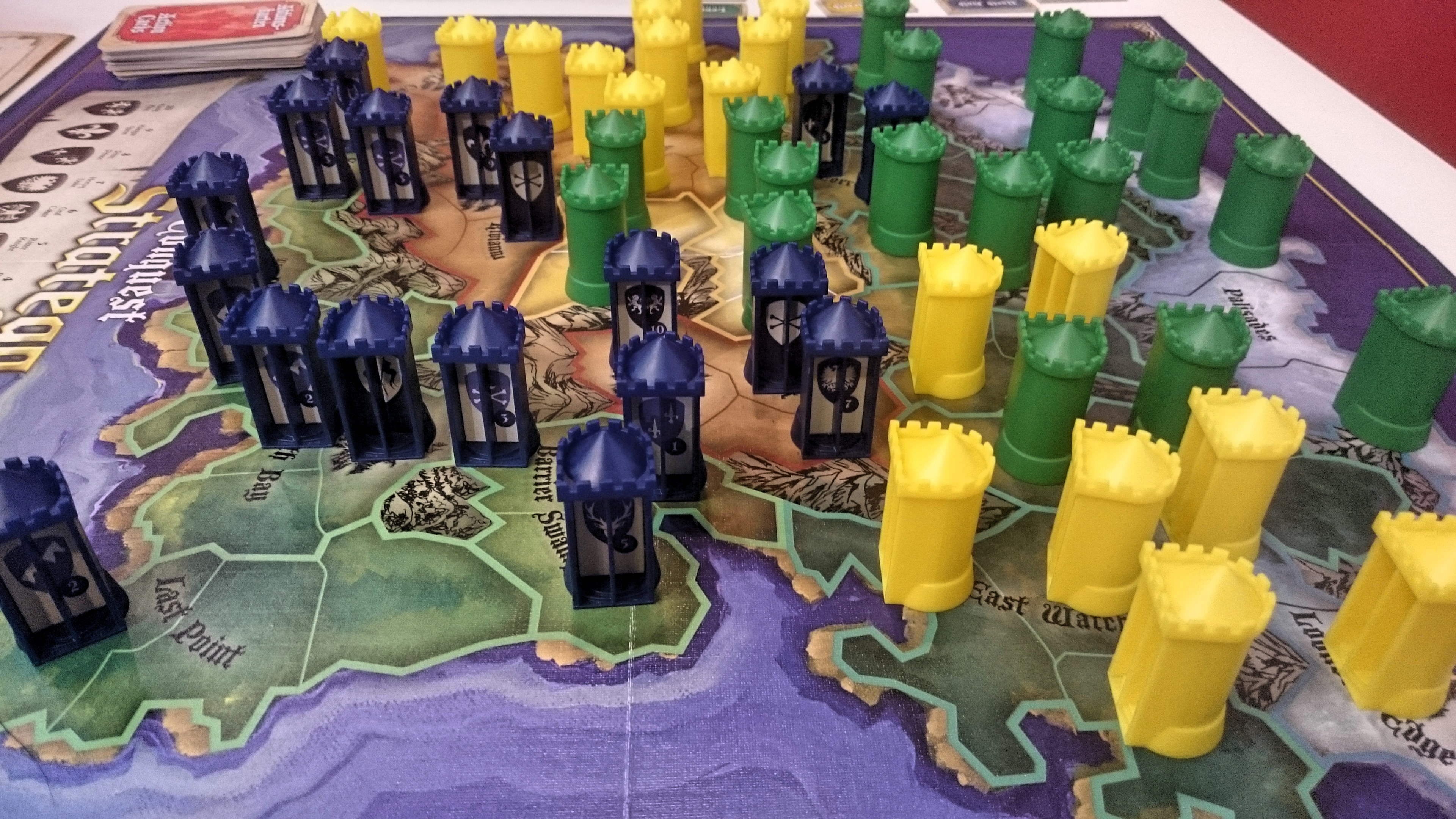
Day 3 Game 5: Conquest Stratego

This final game was another case of a last-minute choice based on glimpsing a free table in the distance. Conquest Stratego is based off another game, Stratego, which thanks to our excellent research and journalism skills we can tell you almost nothing about.

DSC_0168_FotorWe can, however, tell you about Conquest Stratego. CS is a game of battles, a bit reminiscent of Risk, but without dice rolling. Instead of dice rolling your pieces have a range of numbers from 1-10 and, bar a few exceptions, the highest number wins.

The game has one neat little mechanic which we’ve not yet seen before, which is to have these strange little capsules for each of your pieces, designed so that only you, at one end of the table, can see what your number is. This actually worked better than we’d hoped, which is probably also how we’d describe the game as a whole. Not that bad, but wouldn’t personally buy it.

As always, the real winner is board games. As day four dawns, your  brave journalists are heading out for one last morning pastry for the final day! Wish us luck.

Guten gamin’

*Bob brought so many spreadsheets for Essen board games. Cumulative cost was the scariest column.

Misery Farm On The Road: Misery at Gavcon II

This week we bring you the next in our sporadic series of event reviews, in which we bravely leave the house to give you an exclusive report from one of the hottest board game conventions in … a little area north of Southampton, England.

P1020554_Fotor

Ok! Perhaps, more accurately, we bring you an exclusive report of what it’s like to host a small board game convention between friends. Apologies for the lower quality photographs than normal, Dr Photographer (link) decided he’d rather spend the convention ‘having fun’ and ‘playing games’ than working for us, for free, all day, so most of the photographs have been taken by Lizzy. At least this time she remembered to wipe the lens of her digital camera first, instead of just getting confused as to why all of the photos were blurry.

Gavcon (lovingly called Gaviscon* by everyone except the eponymous Gav) is the now-annual convention run by one of our good buddies we went to Essen with in 2013. A year later Gavin ‘went rogue’ and, while wildly shouting “I don’t play by your rules!”, tried to save on his yearly trips to Germany by hosting his own mini-convention, for about 20+ people, friends and friends-of-friends. This is our report from the second annual Gavcon!

How does Gavcon work?

Gavcon is unlike any other small (or large) conventions we’ve been to, but it seems to work really well. The host, Gav, charges everyone about £30 (that’s about 40 euros, 45 USD, 12,500 Hungarian forints, etc). In exchange for this unusually large sum for a convention he will book a hall and buy one game for each paying participant.

The room preparing for Gavcon

So suppose he gets 12 paying participants. He sets up a list on BoardGameGeek where everyone nominates and votes for the games they want to be able to play; we often pick new releases, things we’ve not played before but heard about, recent recommendations. Based on votes, variety and availability Gav will pick 12 games to buy and bring them all to the convention. There’s a full day of merriment, playing, food from the bar, seeing your friends who inconsiderately moved to Cambridge but are down for the convention, etc.

As the day wraps up, maybe 5pm, the real game begins! Gavin will have the names of everyone who paid their £30 on a piece of paper and in a hat. One by one a name is drawn, to applause and envy, and everyone will get to pick one of the games to take away and keep! Hopefully throughout the day people will have played a wide enough variety of games to make sure they can choose something they like, and if not they can get by on recommendations from others.

Since the £30 entry fee gets you a free game at the end of the day it turns out to be a pretty good deal. And people who can’t afford the fee or didn’t get around to paying are still encouraged to come along, they just won’t get to take away a game at the end of the evening.

Gavcon 2k14

Now for the low-down on this year’s Gavcon from Lizzy, our Chief Gavcon Correspondant.

The first trick to running a small games convention, it would seem, is to pick the location very carefully. You need the space, you want somewhere that sells beer and food, but most importantly you want it to be both conveniently close and incredibly difficult to find. Gavcon meets each of these criteria, hosted just north of Southampton while simultaneously being in the middle of nowhere at all. Even when you can see the building, somewhere in the woods, it will take the driver at least ten minutes to find the entrance to a carpark. This is an important part of convention scheduling; you want the players to feel like they’re warming up, being challenged, playing their first game, getting their first victory in before they’ve even arrived.

Red7

The first game we started off with was Red7: a small and quick card game, but with some fun mechanics. It consists of the numbers 1-7, each in seven different colours.

P1020518To play, you have a choice of putting a card in front of you or in the middle. Cards in front of you will add to your ‘palette’, which is where you get your points from. Cards in the middle will… completely change the rules of the game, depending on which colour you’ve chosen! After you’ve played your turn, either changing the rules, adding to your hand or both, you need to be winning. If you’re not winning after your turn, you’re out! The round will end fairly soon and everyone will count up their score and start again.

The game is quick, easy to learn but great fun. A very good ratio of interesting tactics to difficulty. Recommended as a neat small game.

P1020522_Fotor

Castles of Mad King Ludwig

Have you played Suburbia? Good. Well, it’s that game, made by the same people, but better. You have to build the best, maddest castle for the Mad King, with the rooms that become available to you. There are lots of ways that a room can score you points, and lots of exciting combinations you can work towards.

How about instead of a photo of this game you just accept this photo of a duck and ask no questions. Good.

It’s another great one for interesting mechanics; each player takes a turn being the ‘master builder’ and decides how much money each room will cost the players to buy. They’re incentivised to make the more attractive rooms as expensive as possible, since everyone will pay them the money for the rooms.

Slightly more complex, but good fun. It’s great to play a game where you can see several paths to victory and you have to make a tough choice about which one to take.

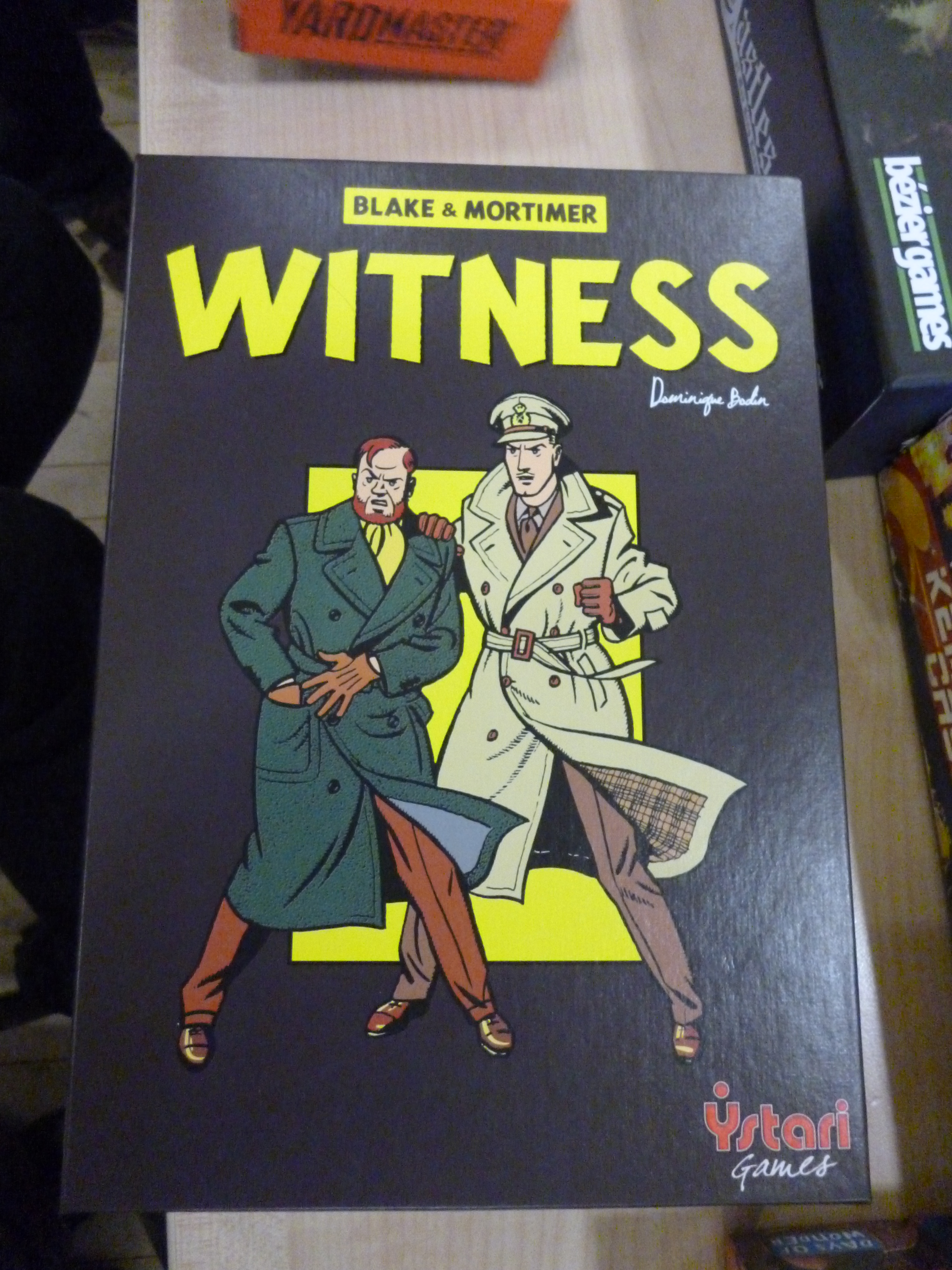
Witness

Oh hell. I don’t even know. The day made sense earlier, what happened? Help!

P1020555Witness is a… surprising game. I don’t even know. What did they just say? Shit. It’s a combination of Chinese whispers and a puzzle game, and I don’t know how a group of four smart human adults could be as awful at it as we were. There’s a lot of information to memorise and you’re not allowed to write it down until the end. You’ll find yourself reaching over to whisper to someone and suddenly realising you’ve forgotten all of the names of all of the participants. There’s laughter, there’s tears.

A very quick game which gave us a lot of fun, but we’re not sure how much we’d want to play it after the first few runs.

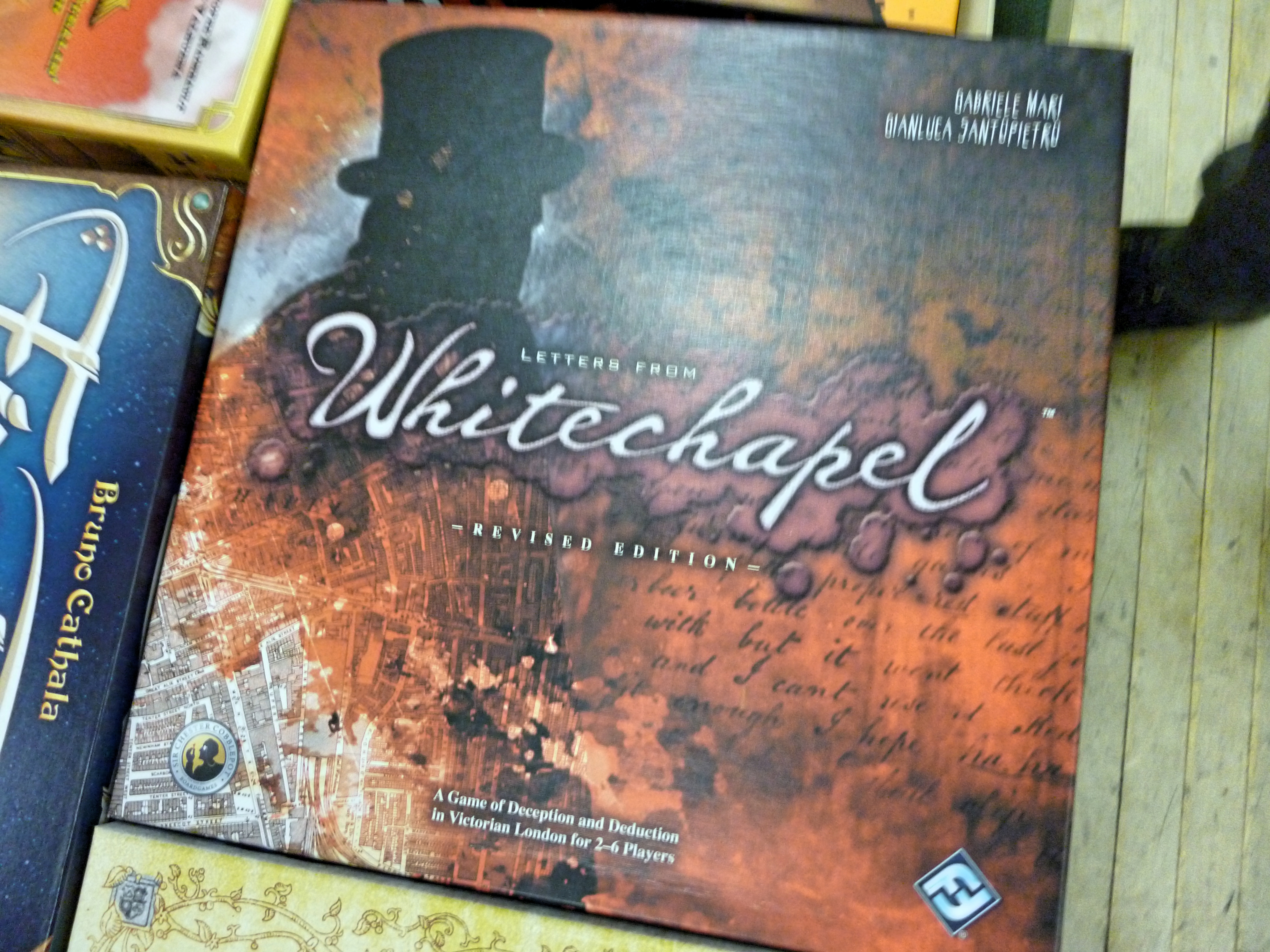
Letters From Whitechapel

Chief Commissioner Moustache

This was, to Lizzy, the most fun game of Gavcon. Since seeing a review for it she’d been mega-keen to give it a go, and voted for it to be a part of the convention both years. This year she was successful and she wasn’t going to miss the opportunity to play it!

The game requires one person to be Jack The Ripper (Dr Photographer was incredibly keen. He’s always had that serial-killer glint in his eye) and the others to be the noble investigators. There’s scrambling, hidden movement, murder and a lot of roleplaying if you get into it properly.

Quite a long game, but simple rules and very enjoyable. We’ve since reviewed it in full, here.

Murder scene
Murder scene

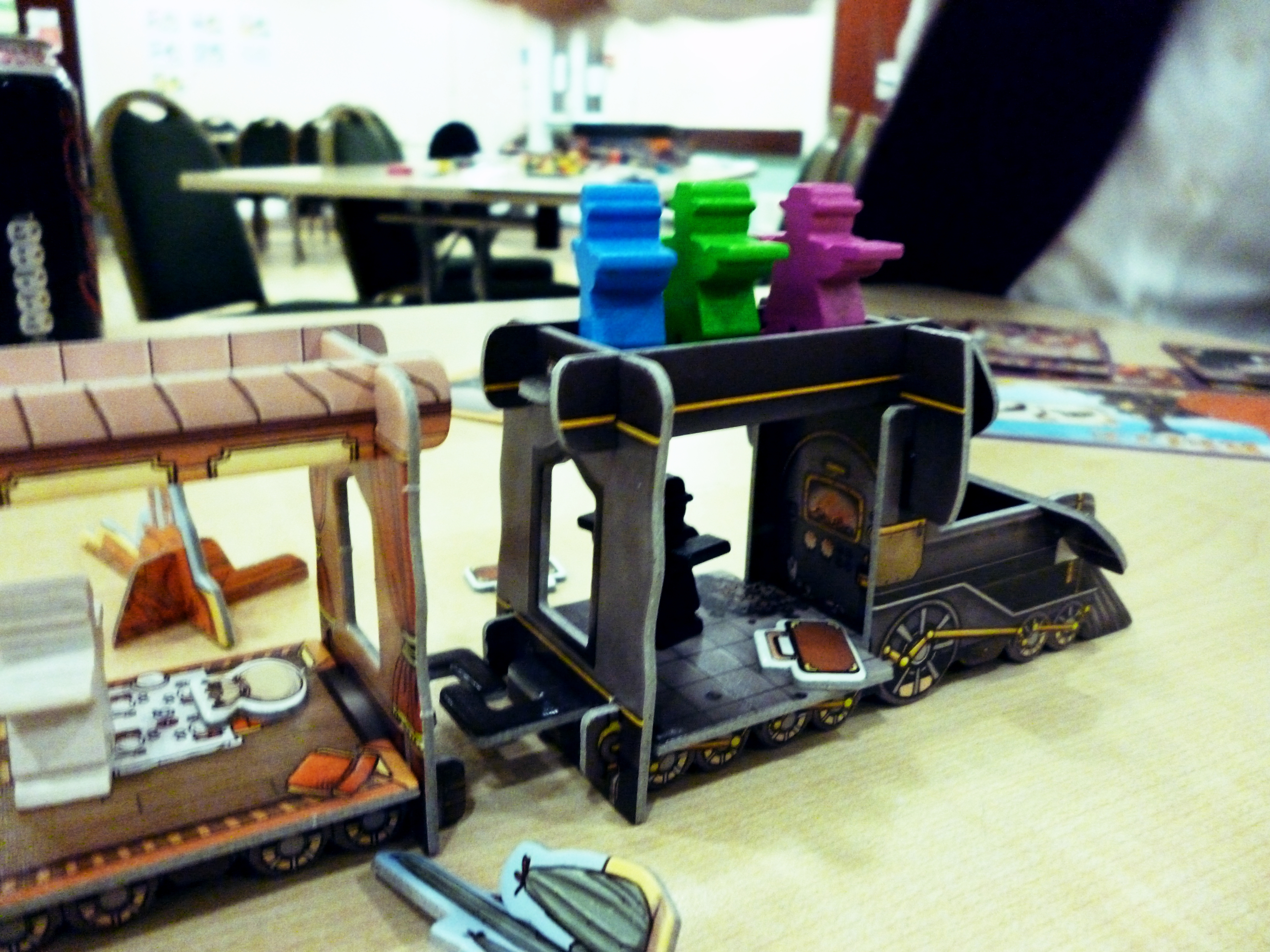
Colt Express

A lot of people would say that this game is worth getting just for the model train. They’re probably right.

P1020543_Fotor

P1020547_FotorIt’s also fun, but if I owned it I probably wouldn’t play it that often. I don’t think that’s just because I lost. It’s fairly simple but also seems to involve a fair bit of luck, and how much the other players get in your way! It has some fun pre-planned movement mechanics that are always a laugh. Fun as a game to play through, but not for strategy, perhaps.

A pretty medium game for me, in both length and enjoyment. But maybe that’s just because the standard of games was so high! (and did I mention  how badly I lost?)

The end of the day

As the dust settled, we all gathered round for the real game to begin. We all screwed up our faces and stared intently at the hat of names, trying to get our names pulled out as early as possible to grab our favourite games. Good tactics at this point are to run around to all of your friends and try to find out which games they enjoyed the most.

Lizzy came some point in the middle but it was enough to win her Letters From Whitechapel; she was pleased as punch. Last year she was chosen first (still managing to look incredibly smug about it, despite it being luck) and managed to grab Glass Road, which is also now a favourite of the team’s.

P1020556_Fotor

Gavcon works really well, but it does so because of the small number of people and the fact that they all know each other fairly well. Then you can be sure there aren’t too many grumpy disputes about anything like the money, the game you win at the end, etc. The atmosphere is friendly and the hosting seems fairly relaxed. It might not work on a larger scale, but if you’re interested in hosting your own board game events with a similarly-sized group of friends then we found this format to work really well!

As always, the real winner is board games.

*Gaviscon is the name of some kind of heartburn medication over here, by the way. Honestly, it’s a very witty joke if you’re from the UK.**

**Disclaimer, joke might not be witty.

.

Skulls and Roses: The lesser known 80s band

Brutus Rating:  2 knives in the skull out of 10. There aren’t really a variety of options for easy dickery to your opponents beyond the regular subterfuge.
Pairs well with: Pint of ale from a tankard.

6D-41-149_Fotor

The ratio of complexity of gameplay to complexity of strategy can be a good basic indicator for how good a game is. A lot of really good fun can be found in a game if it has some fairly basic steps and mechanics, and is fairly easy to learn, while also leaving room for a relatively more detailed, complex and developed strategy. Less fun can be had, sometimes, for a game that has a lot of detail in the play but not so much wriggle-room for thought-out plans for victory.

This isn’t meant to be a perfect recipe for board games, of course. Sometimes you want to just sit the heck down and let the board game adventure and some luck take you wherever you’re headed. Preferably to victory. Other times you want to get really deep into the nitty and gritty mechanics of a game and work for your delicious glory that way.

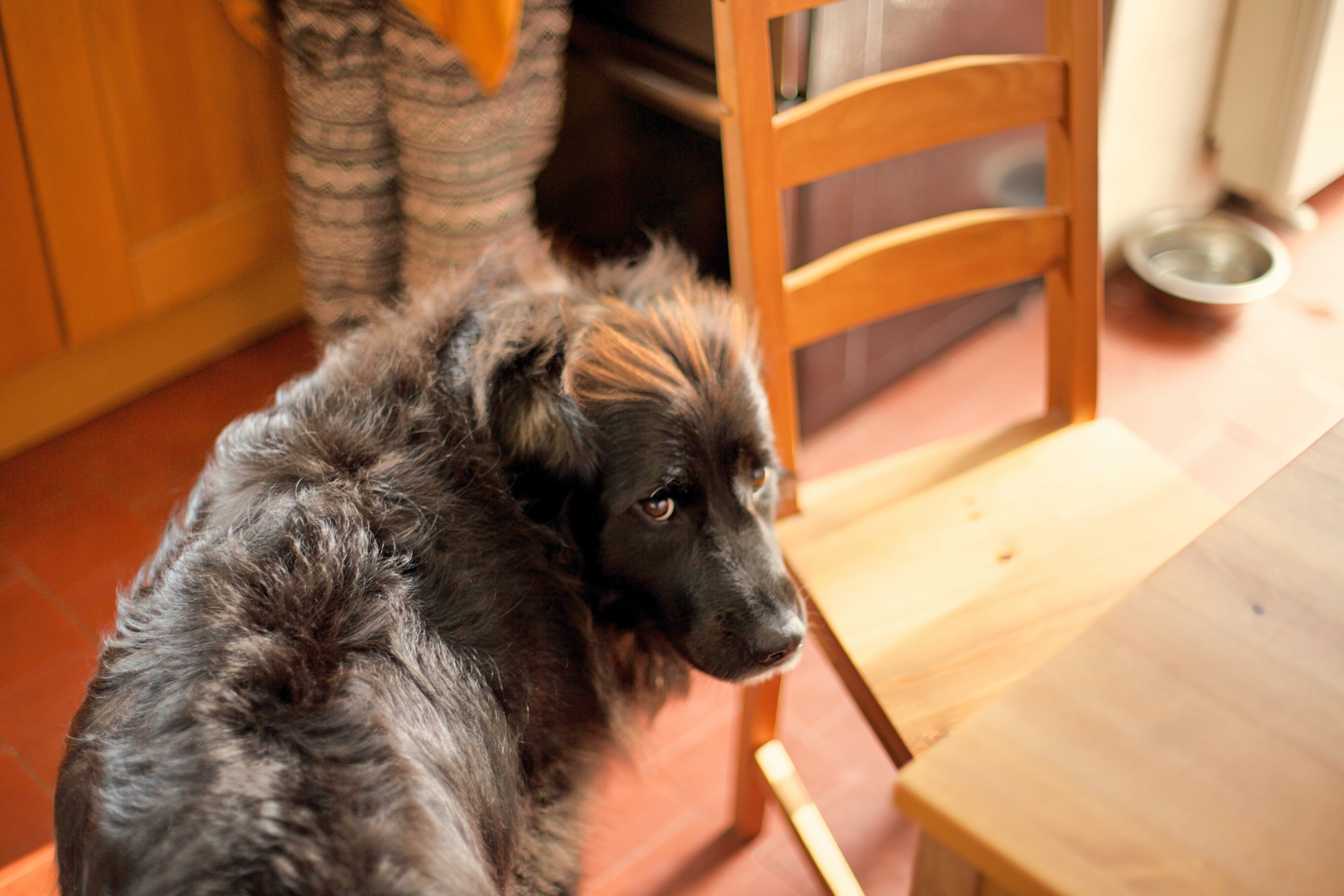
Guest reviewer of the day: Lily the dog

But the play-complexity-to-strategy-complexity formula can still be replicated in a lot of games, including some of the smaller and quicker ones. A good small game is often one that you pick up quickly, has maybe a limited amount of possible ‘moves’, but still lets you develop some excellent strategies for exactly how to play. One of these games is the topic of our review today!*

Everyone present have a skull? Check. You're ready!
Everyone present have a skull? Check. You’re ready!

Skulls is a great game for everyone. After all, everyone has a skull. It’s also pretty damn simple, but you get to develop sneakier and better tactics the more you play.

You’re a member of a biker gang. That’s right, time to whip out the old leather or denim jacket and… I’m not sure, start making motorbike noises and talk about how you miss the feel of the wind in your hair? Presumably that’s what bikers do. You’re competing to become what the rules call the supreme leader. Apparently, biker gangs are run just like North Korea. You learn something new every day!

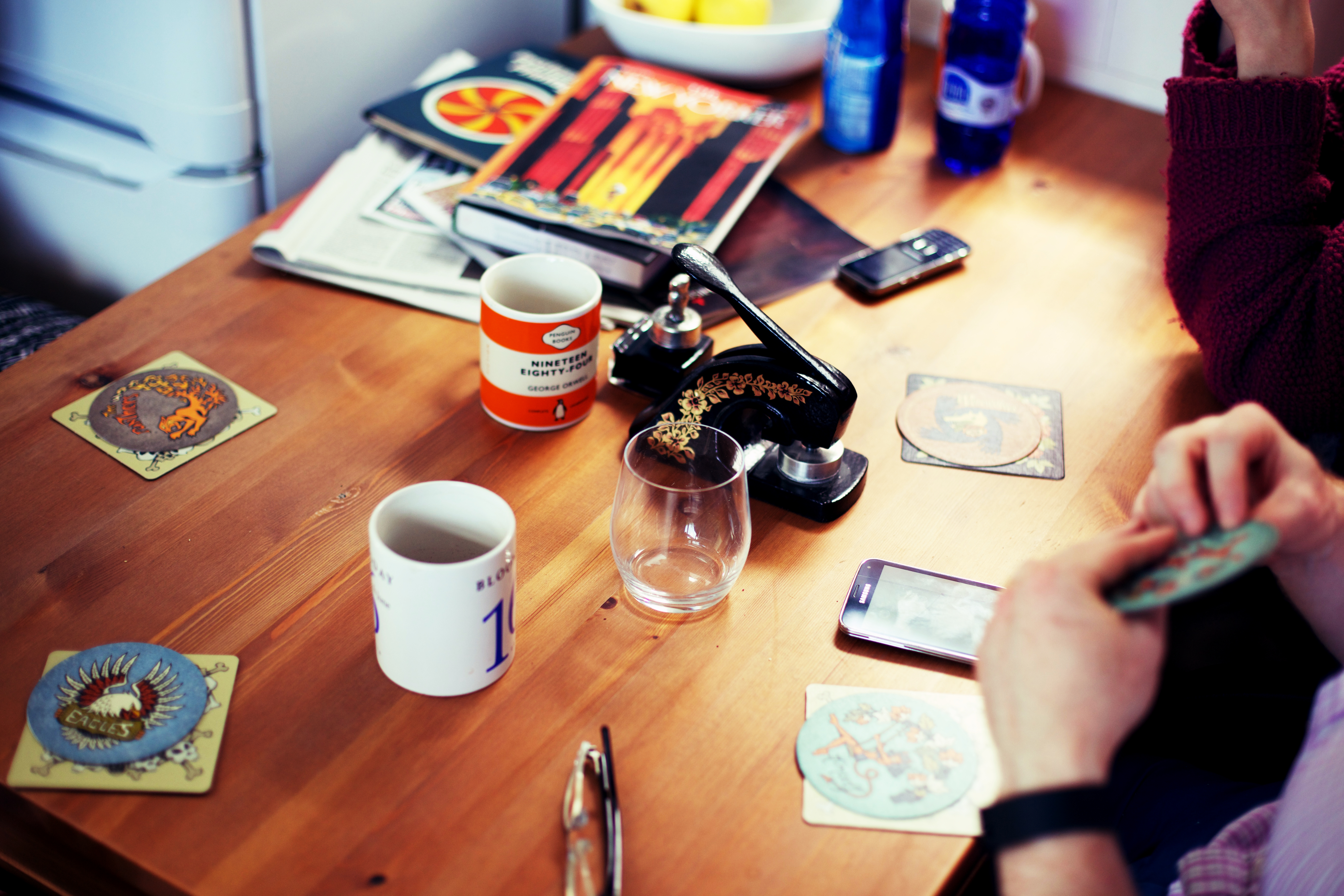
6D-41-90_FotorEach player in Skulls gets a bunch of circular beer mats with your biker insignia on one side (Which gang are you in today? Panthers? Eagles? Snakes? Weird cow-skulls?) and three of them will have a rose on the other side, the fourth will have a skull. They also get a nice square beer mat with a skull on one side and rose on the other.

Once you’re done with the formalities of pretending to mistake some of the ‘cards’ for actual beer mats and getting yelled at by the person who owns the game, then you’re ready to begin.

6D-41-148_Fotor

It’s a short game, and it’s a game of bluff. Everyone takes turn placing cards down in front of them (insignia side up, or the bluff part won’t be very effective) and definitely remembering whether you’ve put down a rose or a skull. Eventually one person will decide that instead of putting down a new card they’ll ‘bid’ on how many circular beer mats they can turn over without finding a skull. The trick is, whoever wins the bid (and therefore actually has to attempt to do so) will have to start with their own beer mats first, and starting from the top. Getting it right will lead you halfway to victory (counted by flipping over your square beer mat) and the penalty for getting it wrong is a good mocking and removal of one of your four cards, making it more difficult for you to play. (Particularly if you lost four times… having no cards makes it very difficult to play indeed)

It's actually unclear whether it says 'panthers' or 'punthers'
It’s actually unclear whether it says ‘panthers’ or ‘punthers’

So what you DON’T want to do is forget that you put down a skull and then knob yourself over by bidding as high as possible. Unless you’re trying to lure everyone else into a false sense of security with your incompetence so that you can sweep them all away in the next few rounds. The brilliance of this game is that shit like that can actually happen, and maybe even work!

It’s all about trying to trick everyone into thinking you’ve got a rose when you’ve got a skull, and into thinking  you’ve got a skull when you’ve got a rose. And this isn’t just done by plain old conversation: “Hey you should definitely pick my card. I’ve just put loads of roses down. OR HAVE I?” because, you know, that would be silly. It’s also bluffing through your actions. Bidding really high to convince people that you do have roses, just to have the bid snatched away from you at the last second (just as you’d planned!) so that the winner of the bid will pick your card, convinced that you wouldn’t have done that if you’d had a rose, only to fall down crying when you flip it over to reveal your cunning bluff. TAKE THAT, RICH! YOU NEVER SAW IT COMING! WHO’S YOUR DADDY?

SKULL! GOTCHA!
SKULL! GOTCHA!

It’s also a very reactive game. Because it fits in that part of the collection for small games, ones that you can fit between other games or when you’re busy, and ones that you can play anywhere because it doesn’t have many pieces, you’ll find yourself just intending to play a quick round of it before you start up the Battlestar Galactica or the Eldritch Horror and then realise, an hour later, you’re all still in the kitchen desperately trying to stop Sophie from getting a fourth victory in maybe six games.

You can play it anywhere!

“AHA! Well, Will clearly has a rose because he tried to encourage us to pick his cards”

6D-41-130_Fotor“AHA! Rich definitely has a skull because he was pretending to deliberate, and there’s no way he would have actually been deliberating about bidding higher than five at this stage because that would be MADNESS, so he must have been pretending to deliberate to trick us into thinking that it would be an option for him and to trick us into thinking he has a rose!”**

“Just… never trust Sophie, guys! She’s going to have a skull, she always has a skull! She…. NOOO!”

The spurt of victories from Sophie was quite the surprise. We actually started to wonder if she’d been playing the really really long game, faking incompetence in previous games just to finally show her colours as a ruthless bastard in Skulls and Roses.

All in all, the developed bluffery from Skulls and Roses makes for a great small game, and ranks it pretty well in the ratio of complexity of play to complexity of strategy. Sophie may have played us all for fools but, as always, the real winner is board games.

And Lily the dog.

This review doubles as an educational piece about how difficult it is to take photos of dark dogs in light rooms.

*You’d bloody hope so wouldn’t you, or else what have we been rambling on about for the last few paragraphs?

** Take our word for it, this paragraph definitely makes sense to Skulls and Roses aficionados.

Credit goes to our photographer friend for, of course, the photos. Huzzah!

7 Wonders: For when 6 wonders aren’t quite enough but 8 seems excessive.

Brutus rating: 4/10 knives in the back
Pairs well with: A suitable drink to match your wonder (we recommend buying some of that classic terrible cheap liquor that all tourists buy as souvenirs while wandering around in a hot country. ‘But honey, it’s made with guava – that’s so traditional!’)

DSC_0331

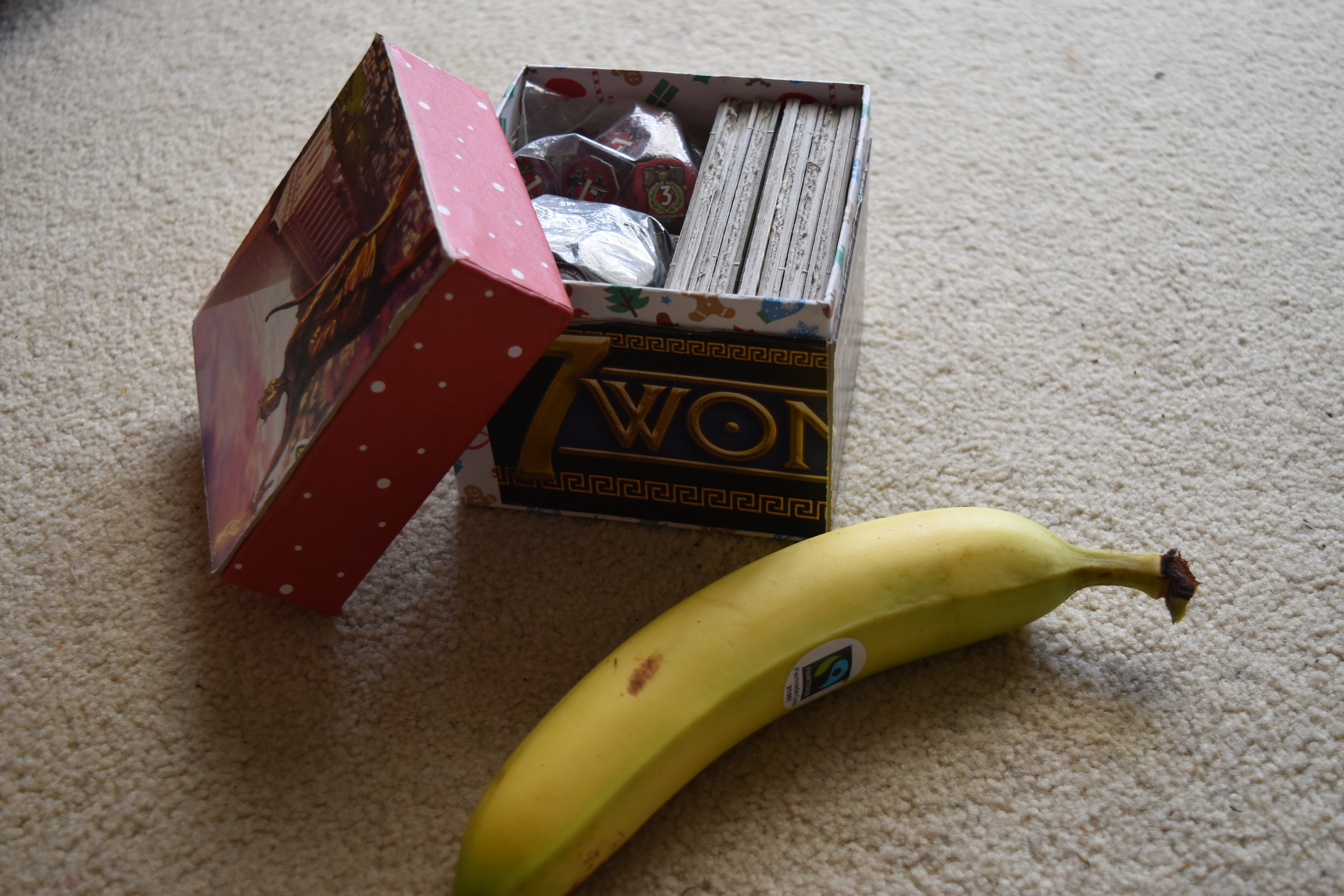
In Briony’s house, the copy of 7 Wonders was deemed too big to carry around with ease. To address this her angry spiky-haired boyfriend Pat spent a week engineering the perfect compact version, presented in a lovely Christmas gift box. The juxtaposition of the Colossus of Rhodes and the Christmas tree works beautifully. To give you some indication of exactly how much more compact it is, here is a fair trade banana for scale.

DSC_0348DSC_0347

Onto the actual game?

Have you ever wanted to control your own Civilization? Order your serfs well paid labourers to build cool stuff that will ensure your name is never forgotten for as long as humanity walks the earth? Cry war when someone upsets you? Wait for your turn patiently while your fellow assholes can’t pick a single card in a three-hour time frame? Good. Although this may sound mightily like Civilization (of which a couple of board games actually do exist) it’s actually 7 Wonders. At least, this week it’s 7 wonders. Can’t speak for future weeks, it’s not like we have a schedule for these things.

DSC_03397 Wonders was actually Briony’s ‘gateway drug’ to the board gaming world. She rocked up to a friend’s house one night expecting pizza, but instead got a lot of cards. At the time her friends explained the rules slowly, as if to a small confused child who couldn’t possibly understand the word ‘wonder’. They concluded ‘We’re all really good at the game because we play it a lot, so don’t worry about getting a low score. You’ll get better next time!’

Unfortunately for them Briony has accrued some 400 hours playing Civilization. She promptly wiped the floor with all of them, and has only been beaten once since. 7 Wonders has remained one of her favourite games to this day.

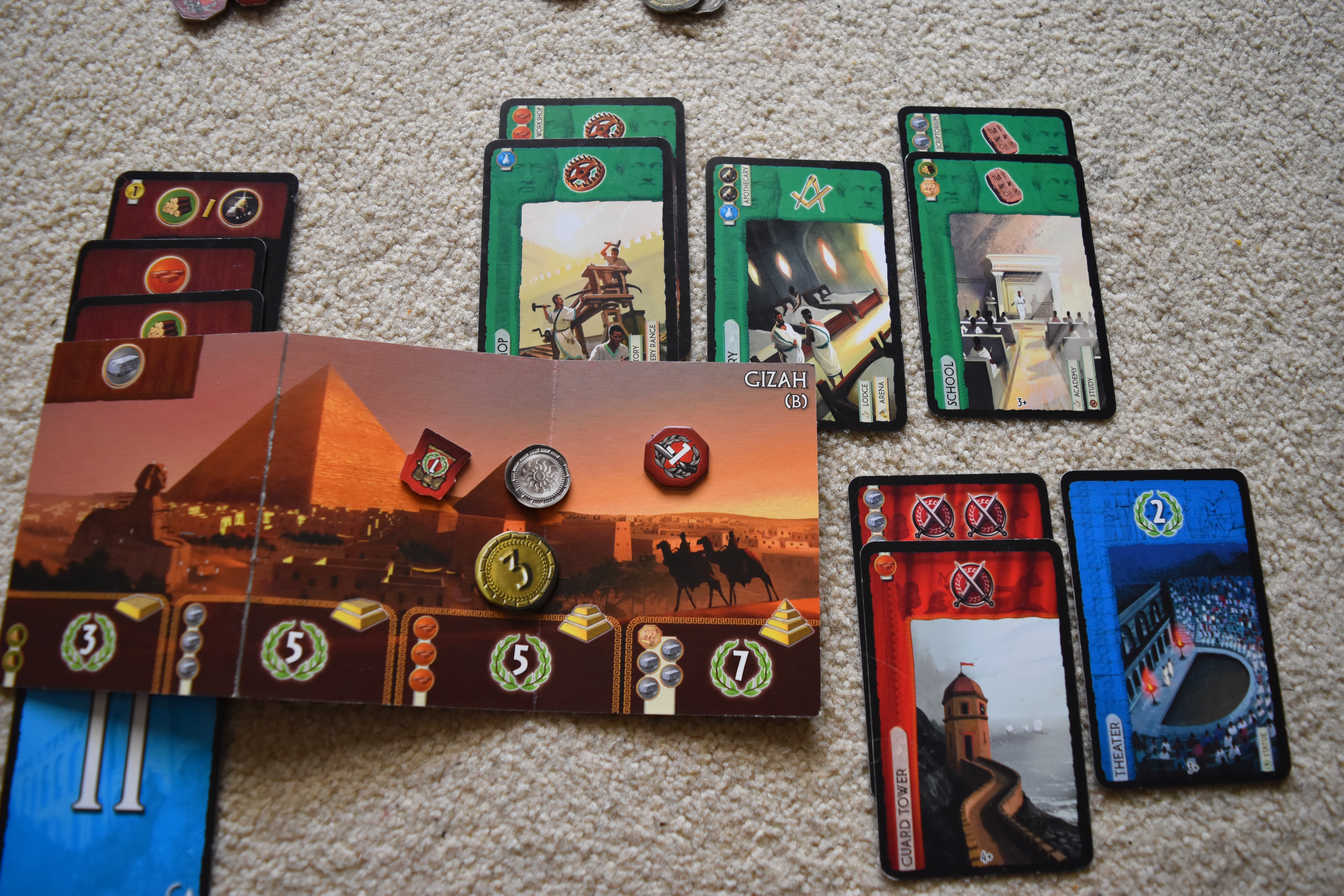
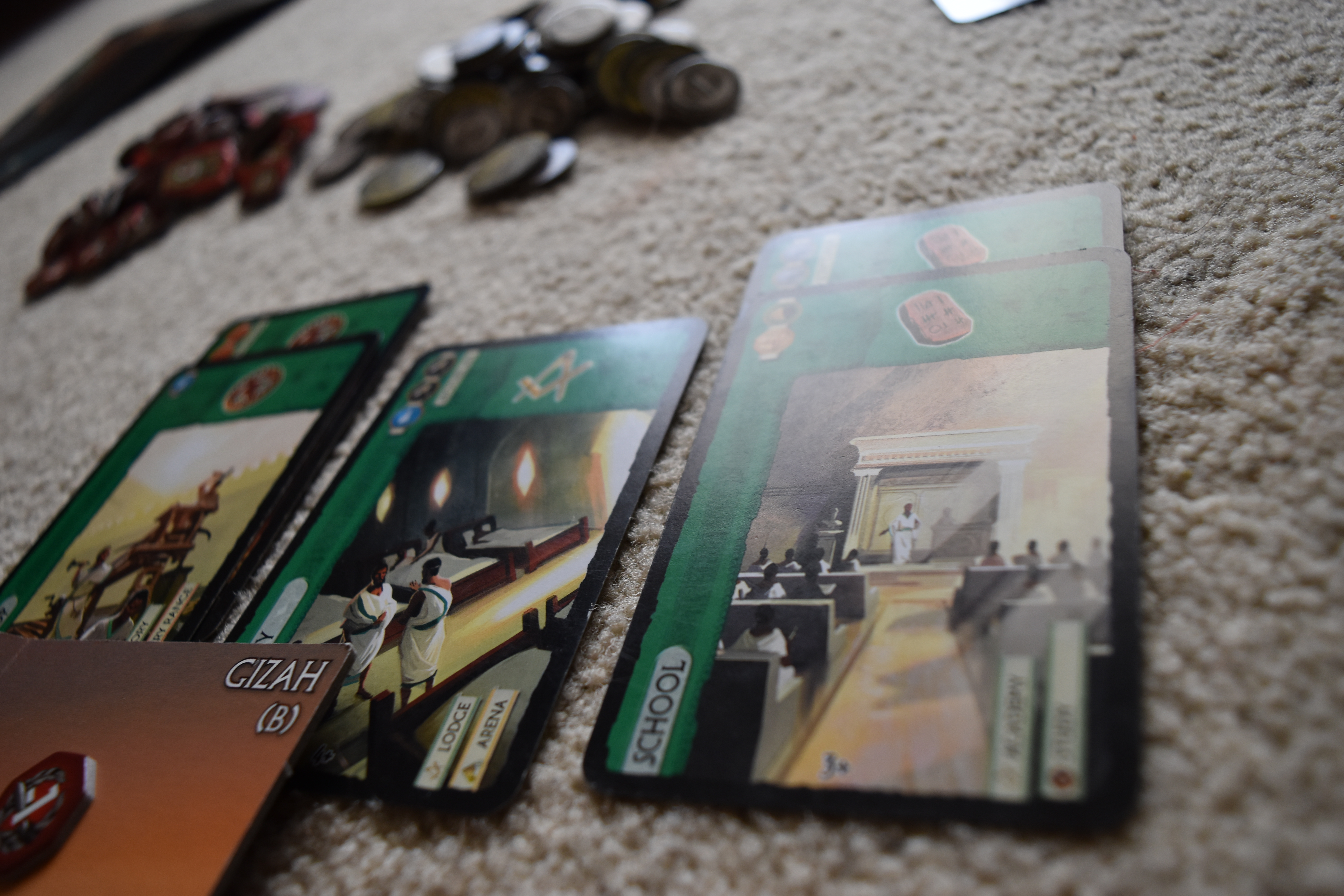
DSC_0337To begin, each player is assigned a great world wonder. One of seven, hence the name, but you probably figured that bit out (It’s not doing the “Five Tribes” trick where there aren’t actually five players and you don’t actually get to play the five tribes, confusingly.) Again, if you’ve played Civilization (the non-board-game version) you’ll already recognise the wonders; maybe you might even recognise them anyway. They differ both in starting resources and the benefits they offer. During the game you can, but are by no means obligated to, build parts of your wonder (they usually have 3 stages), and thus reap some tasty ancient treats.

The game works in three eras. Each player begins with a hand of cards. You look at the cards. You eye them up, rate them out of ten, or ask for their number – whichever is the most effective way of determining a good card for you. Once everybody has selected which card they would like to build, you pass your remaining hand of cards to the player clockwise. Everyone then simultaneously places their chosen card face up and everyone has a lovely time.

DSC_0342Simple. Now, do it again. In fact, keep doing this until you only have two cards left in your hand, then discard one and build the other. Now it the ending of the era, but it’s not particularly like the great works of writing and art suggest. It’s mainly about war, really. Each player has a mandatory fight with the player either side of them. Losing a war means losing points, winning war means winning points. Huzzah!

Well done everyone, we survived an era. Best keep going.
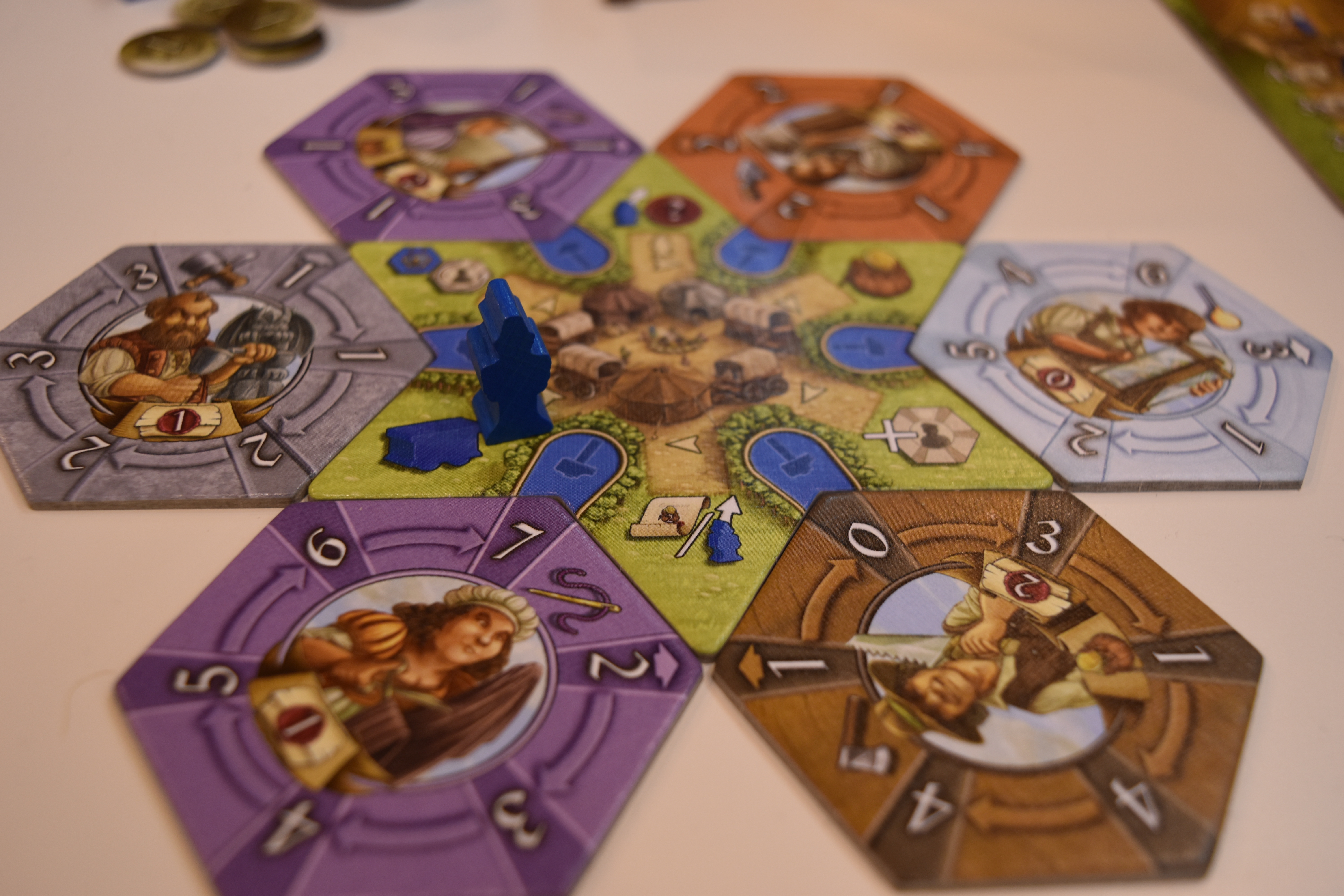
With the start of the second era a new deck of cards is brought out. These cards build on the resources you gathered in the previous era, and will either start racking up victory points or generating larger amounts of resources. The same mechanism as before happens (start with hand, play a card, pass it on, repeat), only this time you pass the cards anti-clockwise. Bet you didn’t see that one coming! Era ends, have some war, next era begins.

DSC_0338This mechanic where everyone picks cards at the same time means that the game is fairly simple, fast, and can sit up to seven players without significantly racking up the play time to the point where you want to claw your eyes out, or go to bed, or have a life, but you can’t because you started playing a nine-hour game. None of that in 7 Wonders. Even better, it manages to do this while still keeping a lot of delicious strategy and giving everyone some good time to think about what to do.

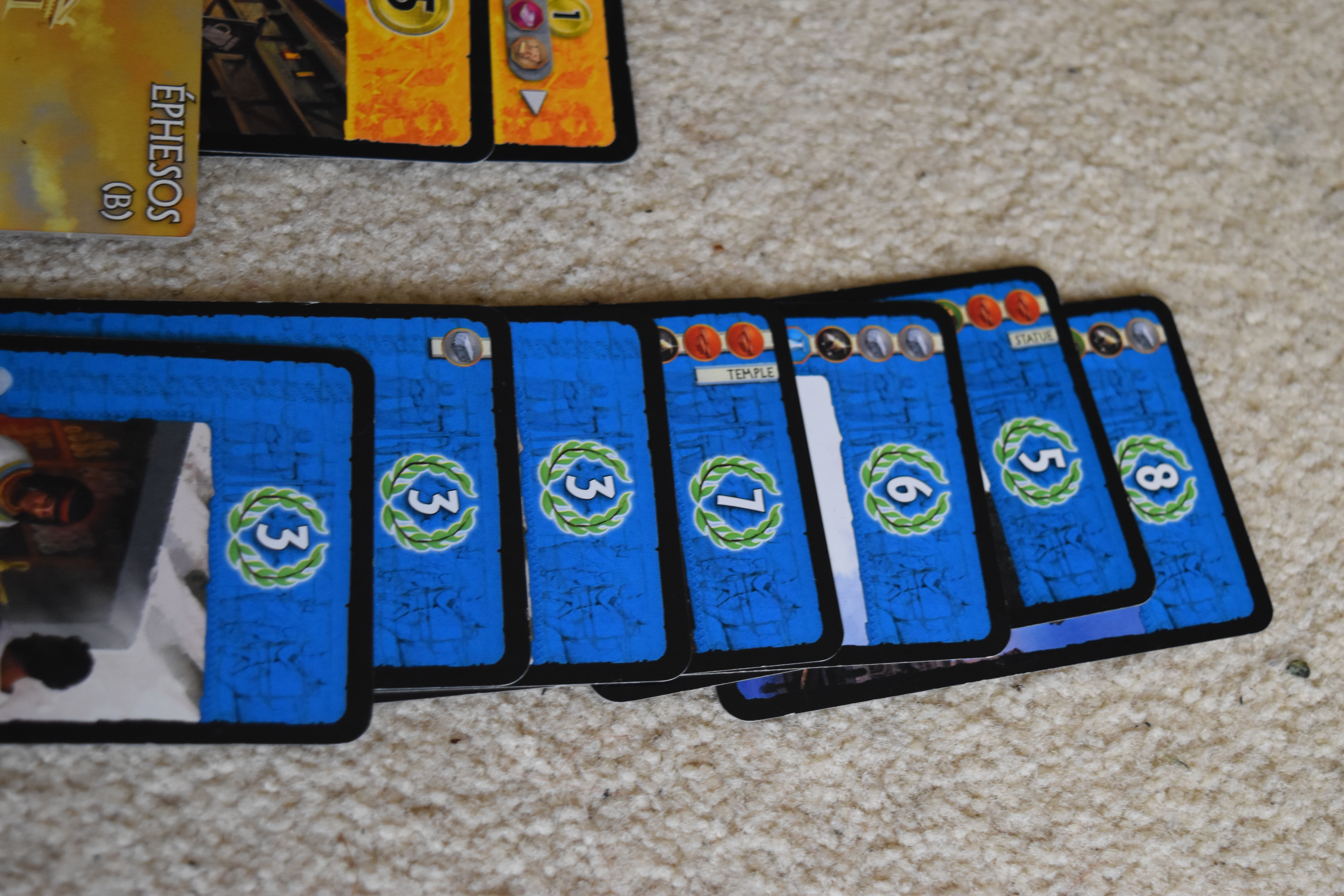
The third and final era is where it gets particularly interesting as all the big cards come out. This is the only era where purple, or ‘victory’, cards emerge, and they have the power to significantly enhance your score if used wisely. During this era it also becomes fairly apparent which major strategy a player has gone for. And by apparent we mean ‘huh, Pete the twinkly-eyed hippie has 739 blue cards. I guess he’s collecting blue’. This is partly where this week’s Brutus rating comes in- there game does still give you a bit of wriggle room for player interaction, mostly in choosing which card you want (and therefore which card you don’t want the player to the side of you to have). If Pete is collecting blue cards then this gives you at least some reason to nab all the ones he needs before he can lay his grubby little paws on them (disclaimer: Pete actually has hands and they aren’t that grubby. Sorry Pete).

DSC_0344It also earns an extra dagger because after each era you have to have a war with the players to your left and right either side, the poor buggers, and if you want those extra victory points you’re going to have to softly jab someone at least a little.

Unless you’re Rhodes, and then you fully jab everyone. Unapologetically.

Of course the problem with this, and with the fighting mechanic, is that you get a bit dicked over depending on where you decided to sit at the table. Lizzy may be a charming barrel of wit and great to sit next to sometimes (we said “may”) but this kind of game could result in everyone scrabbling to get away from her so they don’t have to put up with her meddling in their affairs for most of the game.

DSC_0343Like all things over the great expanse of the centuries, the game will eventually come to an end. Victory is tallied up and your Civilization scores points for various card-related and wonder-related things.

One thing we should mention is the trickiness with how to score science: no-one really knows. It is literally the only complex thing about the entire game. Usually there is some 7 Wonders veteran in the corner who is called upon to interpret and talk with the science cards, and then relays that information back to the rest of the group like some sort of lesser prophet. Fortunately for the rest of us mortals some genius made a thing that does it for you  http://neilsutcliffe.com/7wonders/   If you can figure out how to make it work, the ‘science!’ strategy is a reliably high scorer, though easily ruined if your neighbours are paying attention to what you’re building.

Had enough photos of cards yet?

The game is fast in general, which makes it perfect to play several times in one evening or to get new people into gaming. As was the case with Briony, it can make a pretty good gateway board game, as long as you take the time to explain each component and keep the card-choosing phase pretty quick. Bob actually hated (or thought she hated) this game for years, not having Briony’s Civ experience and finding game frustrating and exhausting as a board game noob. Turns out, she just had really dawdly friends who didn’t make the trading rules clear. In addition, make sure to stop and take in the art work on the cards, if that’s your cup of tea. They’re often beautifully painted scenes or buildings and they add a lot to the game design.

The real winner is history. But also Briony. She’s just really good at Seven Wonders, man.

This week the credit for the photos also goes to her. Good work, Bri!

Just assume that it says
Just assume that it says “Briony Wins”. Convenient blurring, Briony.

Battlestar Galactica: or ‘how to legitimately take out all of those secret grudges you had on your friends with bullying and wild accusations’

Pairs well with: Space whiskey for the humans, some kind of oil-based fuel for the toasters

1

In a fit of hostility we’ve decided that it would be a great idea to take on a traitor game two weeks in a row. Who can say why? Perhaps because once you’ve started stirring the resentment-pot then you might as well keep going until you have a delicious broken-friendship-soup. Or perhaps it’s because games with a traitor mechanic are bloody brilliant.

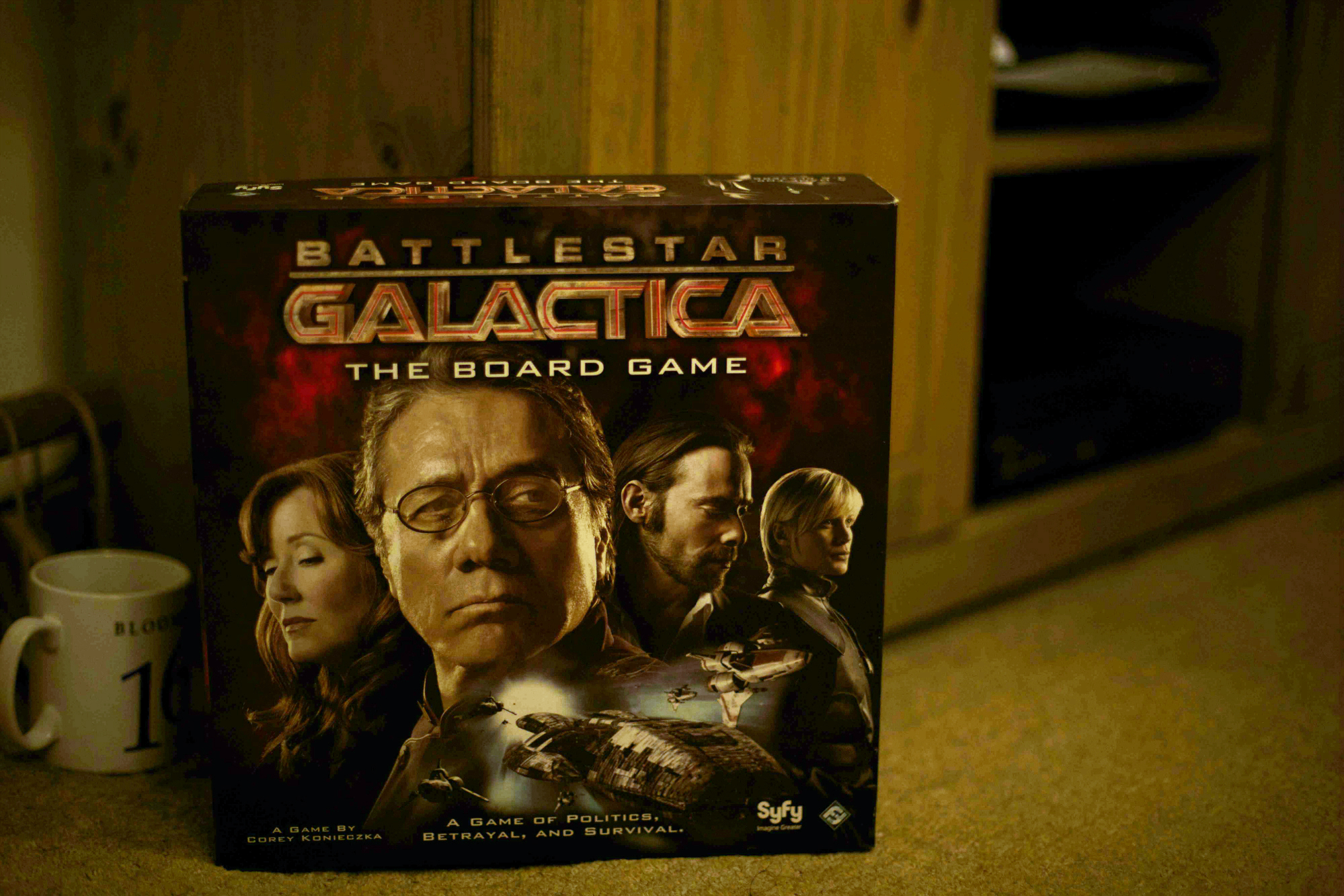
2As far as traitor games go, Battlestar Galactica is one of the greats. A familiarity with the television series isn’t necessary, but is a good idea regardless of your position on board games since it’s pretty damn good. (What’s that? Strong female characters? More than one?! Don’t mind if we do!) As such, we’ve always found it a good game to whip out with a group of friends no matter their gaming experience or level of nerdiness. We have all kinds of gateway drugs board games here.

3A willingness to play along when it comes to shouting at each other always helps, though. Like with a lot of traitor games, a lot of the real fun comes from player interaction, rather than clever mechanics and strategies. But that’s good, and there’ll always be space for those sorts of games too in our board game collections. Be wary about playing it with a room full of very quiet people though: we’ve all had mishaps where we have been the only person in the room accusing, thinking ‘maybe if I get this going, everyone will join in…’, when ultimately the room silently and awkwardly judges you. We have instead worked out through trial and error that you will require at minimum of two louder people (three if possible), who are poised and ready to create a shouting, energy-fuelled, accusatory positive feedback loop between themselves. As they get louder, and the claims get wilder, the other players in the room are drawn in like the event horizon of a black hole.

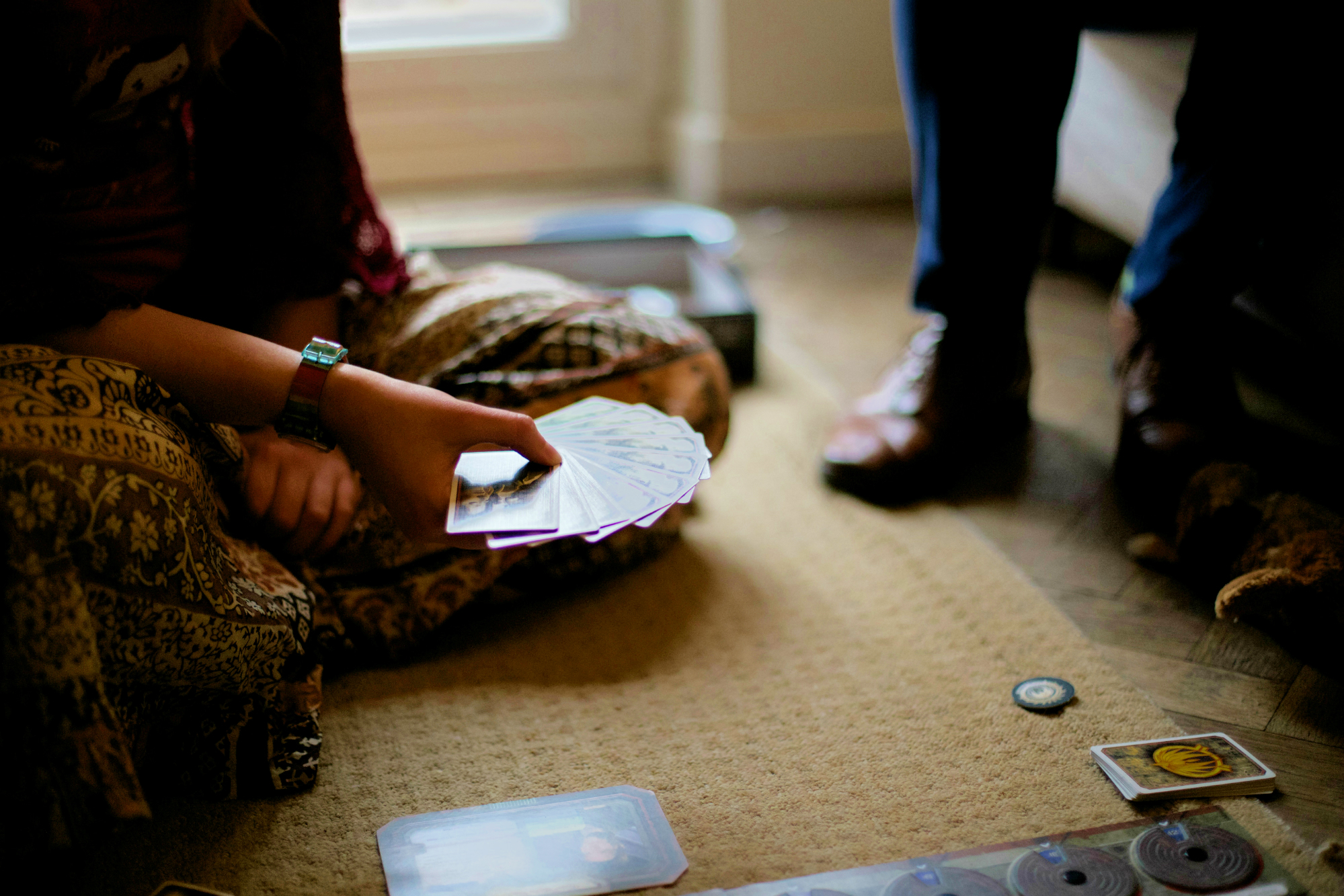
Pick a loyalty card, any loyalty card!

It doesn’t even matter if their accusations are true – say literally anything to gain the room’s unyielding attention. ‘I put it to you could have stolen that cargo before you baked the innocent unicorn into the birthday cake!’

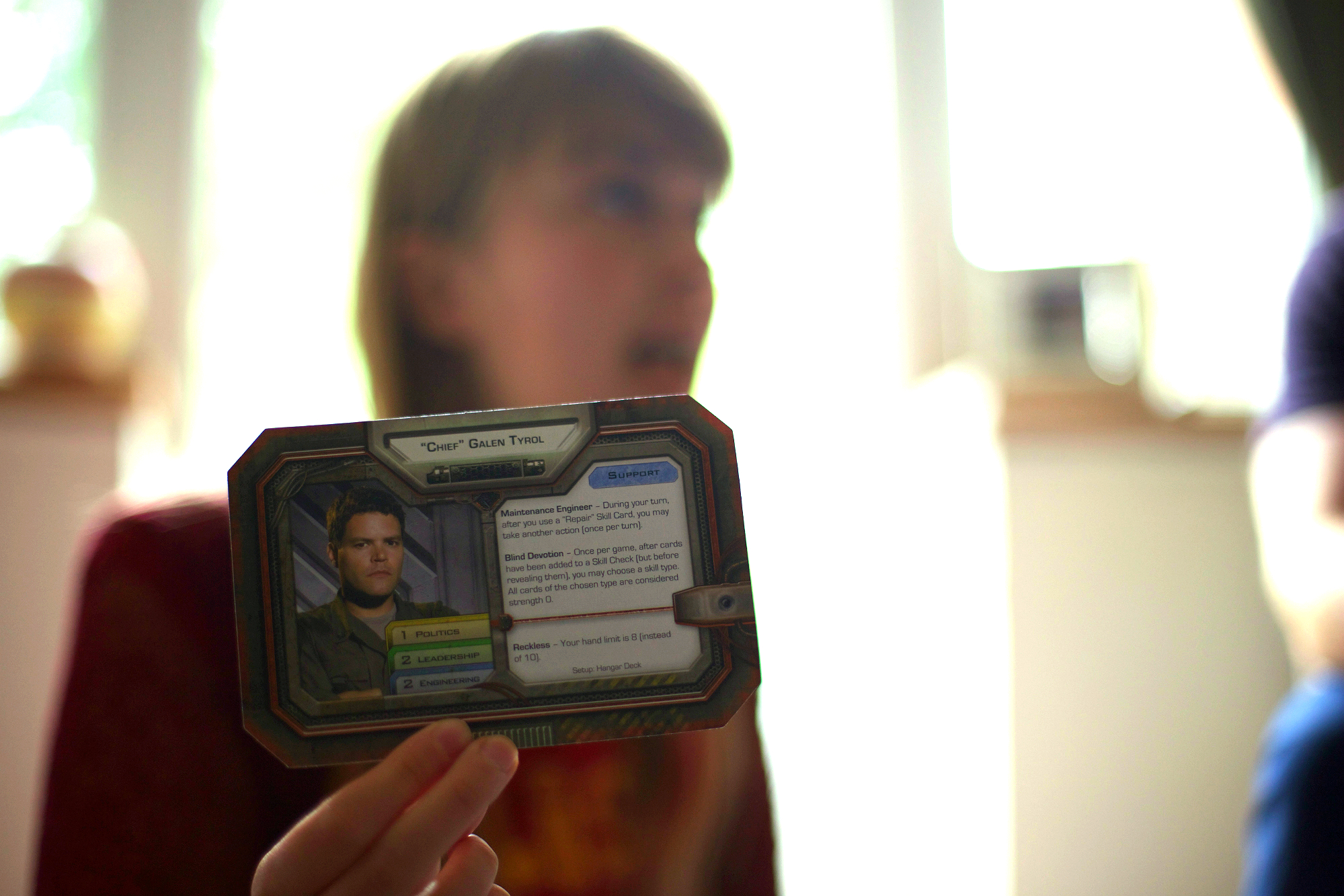
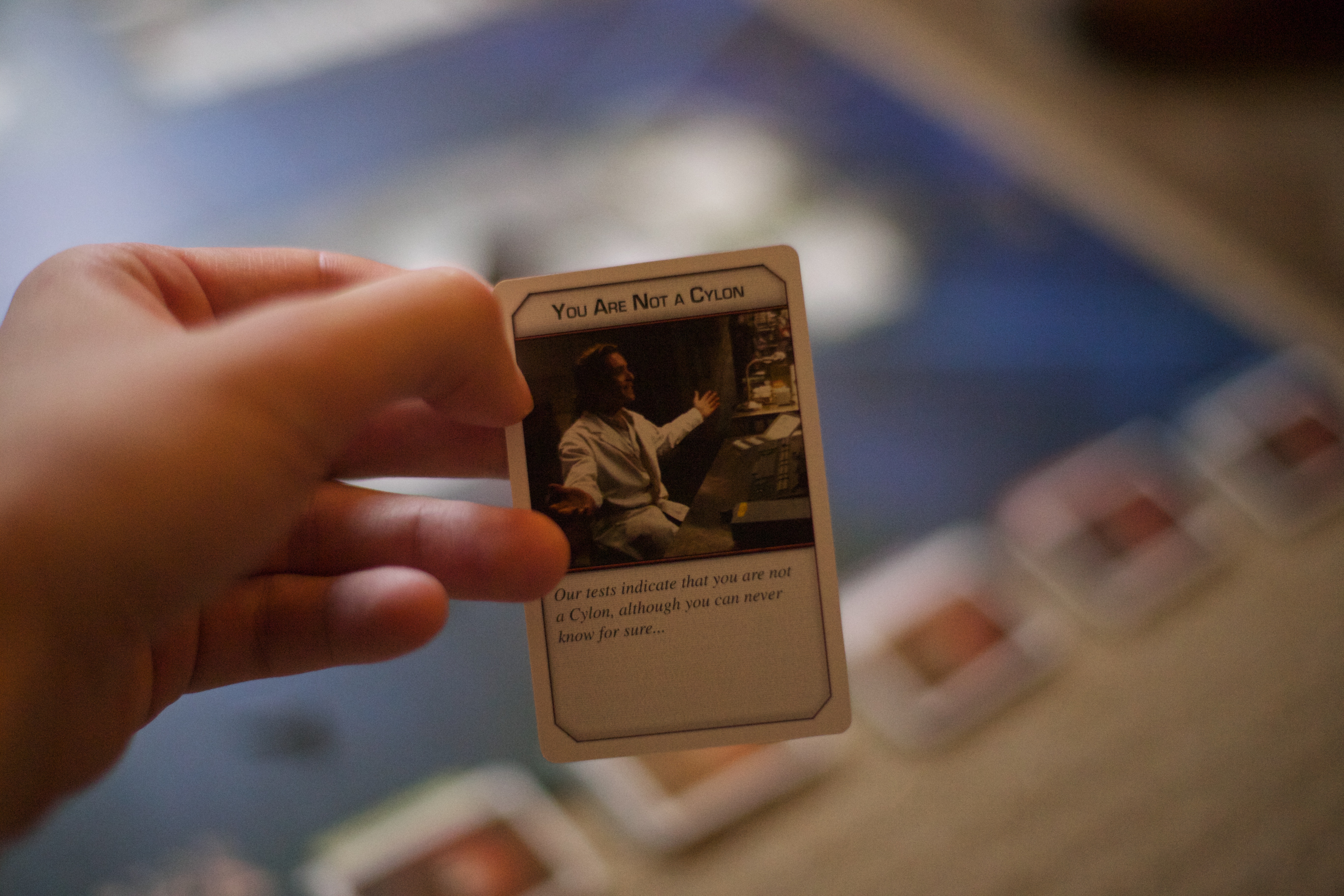
Continuing, the theme is a really well-done sample of the well-trodden trope of “human-makes-artificial-intelligence. Artificial-intelligence-thinks “fuck-this-I’m-a-mother-fucking-bad-ass-robot-I’m-having-you-all-for-breakfast-except-I-don’t-even-eat-meat-because-I’m-a-robot-so-I’ll-just-kill-humanity-and-mount-your-squishy-heads-on-my-wall-as-a-trophy””. Humans are the “good guys” (say The Humans) and Cylons (or “robots” or “toasters”) are the baddies. There tends to be one or two toasty traitors per game, depending on numbers, and traitors will discover their role secretly with hidden cards that are given out at the beginning and in the middle of the game.*

Dr Photographer is a good guy. This time!
Dr Photographer is a good guy. Not in real life, maybe, but in this game.

No matter how much you sit your friends down and tell them to please, carefully read the page in the instructions about what to do if you’re a Cylon, and please all make sure that you understand it all and ask any questions before the loyalty cards are handed out and the game begins, there’ll always be one person who picks their loyalty card, looks at it, looks uncomfortable for five minutes and then has to meekly ask to see the rulebook and shiftily hide which bit they’re reading. This is not a subtle Cylon strategy and we recommend avoiding it if possible.

The sympathiser
The sympathiser

One downside that this game has, (at least, nobody we’ve ever played with has seen it as an upside, that’s for sure) is the way that it deals with certain numbers of players. Camelot, for example, makes the brave move of always having only zero or one traitor per game, no matter the number of players. (It also leaves you with this nifty ability to introduce and lose players mid-game if people suddenly want to join in- genius!) Battlestar has this determination to balance things out, which maybe goes a little bit too far. The Resistance does this to a lesser degree, but still it’s super fucking difficult when everyone is shouting ‘BAD GUY’, and half of the room actually is…

More players (5+) means more Cylons. Fair enough! That can be kind of fun. There are still more good guys than bad guys and there’s an extra level of fun you can have with two Cylons working together to defeat the pesky noble humans.

Playing Battlestar with 5 players is excellent! Two Cylon traitor cards and a lot of fun. Playing Battlestar with 3 players is pretty good too, one Cylon traitor and still enough people for a bit of the ol’ shouting and accusing. With four or six players the game starts worrying that maybe it needs to add more bad guys but also there aren’t enough players for more bad guys, so it says “Shit! We’ll introduce this sympathiser to add instead!”

Let me out of the brig!

Nobody wants to be the sympathiser. The sympathiser is a poor player who gets dicked over at the ‘halfway’ point of the game. If the human team are close to death then the sympathiser is a Cylon who sympathises with them, and gets put in the brig but is still on the human team. If the human team aren’t quite teetering on destruction yet then the sympathiser is a dastardly human who sides with the Cylons but can’t do the full range of Cylon moves. So in attempting to balance out the human vs Cylon ratio the game just selects a player and shits on them a little. Boo, sir.

A team that’s getting along fairly well might find themselves trying, on purpose, to lower a resource to a required level so that the sympathiser that’s about to be chosen will side with them. How does that translate into plot? It doesn’t, it definitely doesn’t.

“Why are you chucking all of that food out of the airlock, Sir?”
“Oh, I was hoping that if we get a food shortage then the Cylons will start to take pity on us.”

I don't mean to worry you all, but this card says
I don’t mean to worry you all, but this card says “Ambush”…

Is there also something a little shitty about being a regular Cylon who only gets their traitor card halfway through the game? After you’ve been trying so hard to stay alive this whole time? Maybe, but that does kind of work as a mechanic. You realise your programming, you realise you’ve just been trying to blend in with the fleshbags and earn their trust, and now it’s up to you to make them pay.

Shit's going down
Shit’s going down

The plight of the humans is pretty damn difficult anyway, as it should be in any co-op game. You don’t want victory to come easy, you want all of your games to be a painful and horrible slog, clawing hopelessly at all your resource dials and trying to stay just about afloat in time to reach the end of the game. Our photographer bought this game over one evening when we’d requested a “small-to-medium sized game”, and he insisted against Lizzy’s protests that it would totally be fine. Several hours later he confessed that, actually, it was just so rare that he’d survived long enough during a game that he barely knew the full length of it.

The card appropriately titled
The card appropriately titled “Loss of a Friend”

Perhaps Lily the dog had the correct tactic when she just waltzed in and knocked everything over. Good girl, Lily.

The gameplay itself has two important rules that aren’t mentioned explicitly in the actual official rules set. Firstly, whenever someone does anything it’s important to determine why, assume that makes them suspicious, and to yell at them for probably being the traitor. This is particularly the case when it’s something that you know they had no choice over.

“OH! You just happened to draw THAT random card, huh? Just what the Cylon would do.”
“OH!! You’re going to the bathroom NOW, huh? Seems like you’re all too keen to convince us of your human functions, huh? cough cough CYLON”
“I saw you touch the toaster this morning, to get toast huh? Lies. You don’t like toast. More like communicating via instantaneous up-link the invasion plans back to the general!”

THEY'RE EVERYWHERE
THEY’RE EVERYWHERE

Secondly, it’s important that you make the appropriate noises when you’re trying to blow things up. Every time one of us forgot to make the appropriate “pew pew” noises as we rolled a die to destroy a raider, we failed. COINCIDENCE?**

Appropriately for a team of misery farmers and their friends we ended up losing from too much misery. Losing any one of your four main ‘resources’ will end the game. It’s pretty clear how this works in terms of running out of population (“Guys? Where is everyone?”), food (humans need that to survive, apparently) and fuel (“Ok, ok, we’ll just float around in space… let’s see…”) but it’s not as clear what’s happening when you run out of morale. Mass apathy? Everyone just goes to their room and has a little sulk? Riots, perhaps?

Too much misery
Too much misery

Whatever it was, it got us good. It was an apt representation of our real life selves, as Sophie was just starting to fall asleep in the corner.

It’s a great game for several players and several hours, as long as you have a good team of people keen to accuse each other. Good luck, brave humans. Get your accusatory pointed finger at the ready.

*of course saying that traitor cards are handed out in ‘the middle’ of the game is a generous but loosely-used description. It’s the middle of the game in theory, if the mighty humans are heading for a full game and a victory. It is, unfortunately, also possible for the game to not even reach the point of handing out the second round of cards before humanity gets blasted into oblivion. It maybe wouldn’t be too shocking if this happened when there aren’t even any traitors on board yet.

** Yes.

Credit to Adam “Not the cylon for once” Photographer-friend for the photos. (Usually about 50% game and 50% hamster these days)