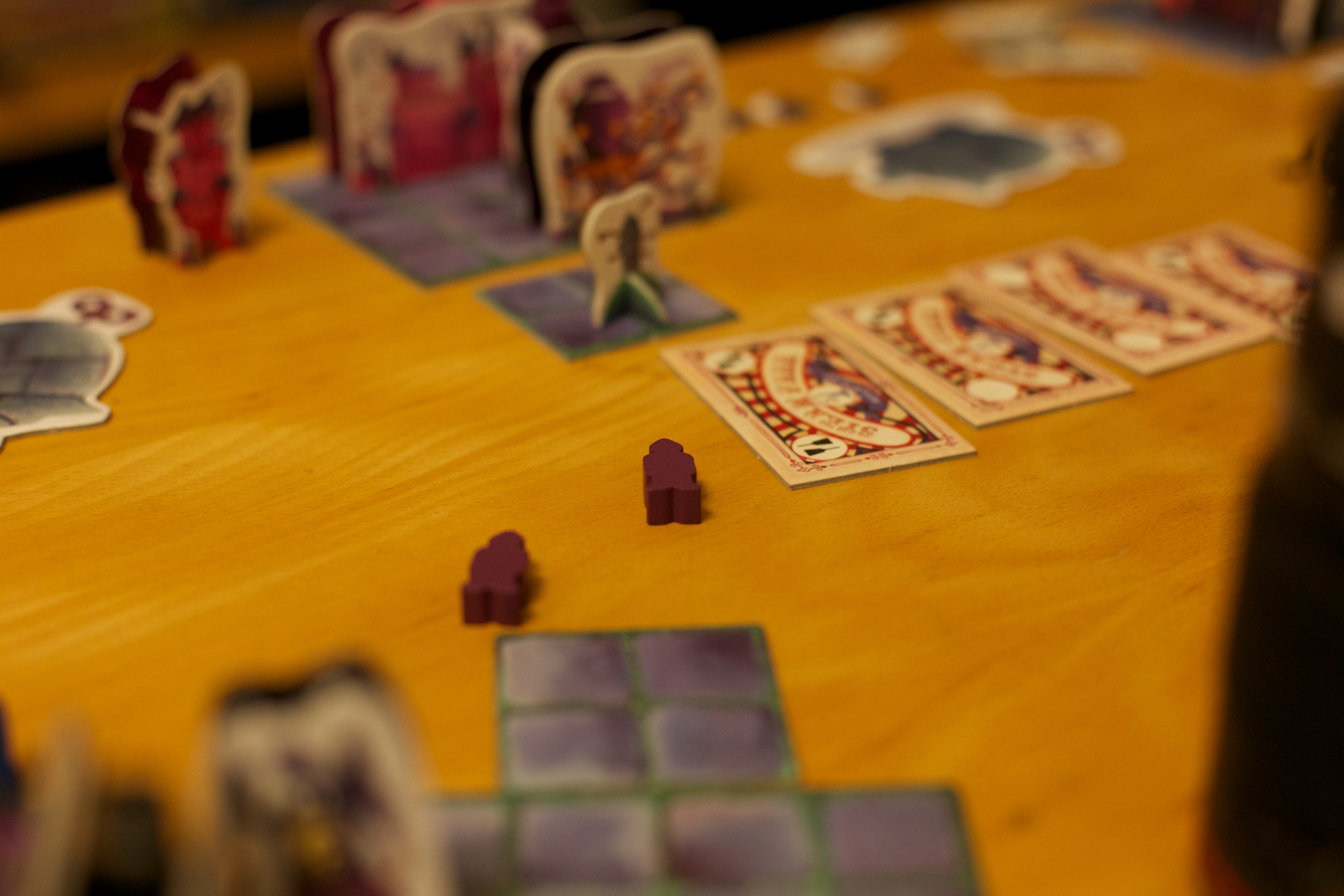
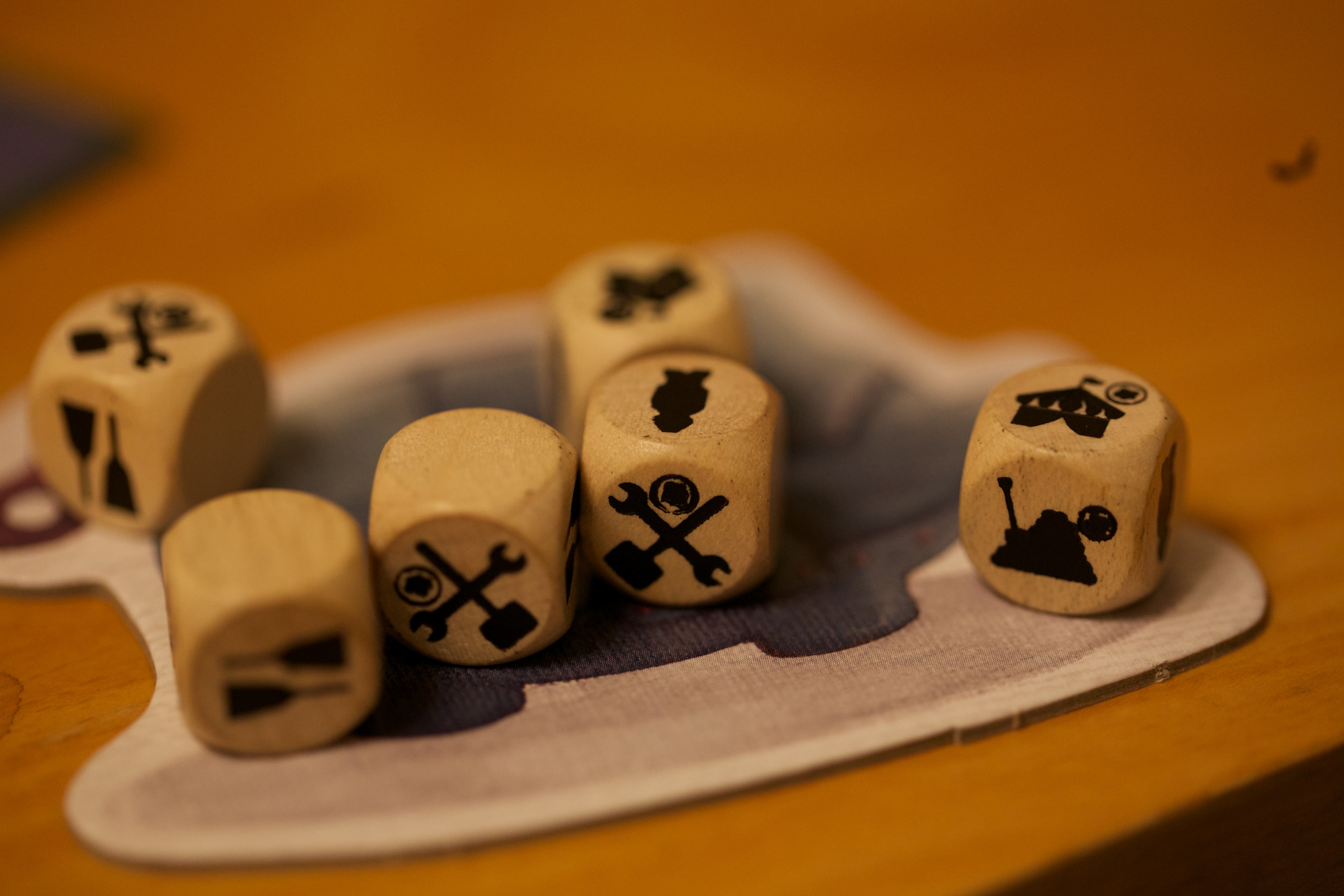
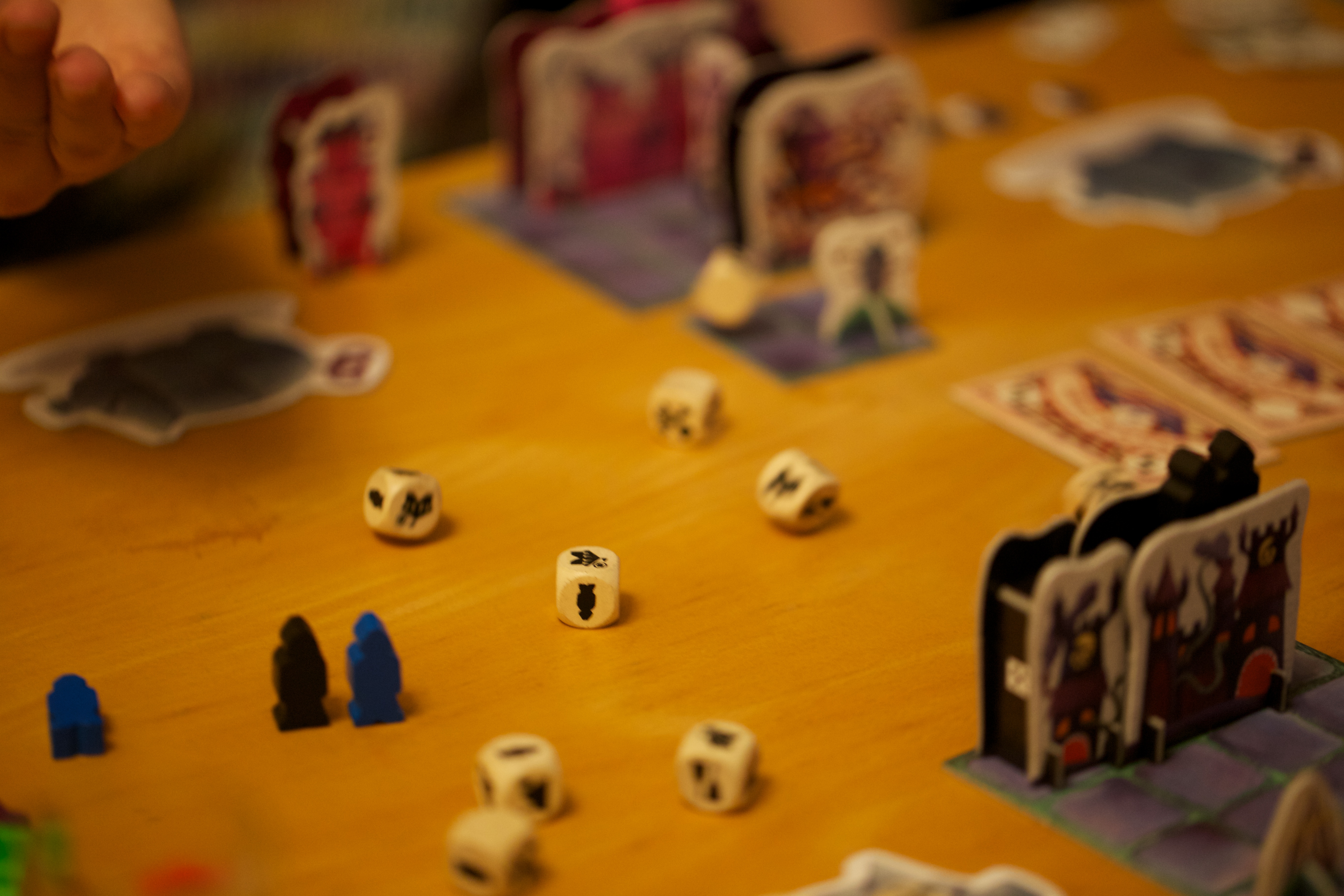
Codenames: From Essen With Love

Pairs well with: Martinis. Shaken, not stirred. (Rumour has it they’re actually better stirred, but that’s just the kind of shit you’ve got to deal with as a spy.)

Traitor-rating: 2/10 for the ability to try to put off your opponents mid-game.

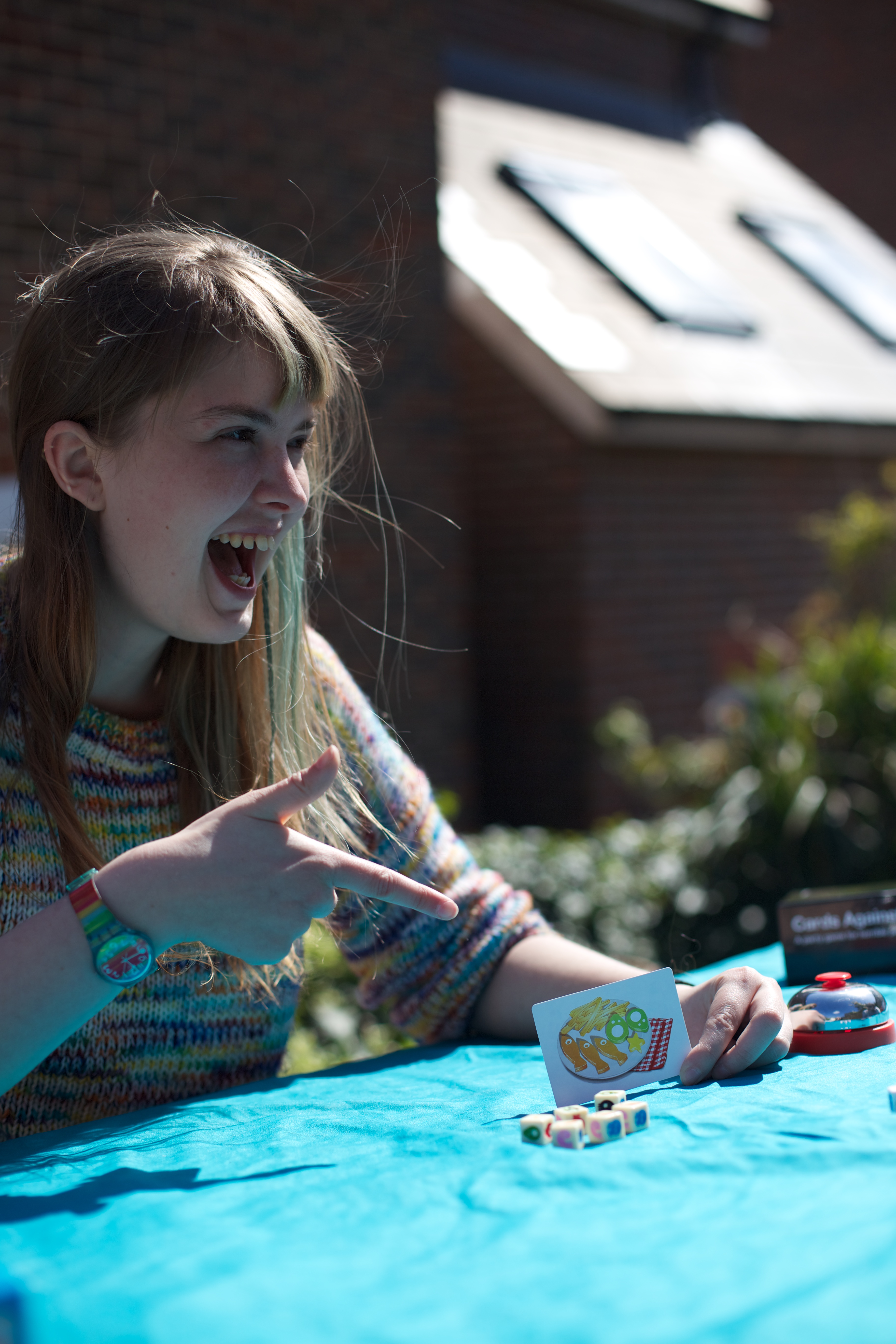
DSC_0752_Fotor.jpg

We three kings* board game enthusiasts have had a lot to say about what some of the best games from Essen 2015 may have been. There have been a lot of candidates and a lot of enthusiasm. It’s almost as if we really, really love board games! Weird.

The excited froth of enthusiasm shall continue to spill forth as we move on to what really is one of the best, and surprisingly so, games of the year: Codenames. Don’t be put off by the box art which looks like it was designed in MS Word and features the thrilling byline of ‘TOP SECRET WORD GAME’,** this is some addictive shit. We hope you’ll forgive a bit of brief explanation, since the game is pretty simple to play and explain.

DSC_0715_Fotor.jpg
Lizzy gets fancy photography confused with just holding the camera in a funny place

In Codenames you (usually) play as two different teams of spies. One person per team is the spymaster, the rest of you are regular vanilla-spies sitting in the field awaiting instruction.

The ‘board’ consists of a 5 x 5 grid of cards, each with a different word on it. The two rival spymasters, presumably sitting nice and comfortably somewhere in Spy HQ playing with some gadgets and looking at a dozen different CCTV monitors, have access to an extra card which they share, but which the rest of the players aren’t allowed to see. That card shows the ‘board’ as a 5 x 5 grid with each card marked as red, blue, grey or the single black.

This little card means that the spymasters can know which of the words on the table are the codenames of red-team spies, blue-team spies, regular confused passers-by and THE ASSASSIN!

IMG_0311_Fotor
The Assassin

The actual game is a word association game, with the aim being to contact all of the spies on your own team before the other team does the same, and to not contact the assassin (for obvious, game-ending reasons). The spymasters will take turns giving exactly one word and one number, the word being one that they’re trying to associate with some on the table and the number indicating how many words they’re trying to link.

Simple!

One of the first things you come to notice as you play the game is that you really feel sorry for some of these spies. Agent Ghost? Cool. Agent Roulette? Pretty classy. Agent Ham? Umm, maybe not so much. Agent Ketchup? Are you sure you work here? Oh and I’ve got to say I’m a little embarrassed to be working with Agent Pants over here. There’s a reason we gave her that name.

IMG_0312_Fotor.jpg
Confused passer-by

And sometimes you’ve really got to question just what the secret service were thinking about. Agent Spy? I mean really. AGENT SPY? What do you think the point of a secret codename is? Maybe to avoid revealing your identity as a spy to everyone? Tsh. Some people just weren’t cut out for this business.

The plus side of Spy HQ’s batshit, overboard spy-naming policy is that you’ll never be short on variety between different games, even when each one is only about 15-20 minutes long. The box is jam-packed with different words, two sides to each, and you can get through a hell of a lot of games (trust us, we’d know) before you need to come across the same words that you’ve already used. Even if that weren’t the case, the way that the board is always different means that it’s unlikely any of your games will ever resemble each other. And other factors, like the impossible and bizarre ways that you and your friends’ brains work.

Bonus points for the game come from its flexibility. In our short time of owning it we’ve played it on beds, on floors, in hotel lobbies… even on walls. While procrastinating our PhD research doing important board game research for this blog we even spotted someone on /r/boardgames who threw together a makeshift copy for a family gathering. Pretty impressive.

Codenames is more fun than we ever thought a word association game could be, and at least part of that is thanks to the mad things you’ll try to connect, the connections that seem startlingly obvious to some and mad to others.

Lizzy: Water; Two.
Bob: Right. Ok. So, I’ll go for… ‘Well’
*Well is correct*
Bob: Good. Ok, so next I’ll go for Bridge..
*Bridge is incorrect*
Bob: WHAT. WHAT DO YOU MEAN BRIDGE IS INCORRECT?
Lizzy: *silence*
Bob: Bridge! Water goes under the bridge!
Lizzy: *awkward silence*
Bob: Seriously? ARGH.

*later*

Bob: Wait, so what the flip was the other word for water?
Lizzy: Palm.
Bob: P… pardon?
Lizzy: You know, Palm. Palm trees… are… er… sometimes near water. And Palm Springs is a place that sounds like it’s named after some, you know, springs.
Bob: … I think we should be on different teams.

Other times you find that special friend who just seems to share your brain.

Spymaster: Bond; Four.
Secret agent: Right, well. There’s Octopus, because of Octopussy, (correct answer), Moon, because of Moonraker (correct answer), Spy because James Bond is a spy, (correct answer) and… well, James Bond holds a gun in the palm of his hand, so… Palm! (correct!!)

Another great feature of the game, although one that only really works with a group of 4+ playing, is the constant (but friendly) mockery of the other team’s guesses. Not to mention trying to put them off!

Lizzy: Right guys. Beef; Three.
Opposing Team (pretending to talk to each other, but loudly so the other team can hear): OH! Yeah. She’s probably referring to the great Beef Revolution of ’93. Or she means ‘Beef Dice’. Isn’t that the sequel to Sushi Dice?

IMG_0314_Fotor.jpg
It’s really an unfair advantage that the blues get Pierce Brosnan on their team

LWH Codenames Tournament

As we briefly mentioned last week, one of our local conventions Little Wooden Houses ran a Codenames tournament at their latest shindig. Teams of 3 people competed for the coveted Tiny Trophy of Being Good at Games in an incredibly tense competition.  Team Misery decided that despite wearing her ‘Captain Hangover’ hat, Bob should be spymaster as it’s very easy to get inside her head.***

DSC_0726_Fotor_Fotor.jpg

Round One

The first match was against a team of raw recruits who’d never met. It’s easy to underestimate a team of nice (ha!) ladies but all early pleasantries were rapidly erased as Bob politely but firmly invited the opposing team to suck her dick when they took an early lead.**** Team Misery sucked it up and got their shit together to win convincingly and immediately take on the next challengers.

Round Two (or ‘Semi-final’… it was a pretty small tournament)

On round two, shit got serious. These were no fresh-faced n00bs, but experienced gamers and long-time friends. It would be easy for them to work together, and the stress was real. Ground rules were firmly laid (no speaking at all from the spymasters apart from clues (a rule which Bob finds supremely hard to follow), and taunting and smack-talk from team-members absolutely allowed). Adrenaline pumping and neurons firing, Bob flopped her enormous spymaster-schlong across the table with a steady ‘Culinary, six.’

Six correct card choices left the opposing team in the dust, and Team Misery advanced to the final round unbeaten.

The Final

The final match was played as best of three rounds, against a team which included a girlfriend-boyfriend pairing (Dr Boyfriend and Cthulhu-Joss) and Dr Charlie. Harsh.

A strong start in the first round got Team Misery off the ground, but they were nearly brought down by an incredible last-ditch hail-Mary clue from Charlie, whose team needed to get five correct answers in one turn to win.
DSC_0712_Fotor
Play along at home!

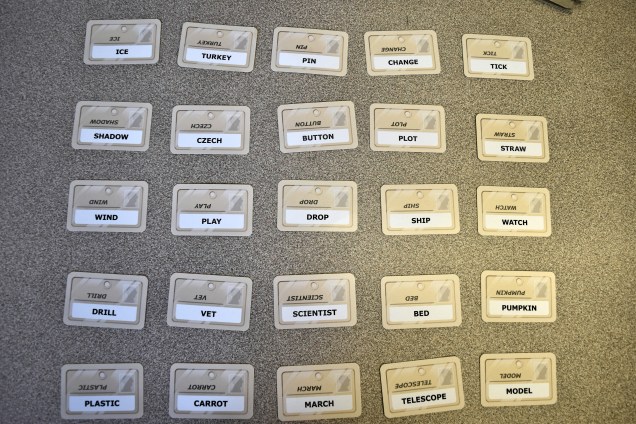
‘Nazis, infinity.’

Um. What. Surely this could never work! But after the initial laughter, Joss and Al took to the board to give it their all.

‘Er. Did the Nazis ever go near some Czechs? Czech!’
*1/5 correct*
‘Well, they probably had ships. Ship?’
*2/5 correct*
‘They love to MARCH!’
*3/5 correct, panic from Team Misery*
‘Drill?’
*4/5 correct*

Team Misery watched in shock as all their dreams decayed in the face of insanity. If the opposing team got one more correct answer, they would win.

‘Aw nuts. Isn’t there a movie about Nazis where they’re all somewhere really cold? And they’re zombies? Dead Snow! Yeah. Maybe he means that! ICE!’
*INCORRECT*

Thank goodness for good guys. (That’s us, by the way.)

DSC_0713_Fotor
A very tense Dr Charlie and ‘Hangover-hat’ Bob

Round two was almost as close, but went to team Charlie, making it even-Stevens going into the final round.

Bob meditated while Lizzy and Briony made a break for stress-wees and tea.

It was a tough board for the team. ‘Hollywood’, ‘France’, and ‘New York’ were all needed, but ‘England’ was the assassin and ‘Beijing’ belonged to the opposing team, so a simple clue like ‘places’ was out.

‘Cannes, three’ managed to tie Hollywood, France, and Premiere together, but that was just the start. An incredibly close, tense game ensued, until both teams were down to their last two words.

Bob made a desperate bid to tie ‘New York’ and ‘Forest’ together with ‘Jungle, two’ (urban jungle, right?) but was thwarted by Lizzy’s insistence that ‘Jungle Jam’ was a thing (she meant a jungle gym. Like the climbing frame. Bob actually broke the rules when that went down as she was incapable of stopping a stress-pressured ‘Mrrrrrrrrrrrrrrrrrrp’ from escaping).

To be fair, the team’s eventual demise might also be put down to a glorious moment in which Bob forgot which colour she was, and gave a clue for the wrong team’s spies. Some swearing followed.

DSC_0729_Fotor.jpg

A smooth final two from Team Charlie and it was all over. The tiny trophy of ‘Good at Games’ was wrested from the Misery Farm’s grasp, and Bob unclenched her butt-hole for the first time since the tournament started.

Codenames is a frickin’ excellent game. Good as both a light party game for the inexperienced, and as a brain-crusher for more experienced players. Incredibly stressful. Highly-recommended.

The real winner was the stupid other team. But also, board games.

DSC_0731_Fotor.jpg
Hate is such a strong word, but…

* Too early for Christmas jokes? What? Christmas jokes are never appropriate? Psh.

** Codenames won Shut Up & Sit Down’s prestigious ‘Best Game, Worst Box’ award 2015.

*** It is mostly filled with air so there’s plenty of room.

**** Did we mention that we’re really, really competitive?


Misery Farm on the Road: Essen Spiel 2015 Day 4 Field Report

Exhaustion looms, but we’re still truckin’. On the final day of Essen Spiel 2015 we offer some final play-throughs and insights, including our considerations for Children’s Game of the Year.

Bob starts the day late, and hungry. The sheer number of games she and Chris have purchased has completely overwhelmed even her giant suitcase and they’ve had to rope in the aid of Friends With Cars to help lug twenty-something board games back to England. Additionally, Saturday night sushi had been completely de-railed when the previously-awesome all-you-can-eat sushi place failed epically in its mission to, you know, serve sushi to hungry gamers*. Deeply disappointing stuff. It took a generous liver-sausage roll and slice of pleasingly stodgy cake to fortify her for the day’s first mission: get Naïade to sign stuff, take a selfie, and draw us a picture.

CRBpZnvWUAATBfD

Mission success, though with many a concerned look. Naïade  is very French, and as such does not understand enthusiasm.

Day 4, game 1: A Study in Emerald
Sanity or victory points.. sanity or victory points..

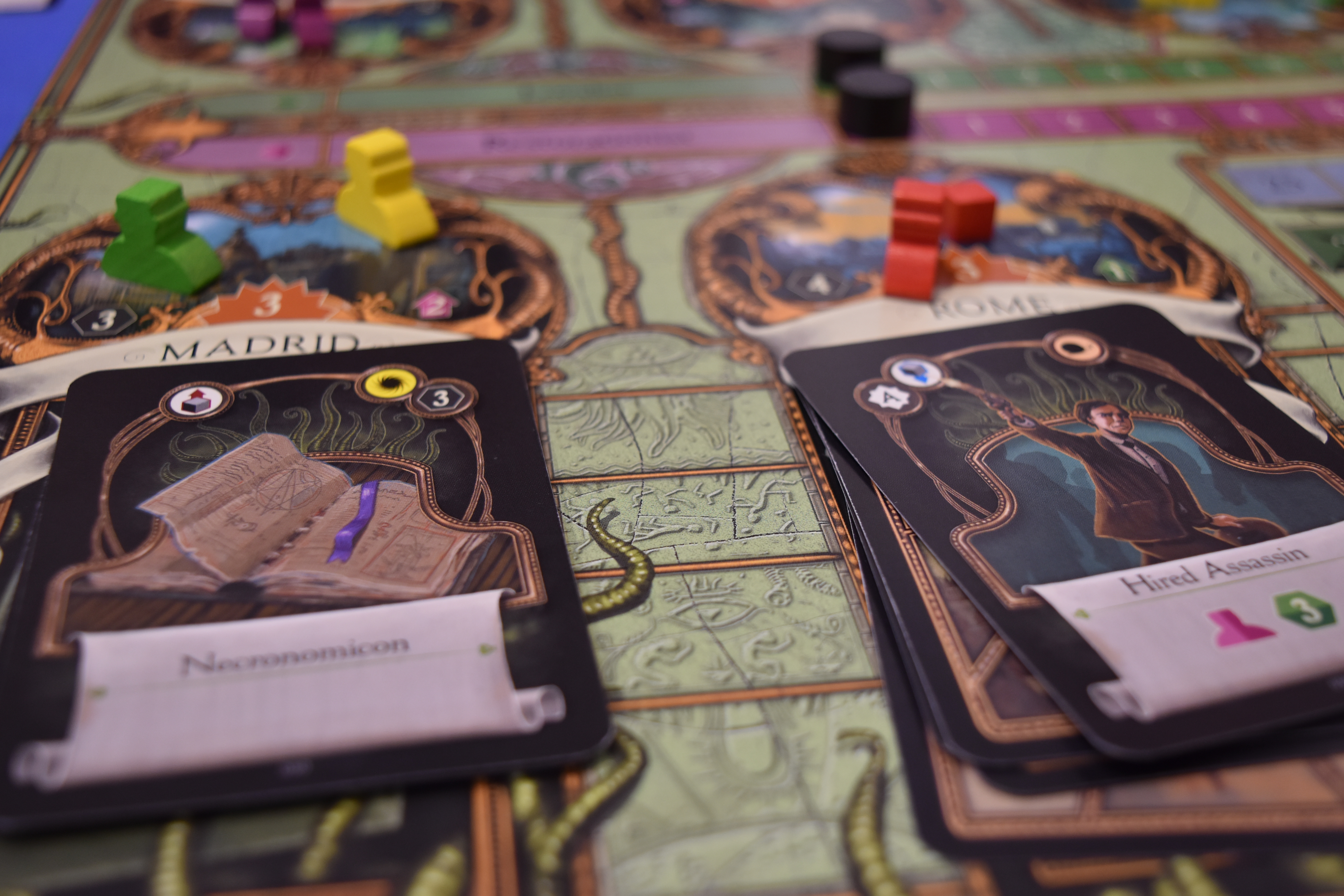
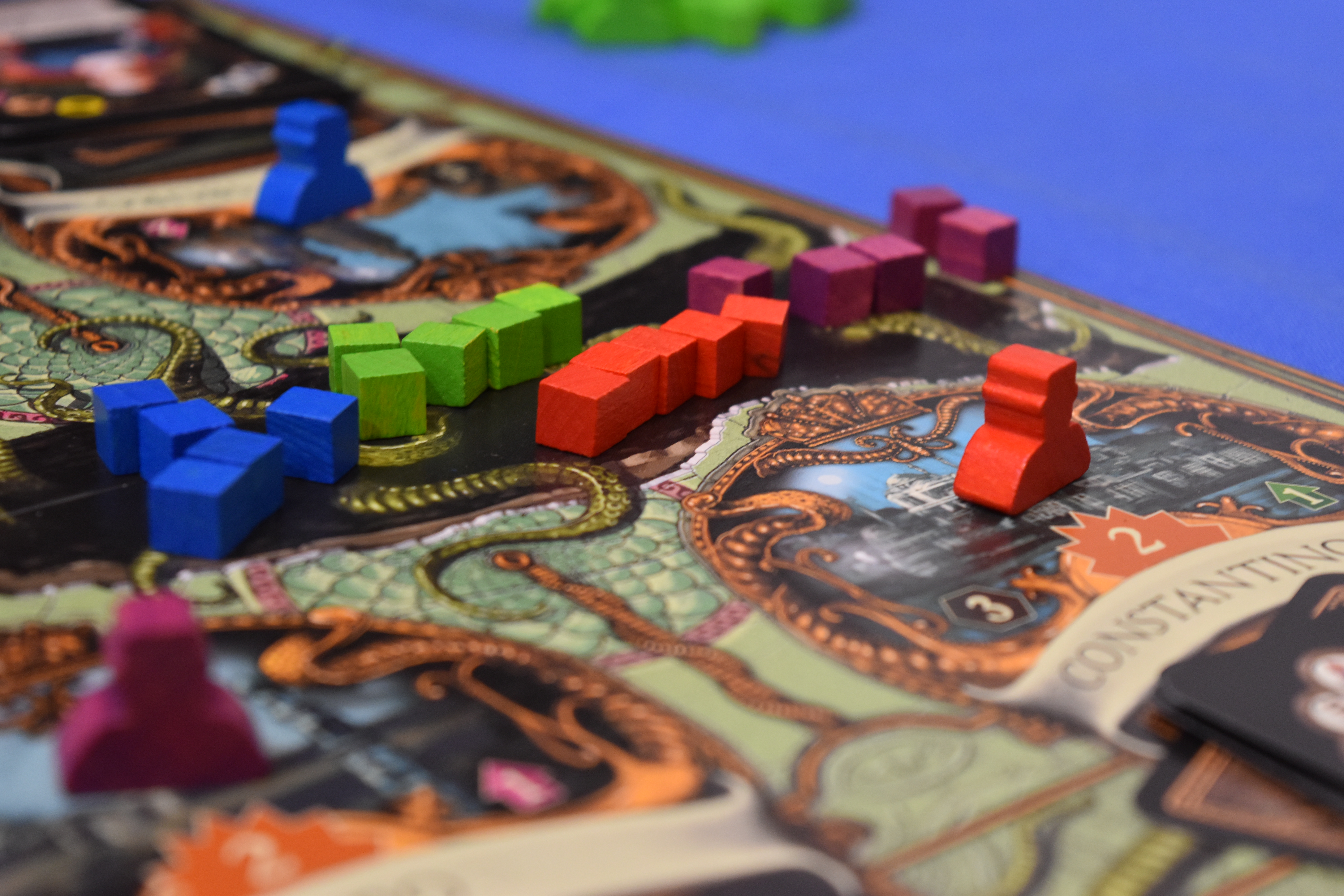
First actual game of the day was the second edition of A Study in Emerald. The game is based on Neil Gaiman’s cult short story of the same name, which is set in an alternate Lovecraftian nineteenth century in which the royal family have been replaced by Great Old Ones. Sherlock Holmes is there, along with a number of figures from history and fiction. In the game, you play (secretly) as either a Loyalist, faithful to the ‘royal family’, or a Restorationist commie intent on bringing down Britannia as we know and love her. The board is divided into locations which allow certain actions with varying ease, as well as a draw pile of cards. It’s effectively worker placement combined with deck-drawing mechanics, to reasonably solid effect.

DSC_0438Bob liked it, Briony didn’t. It may be that Bob really wanted to like it as she’d bought it on day one and it had sold out, but equally it’s possible that Briony hated it due to being hungry combined with a shockingly poor game demonstrator explaining the rules**. Certainly it’s simpler than the ‘glorified beta test’ original, and much cheaper and cleaner to boot!

Team Misery divided, and wanting everyone to know about it.
Team Misery, divided and wanting everyone to know about it.
day 4, Game 2: M.U.L.E.

Next, Bob and Lizzy tackled M.U.L.E., the boardgame based on the 1983 Commodore 64(?) game. It is absolutely charming. It starts off as a farming/resource management game set on an unexplored planet called Irata, where all you have for company is a robot-mule worker and your fellow explorers. Then suddenly there’s a capitalist market-trading mechanic and a magic money-generating Wampus and a mystical mine of purple crystals which change value in each game round. The board is busy but in a very Stonemaier-Games way in that all the initially-confusing symbols are actually there to clarify any potential misunderstandings and remind you of available actions. The winner is the Bob with the most space gold, while the loser is the Lizzy who has forgotten what their plan was to maximise their resources.

After that economic thrill ride any form of grown-up game seemed an impossible task. Our brains were just too full to absorb any further information such as ‘rules’ or ‘strategy’ or ‘tasks’, so we took refuge in Push-a-Monster, the award-nominated children’s game of monster-crowding. It’s very simple: try to fit your monster on an already-crowded monster platform, without knocking any monsters off the platform. If you knock a monster off, it gets hurt and has to go to monster hospital, so everyone else gets a point. Best of all is the lack of numbered scoring. No one needs that shit. Instead the monster-points are different sizes so the player with the longest string of monster-points wins. The illustrations are adorable to boot; one of the monsters makes exactly the face that Bob’s robot boyfriend makes when he wants to not be part of the Misery Farm.

10505414_10152401408286161_9040811379626614324_n (1)
Stop. Including. Me.

Two refreshing, addictive little games later and we were ready for more. Not before stopping by the HABALINK stand though, where we found a strong best kid’s game contender in Treasure of the Thirteen Islands. In this tactical children’s game, you explore treasure islands by navigating with your finger, then attempting to follow the route blindfold on a grooved board. If your little airship falls into a groove, you get stuck! If you find treasure, you win! It’s adorable and at least one person bought it.

day 4, game 3: Cash and Guns

Somehow we next managed to grab an eight-person table for Cash n Guns, which was promoting its fresh expansion, a special-edition Cthulhu character with a tommy-gun, and foam Uzi machine guns. The expansion was rapidly scorned as unnecessary, as Cash n Guns is perfectly fun without any extraneous bullshit, and plenty of shoosty fun followed.

Meanwhile, Bob secured a game of ‘Acquire Giant Sausage’, which she promptly then lost by dropping half of it on a surprised passer-by. Strong work, Bob.

CQ9NwHVWwAAxSr7
Pictured: Large sausage.
Day 4, Game 4: Architect
The road to victory. Deed-filled victory.

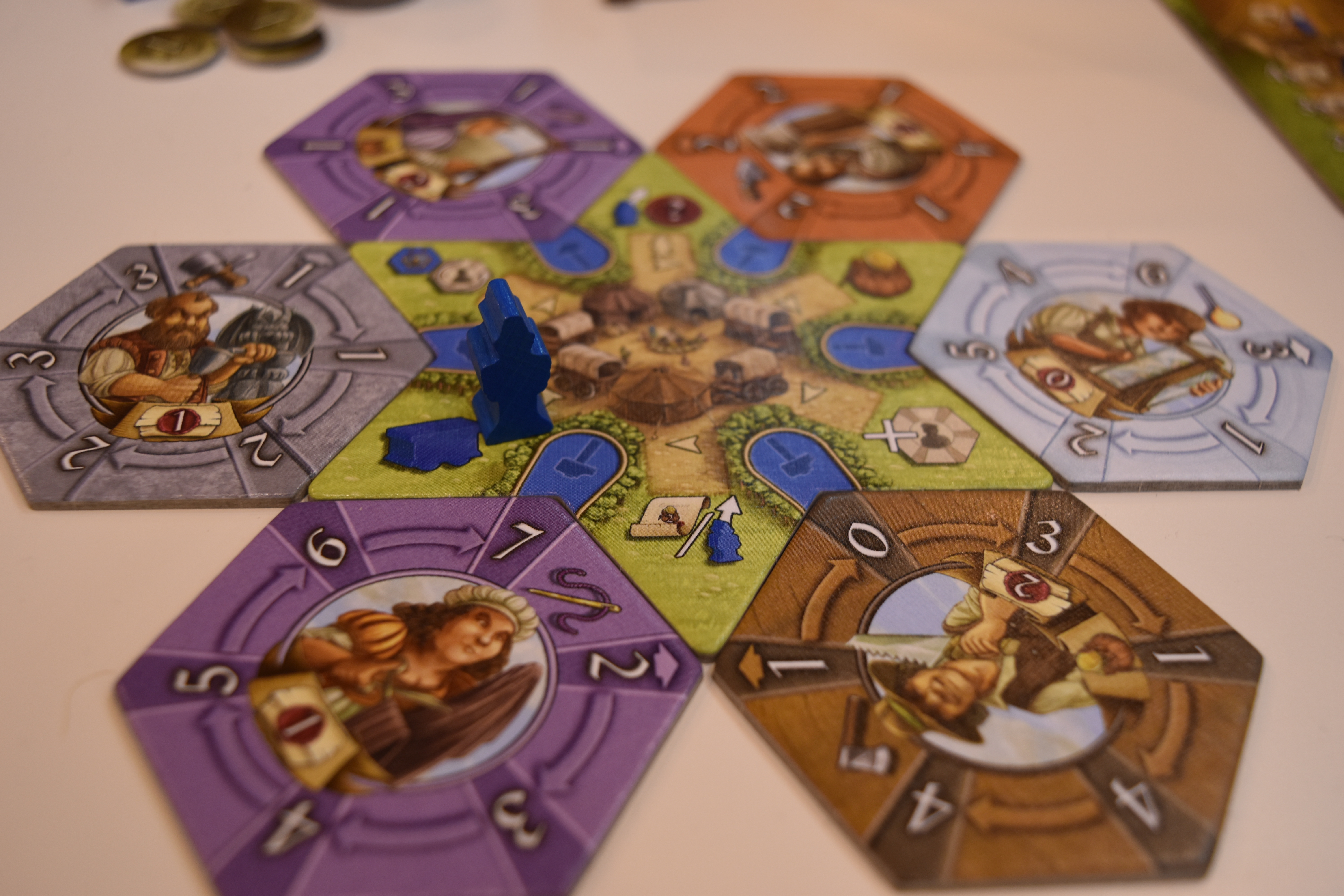
Briony and co., after being fairly disappointed by the experience of A Study in Emerald went and found a solid worker placement game. Architect fully ticks all of the boxes of worker placement, gasping drought, and being an intricately themed board game. Awesome. In this game you represent a travelling band of folk with different and useful jobs forming a caravan. The caravan travels around small villages and towns in a miscellaneous medieval European region, with a castle located in the centre. The band of travellers must fit the requirements of the specific village/town to be able to build or repair buildings generating prestige points.

Prestige points must be generated to go up each level of the victory track, which will eventually allow a player to win the ultimate prestige from the castle and win a contract. Or something. Honestly we needed a little more coffee to follow the broken English rules, but the game was fun regardless.

DSC_0450There are a nice number of mechanics in this game – the most unique of which is the ‘worker star’. Workers which you buy have different careers which are denominated by the numbers around the corner. After using them to build something you twist the worker around, showing a different number. Throughout a worker’s career their numbers go down, sometimes plummeting to zero if they’re going through stuff, maybe their wife left them or something.

The actions you are able to fulfil are dictated by the worker star also. But in the end, this game is about generating enough build points to get the castle’s favour. Fortunately the whole team was in agreement that this game was fun, quick, and exactly what we needed at that time during the day.

DSC_0445

day 4, game 5: Elysium

So this was the final game of Essen. Sad times. A band of team Misery longingly searched the halls looking for an empty table where they were able to play a game on their ‘to play’ list, and much to their delight found a free table for Elysium.

DSC_0453

The game is card based, and is heavily focused upon mythology. For anyone who likes 7 Wonders, boy is this your game. Half of the table was excited about its similarity, while the other half was excited because of its twist and difference from 7 Wonders. It ticks both boxes. In fact it won an award at Essen this year (and yet only two gaming tables! Why, Essen, why?!). Instead of representing a nation (as in 7 Wonders), you are a demi-god striving to generate enough myths about yourself to advance to becoming a full God. You have two areas where you may play cards: the mortal realm, and the immortal realm.

DSC_0451Each game plays with 5 gods, and there are 8 in total in the box so there’s variation, replayability and excitement! Your humble misery farmers/demi-gods played with Zeus (a classic), Aphesites (god of metal and hammers, stuff), Athena (owls, wisdom and the Hogwarts postal system), Ares (WAR hurr!) and Dickseidon (aka Poseidon but for serious, this guy is a dick and all his cards are dicks and the illustrations on his cards are dicks and his dick-in-ear scale is measured in kilotonnes).

The game plays out over 5 turns split into 3 phases. First is the ‘Agora’ (or ‘marketplace’. Yeah this game has got its Greek down, yo). This was helped by Lukacs, our excellent and friendly game demonstrator (helpful as we cannot read German rules). After that you move some cards into their immortal realms where their effects disappear but become sets (either by colour or number) and lastly the usual maintenance.

Screw your mortal resources, we need only pillars.

The cards have different coloured symbols relating to 4 actual, physical, coloured columns that each player has on their board. To take a card from the ‘Agora’ a player must have the relevant coloured column. Each card has effects, as you would expect – some of these affect only the player while others affect the player and the others players (not as good, obvi) You can also destroy whole coloured columns with barely an evil laugh. Dickseidon’s cards on the other hand usually do not affect the player but dick over other players (such as losing gold, victory points, discarding cards etc). This game is highly recommended, especially for anyone who likes 7 wonders, mythology and Dickseidon.

Rounding up the day

Finally we retired to a nearby hotel lounge, where our easily-bored but deeply punk friend Pat had secured a few big tables and crates of beer. Codenames, Potion Explosion, and Microfilms*** were all brought out and played to great enjoyment. Codenames remains an instant classic while Potion Explosion is shameless fun, and not just because Lizzy is hilariously bad at it. Microfilms needs… a more thorough explanation than we received. A cousin of [redacted], it relies heavily on keeping your cards secret, so if you don’t understand it you can’t ask what your cards mean. It has potential as a quick three-person game though, and our version comes with highly-professional art!

This weekend (FOUR DAYS IS NOT A WEEKEND -ed.) has been beyond intense, but extremely fun. Really we need to add ‘get enough sleep’ to our survival tips, but somehow between the beer, boardgames, and bratwurst that seems to be impossible. Besides, who needs that stuff when you’ve played upwards of 20 different games in four days? Especially when you’ve been playing with friends as good as ours.

We’d like to extend our thanks to the friends who came with us and made this trip as mad and brilliant as it was: Pat, Chris, Martin, Emma, Sina, Dave, Sam, Charlie, Gord, Mac, and The Reading Boardgames Social guys.** Final thanks to all the wonderful game creators, illustrators, vendors and demonstrators who work so hard and put up with the manic excitement of nerds like us. We’ll see you next year.

*Red Sun sushi, you guys make some delicious food but dear god expecting us to wait an hour for each of five courses is insane. We’re sorry we had to sic Bob and her mediocre German on you, making a complaint was physically painful to our English sensibilities.

** She also strongly dislikes deck building games due to unfortunate circumstances in her earlier years. It’s amazing how difficult it is to like a game again after you’ve cursed it to Hades for a truly terrible experience.

***On a side note, Microfilm has a character that looks hella like Briony. Is she really a Misery Farmer, or is she really the American spy?

Spy-Bri
Spy-Bri

Sushi Dice: What is the Sound of One Hand Dinging?

Brutus Rating: 2 little fish hooks in the back.
Pairs well with: Sake or Ahasi beer.

6D-33-106

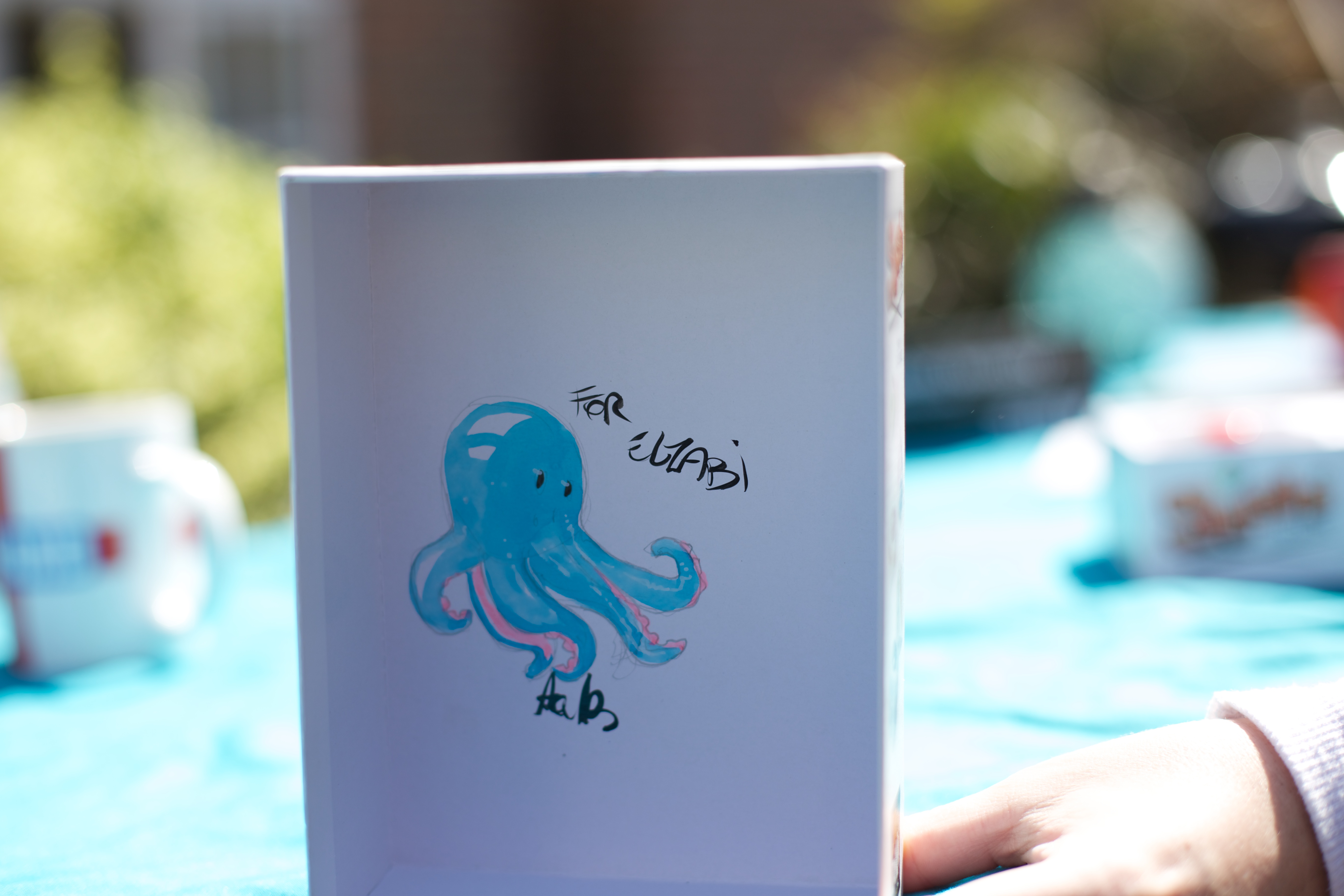
There are two ways to play Sushi Dice. The adult way, and the kids’ way. The adult way goes like this: You go to Essen Spiel with your friends and partner of choice and have a wonderful time (very important stage, this one). While there your friendly robot boyfriend should find the stand6D-33-104 where a new game called Sushi Dice is being exhibit and played (note, sushi is for some reason the current theme of choice for casual games – don’t confuse Sushi Dice for Sushi Go! or Sushi Express or some other nori-based nonsense). The game artist will hopefully be sitting at the stand, churning out little watercolour octopus drawings on the inner lids of games bought then and there. Friendly robot boyfriends know that this makes an excellent gift, and will buy it for their neurotic board game girlfriends (ie Bob).

Later on, when you and your wily gang of nerds are relaxing at a German Brauerei with beer 6D-33-117and bratwursts the length of your arm, you figure out the (very very simple) rules and have a go at playing. The game can be played by any number (>2) of people, but there are only ever two active players at a time. Each active player gets six dice, with are printed with sushi ingredient symbols. Three of the six dice have a star symbol, and three have a black skull.

To play, a deck of cards depicting sushi and other fish dishes (e.g. paella, fish and chips) is placed face down. Three cards are drawn from the top and laid face-up in the middle of the table.

6D-33-149

Players roll their dice until they match the ingredients of a fishy dish and if they get there first they get the dish card. Whoever has the most cards after an arbitrary length of game time wins. Then the round ends and the dice pass to the next pair of players.

6D-33-122Stars are wild. If you see another player get a skull dice you can yell ‘YUCK!’ and they will have to re-roll all their dice. If a non-active player sees both active players roll a skull they can yell ‘CHOP’ and the round ends.

To signify that you, the plucky sushi chef, have completed an order of whichever fishy dish you’ve chosen, you ring the handily-included bell. Of course, when you play the grown-up version you’re in a tap-house, so it’s unlikely that a group of people ringing a service bell would be very popular. So instead of hitting the bell you instead say ‘Ding!’ This swiftly escalates to shouting ‘DING!’ while hitting the table but that’s still way better than being the dickheads with the bell, right?

6D-33-138

Of course, when you play the kids’ version you have to include the bell. Them’s the rules. You also have to become suddenly and tragically blind to cheating. As part of Bob’s plot to indoctrinate the youth of today with geeky values* she has become adept at rooting out decent games which are still child-appropriate.**Sushi Dice is pretty and brightly-coloured, easy to learn, and loud.

6D-33-141

DING!

Kids like loud***.

DING DING DING!

In fact the children Bob played this game with liked it so much they refused to stop playing it even after all the adults had lost interest.

(DINGING intensifies)

The two of them played it between themselves for a good while until the accusations of cheating got out of hand (they were both cheating, and they weren’t even playing to win). Then one of them continued to play it by herself, mainly just to be able to hit the bell every time she finished a combination.

6D-33-154

(DINGing continues, forever, until all meaning and time is lost to the sound of one hand dinging. And every time the bell rings, Bob’s dog barks. She has created a monster.)

That’s what we can consider a success story.


*Parents! Are you worried about your teenage children growing up to be hoodlums and drug fiends!? Well try this remedy on for size: Magic the Gathering! With this collectable card game your son or daughter will never have the money for drugs, and all their friends will commit no greater crime than failing to shower regularly! Hurray!

** Unfortunately she still hasn’t been able to stop saying ‘fuck’ in front of the kids. You can’t fight nature, man.

*** See the Twilight Imperium review for the moment when loud became unbearably loud.


Picture thanks to Dr Photographer


Cthulhu Gloom: The Clue is in the Name

By Bob and Briony

Brutus Rating: 8 out of 10 gruesome daggers in the back
Pairs well with: Port, red wine, some Edgar Allan Poetry.

Cast your minds back to bygone days of yore. Days when still had a deputy Prime Minister to rein in our cartoon-villain overlord, and the horseless carriage was just coming into vogue (wait, no, too far back). The year is 2012, and your misery farming friends have been invited to a wedding. Well, to the reception anyway. Some of us (Bob) arrive way, way too early and have to find creative ways to pass the time while the proper grown-ups do things like ‘say their vows’ and ‘give speeches’. Luckily the wedding is at one of those fancy hotel/castle/stately home affairs with lots of turrets and nooks for exploring. Bob also finds a similarly left-out comrade in the form of former Call of Cthulhu RPG buddy Joss. Joss has a copy of Gloom, and Bob has a bottle of port and a plan.

Image via Atlas Games

You see, here at the Misery Farm we are all about three things:

  1. Misery
  2. Blanket forts.
  3. Board games (obviously).
Just as nature intended.

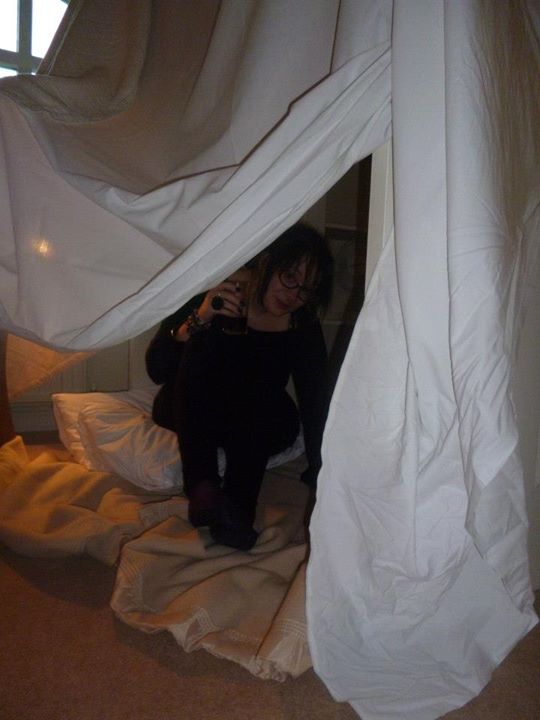
Therefore, it should be obvious that miserable board games in a pillow fort are the best things ever. And hotels, for those of you who don’t know, are prime pillow-fort territory. You simply call up reception and ask for extra pillows and blankets, and before you know it you have yourself a fabulous and comfy little nest – the ideal set-up for a two-player card game. With port.309431_10152381350750317_856648447_n

Gloom is simple, cheap, and portable. Cthulhu Gloom is slightly less simple, but just as cheap and portable.*

The card art is appropriately Gorey-esque.

Both games are based on the premise of winning at misery. Each player gets a uniquely melancholic and gloomy card family and the aim of the game is to make them as sad as possible before killing them off. More sad means more points.

Here’s where it gets interesting. To make your family members miserable (or make other players’ families happy) you play modifier cards on them (see-through plastic, so you can see the modifiers below!), but you must tell a story to explain what happens to make them sad. Luckily there are prompts on the modifier cards so you don’t have to come up with a complete story on your own:

6D-34-97Alas!** Poor Lavinia Whateley, she was travelling a dark forest path, driven in search of she-knew-not-what by dark, insane dreams beyond her comprehension. Suddenly there came before her a clearing, hideously illuminated by the moon, in which she saw mounds and mounds of misshapen mushrooms. And that is how she ‘found some funghi’.’
6D-34-102Then you play the miserable modifier card on poor mad Lavinia and she gets however many negative points it indicates. Once you have deemed a family member to be sad (and therefore point-rich) enough, you kill them off with a ‘sudden death’ card. As soon as a whole family is completely dead the game ends, and you tally your scores. Only dead family members count, so it’s a payoff system between killing them quickly and scoring high. Of course, you can also sabotage other players with some happy points:

6D-34-95
Happy little tentacles.

‘Joy be!*** Lavinia, after her squamous encounters in the dark forest walks through the night and, coming to the edge of the forest, finds before her the incredibly cheerful and fortifying sight of a family campsite. Yes indeed, it was in fact a completely harmless forest in Wales, and a whole host of achingly friendly North-English families are keen to welcome to her to their holiday party. There are breakfast bacon sandwiches and healthy nips of gin all round. And that is how Lavinia came to ‘forget the funghi’.’

6D-34-92
Also pictured: Cthulhu leggings

In Cthulhu Gloom all the family members are based on Lovecraft characters, and modifiers and deaths based on narratives from the stories. Your Whateley family might be minced by Mi-Go or discover a strange new colour. Asenath Waite might finally get revenge on her father, or maybe just show up on your doorstep in the dead of night, dead. Charles Dexter Ward’s infamous cat even makes an appearance, though thankfully with a new name.

When we finally get round to playing it as a blogging cohort it is completely the wrong atmosphere. Late morning on a Sunday and we’re still not quite sure whether what we’re feeling is hangover or just some sleepiness and stress-residue from a busy week of being adults in the competitive world of post-graduate research.****

This mug is inappropriately cheerful for Gloom.

We decide to skip some of the more awkward bits of the rules, mainly because Bob accidentally threw away the rule book and can’t be bothered to find them online. This is not recommended, as the Cthulhu version does have some extensions and changes which means that even seasoned Gloom-players would do well to re-read the rules. There are, for example, full game objectives which will, if fulfilled, add a big pile of misery to your final score. This adds a stealthy strategy element distinctly lacking in the original. Otherwise the expansion mostly just clears up some fuzziness in the original rules like when to play one-off event cards, and how long effects like increased hand-limits last.

Don’t play Gloom, Cthulhu or otherwise, with people who have no imagination. It’s a dire experience as they take so, so long to play the damn card and stop rambling on, and without the stories it can be kind of boring in its simplicity. Do play this game with people who are new to board (card?) games as it’s straightforward and fun but definitely falls into this whole quirky ‘modern age of board games’ era.  Despite the port, this actually doesn’t make a very good two-player game, so we recommend three to four players.

6D-34-147
‘And then they died.’

Bob appropriately wins this game, as she has the darkest lipstick and most morbid outlook. Death to some and misery to all the rest!


* OK it’s not actually that portable. It just looks portable because the cards are clear plastic so you think ‘wow, those are some durable cards, unlikely to suffer any water damage and therefore perfect for pub trips and long car journeys.’ But then you take them to a festival and try to play a game of Gloom in a leaky tent during a sudden rainstorm, but you’re a bit drunk and the tent is full of people and suddenly the cards are sliding around everywhere and you eventually give up on playing but by then you’ve lost a few in amongst the inebriated bodies and sleeping bags. Not that we’re speaking from experience or anything.

** We like shouting ‘alas’ when there’s some fresh woe. Makes the whole thing more dramatic.

*** See ‘alas!’ footnote, previous.

**** Ironically, Bob is actually the furthest-along in her PhD and has spent at least 15 hours this week playing Hearthstone. This was, obviously, a mistake.


Photos by Dr Photographer

Camel Cup: The Yellow Menace

Brutus Rating: 2 daggers in the back out of 10
Pairs well with: One of those liqueurs you bring back from holiday that nobody wants to drink. Maybe cactus flavour, or ouzo. Raki is pretty rough too. Damn Greece, you got some terrible booze.

Note: our photographer insists that the bright glaring photographs are supposed to represent the sun in the camel-filled desert. This, we are assured, is definitely on purpose.

Disclaimer: In the interests of maintaining ethics in board game journalism we at the Misery Farm feel that it’s important to make our audience aware that this post contains a high level of pro-yellow camelist propaganda. This does not mean that we aim to denigrate other colours of camel or beings who identify as camels. All camels are equal. Yellow camel is just slightly more equal than other camels.

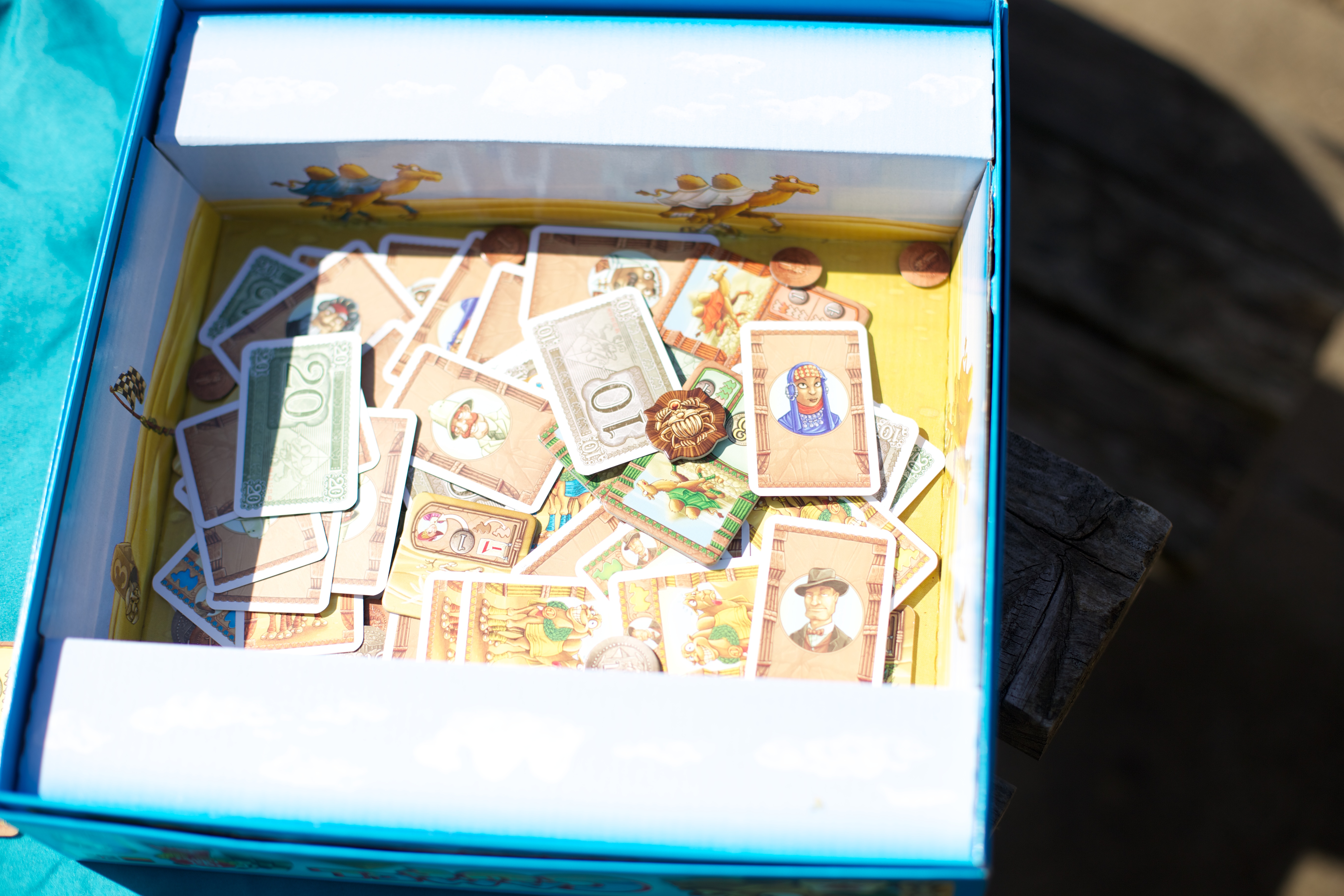
There are several ways in which Lizzy is the villain of The Misery Farm. She wins too often, she’s a little bit too keen to play the bad guy and she has a really awful smug face. These things might all make her seem like a kind of loveable rogue, but there’s one thing that we’ve hidden from you all so far. The real reason she will strike fear into your heart. We’re about to show you the inside of Lizzy’s copy of Camel Cup. If you’re of a nervous disposition, or there are children in the vicinity, look away now.

6D-33-60

Urrrrgh. *shudder* That game even comes with baggies, guys. There’s no excuse for that mess.

Anyway, now that horror is over, let’s get onto Camel Cup.

There are two schools of thought on the name of this game. Some people think that it’s actually called ‘Camel Up’. Perhaps because of the stacking method, in which the camels go ‘up’ and stack on top of each other.

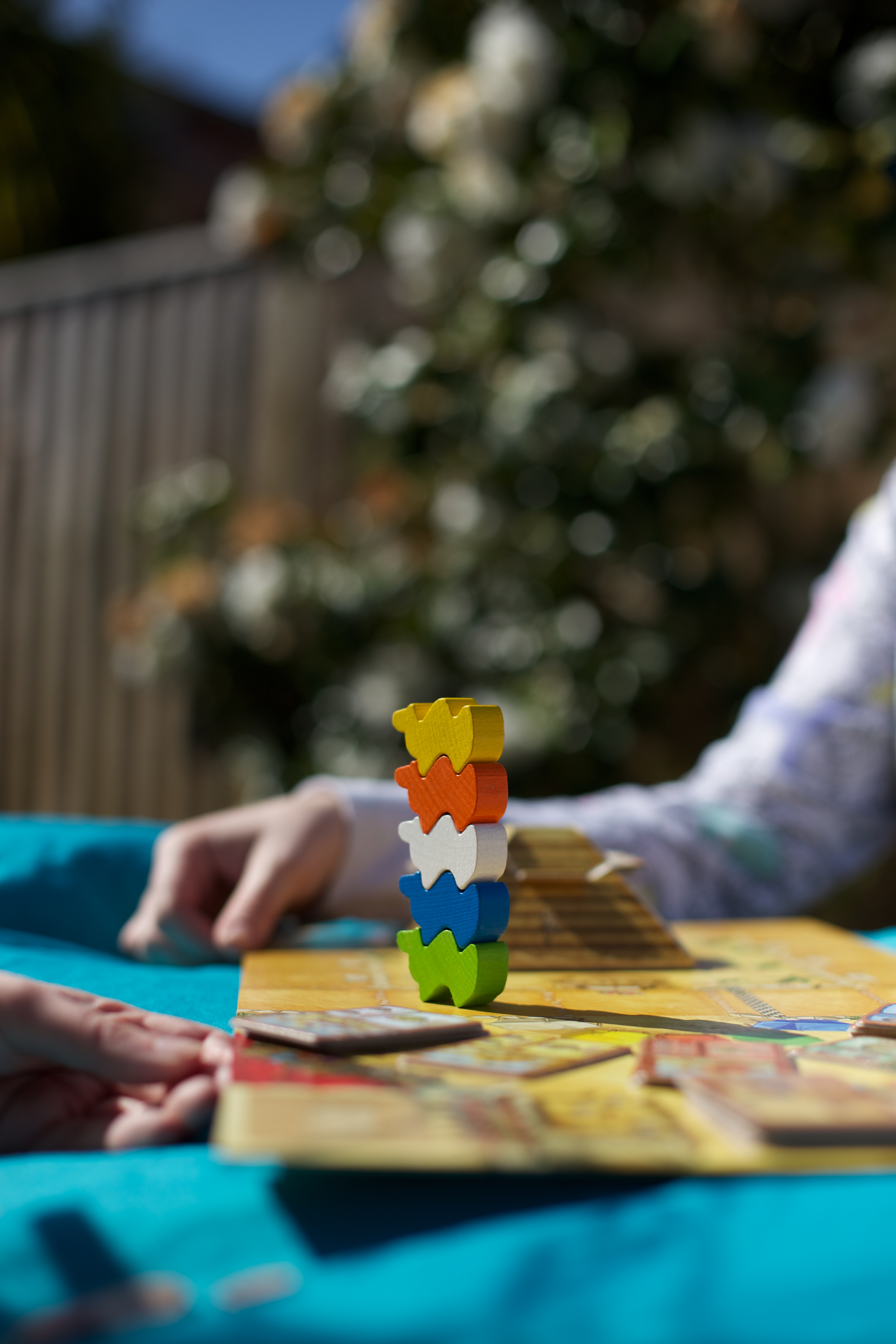
The camels lining up for a bit of pre-race chat

These people claim to be right because of silly little reasons like “that’s what the instructions say”, “that’s what it says online” and “that’s just the actual name, you guys”.

The other school of thought says that the game is ‘Camel Cup’. Because the camels, you see, are racing to win The Camel Cup. These people claim to be right because of excellent reasons like “there is an actual Camel Cup race”, and “we just prefer this name so agree with us or get the hell out of our living room”, and “shut up and play.” The Misery Farm are a part of the latter school of thought.

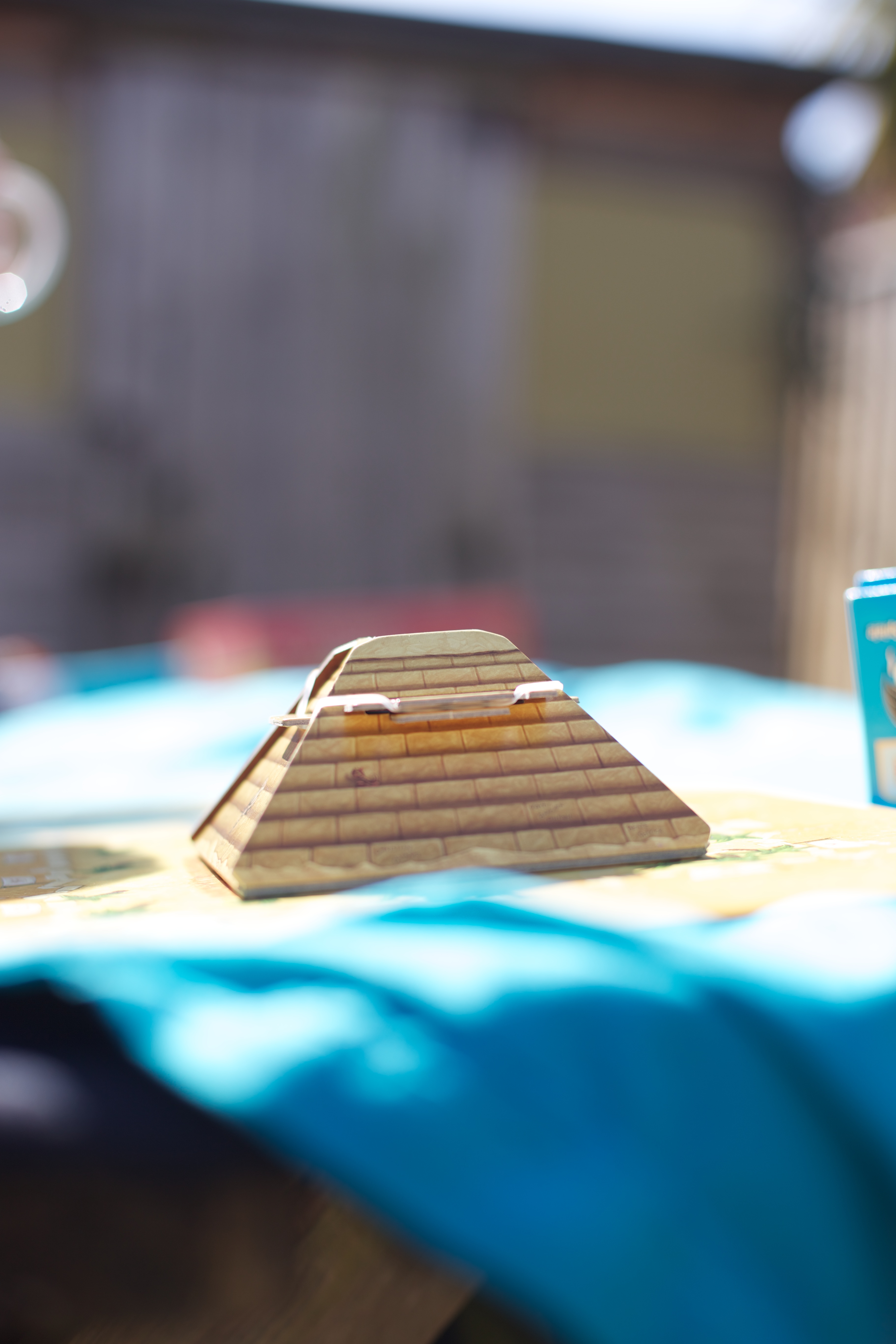
Pyramid-scheme
Pyramid-scheme

Camel Cup won Spiel Des Jahres 2014 (“Game of the Year”. Thanks Bob, that degree in German wasn’t wasted after all.) When you first look at the game, running around a giant convention hall in Germany, then that fact can seem a little surprising. It looks a bit gimmicky: it has some sort of strange pyramid thing scheme going on.

It turns out that Camel Cup is almost certainly the best gambling, camel-racing game you’ll play all year.

In Camel Cup you don’t play as the camels, and you don’t have much influence on how fast each of the camels race around the track. Instead, you’re the Egyptian aristocracy. Your goal is to make as much money as you can by the end of the race, having gambled on which camel will be the final winner, the final loser, and which camels will win each ‘leg’ of the race.

The Egyptian aristocracy

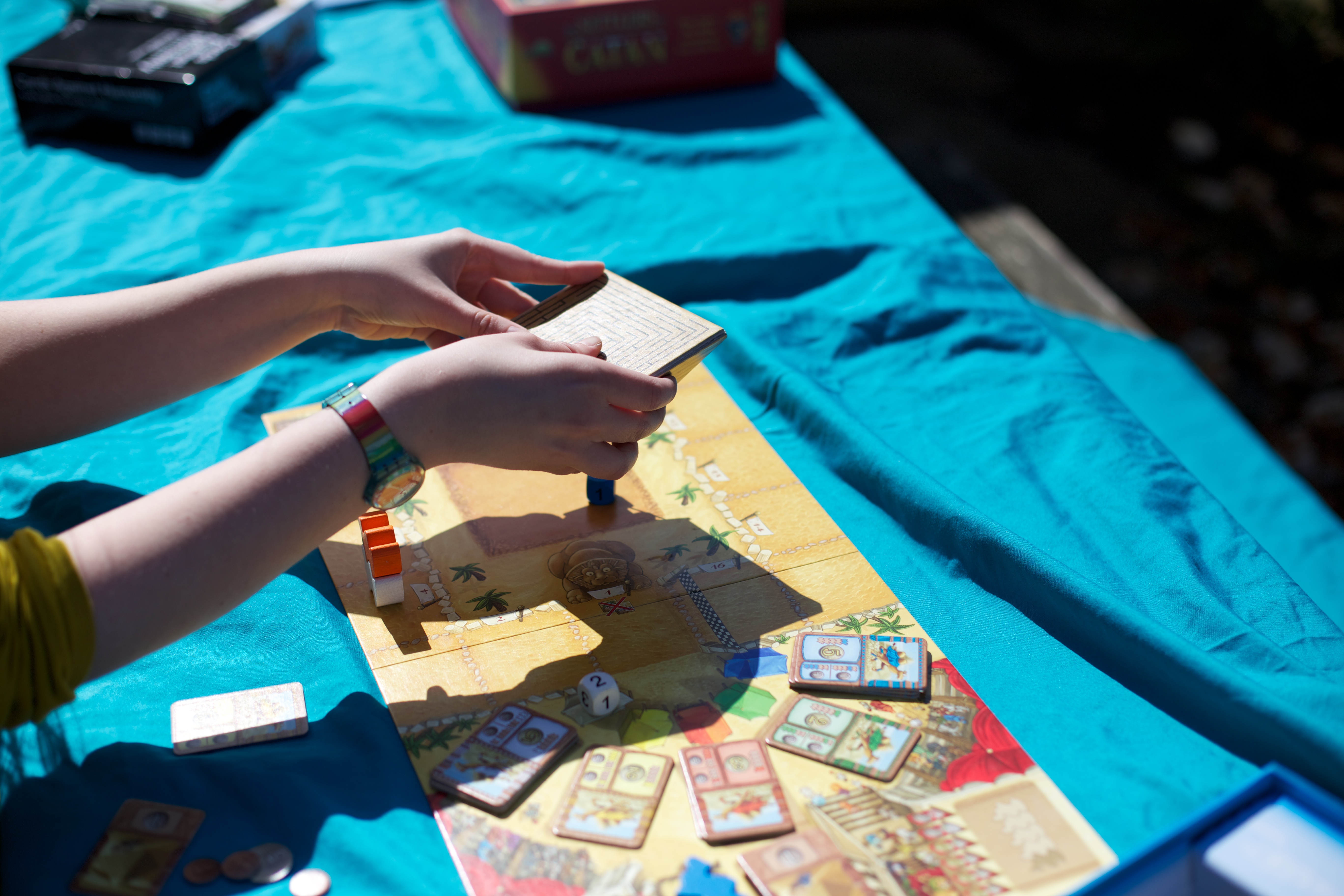
It’s fairly fast-paced, and (hopefully) everyone will do one of four actions quickly and move onto the next person. Two of these actions are gambling (betting on a camel for either the leg or the whole race), one is placing down an oasis or barren dessert sort of token (the one way in which you can almost sort-of influence the race) and the final is to move the camels. That is, make it so that the camels move themselves. You get limited choice in the matter.

“I BELIEVE IN YELLOW CAMEL!” (Lizzy bets on Yellow Camel to win, as is tradition)

“Green Camel is currently in last place… so I think I believe in Green Camel.” (Generic male gaming buddy gambles on Green Camel)

“I think I’m going to move the camels!” (Everyone starts chanting ‘move the camels’ and banging on the table)

The game also features Nigel Thornberry

Of course, I say that hopefully everyone will do one of four actions quickly. Occasionally you’ll get players trying to cheat. By ‘cheat’, of course, I mean ‘actually trying to think about their turn logically before having it’. Don’t do that, it’s a terrible idea. You’ll look like a dick, and it won’t help. Camel Cup can be for up to eight players, so such behaviour is rightly discouraged in our circles, and hurried along by coughing and reminding guilty parties that “Ahem! This is Camel Cup! The fast-paced camel racing gambling game! Get your shit together” until they take their turn. Attempting to mathematically work out the winning and losing odds has no place in this game, for reasons which we will soon make clear.

The magical pyramid of camel-moving

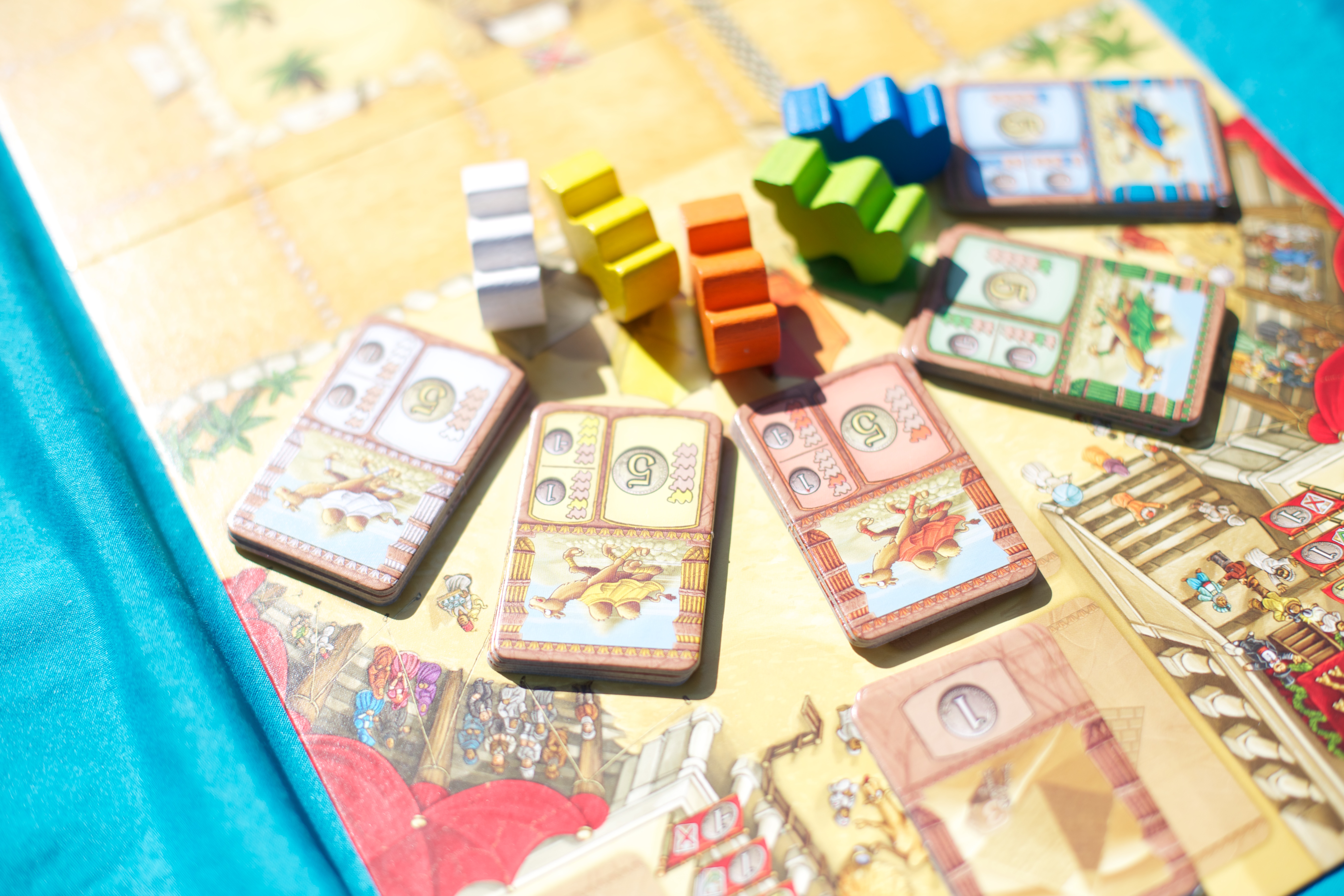
To get any good picture of how Camel Cup plays, it’ll be useful to mention how the camels actually move. At the beginning of the leg, the mysterious pyramid of camel-racing is placed in the centre of the board with five different dice inside it, one for each colour camel. The dice are all numbered 1-3. When some brave gambler chooses to move the camels (cue chanting) she takes the pyramid, tips it upside down and pushes open a little flap so that one single die will fall out. The camel of that colour will then speed that number of spaces along the board! The die is then put aside until the other four are out of the pyramid, so that each camel will get one turn at moving before the dice are all put back inside. When all of the camels have moved once, that’s a leg of the race.

Once the novelty of a pyramid dice-shaker wears off, that can all seem very dull. Some dice are rolled, some camels race at that particular pace. *yawn*

But wait! This game didn’t win Spiel Des Jahres 2014 just for some camels trundling along next to each other at a speed of 1-3 per leg! Oh no. I’ve left out the best bit. The camels… they stack on top of each other.

Woah!
Woah!

Yep. Apparently the race course is so narrow that there ain’t no room for camels to be side-by-side. When a camel trundles onto an already-occupied tile, they’ll just park their camelly behind on top of that first camel. This is a mechanism that makes Briony feel deeply uncomfortable – when she’s claimed a certain spot on the board she expects not to share, or at least to swear at someone attempting to come near her. This is a particular problem in other games like Tigris and Euphrates as she strongly believes in keeping other civilizations out. Everyone else though? In awe.

6D-33-36BUT THEN! When that first camel moves, does she ask the second one to get the hell off? No! She races on with up to four camels on top of her. The implications that this has on the odds are staggering. Instead of moving a maximum of three places, a camel with some lucky stacking could move fifteen tiles.

Staring into the eyes of Yellow Camel

What looks at first like a simple race turns into a crazy one, where the odds a lot of the time are almost impossible to figure out. This is the essence of Camel Cup, and what makes the game so much fun to play. It’s not uncommon to see a camel go from last place to first in one leg, ruining all of your bets and expectations. The game is made by the sheer improbability of it all. It’s made by deciding which camel to bet on just by looking really closely into their souls and seeing which camel really has what it takes (Lizzy deeply believes that Yellow Camel has that X-Factor that’ll take it all the way to the big leagues). It’s made by having all of the enthusiasm in the world for the camel in last place, then actually seeing them win and getting to rub it in the faces of the non-believers.

Having said that, there are several things that Camel Cup is not. Camel Cup is not a lengthy game, nor one for much strategy. Not by board-gaming standards, at least. But that’s ok, because most people’s collections need a place for that kind of game. One that’s fairly quick, fairly simple and doesn’t involve too much thought if you’ve had a long day / are playing with some non-gamer friends / are a bit drunk already at 4pm and can’t quite think straight. It also comes with a Totally Official™ side-game in which players should try to pull faces that match those of the camels on the box art.


10710811_10152401406566161_3131231986079642096_n 6270_10152401406496161_9146959643205959983_n

As you can probably tell, it’s important to play Camel Cup with the right kind of people.

The players need to be willing to get excited about some crazy odds and racing camels, and to not mind the lack of reliable strategy or planning ahead. You need to be able to place a wild bet on a camel just by what feels right. I mean I’m not necessarily saying that it’s your fault if you don’t love the game (you might just have terrible friends). But it might not work so well if everyone’s incredibly quiet, or if everyone’s just received some tragic news.

6D-33-34

The game receives just 2/10 daggers-in-the-back since there aren’t all that many opportunities to stick said daggers into your opponents’ backs. There simply aren’t many ways to encourage a lame camel to victory or stop the juggernaut momentum of Yellow Camel. You can sometimes place a tile which will make it better or worse to land on, but most of the screwing-over will just be done by the luck of the dice and the speed of the camels.

A great game, for its type.

The real winner isn’t Lizzy. Nor, for once, is it board games. The real winner is Yellow Camel.

Tiiiiimbeeeeeerrrr
Tiiiiimbeeeeeerrrr


Credit for the photographs to Photographer-friend BA (Hons), MA, PhD.

Catan: Has anybody got any wood?

Brutus scale: 7/10
Pairs well with: cola and vodka. you know, the stuff you drink when you first start drinking and haven’t acquired much of a refined taste yet. 

6D-33-285

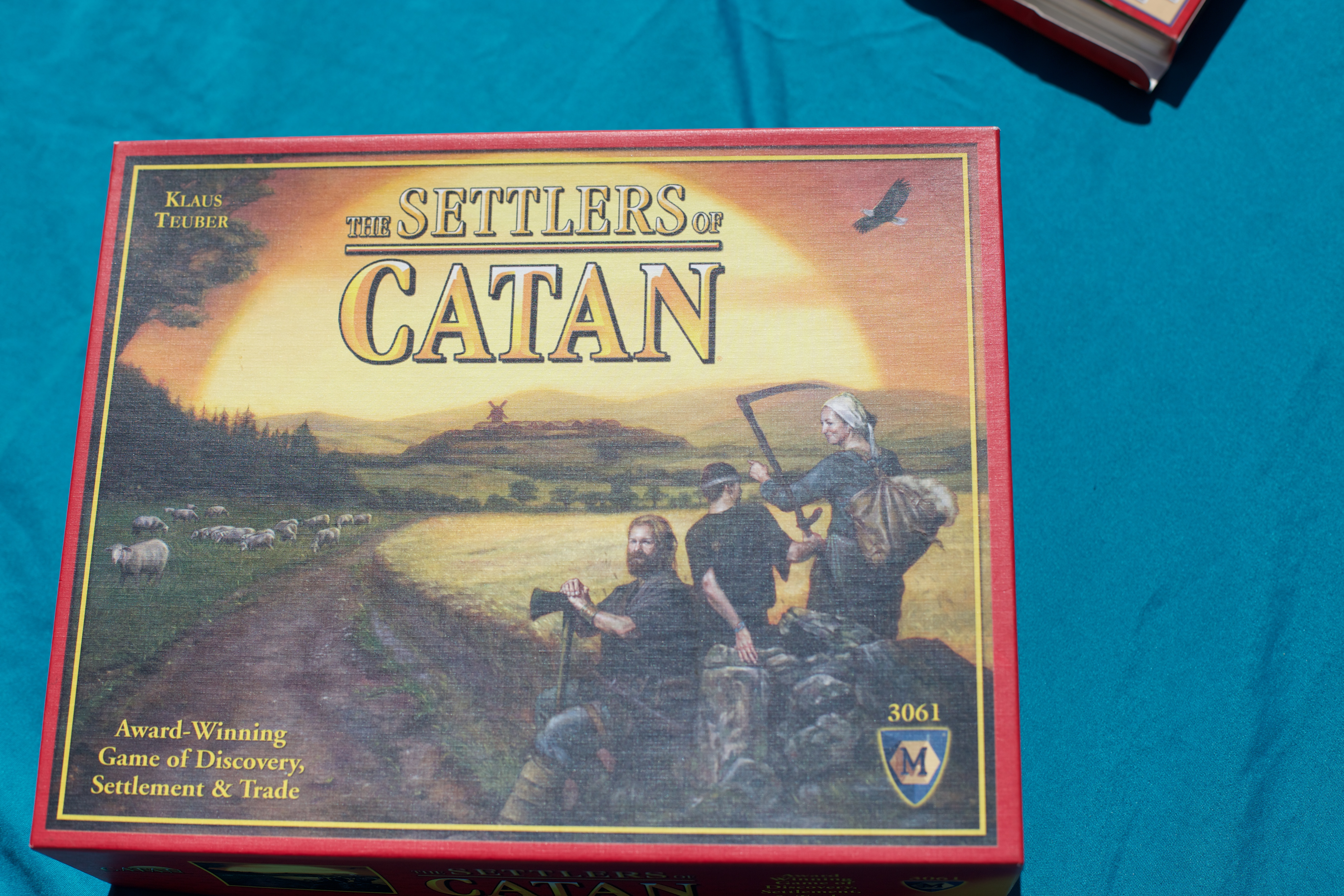
So we’ve just been informed that Settlers of Catan has now actually been renamed to just ‘Catan.’ This is presumably a move to make it ‘catchier’, ‘edgier’, more ‘down with the kids’. It’s also a move that could be described as ‘dumb’ and ‘unnecessary’. All of the expansions are already called ‘Catan: Slightly More Convoluted’ or ‘Catan: Now with Pirates AND Robbers’ or whatever, it just seems a bit redundant.

‘Wanna play some Backgammon?
‘Oh we just call it Gammon, now’,
‘But that’s already a thi-’
‘GAMMON!’

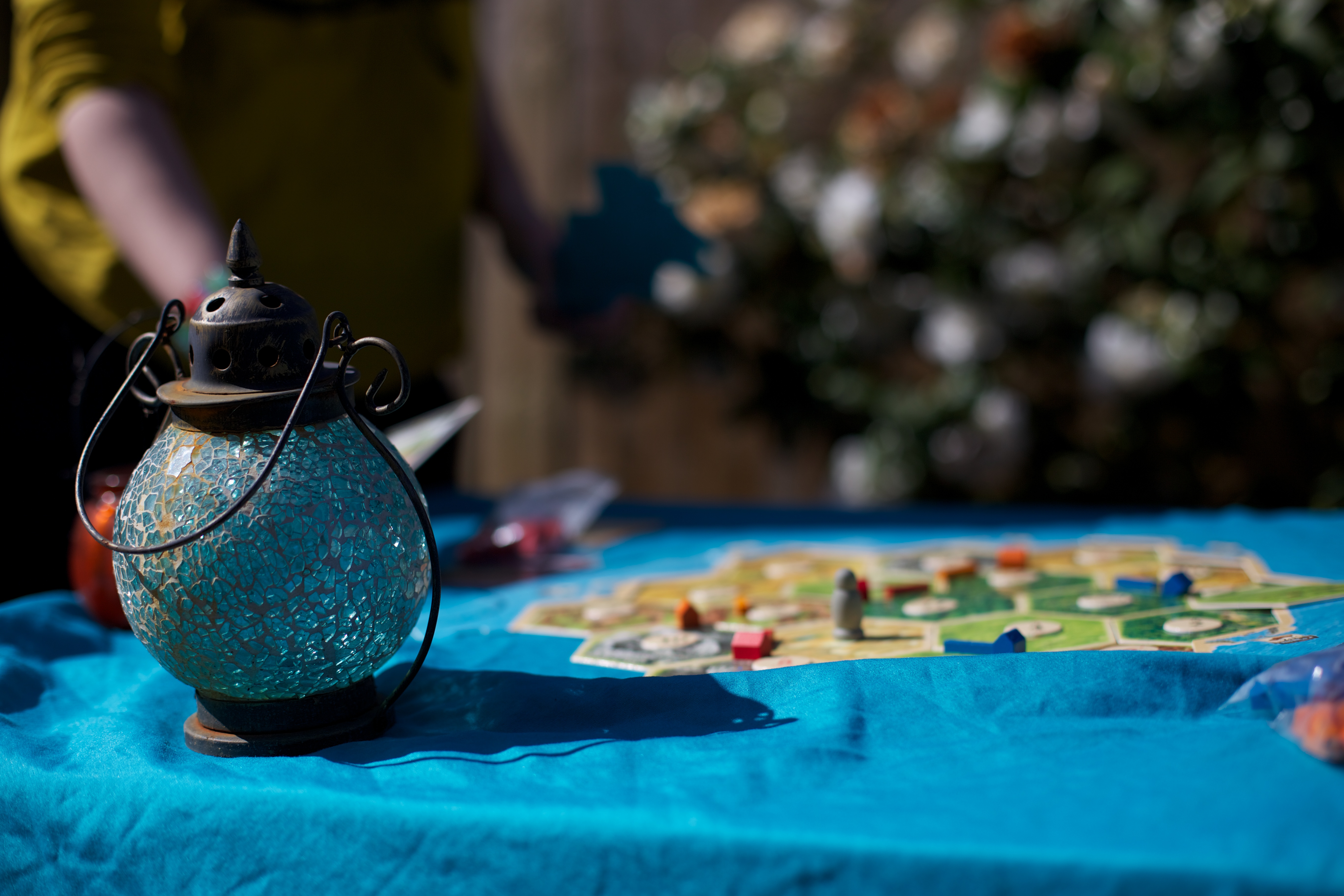
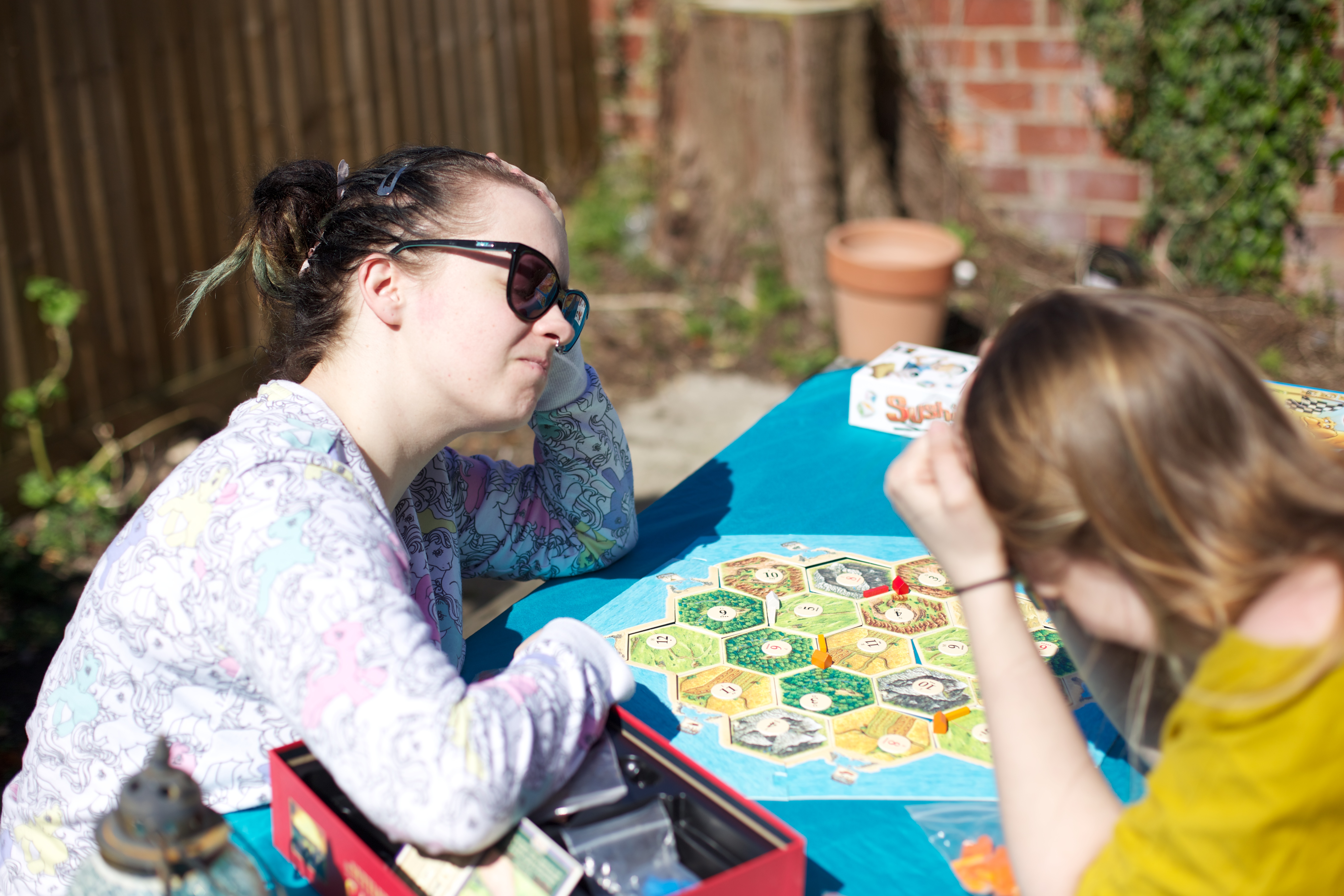
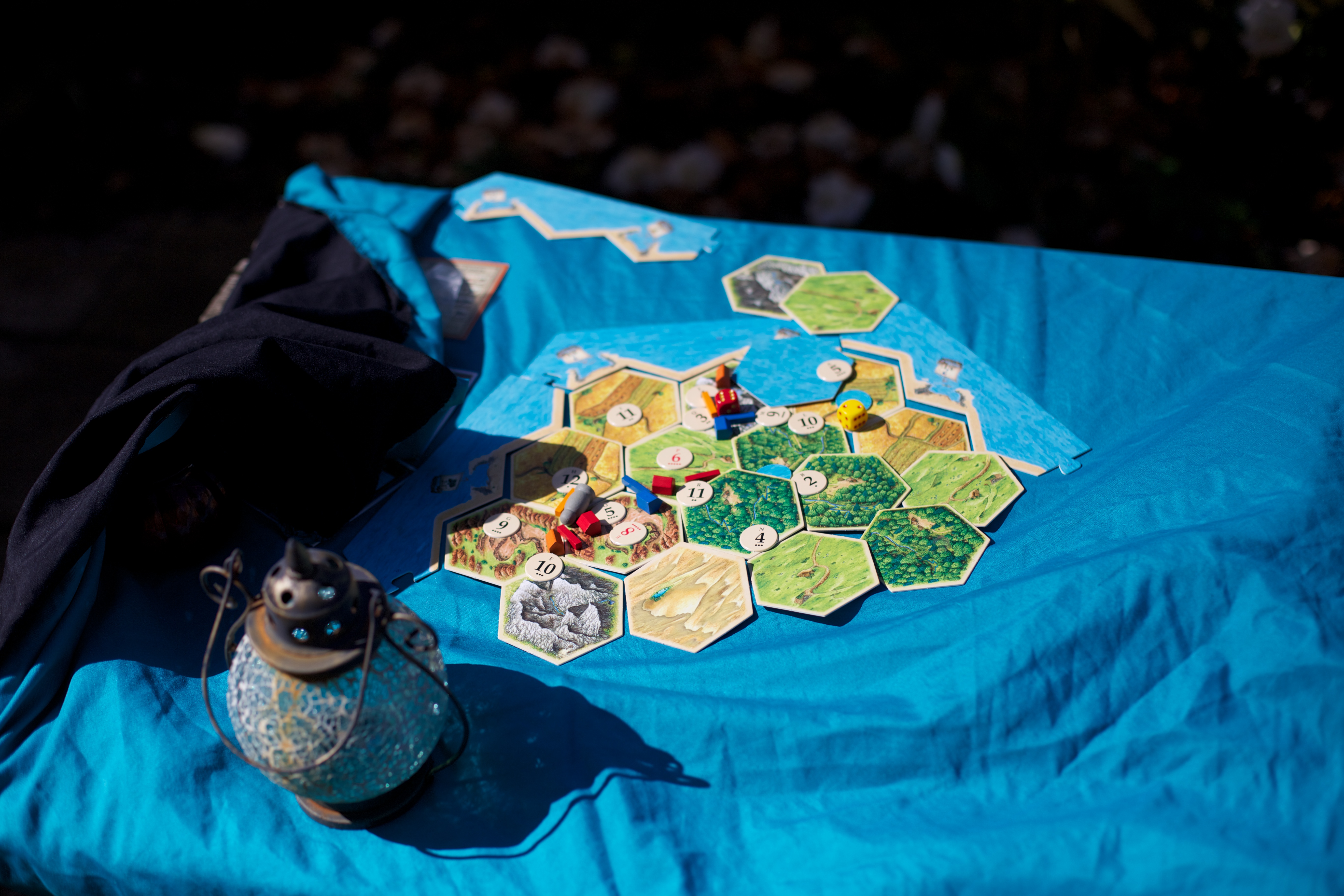
Nice game of Catan in the garden! What could go wrong?

Anyway. Let’s have a show of hands, who hasn’t played Settlers of Catan yet? It’s OK, this is a safe space. There’s no judgement here (except probably from our German readers. Over there I believe it’s as ubiquitous a part of family game shelves as Scrabble or Monopoly in the UK). Until recently, Bob was one of you. In fact she still sort of is. Despite the fact that Catan is THE gateway board game for future board game addicts it just somehow passed her by. There were always newer, flashier games to play, or no one around with a copy handy and a willingness to explain the rules.

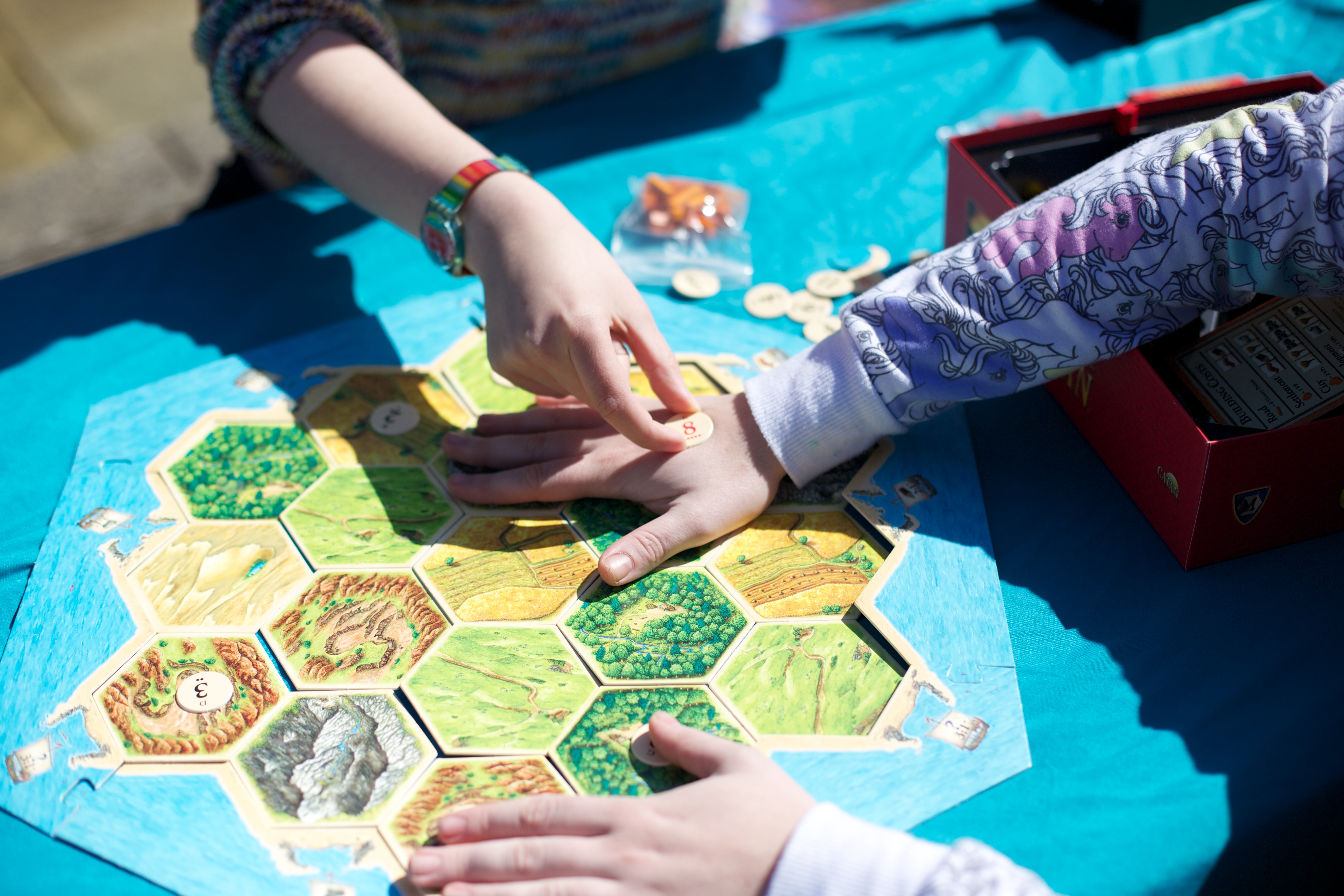
Ehehe. Wood, anyone?

By 2015 this state of affairs had become something of an embarrassment. What kind of board game reviewer hasn’t played Catan? A piss-poor one, that’s what kind. Luckily salvation was on the horizon in the form of a local mini-convention. Lots of friendly local nerds gathered at a hotel to share their (collectively enormous) stash of games, make friends, and carouse until the early hours. When the incredibly friendly and helpful in-house vendor heard of her plight he cheerfully not only conjured a show copy of Star Trek Catan to learn on, but a couple of experienced players at a loose end and willing to teach a newbie. Despite Bob’s ordeal, Briony’s first Catan experience was simply to be told to play it. She then won. Like, by a lot. And since those friends were the only people she knew with a copy, has never been asked back to play it again.

6D-33-269

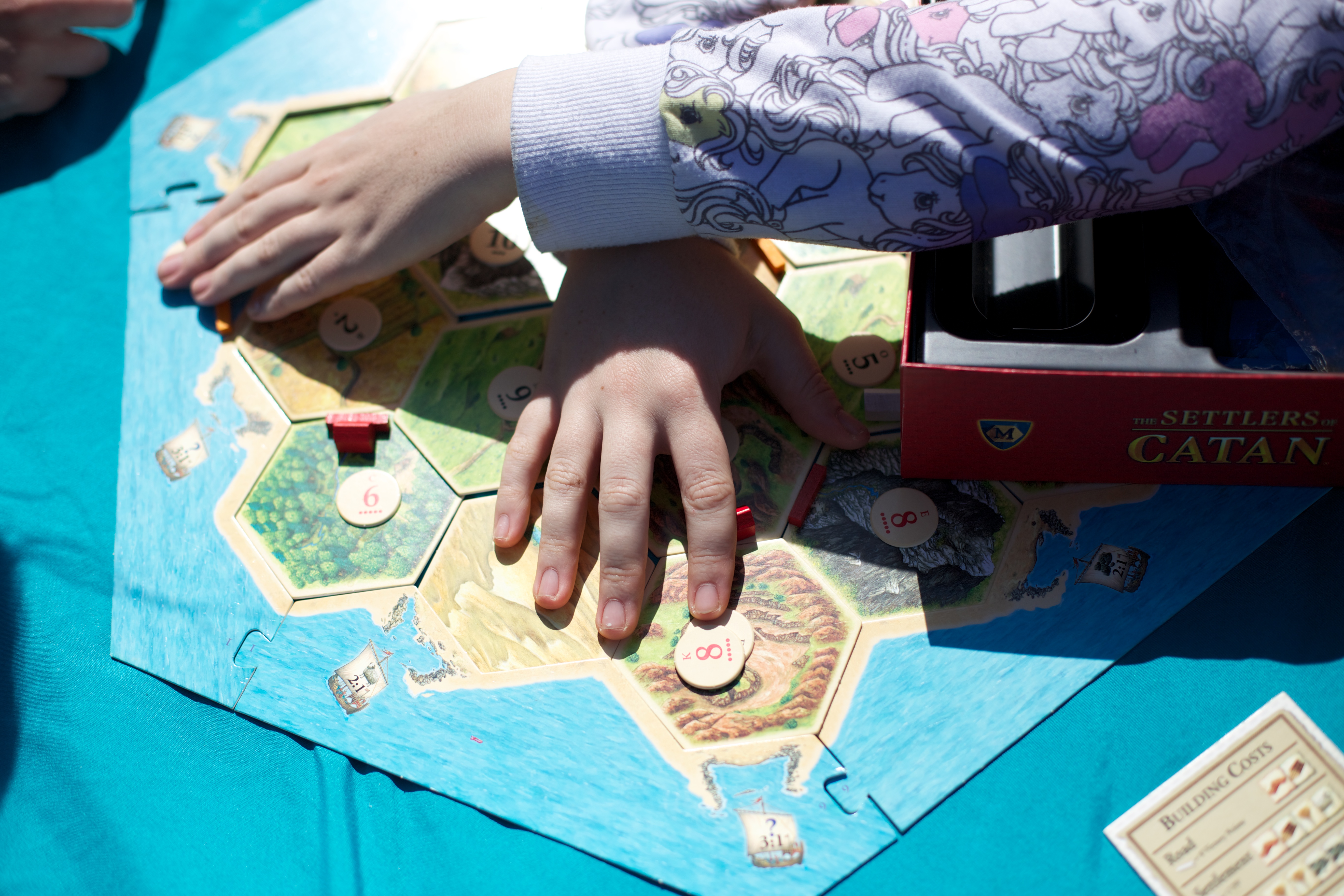
Catan was one of the first European-style agricultural resource management board games to gain mainstream success. In case you have also lived your life under a rock until now, it’s comprised of a randomised modular board made of cardboard hexagons, so no two games are ever identical. The aim of the game is to build towns and cities which generate resources from nearby hexes, depending on dice rolls. Mo towns and cities = mo victory points. Longest road between settlements also = mo victory points. Instead of making your settlements bigger and more numerous you can instead choose to earn points through development cards, which grant favours like extra roads, resources, or knights. Get the most knights in the game, earn some victory points. Get 10 victory points and you win the game.

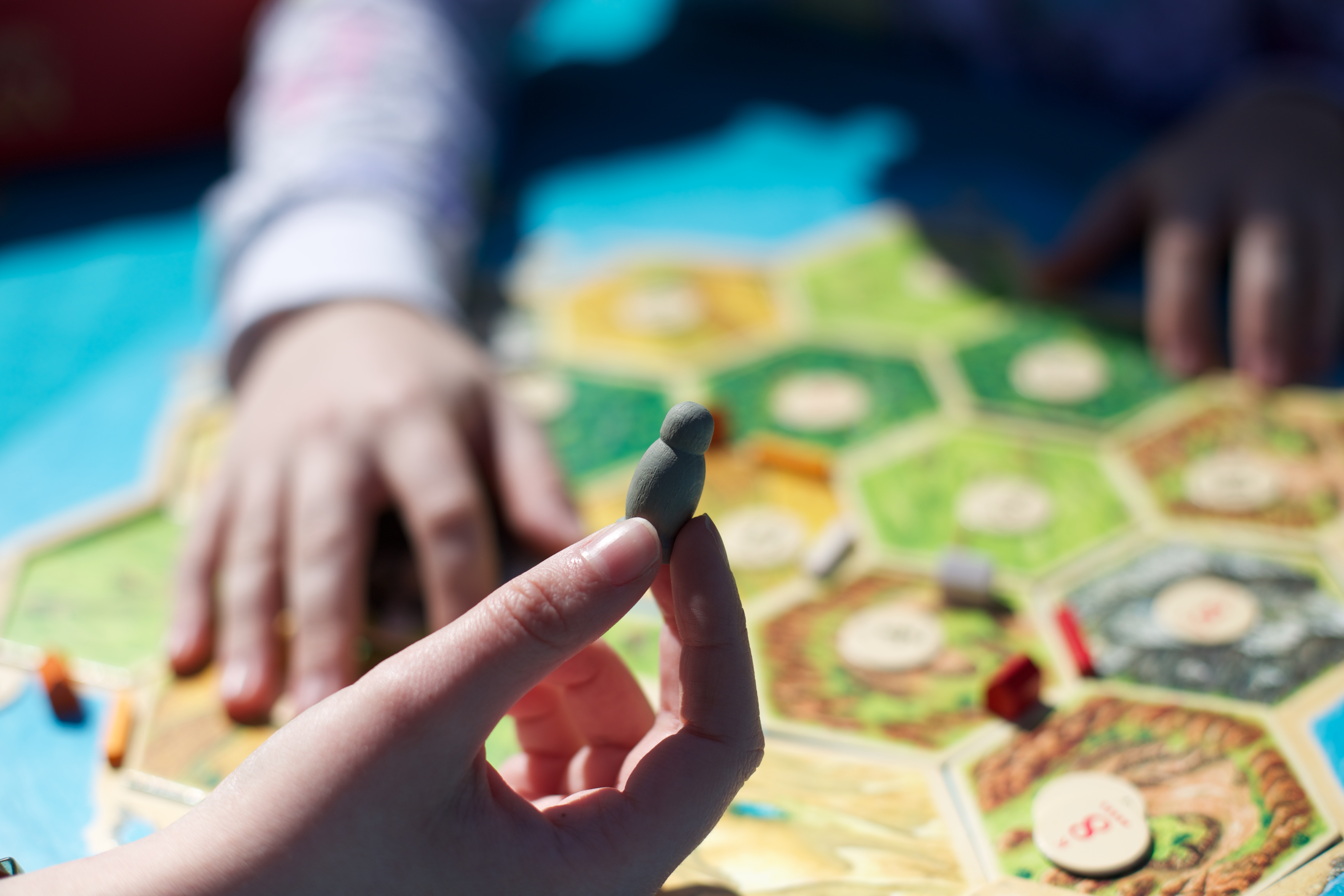
The little grey douchecanoe

There is also a nasty mechanical implement in the Robber. He’s a dick who shows up every time a seven is rolled. Because every player rolls two dice on their turn, he is statistically likely to show up pretty damn often to annoy the crap out of you. His job is to sit on a hex so that it denies you resources, and steal from you.

Star Trek Catan! Credit to  Richard Harris-Abbott for this one
Star Trek Catan! Credit to Richard Harris-Abbott for this one

Star Trek Catan is pretty much regular Catan with a Star Trek: TOS makeover. The robber is a Klingon battle cruiser. The resources are things like dilithium, tritanium, and oxygen. Roads are itty-bitty starships and towns and cities become outposts and starbases respectively. It’s pretty damn adorable. The only real difference is that the ‘Helpers of Catan’ expansion is integrated into the game in the form of Kirk, Spock, etc. showing up to give you a hand.

It is not an easy game to get the hang of right away. While it doesn’t immediately punish you for every mistake, and strategic errors made in the early game can be overcome, this very much depends on the savviness of the other players. There is no open conflict mechanic, but there are definitely ways to stab your fellow settlers right in their puny, exposed backs, enough for a 7/10 on our ‘Brutus Scale’. This game is war. Gentle, cerebral, agricultural, sly road-blocking war. Any fault made in another player’s turn should be harshly punished, while any obvious strategy should be blocked or made unfeasible. Sun Tzu’s wise advice to ‘know your enemy, especially if it’s Lizzy’ is to be heeded here.

Misery Settling
Misery Settling

Success means being able to tally this awareness with an overall strategy based on early settlement placement, as well as being flexible when the fucking dice keep rolling nines and you’ve banked heavily on an ‘eight’ hex. A new player is at a distinct disadvantage. Bob’s first game is marked by banter, desperation, and a pair of dice that refuse to roll anything but a seven. You may think this is an exaggeration, and that in any case sevens are the most likely outcome so it’s not a surprise anyway, but really this was ridiculous.

Argh! A terrible gust of wind devastated the island!

After eight turns which included six sevens someone brought out their freshly bought, unrolled Firefly-licenced dice, reasoning that the stacked dice was probably the reason for this being a show copy. Luckily Momus, the god of irony and mockery, was grinning down and sent another two sevens in a row before letting the players get on with the damn game.

Bob managed to earn four whole victory points, and the winner was a Settlers savant who sat down with no prior knowledge of the game just as the rules were finished being explained and asked to join.

More scenes of destruction

This is not the end of the review, gentle readers. Oh no, Bob had only just whet her appetite for sheep and wheat. Despite a miserable score the potential for fun in Catan was unmistakeable. By sheer coincidence Catan: Creators Edition (the latest Catan ‘videogame’) showed up in the following week’s Humble Bundle along with Ticket to Ride, Smallworld 2, and some other crap that no one cares about. Pennies later, the download was quick and running the game only made Bob’s elderly and increasingly senile laptop fall over and die twice. It includes the original vanilla game, Catan: Seafarers, and Catan: Cities and Knights.

Rebuilding efforts
Rebuilding efforts

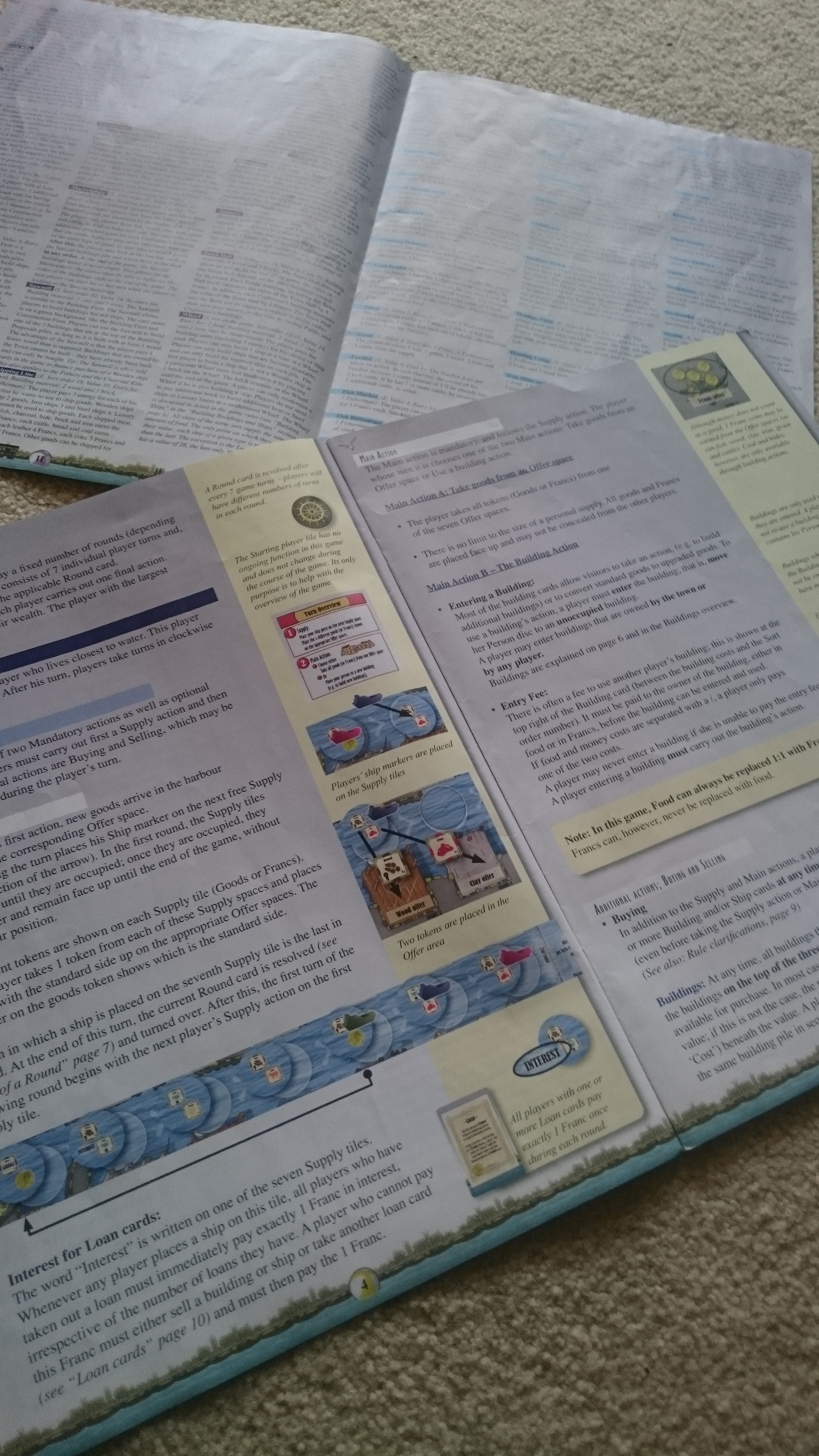
In general it’s a faithful but cheap and somewhat nasty port. The rulebook, for example, is dreadful. It has no easily-searchable index, bundles all three versions together in its explanations (confusing as fuck, yo), and is remarkably brief on the details. This is fine if you already know the rules, but not great if you’re trying to find the expanded rules which apply only to Cities and Knights, for example (it looks like there’s a dragon involved? Is that right?).

It does, however, come with some pretty great little game ‘scenarios’, which alter the gameplay to make certain strategies more viable or difficult, and reward you in different ways. There is also a whole gang of computer-generated characters to play against, including knights, mothers superior, craftsmen and nobles. They curse you in different ways when you screw them over by plonking a settlement in front of their longest road, and have a rotation of phrases during their turns. The game also makes a variety of noises to let you know when somethings happening (gained some sheep? Have a sheepy ‘baaa’ noise. Gained some wheat? Have the sound of… uh… some grains? Being scattered? Whatever, they tried.)

Very helpful, Lizzy
Very helpful, Lizzy

Of course the best thing about having a digital version of a board game is that play is much faster, meaning you can play several games in a day instead of doing your PhD research, which all of the misery farmers approve of. Although computers don’t make the same mistakes that humans do, you can definitely begin to identify winning strategies and refine them to work in different situations. ‘Desperate resource-grabbing Bob’ is long gone, having been replaced by ‘longest-road-builder of Catan’ Bob, ‘successful sheep-farmer’ Bob and ‘fuck you and your army I’ve got a monopoly on the supply of wheat so good luck building a city’ Bob. Lizzy better watch her back, harbourmaster Bob’s a-coming.

6D-33-282

Lizzy is tempted to counter that the game is actually a lot better as an app, after you’ve played it your first few times and have been gently welcomed into the gaming world. But that may be because there’s just too much opportunity to ruin each other’s game. If, for example, you’ve earned a reputation as someone who’s ruthless and always wins games, then nobody will ever trade with you. Ever. Even if you’re desperate. Even if they’re desperate. At least the AI on Lizzy’s phone won’t bully her quite that badly.

Hold onto the island! The gentle breeze is back!

Bob is very enthusiastic about Catan. It’s a bit like watching a grown adult who’s never eaten peanut butter before try it, go mad, and refuse to eat anything else for three weeks straight. Suddenly a whole new world has opened up to her, and she tries to tell all of her friends about it, but all of her friends already know about peanut butter. It’s actually quite surprising that she’s eaten five jars of it in a row and neither thrown up yet (metaphorically) nor gotten bored of it.

Soon she’ll realise that peanut butter involves far too much dice-rolling, luck and reliance on other players. Until then, we’ll have to cope with playing more Catan than is healthy. (Are you sure you wouldn’t like a nice game of Caylus? Bob?)

Even this bearded dragon has played the game too much

Briony has only played Catan several times, and unlike Bob has not gotten hooked. Any board game that has memes about sheep trading are way too cool for her, and she prefers to instead to engage with these types of games by turning up, ignoring the rules, being mysteriously silent and then thrashing anyone else without batting an eye. The good thing about this strategy is that you can get away with doing it once, and claiming that it happens as consecutive times. But, she supposes, at least Catan is a good way for normal people to be swayed to the way of the board game nerd.

Credit for the incredibly sunshiney photographs go to Dr Photographer-Friend. Credit for the photographs, that is, not for the sunshine. He hates the sunshine. And happiness.

Le Havre: Misery Shipping

Written by Briony, Bob and Lizzy.

Brutus scale: 4/10 slippery fish-gutting daggers in the back.

Pairs well with: Salty tears. Port.

1384

Le Havre is a game that has been languishing on Briony’s game shelf for far, far too long. It was bought more or less because it was made by Uwe Rosenburg, the same chap who made Agricola and Glass Road (you may know him from our other posts as the King of European gaming and farming misery). Le Havre, named after the French port city, demands that players generate and sell goods from the docks over a shipping line. Although similar to Agricola in many ways, for example in needing you to generate enough food per round, it also brings in other mechanics from trade-based board games. The trading and shipping of goods is extremely similar to Puerto Rico, whereas the buying of transportation for your goods is similar to Gluck Auf.

As it’s taken us so long to play this game, and as we haven’t found anyone else who has actually played it before, Briony, Pat and Pete (generic gaming buddies 1 and 2) have decided to dedicate an entire evening to the misery of learning complex rules for the selfless benefit of humanity. DSC_0092They strongly suspect some of the emotional traits of Agricola will have crossed over to this game, but are willing to lay down their lives, or at least good mood, to break some new ground and report back on their findings. Unfortunately, reading the entire rules has taken Pete so long that he’s had to tag out and get a beer while Pat takes over. Briony suggested simply watching a YouTube video on setup and gameplay, but they got less than three minutes in and the YouTubers’ immaculate setup and condescending encouragement to buy extra plastic trays and inserts in the name of personal organisation became too irritating to bear. Today’s misery team were going to have to do it the hard way.

3,000 pieces counts as simple, right?

Fortunately the set-up of the game is relatively simple, including the docks, resources, the town building firms, and the range of buildings on offer. Resources are generated by sailing through the port, meaning that there is a timing critical element to selecting and claiming resources you need. Your ship (the HMS Cardboard Puck) sails to the next available space which restocks the particular item you land on. You may then perform an action: this can be taking all of an available resource, using a building, or constructing a building. And so off we sail down the port, excitement in our hearts at beginning our new journey as a shipping company. (Note: If you really want to feel the joy first hand watch the opening 20 minutes of Muppet Treasure Island before beginning for full effect).

DSC_0091

Early game: the excitement is short-lived. What a surprise. As we generate resources by sailing through the port, it has quickly become apparent that there is not enough food in the early stages. At the end of most rounds there is a harvest, (Much confusion, are your ships farmers? Can you harvest the actual sea?) and then you must pay the amount of food on the round card to sustain your workers. This is only assumed, as there is no explanation as to where this food actually goes. We might just be throwing it in the sea as tribute to Poseidon, who knows. The first few rounds seem to mainly be about generating enough food to last you a few more rounds, so that later on you can invest in building or luxury resources that you may use to build or ship later. This is Briony’s method so far as she believes a massive stockpile of fish and cattle will be worth it later on, and may even look intimidating to the other players forcing them to make errors in awe. Pat and Pete have gone for the opposite: wildly claiming resources and constructing buildings straight off of the bat, cranking up their early game points and constructing some sort of giant building that incorporates all buildings. Who knows what goes on behind those closed doors.

Mid game: The demand for food is ramping up each round, making snack-generation a pressing concern almost constantly. Poseidon is a demanding deity indeed, and doesn’t seem to take the suggestion of going for a sneaky kebab very well. No sir, this man is hangry, and no grease-laden snack shall suffice. This leads to the diversification of strategies, which is a great part of this game, as there are many methods and possibilities to get the resources that you might need. The simplest is to just take them from the offers at the docks, and the more complex using of specialist buildings that allow conversion, purchase, or generation of resources.

As the game is progressing each of us has constructed a wide range of buildings (primarily for victory points as we had little idea about which would be the most beneficial) so almost by accident we opened up a bounty of opportunities for ourselves. Pat has set his heart on buying a fleet of wooden ships more or less because they were there and they were new and pretty. Briony has generated enough meat to last a lifetime and has now begun investing in any buildings she can get her hands on. Literally.

Who wouldn't want a clay mound?
Who wouldn’t want a clay mound?
Expressing sad fisherman feelings.

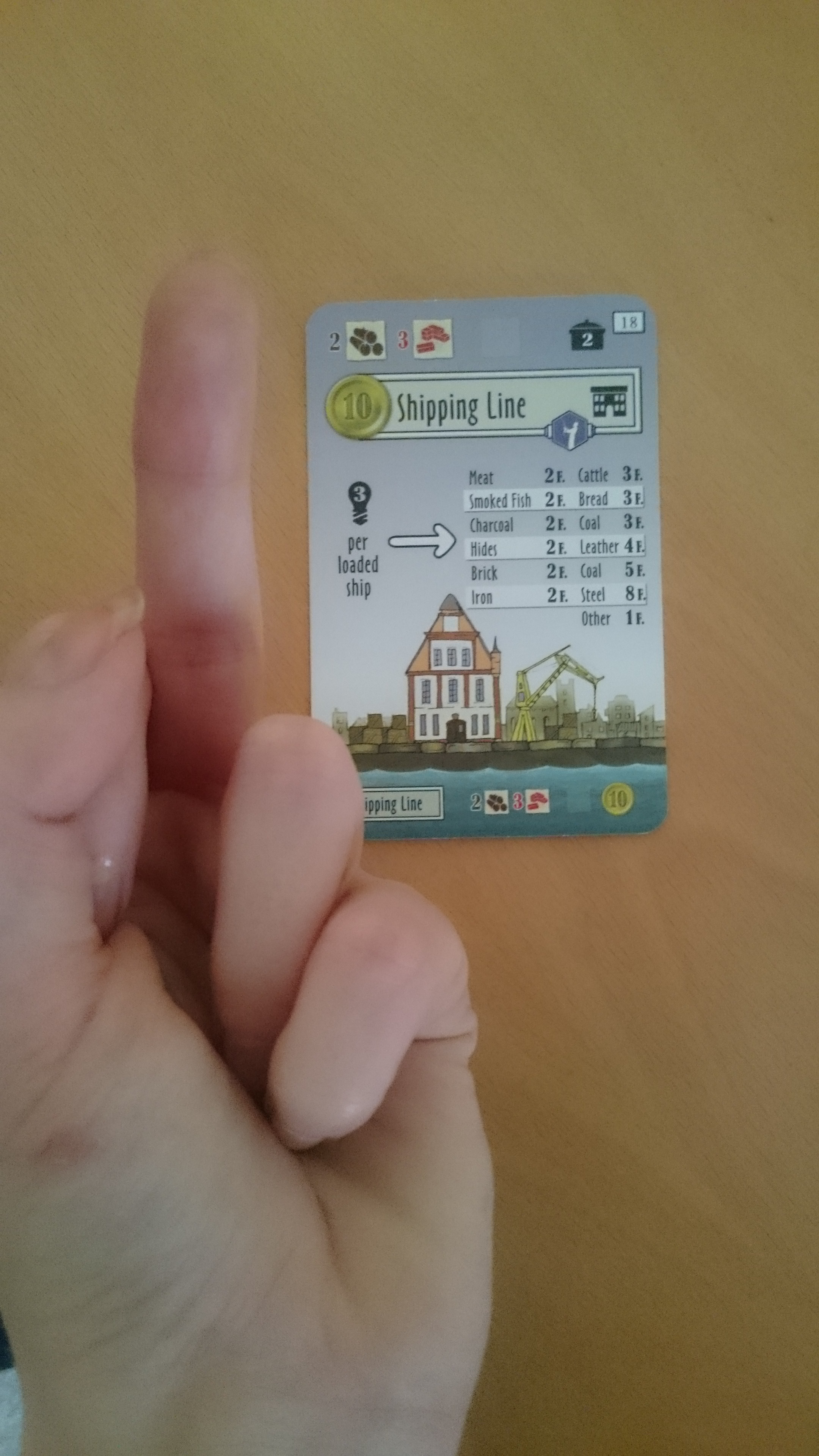
Late game: Shit is going down. Prices, food costs, victory points, everything is now higher than Snoop Dogg at an alpine resort party. Pat and Pete’s wooden armadas provide a set amount of food per round, meaning that they need fewer resources. Briony’s sprawling industrial metropolis continues to grow, which serves to both help generate victory points and convert basic resources into luxury ones. As a result she’s now the first to use the shipping line to sell these goods and make a ton of cash. Unfortunately she spent an awful lot of planning and effort into collecting coal, a resource which was listed on the card as being worth 5 francs, when in fact it turns out there is a printing error. It turns out coal is listed twice, once at 3 francs, and second at 5 francs, which should actually list coke (converted coal) as 5 francs. Briony is a very sad, sooty fisherman. ‘Have mercy, great Poseidon!’ is what should have been called, but by this stage it was more like ‘fuck you, Poseidon. I don’t need to prove shit to you. Get off my back already.’

Endgame: A noticeable effect of constructing literally all of the building cards available is that the port is now brimming with massive piles of resources, including money. Pete has opted to claim huge stockpiles of free wood (feel free to insert* all generic ‘got wood’ jokes here) and clay and is rapidly transforming them into brick to ship, and selling wood in the joinery building. Both are racking him in some big hits of money. Unfortunately there is only one building card that can be used to ship goods (‘the shipping line’), so this is easily the most contended-for card throughout the latter stages of the game. Pat is muscling in on it, and has been shipping cow and coke (that classic combination). As the number of rounds left is ticking down we’re all beginning to hawk everything we can in order to scrape in as many victory points as possible.

If you’ve played Agricola before, you’ll now that scoring can potentially be the most depressing part of the ordeal, with dizzying heights of 11 or 12 winning the game. Now, take that and throw it out of the window. Le Havre has been designed to work in the exact opposite way, with all players scoring well over 100 points. This is probably because resources can be sold for money, as well as receiving money for shipping goods, and counting the cost of your buildings contributing to your final score. Make it rain. Briony has wiped the floor with the others with a closing, and first time playing, score of 271. Fuck you, Poseidon.

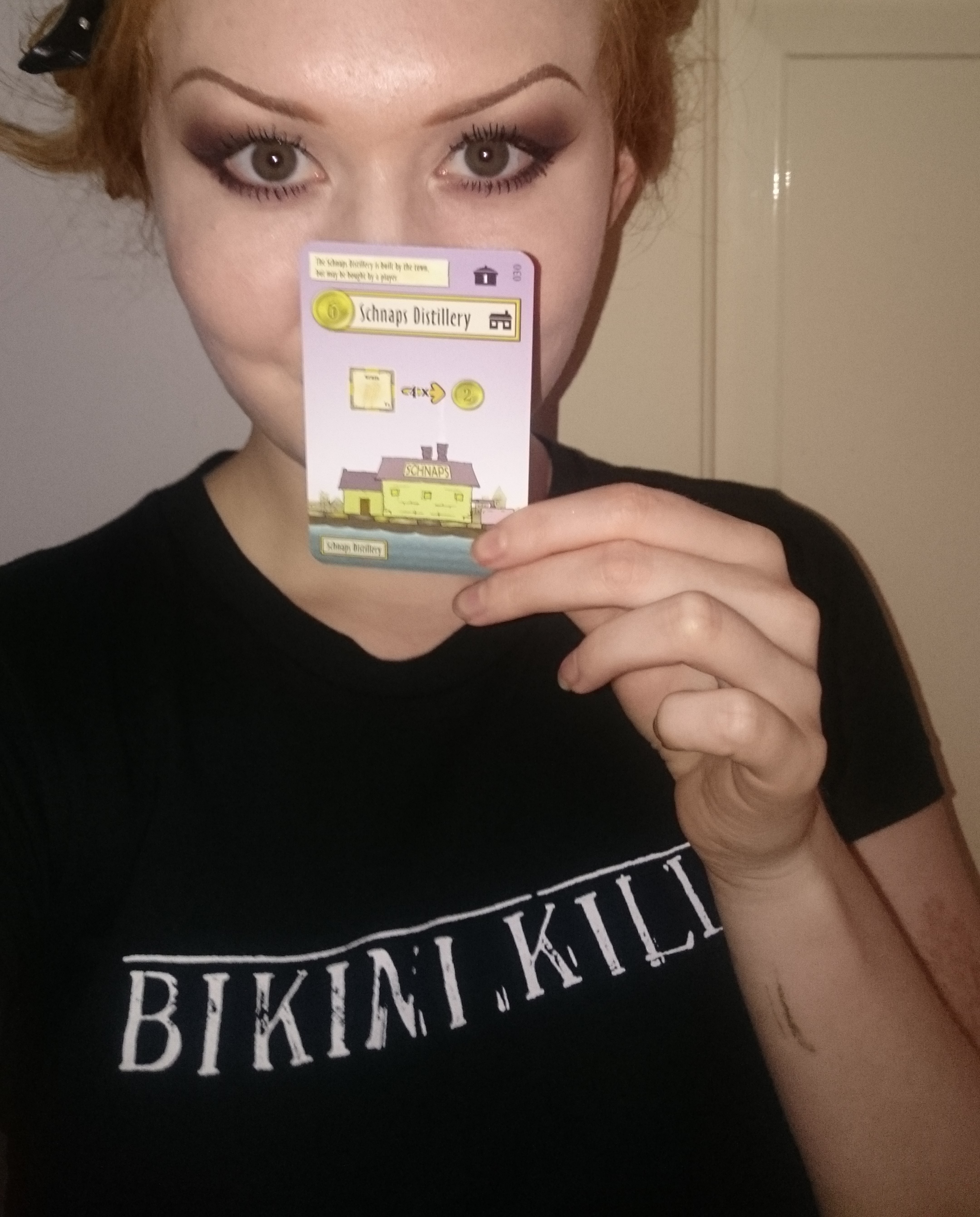
The 'Shnaps Distillery' is a card that Briony fully endorses.
The ‘Shnaps Distillery’ is a card that Briony fully endorses.

In conclusion, our brave reporter and Uwe Rosenberg connoisseur Briony enjoyed this game far more than Agricola for a number of reasons. Firstly, it demonstrates that designers listen to their target audience and feedback, as Uwe has addressed the issue of misery-scoring apparent in Agricola. Despite this, scoring in Le Havre is a little extreme, as it patronisingly cheers you on like an overly-competitive mum at a school football match. ‘LOOK HOW GOOD YOU ARE AT FISHING. GO YOU. SHIP THAT FISH. WOO!’ But you know, that’s okay. It feels quite supportive. Secondly, there is a really wide variety of strategies available that allow you to be very flexible. This consequently means it’s a lot harder to drastically fuck up your turn by miscalculating or not paying enough attention, because chances are there is another free card or action that could have roughly the same benefits. Thirdly, the designs and iconography of the cards, resources and board are really well thought out and themed. And finally, the game is very well balanced and offers more mechanisms, such as selling resources, converting resources to money, and breeding cattle or grain that aren’t available in similar shipping games like Puerto Rico. Definitely check this game out, but be prepared for some intense rule reading and playing a couples of rounds to get the feel of it before diving in to the full version (a shortened one is available too). Or just have a better set of friends who have already played the game before.

DSC_0089

*Feel free to insert all generic ‘insertion’ jokes here.

Top image courtesy of Z-Man Games 

Steam Park: Robots Just Wanna Have Fun

By Bob, Briony, and Lizzy. Go team!

Brutus Rating: 2 or 3 grubby knives in the back, depending on the number of players.
Pairs well with: Oil, petrol

6D-31- 360

Steampark is a beautifully steampunky game in which you can build your own little rollercoaster theme park with such mechanic-altering extras as casinos, tents and toilets. If there’s one thing Briony has learned from years of Rollercoaster Tycoon, it’s that you should never ever think “that’s enough toilets now”!

06_steam-toilet
Though in this game you can actually only build one toilet. What would your robot guests do with more toilets, anyhow?

Yet another Essen find; this one is light, frenetic, and sometimes blackly humorous, bordering on the dystopian. Bob obviously had to buy it as it was the gothest game at the convention.*

Team Awesome Blog came together with our generic white male friend (this one we call ‘Andy’ for short) for a game together as we wrote this review. For the sake of maintaining a strong sense of ethics in board-games journalism we should disclose that we forgot to invite Dr Photographer to play on this occasion and all of the photos are reconstructions.

As the many, many pieces of game are unpacked Briony looks more than a little apprehensive. 6D-31- 344She is, after all, the team’s dice-hater and the handfuls of dice coming out of the box do nothing to alleviate her fears. Contrary to popular belief, it’s entirely possible to develop post-traumatic stress disorder from playing Risk, Warhammer and Blood Bowl too many times. Dice! So many dice!

Plethora of dice aside, there are some friggin’ awesomely-designed rollercoasters and tents and such, easily making up for it. It’s a very enticing game.

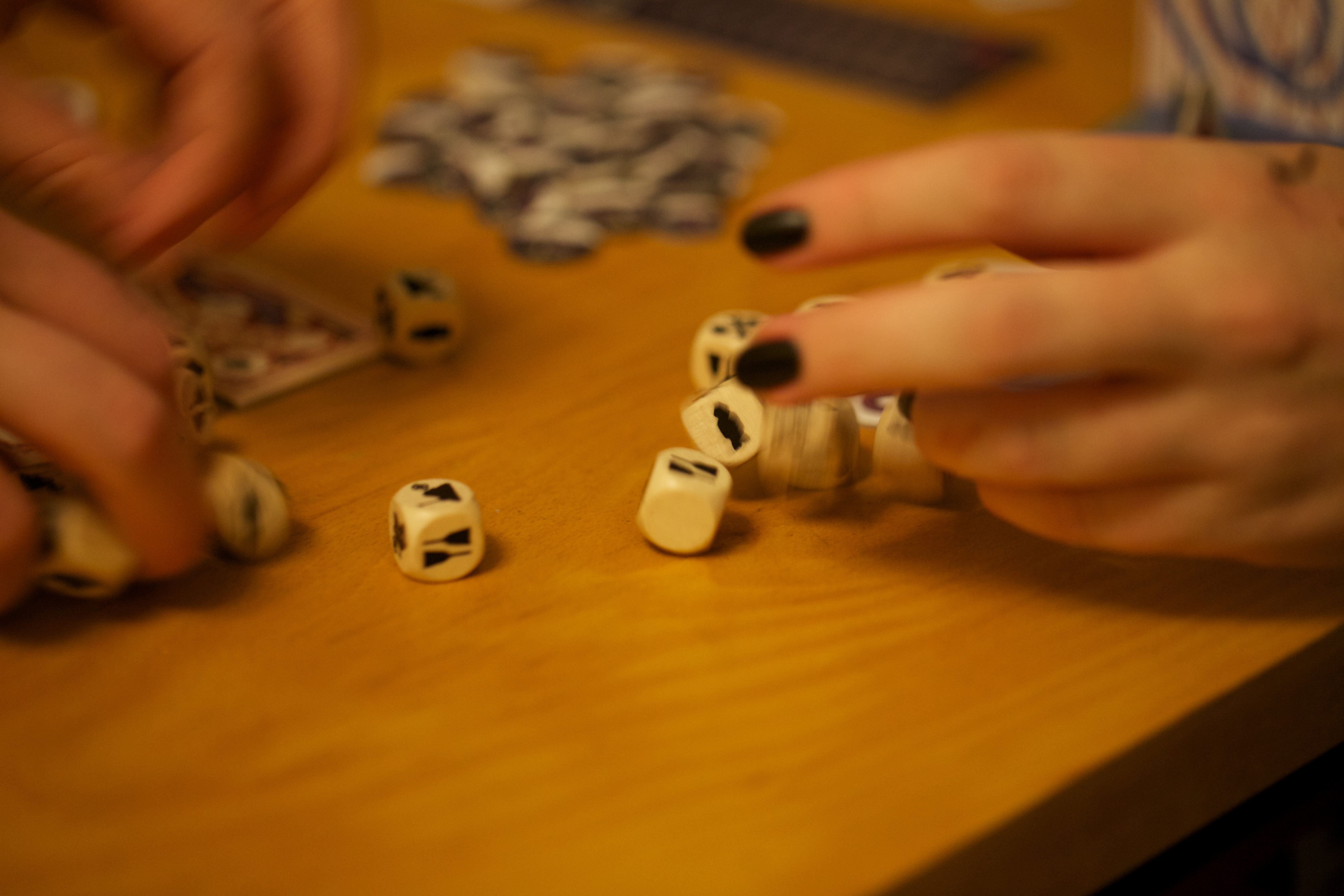
Right, we should cover the rules. Each player is allocated a plot of land in the form of a grid of squares on a small board, on which they can construct their steampark. Rollercoasters, or any other buildings, cannot be built within one square of anything else, making board-space efficiency a good part of the game. Each player also receives a buttload of dice (that is now the official measurement of ‘too many’ dice. It’s approximately 6). Instead of numbers the dice have a different symbol on each face which corresponds to an action you can take during your turn.

6D-31- 353There are 4 pucks in the middle of the table which only become available once a player has finished rolling their dice, and which determine turn order. The sooner you finish rolling your dice, the better puck you pick. This phase is particularly stressful as all players roll at the same time, and can re-roll the dice as many times as they like in order to get what actions they need, until there’s only one player left to roll.

Seems nice, right? Light-hearted fun? Forgiving of bad rolls? No. Instead, it becomes a stressful dice race!

Suuure, Briony says. She could get the perfect set of dice she desires with enough time, but Bob 6D-31- 319has already finished rolling and can now grab the first player puck! Panic for everyone! This gives her park-building benefits, while getting the last puck actively punches you in the guts by filling your park with ‘dirt’. Ultimately the dice-rolling stage is more like the ‘throw your dice around the room, swearing violently, resenting anyone who looks remotely calm or close to finishing, madly panicking to find said dice, praising the ones who rolled correctly, and hoping that everyone else is having as much bad luck as you’ stage. Andy’s method has been to roll a perfect selection of dice and then knock half of them off of the table. We’re going to rename it ‘The Panic Stage’.

In addition you must place your rolled dice onto a flat cardboard mechanical piggybank otherwise they don’t count. Because that’s what all the other board-games are missing…

6D-31- 356
Wind-up piggybank dice mats. Officially the future of board gaming.

We’ve given this game an ambiguous Brutus rating because of the way that taking a puck can royally screw your competitors. In a larger game this won’t make too much difference: if one extra person finishes ahead of you then you’ll maybe have just a small amount more dirt in your park. If it’s a two-player game then the difference is much greater, lending a distinctly more cut-throat flavour to the game.

6D-31- 347Back to our team play-through. ‘The Panic Stage’ is over. Looking around the table we each have 6 dice which represent the actions we would like to take for that turn (or to the nearest approximation of that). Now each player can do stuff and things according to this, beginning with whoever has most effectively managed the Panic Stage to get the first-player puck. Unfortunately, Bob doesn’t actually know what to do with this mighty privilege, and a chorus of sighs ensues. Briony got the last place puck as she was writing (taking one for the Misery team), and as such this is all of the suck. To better deal with her frustration she decides to build a super-awesome octopus-coaster. It’s holding tiny teacups with its tentacles. Adorables.

In the interests of staying calm, let’s move onto some of the scoring components of the game. Lovely, rational scoring. Or not. Victory in this game is determined by cash moneys (what is the point in running a steampunk theme park if not the money?), which is made by having little robot meeples ride your theme park rides, forever.

6D-31- 318
Don’t worry about them, they don’t get bored or run out of money or anything, they’re robots.

You also have two cards that have a bonus feature for scoring, for example ‘For every purple rollercoaster you own, take 5 more money at the end of a round’. These are essentially your 6D-31- 347victory cards. Playing a victory card is one of the options given by the dice. The dice decide all, and it is supremely irritating when you’ve especially built a purple octocoaster to please your victory cards, then forgotten to make sure that at least one of your dice allows you to play a victory card. Once every player has finished the round ends and you collect your park revenue, which is the sum of all of the things you have built plus any bonuses from cards. And then there’s dirt. Dirt is bad (but calling other players ‘dirty’ is fun). Dirt is made by the meeples riding your rides, by building rides, by being too far back in the turn order, by making the eighth ‘Tim Burton’s theme park’ joke of the evening, etc. Dirt seems to build up more rapidly than you can clear it away by rolling the appropriate dice, and punishes you at the end of the game by taking away your revenue. Dirt is bad.

6D-31- 333There is another slight hitch in our fantastic upcoming parks. You know when you’ve built your first attraction in Rollercoaster Tycoon and it’s utterly underwhelming? Think, Ferris Wheel. This is the current state of your mechanical park. In order to get a really awesome park you need to invest both into getting more people to ride the rides, and in park maintenance. To get more people (or, in this case, fun-consuming robots) you should roll the ‘get visitor’ action with the dice, and then selecting randomly from coloured robots in a bag. Only robots of the same colour can ride on a correspondingly coloured ride so there is some mileage in a strategy that has attractions of many colours. There’s some chance involved with this but being persistent pays off.

How many rounds does a game of Steampark have you ask? 6? Does it ever really end? Those robots are going to be riding and having fun forever while you age and eventually die. But for us mere fun-lacking mortals we only get 6 rounds to make our parks the best.

And here’s the happy ending to our playthrough:  Briony stopped writing and turned her game 6D-31- 324around, winning the first player puck for most of the game. This is a viable strategy because you can almost always find a use for all of the dice mechanisms, even if they’re not ideal. Andy slowly but surely generated little more than a pile of dirt, and is probably still sat there quietly contemplating his little mound. Bob and Lizzy were solid throughout, but victory was ultimately Briony’s. The real winner, as ever, was board games.

In summary this game has some great design aspects and some cool mechanisms. To be honest there are slightly more mechanisms than necessary, but that doesn’t draw away from your goals. It’s simple to learn and has a relatively short play time with a distinct lack of hatred for your fellow players. I recommend trying it, and at the very least you should find someone who owns it and stare at the pretty little components in awe.

Why is there a one-robot Tunnel of Love? Why indeed.

*In fact Chris (friendly robot boyfriend) very nearly simultaneously bought it for Bob as it was the gothest game at the convention. Being deeply predictable sometimes has its dangers.

Photos credit to Dr Photographer
The toilet art is directly from the Horrible Games website

Agricola: The Original Misery Farm

By Briony

Dicks in ears rating: 3/10
Pairs well with: An English cider

I play board games pretty frequently, but I’ve so far managed to avoid Agricola. I haven’t actively avoided it, but at the same time I haven’t actively sought it out either as I’ve heard some pretty polarised reviews. If there’s one thing I know, it’s that board gamers have strong opinions. For those of you who don’t know, Agricola is a worker placement board game. 6D-31- 172The description on boardgamegeek states ‘you’re a farmer in a wooden shack with your spouse and little else. On a turn, you get to take only two actions, one for you and one for the spouse, from all the possibilities you’ll find on a farm: collecting clay, wood, or stone; building fences; and so on.’

So tonight is the night, and I have my first beer. This post will be a running commentary of my thoughts, feelings and reflections whilst playing it for the first time. Side note – don’t read this if you’re interested in an actual synopsis of the rules of the game.

6D-31- 171
Bob: Unsure
  • Setting the things up. As usual this involved making pretty piles of meeples that will almost immediately be destroyed. The game has 6 stages, with a harvest at the end of each.
  • Stage 1 – There are an awful lot of pieces, and 6D-31- 183unfortunately they all seem to be pretty important to any overall strategy. Beginning with a set amount of jobs was a good way to ease into the mechanics, in much the same way as Caylus. I got the immediate suspicion that being relaxed into the game would screw you over simply for feeling relaxed at some point, especially as one new job is added per round.
  • As I’m playing with three people who are all veterans, I’ve decided it’s a good idea to get a gauge on their individual strategies. So far Pat’s is mainly starving his family. Pete’s is actively farming his family instead of animals, with an initial single vegetable from his one field. Simon’s was to build one giant pasture and then knock over his entire board by accident.6D-31- 187
  • The first harvest has come! When these occur you need to have two food for every one member of your family (starting with two) or risk a lot of minus points. In addition, some other fiddly stuff happens with resources that I won’t go into. Fortunately, my family survived thanks to some measly and hastily ploughed corn. I immediately invested in some more fields for grain, and some clay for a badass oven that converted 1 grain to 5 food. Pat’s family is still starving. Pete is building more houses, which might end up being a sky-rise complex at the rate he’s enhancing them. Simon is farming sheep.

    6D-31- 193
    Setting things on fire.
  • Stage 2 – I’d so far avoided the many cards I was given. Probably not wise. They required too much reading at the beginning to bother with until I needed them. I took a chance and played one that seemed the most beneficial, seen as everyone seemed to be stocking up on wood, because it gave me the ability to build fences without any wood. I put a little sheep in there, he looks pretty happy.
  •  I got another sheep. It’s been a good day. Added bonus of extra sheep next harvest, and I’ve got a lot of food for the family. Now to expand some pastures and get in on some other livestock. I’m aware hard times are coming that I’m probably not equipped to deal with, having never played the game before, but so far it’s pleasant and I remain optimistic. I’m wondering whether I should have used my cards more in conjunction with the game, I’ve
    resolved to play another next round.
  • The harvest has come again. Panicked conversations occur:
    ‘Right. Fuck. I’d forgotten I didn’t have any food. Can my family eat wood?’

    What did you just say to me you little bitch?
    What did you just say to me you little bitch?

    ‘It’s ok we can eat the house cow. Kids, go kill the house cow.’

  • ‘I could get some food… but I could also get some fences.’
    ‘But you don’t have any food…’
    ‘Yeah you’re right, fences it is.’
  •  Stage 3 – My sheep are at capacity, so it’s time to build a pasture for wild boar (since I just played an occupation card of ‘Boar master: master of boars’. This is my own made up title, I preferred it to the original). Expanding more occurred to me earlier in the game, but being in the situation where I knew absolutely nothing, wasn’t able to form a sensible strategy using previous knowledge, or know whether doing a little bit of each strategy would work. So I decided to be slow and sensible, and simply do one thing at a time to a decent level while selecting only a handful of things to develop. Consequently my family are still basically living in a swamp with a couple of stones thrown in. But hey, now I have a lot of pasture and grain.
  • Harvest. For fuck’s sake, I have too many sheep and not enough everything else. The free pen is too small for any more sheep, even with a barn, so I have acquired a house sheep. I’m fairly certain it’s going to smell. Luckily I’m pretty comfortable with having to plan out actions in advance even if I now have a sheep all up in my shit. I’m not losing faith though; planning for misery in advance is something board games teach well, Caylus, Puerto Rico and Year of the Dragon are three of my favourite merciless epics. The other players are continuing to reap misery.
  • Stage 4 – We’re all now doing something which we’ve convinced ourselves is a strategy. It’s mainly poor decisions, hope and miscalculations. But nonetheless we’re going strong. Pete and I have more pastures, Simon has more livestock. Pat has realised he doesn’t have any food again, so the remaining sheep will have to be sacrificed.
  • Harvest. I say harvest in the loosest sense of the word: in the sense where actively burning your livestock in a resource pile constitutes a meagre amount of food and there is no joy for your family. Fortunately my oven and grain strategy is working excellently for food. My family is living off of bread, and bread alone. It’s a shame about the whole collecting victory points thing. I’ve decided to go for that next stage.

    6D-31- 191
    Yeah, that sounds about right.
  • Stage 5 – Victory points are hard. The effect of having few points for what seems like an awful lot of effort you’re investing in your farm is disconcerting. I can’t help but feel it was designed to do exactly that. Not only are we now silently adding up our current points in preparation for the final stage, we’re also cursing at our inanimate objects because we ourselves didn’t have the foresight to improve them. Pat has now gone heavily into farming, mainly as a result of being annoyed at the everything in his empty farm. Pete remains the group troll, taking all the resources we want but having no livestock to invest in. Simon has merged all of the livestock into one giant dystopian pen (an ability granted by one of his cards), in which the animals have developed some sort of rudimentary government.
  • Stage 6 – Honestly stage 6 is letting me down. With only one round to scrape together as many points as possible, my fellow players have neglected to tell me vital scoring rules that are definitely going to fuck me over at the end. I really wish someone had told me I’d get minus points if I didn’t have any of one resource type. I have neglected farming vegetables the whole time, because I had shit tonnes of grain. I also wish I’d known that space efficiency on your board/farm doesn’t get you anywhere, unlike in other worker placement games such as Puerto Rico or Terra Mystica. I’d intentionally used the least amount of board for the things I was doing – but it turns out leaving blank squares will give me minus points.
  • End of the game – Obviously as my first run through I hadn’t been able to win as most of my time was spent trying to get to grip with the rules and to understand the game a little better. Being able to plan your next moves ahead with the ability to adapt to other players ruining your strategy is a great skill to have, and certainly probably stopped my family from dying.

    Briony: The hair of defeat.
    Briony: The hair of defeat.

I actually quite enjoy the task of resource collecting to be able to play cards or perform tasks in games, and I think Agricola did that very well. The jobs built up well throughout, and the resources restocking supported that. I really like the very simple mechanic of having two livestock in one pasture, and them reproducing as part of the harvest. Not only is it interesting to factor in to any strategies, it makes you feel like your farm is actually functioning. You’re being the farmer, channelling that farmer knowledge, successfully doing agriculture (or not, as we’ve proved). I feel like the point scoring is pretty harsh, especially with negative scoring. I also felt a bit stranded as there was no real way to do damage limitation. The resolution to that is simply to play the game better next time. I felt that having a pen with a barn and fences and 8 wild boar deserved more than 4 points, especially in comparison to earning 2 points for the house you begin the game with.

“The only time I enjoyed this game we were playing it wrong. This is misery farming.” – Pat, 2014.

One thing I wasn’t totally convinced about was the effectiveness of the cards. Sure, it’s handy to be able to play something good you’ve got and tailor your strategy to maybe a few key abilities. However, I think it may have been better to have a mechanic to pick up a card at random, and to only introduce them at certain stages of the game. In fact much like the purple ‘victory’ cards in the last age of 7 Wonders. (Of course that can backfire horribly, forcing players into strategies completely at odds with their original aims a la Twilight Imperium -Bob)

Overall I enjoyed the game, and I’m convinced that a second round playing will seal that opinion. Having my friends in just as much misery and sticky predicaments as myself was perversely amusing, and the game definitely didn’t allow one or two players to be riding free of worry. You’re all in this farming malarkey together.

Briony: Wah.
Briony: Agriculture expert.