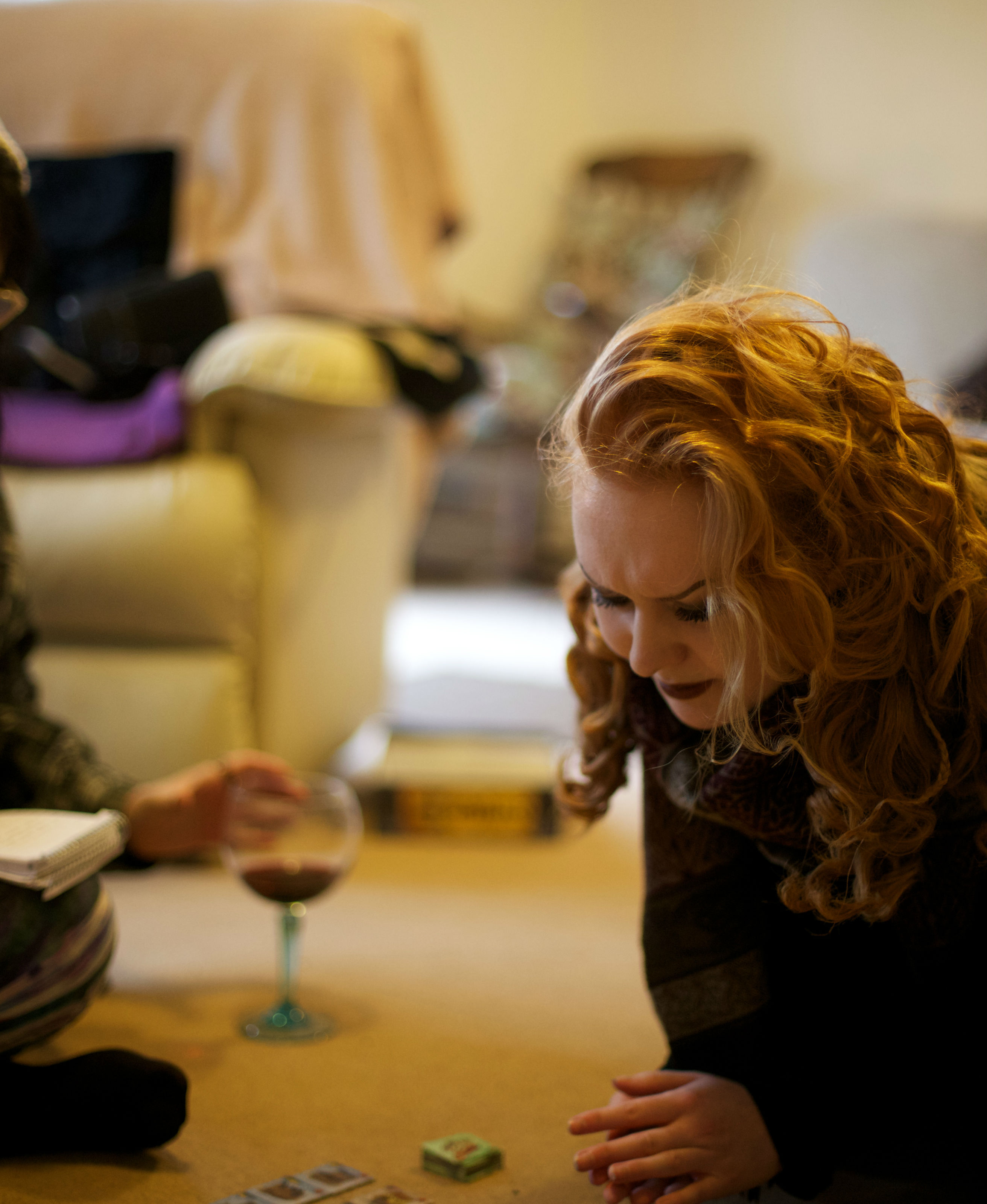
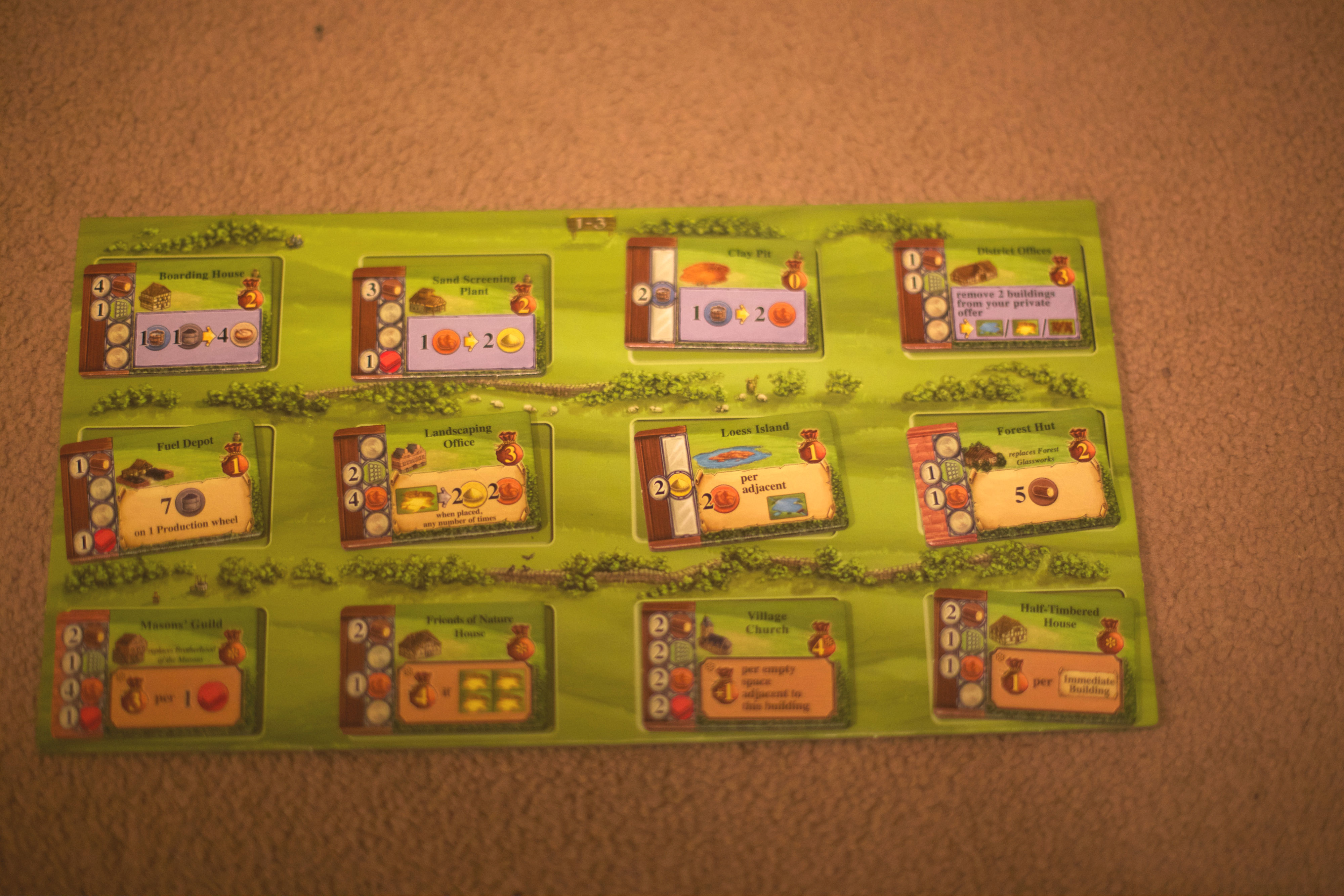
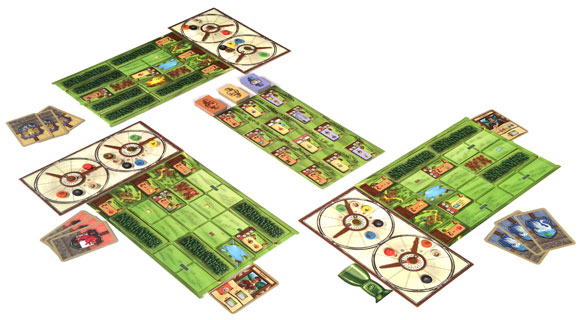
Eldritch Horror: Misery, Doom, Tentacles. A normal Friday night in.

Brutus rating: 1/10 knives in the back
Pairs well with: some very strong whisky. Strong enough to forget the horrors you’ve seen.

6D-34-144

The Misery Farm’s friendly photographer-friend enjoys only three things: board games, cameras and suffering. This makes him a good misery photographer but a bad person. It has also adapted him to suit a game called Arkham Horror: a board game that brings nothing but relentless suffering. If you’ve not played it, then rest assured that it’s just hours and hours of trudging around dreary old Arkham before being eaten by a void-born tentacle-god.

When Eldritch Horror came out, Dr Photographer sold it to us as “It’s Arkham Horror, but fun.” Does being fun take the fun out of it? … No, it turns out!

Lizzy's tentacle.
Lizzy’s tentacle.

It’s big and it’s long and it’s tentacley. The board is a great chunky world map which you traverse, and there are lots and lots of extra cards and tokens and doodads which make setting it up annoying but playing it extremely satisfying. Like many ‘big’ games turns take a while and are divided into phases. They are, roughly, Doing Stuff, Stuff Getting Done To You, and Bad Stuff Happens (or ‘action’, ‘encounter’, and ‘mythos’ if you’re being fancy and accurate). The aim of the game is to solve mysteries and stop the hell-spawned Old Ones from rising up and devouring the universe. You will sometimes often fail at this.

10397047_10152420766204337_8447561979145296536_oEldritch is one of those games that gives you some excellent characters to work with if you want to get into the spirit of things with a little bit of the ol’ roleplaying. This makes it an immediate favourite for Lizzy already, and the rest of the team are just relieved that it’s a co-op and they can take a break from having to beat the crap out of her in case she gets ahead. Everyone each gets their own character (until they die, go insane, or the game ends) and a good group of friends will heavily encourage acting, an elaborately developed personality and a funny voice for the duration. The characters each have special abilities of some kind, their own set of stats and their own backstory.

6D-34-118

Of course, the game also doesn’t shy away from other classic Lovecraftian themes such as racial stereotyping. There’s an Asian lady who’s… really good at martial arts? Ok. And the Nigerian’s backstory is about wise village elders and spirits? Yup. Let’s just… yeah. And let’s not put on voices for those characters k? K.

And then there’s our own personal favourite: Silas Marsh. One for the ladies. His thing is that he’s better on sea-tiles. What’s his intricate and carefully woven backstory? He… quite likes the sea.

What?

Yep, that’s it. He just really likes the sea, you guys. He comes from a small seaport town, you won’t have heard of it. It’s in New England somewhere.

"I'm basically just producing slashfic now." -Dr Photographer
“I’m basically just producing slashfic now.” -Dr Photographer

Good.

So as mentioned above, Eldritch Horror is a co-op game, hence the small “knives-in-the-back” rating. It still gets one knife however, in case someone gets a death pact and has to kill one of their friends.

darkpact
You see this face? This is the face of ‘I just found out what a Dark Pact does.’

… Pardon?

Horrors?!
Horrors?!

Yup! That brings us right round to the main theme of the review, the game, and indeed life itself: never-ending horror. As with most good co-ops, at the end of every turn someone needs to trigger what’s known as Bad Stuff Happens (‘mythos phase’). For Eldritch Horror this means turning over a card and letting all hell break loose. Not got enough monsters on the board? Have some more. Not got enough terrifying gates to otherworldly and evil dimensions, floating around? Have some of those, too. Not feeling like there’s enough DOOM floating around? Better advance the DOOM track! Frankly if you’re not feeling overwhelmed and panicky once you’ve resolved all the conditions of the mythos card then you’re playing it wrong.

Big bag o'monsters
Big bag o’monsters

If the DOOM track reaches zero, or you’ve got too many inter-dimensional gates spitting monsters all over the board, or maybe just if great Cthulhu’s great alarm clock was set a little early, then congratulations, the Old Ones have woken up. When that happens you are more or less fucked, unless you can pull out some really fantastic dice rolls and co-operation. So yeah, pretty much fucked. Enjoy being devoured.

But of course, there are several other ways that things can go wrong for a plucky gang of adventurers during the ‘encounter’ phase. There’s that aforementioned “death pact” and other terrifying conditions (you don’t need all of your limbs for adventuring, right?) and there are monsters – those tend to want to attack you if you get too close. Sometimes you’re just on a lovely, optimistic quest for a ‘clue’ and instead you wind up beaten and imprisoned. There are really excellent cards that describe what happens in each situation and which skill-checks you need to pass, and you’ll always find yourself shouting at your character as you read it out.

When the horror gets too much, sometimes you have to turn into a starfish.

You see a terrifying crypt… good, that’s ok so far… you head towards it to explore… NO I FUCKING DON’T WHY WOULD I DO THAT… and suddenly an arm grabs you… OF COURSE IT BLOODY DOES I’M IN A SHITTING CRYPT WHAT DID I EXPECT? …Make a strength check to escape…  OKAY COME ON ARMS OF STEEL… SON OF A BISCUIT HOW DID THAT FAIL?? …if you fail you get dragged underground where shoggoths pull off your arm and beat you with it.

Strength check you say?

The game has an exciting balance of making you firefight all of the things going wrong and actually trying to scrabble your way towards victory. You may want to hoover up all of the lovely clue-juice, for example, depending on the current victory goal that you need to achieve, but you also don’t want to leave open five portals which more terrifying goat-spawn can clop through at any point.

One thing that seemed a little less balanced is the discrepancies between different numbers of players. We left Bob unsupervised once or twice and she had a few solo runs of the game, which she tells us was possibly a little too easy. Obviously we can only explain this by the game being easier with only one player, and nothing at all to do with Briony, Lizzy and the Camera-Man holding her back the rest of the time. It’s also absolutely impossible that she was playing it wrong. She’s a known rules junkie, our Bob, who never takes the ‘eh, that’s probably right?’ approach to little things like numbers of dice or how DOOM tracks work.
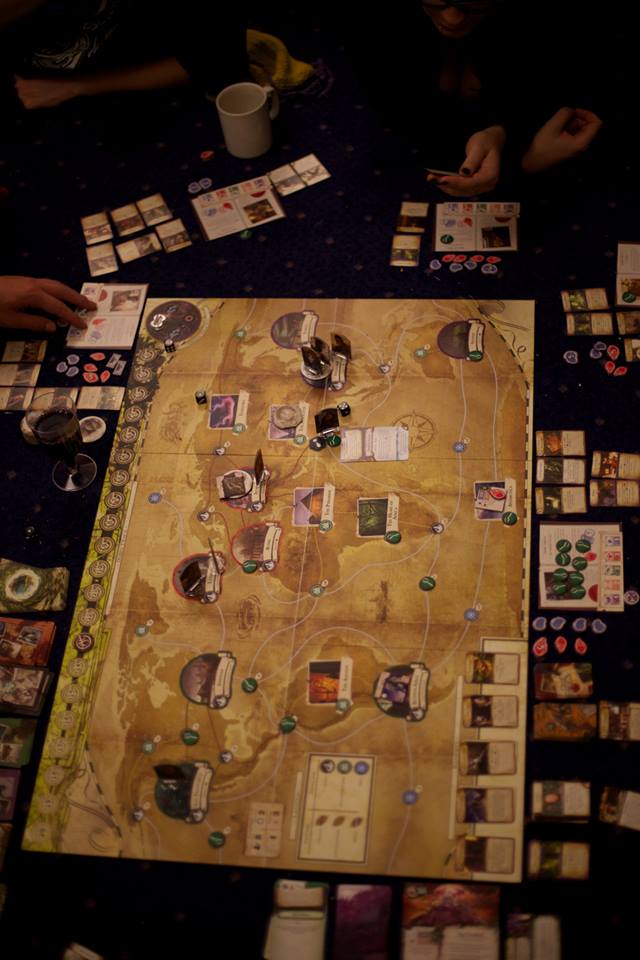
Big board o' horrors
Big board o’ horrors

We also didn’t have too much of the “one person controls all” problem that seems pervasive through a lot of co-op board games, but that might just be the particular team of plucky adventurers / arseholes that we are.

“Get the clue, we need it for the next victory condition!”
“… Hmm but I really want to explore Tunguska.”
“But the victory condition?”
“TUNGUSKA!”

6D-34-135

It’s also got great replayability as you can choose from a variety of world-eating monsters to struggle vainly against, and which affect the gameplay quite strongly. If you fancy your misery Shub-Niggurath-flavoured, for example, you’re going to be spending a lot of time losing your sanity to suicidal cultists. If it’s Yig, you’re going to be poisoned by snakes at least twenty times. If you’re in a Cthulhu mood then I’m afraid you’re going to be spending some time in the sea. There are goat-spawn too, and hellhounds.

The expansion adds to this with a host of new monsters, crippling ailments, and a frozen wasteland. Hurray!

To enjoy Eldritch Horror, you do have to enjoy a bit of misery for your adventures. Luckily, this is right up the street of a group of board game reviewers who’ve called themselves ‘The Misery Farm’. We’d certainly recommend it to people who only hate themselves a little. Most of you, probably.

He really likes the sea.

The real winner is Cthulhu. May the dark lord’s tentacles ever be long and terrifying.


Photos credited to Dr Photographer

The big bag o’ monsters was made during a game by the mighty-impressive Emma Field at JustAddCrochet, who is also featured in a photo as a starfish.

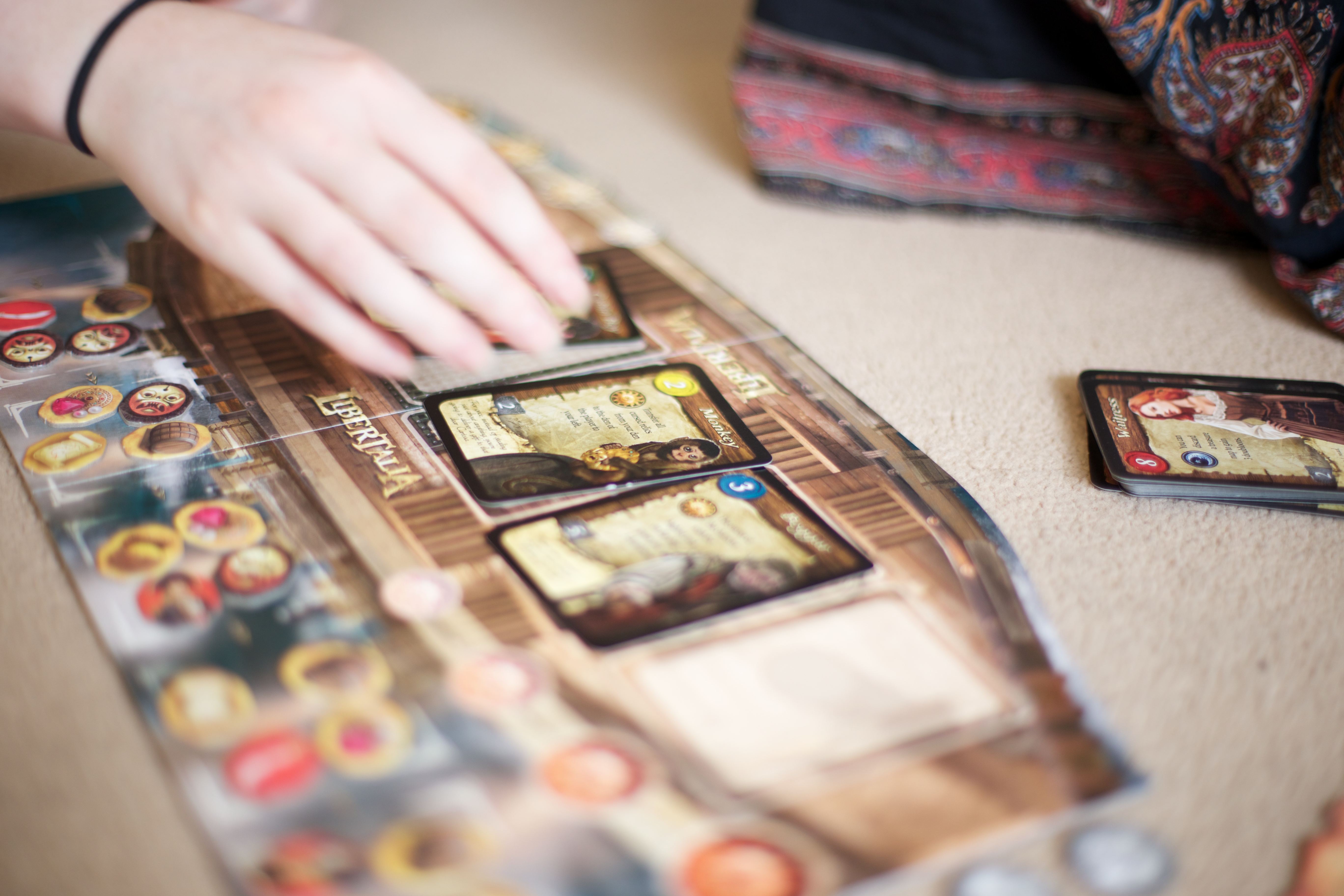
Libertalia: How to Pirate 101

Written by Briony, Bob, Lizzy.

Brutus Scale: 6/10
Pairs well with: white rum, dark rum, spiced rum. All of the rum!

This week, the team have decided to try their hand at pirating with Libertalia. More like Libert-arrr!-lia, am I right? No.

Spot the theme.
Spot the theme.

If there’s one thing the team have learned from the game, it’s that not one of them makes a good, or indeed effective, pirate. No sir. They did all the right things: dressed in pirate clothing gradually throughout the evening, drank for hours before attempting to win some loot, didn’t listen to the reading of the rules like any true badass pirate would, and yet the cards still did not fall in their favour.

Probably because they were continuously playing the wrong cards.

Is it a board because its a ship, or is it ship because its a board?

This has been the overriding theme of the game: you will never, ever play a decent card, but everyone around you will. And consistently at that. A majority of the game will be spent playing a card from a hand of 9 against your opponent’s selection much in the top trumps style of ‘highest card picks loot first’. The board has seven sections (representing days of the week), all of which feature a randomly drawn selection of loot.* Loot may include expensive shit like jewels and other shiny things classic pirates like, bad shit like curses, and the ability to murder another player’s card modelled on a particularly shiny scimitar. The player who placed the highest-rated card will pick whichever loot they find most appealing, and the rest will resolve in rank order. Whoever is left at the bottom rungs of the rank will find themselves lumbered with curses (worth negative points) or something else undesirable. Think, the captain’s old socks.

Furthermore, each player will have the same hand of cards as you, which brings out some great ‘will they/won’t they’ scenarios when considering who will play which card, and when. It also makes the fact that everyone always seems to have better cards than you somewhat baffling.

If pirates played cards this is almost certainly what it would look like.

Certainly remembering who has already played which card is what the pros would do – but we are not pros. Instead of simple and logical prediction such as ‘Bob has played the ‘waitress’ card, that means she won’t play that card again this round’, whimsical drunken pirate logic quickly turns that into ‘Bob has played the particularly untrustworthy-looking spaniard** this round, and it’s a Thursday and she had brown rice for dinner last night, therefore she will plat the Captain next’. Lizzy and generic male gaming buddy Pete aren’t falling into this trap at all, leading to most of the loot being split between them.

Misery Pirates.
Misery Pirates.

Fortunately for the Misery Farm, they do know how to ruin a good strategy. Despite many players doing well, winning treasures, and reaping large amounts of doubloons, there are some good back-stabbing abilities present in the game (no, Lizzy, put the knife down.), earning it a decent 6/10 knives in the back for our Brutus Scale. Bob and Briony have quickly taken on board (hey-oh!) that conjuring a good strategy is not for them this evening, and so have been killing off other characters, drinking more, and generally trying to mangle everyone else’s plans. Pirates shouldn’t have plans anyway. But apparently they should have spoons, because that’s the closest thing to a knife lying around.

As the game has progressed the playing field has levelled. The game is played over 3 weeks, which means 3 rounds of working your way through the 7 piles of loot on the board. It must be the Pirate Easter Holiday or something. By week three, Bob and Briony are more or less level with the other more sober players, still somehow consistently playing the least effective cards possible. As the player’s hand of cards change at the beginning of each week new characters and cards are dredged up, making the game more diverse with many possible future variations.

We wonder is she has starfish on her nipples like the Trident's of Smallworld. Doubloon for anyone who can confirm.
We wonder is she has starfish on her nipples like the Trident’s of Smallworld. Doubloon for anyone who can confirm.

In week 3 we encounter ‘Granny Wata’ who is supposed to be some sort of mythical sea sprite, but that matters not, for at the Misery Farm table she will be referred to as what she is portrayed as – ‘watery tart’, ‘Lady of Sea Things’, or indeed ‘that naked blue one’. Now, this card is a tricky one as it requires understanding and predicting your opponent’s strategies – the Granny Wata card only gives a player points when that is the only copy of the card in someone’s den (this is where your pirates go after they’ve been played in the ship, they take their boots off and have a nice sit down and a cuppa). In the final few turns of the game, every single player has managed to think the exact same thing ‘Holy shit, I need to play the naked blue card, cos mega doubloons. Quick, quick, quick!’

This, ladies and gentlemen, has led to an entire ship populated only by watery tarts.

*Slow clapping* well done team, I thought we were good at this board game malarkey. Despite this final mishap every single player has thoroughly enjoyed this game. It’s fast-paced, well-themed, diverse, and really forces you to try and put your dick in other player’s ears***. It turns out if you make the stabbing-in-the-back of your friends pirate themed, it sort out cancels out a lot of the resentment someone would normally feel compared to in other games. In addition this game is excellent to dress up and drink throughout. We recommend a good few play-throughs to anyone. Unless you actually are or have been a pirate, in which case it might just trigger some intense nostalgia and you may need to go to bed early.

The lesser known pirates 'see no evil', 'swish no evil', and 'vegetable peel no evil'.
The lesser known pirates ‘see no evil’, ‘swish no evil’, and ‘vegetable peel no evil’.

*We’d like to point your attention to Shut Up and Sit Down’s review of this game, if you would actually like to know how to play it. We do however take issue with their use of a reference pear in this game, as thematically-speaking some sort of citrus fruit would make more appropriate loot in the context of pirate diseases.**** You can also checkout Tabletop’s play-through, where you actually see it being played. Who knew?

** It turns out that there’s actually quite a lot of ‘era-themed’ racism and sexism in this game. Untrustworthy French people, Spanish spies, serving wenches with their boobs out. As long as you embrace it with a laugh and think ‘oh back in those times…’ we guess that makes it alright?

*** In the fun ‘don’t question this’ sense.

**** Lemons would be best in terms of vitamin C content, but lime would make a tasty daiquiri with all that rum.

Misery Farming on the Road: Misery at Marshals

By Bob, Briony, and Lizzy

Here at the Misery Farm feel like we should encourage our audience to spread your dice and try playing games in some new settings, or even (god forbid) with some new people. In this sporadic mini-series, we take to the wide open road to review board game events all over the world. But mostly in pubs in the south of England.

A sick Bob is not a happy Bob. There’s a lot of pissing and moaning and complaining and ignoring good advice. She firmly believes that all you need to get well quickly is a regime of Hot Toddies and vitamin C. So, predictably, when our generic white male gaming buddy Andy invited Bob to Marshals on a chilly Monday night for an evening of board games and Tex-Mex she jumped at the chance. We say ‘jumped’ we mean ‘agreed before really thinking about what this would require’ (leaving the house, dressing like a proper adult, putting on pants). Seeing her hesitation Andy sent Bob the picture on the right and, unable to refuse this level of peer pressure, she blew her nose and made him promise to buy her a beer. For its medicinal properties, obvi.

We’re excited.

Marshals is an American blues sports bar-type place in Southampton which Bob can’t decide if she loves or… eh. Big screen TVs are splashed around the restaurant constantly show worldwide sports channels, but this isn’t terribly annoying as they’re usually set to silent and occasionally show late-night WWF wrestling. The Misery Farm would like to say that they don’t get super excited when the Undertaker shows up, but that would be a lie. A complete and utter lie.

Come to mama!

Marshal’s selection of spirits is frankly, inspiring. Shelves upon shelves of very fine whiskies, bourbons, and rums. They’ve got about 8 flavours of bitters alone. And such cocktails. They’re even perfectly happy to go off-menu or invent you a cocktail based on what you like, though unfortunately they haven’t the cloves on hand to make the tequila Hot Toddy of Bob’s dreams.

As a bonus, most of the male bar staff can all be rated on a scale of Hipster to Pirate. Beards and earrings for all!

Medicine!
Medicine!

Board games and Tex-Mex is a strange thing to combine. In fact, in many ways it’s the worst-possible combination of food and game. There aren’t many foods that lend themselves to the clean fingers and lack of drip required to keep laminated cardboard in pristine condition (sushi, pretzels, and boiled sweets being notable exceptions). Luckily Bob isn’t particularly precious about the condition of her games and cheerfully gestures for the waitress to plunk enormous plates of nachos unceremoniously among the notes and maps of Sherlock Holmes: Consulting Detective.

P1020661
Nutrionally null but delicious.

Also on offer: medicinal margaritas. The bartender (approximately well-scrubbed Russell Brand on the Hipster-Pirate scale) espouses the virtues of both tequila and lime as cure-alls. Unfortunately he hasn’t factored in Bob’s staggering capabilities for encyclopaedic knowledge about random bullshit. He patiently listens while a twenty-something woman wrapped in a blanket adenoidally tells him about the massively-reduced Vitamin C content of limes compared to lemons, and how the nominative confusion between the two led to the re-emergence of scurvy among such prominent explorers as Scott of the Antarctic in the 19th.  Then he makes a lime margarita anyway because limes taste better than lemons. It’s delicious.


Thus fortified, they turn to the board games portion of the evening in earnest. There are two other groups of board gamers in the bar this evening, but it’s hardly packed to the rafters with nerds. Bob embarrasses the GWMs by bothering a large group to ask what they’re playing (this is something that the Misery Farm has become particularly used to – we enjoy simply appearing whenever a boardgame is being played, like those pretty but useless patterned D10s that everybody’s got at least one of). Eventually Bob is prised away for more Sherlock Holmes: Consulting Detective (our regular hit of addictive self-flagellation) and Shinobi WAT-AAH for its sheer joy.

P1020646
“Leave me alone I’m sick and solving mysteries.”

Sherlock is, as ever, deeply frustrating and intriguing in equal measure. It’s not really a ‘game’ as much as it is a murder mystery which punishes you for needing to read too much of it before figuring out the entire plot and who did the dirty deed. Mr Holmes is always several steps ahead of you and will drop condescending hints, but you can outshine him at detecting by solving side quests. This game has the power to annoy the crap out of you but you’ll still want to play the next case immediately. It is, unfortunately, hard to find, expensive, and translated from French, which leads to masses of typos which are severe enough to cause irritation, if not full in-game confusion (a notable exception being ‘spirit’ mis-spelled as ‘spirbt’ and causing terrible trouble in case five). A stuffy head and snotty nose do not make this game any easier, and we give up unusually early; allowing Sherlock to patronisingly explain the ‘simple’ case to us.

P1020635
Losing graciously to Sherlock.

Shinobi on the other hand is always fun. Contradictory to our official review, Shinobi actually pairs perfectly well with a heady single-malt (nothing peaty or smoky please, Bob doesn’t like drinking old-man-sofa smell). Andy and Mike for some reason bring their C-game so Bob wins each round and, convincingly, the game.

Bob’s not sure how regular of a Miserable event this should be, as it’s not really an ‘event’ as much as it is an evening in a bar. Not that we’re in any way averse to those, it’s just that Marshals is a bit on the pricy side to make a regular haunt. Is it a fun way to spend an evening? Yes. Is it better than ordering Chinese takeaway to your local and playing board games there? Hmmm… But at least Bob got out of the house, and next time, maybe even Briony and Lizzy will venture forth and try new events too.


Images © Cadbury’s, WWF Wrestling, and Marshals Bar (in that order).
Photos © TheMiseryFarm.com


Twilight Imperium: Friendly Space Race

By Bob and Lizzy

Brutus rating: 9 zingy lightsabers in the back out of 10
Pairs Well With: Slurm! Romulan Ale! Anything pumped with sugar and caffeine

Look at this magnificent shit. You know you’re in for some intense game-time when the box art is this expensive and epic.

The story of the Misery Farm and Twilight Imperium begins with Bob and Christmas. Bob spends every Christmas with her family and a number of close family friends (as South Africans the lot of them are constitutionally incapable of negotiating ‘small, quiet’ events). There’s lots of food, wine, dogs, excited children and merriment.

It’s hell.

Initial plans were to go from family home to Reading for new year’s eve with the friendly robot boyfriend (FRB) before looping back round to the blessed isolation and wonderful silence of home in Southampton. Then the kids got an honest-to-god noisemaker as a Christmas present. The electronic kind, which plays loud, tinny jingles and farty sounds at the push of a button. Far from being a form of passive-aggressive punishment inflicted by child-free friends on their parents it turned out that their mum (!) had actually bought this thing (!!) herself (!!!) as a gift for her own kids (!!!!).

Naturally, Bob wanted to leave as soon as humanly possible. Unfortunately there wouldn’t be room for her at the FRB’s house until the late in December, and he had planned an all-day Twilight Imperium 3 game on that day. But there would be a constant supply of tea and biscuits if she was interested. Sold!

She had no idea what she had gotten herself into.

First port of call if you need a game overview is of course the blog Shut Up and Sit Down. If you are living under a rock and are somehow reading this without having heard of them, then know that they are nice young men who combine informative game reviews with a quirky and funny presentation style (so pretty much the opposite of us). Their review of the game as fun, complicated but not arduous, and epic in both scale and style was encouraging, and Bob proceeded to download the rules with a view to getting a rough idea of the components, win conditions, and what a turn generally looks like (the holy trinity of basic game understanding).

Here she hit a snag. Having only recently become the kind of special, habitual nerd who can visualise a game to any sort of degree just from reading the rules, these presented something of a challenge. It wasn’t the length of the rules which intimidated her, nor their complexity, poor structure, or incredible, gasping dryness. It was more that better things to do than reading them seemed to repeatedly crop up. Taking a nap, for example. Eating all the Christmas jelly beans. Re-watching Star Trek, Frozen, and the Muppets Christmas Carol (with all the scary bits fast-forwarded so the kids wouldn’t have to hide behind the sofa). If she weren’t under strict instructions from supervisors to Chill the Fuck Out and Take a Holiday then some work might even possibly have gotten done. Maybe.

This wasn’t entirely unfair, in hindsight. TwImp heralds from an era of Fantasy Flight games (i.e. their entire history) when writing down the rules was considered an unfortunately necessary afterthought to game creation. The amount of text in the FAQs on their website exceeds that of the written rules by a factor of about fifty, and even the super handy-dandy cheat sheet on board game geek (second port of call for the game explorer) is twelve pages of tightly-packed and colour-coded terror. Bob refused to be deterred though, forging bravely ahead. It was either this or another day of confiscating her mum’s 11am gin and being forced to watch a ten-year old play Pokemon Platinum* on their shiny new 3DS**. To some long-term gaming buddies this mission to Read the Damn Rules seemed one step away in terms of desperate foolishness from considering a career in crippling heroin addiction. Eventually even Bob had to admit defeat at page 14, and instead downloaded the TI3 app***.

Game day rolled round with an inauspicious start. Bob arrived late and without all the necessary supplies of crisps, cigarettes and sugary beverages that would make a ten-hour game bearable. Luckily the FRB has excellent friends. Ones complete with mandatory nerdy graphic Tshirts and an exquisite layout of appropriate snacks including Gagh (gummy worms), Slurm (Mountain Dew), and a handy supply of delicious codeine and Marlborough Reds to alleviate the crampy terror brought on by driving. FRB did his part by making Bob two whole cups of tea without complaining more than 6 times.

Delicious caffeinated sugar water.
Delicious caffeinated sugar-water.

And it only took an hour to set up the game and go over the rules. Briefly: a central planet IMG_0414(Mechatol Rex), the seat of political power in the galaxy now mired in civil war and petty bureaucratic struggles. It is surrounded by planet and space hexes, which generate resources if you invade take them under your wing. You play as a race fighting for dominance according to certain objectives. First to ten victory points wins. You can usually get a point per turn, and a turn takes an hour. No joke.

Okay, so this game. This game, guys. It’s insane. No one playing it for the first time can
possibly have any idea what the hell is going on. Going over every single rule would be exhausting, and remembering them all on the first try is impossible. It’s entirely plausible that everyone was cheating the entire way through but the fact that we were playing with two extra expansions (and therefore a whole bunch of new and expanded rules) meant that no one noticed or really knew what was going on themselves.

Luckily it’s definitely the kind of game that can be played without a fully-fleshed strategy as IMG_0419long as you have a rough overview of what you might want to do on a turn, and there’s someone around the table willing and able to walk you through the fine points. Some things, like spending resources, invading planets, and building technologies and spaceships are very knowledge-dependent, unfortunately, and messing them up can really ruin your turn. Mercifully the sheer size and duration of the game makes it weirdly forgiving until the very last few rounds.

Some parts are refreshingly simple, such as the straightforward dice-rolling ‘pew pew’ of combat. On the other hand some elements, like playing a political action card in order to pass a law in the galactic senate, are almost like bizarre meta/minigames in themselves, as you try to bribe each other for votes while assassinating other players’ delegates. Sometimes, if another player is particularly annoying you with their piractical trading methods or pointed demilitarisation of strategic planets, you can even assassinate them twice*****.

Romulan ale, for when your girlfriend has passed a motion to have you executed by the senate. Again.

The potential for greatness is there (and beginners can do just as well as experienced players with a bit of strategic placement and luck), but it is absolutely exhausting on your first time round. After having your ass solidly kicked across the galaxy by the Winnarian traders you might even swear off it entirely.

But then find yourself thinking, at odd moments, how you could improve your strategy to finally conquer Mechatol Rex and really show those damn space-lions who’s boss.

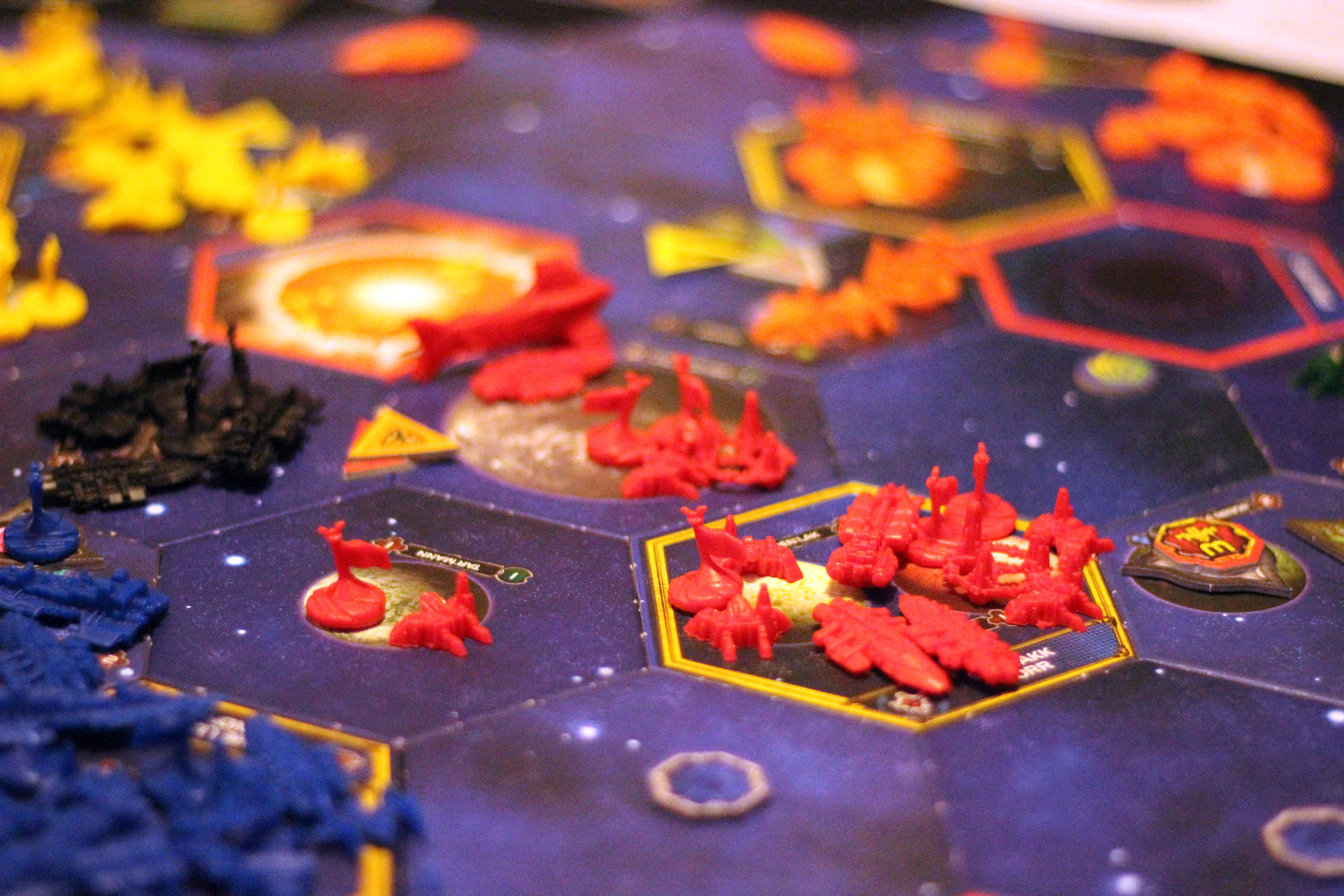
As you play and get comfortable with the rules (which can take several long, long games) it all starts seriously picking up in terms of mad, bonkers, shooty fun. Despite its enormity the strategic elements are reasonably flexible. Alliances are made and broken based on objectives and the layout of the planet hexes (ah, that nebula of hugs sure looks protective. Wait, guys, why are you launching that dreadnought? Guys…?). You learn the particular skills and weaknesses of your race and start to posture with great big spiny hedgehog death stars war suns.

This. This is what posturing looks like.
See that weird little fish-looking guy in the background? Flagship. 'Pointing the wrong way' apparently.
See that weird little fish-looking guy in the background? Flagship. ‘Pointing the wrong way’ apparently.

Bob’s first race comprised spooky space ghosts who love wormholes and for some reason have a super-90s-wildstyle-graffiti-looking symbol/crest thing. They have the unique ability to build an enormous flagship which then acts as a wormhole itself, allowing fleets of warships to pop up all over the map (entertaining but not recommended for beginners). Incidentally the flagship looks an awful lot like a fish with antennae bits all over it. Bob assumed this was to streamline it so that it might effectively fly through the massive friction and air resistance of outer space, but it turned out that she did in fact have the ship flying backwards. Other races include incredibly combative swarms of cockroaches led by a shadowy matriarchy (who for some reason no-one trusts. Damn speciesists), clouds of fungal spores, lion-people with civilisations built on the backs of elephants slowly traversing their desert home-planets, cyborg remnants of the once-ruling race spreading their mindnet low-cost broadband internet through the galaxy.

All that remains of the galaxy after a number of mad alien races have tussled over it.

This game is fun, and mad, but very very long. Set aside a full day for it, and don’t play it without an experienced player to guide you through.


*Sidenote: Pokemon game names are really dumb and not-intuitively chronological. Dem crazy Japans amiright?

**Sidenote 2: This kid wouldn’t let Bob take a turn and had the bloody cheek to tell her that an Umbreon was a kind of Pokemon in a tone of voice usually saved for the hopelessly elderly and out-of-touch. Since being informed that we had in fact had Pokemon when we were kids it’s been non-stop Poketrivia quizzing of seemingly every Pokemon except the original 152. She calls them the Pokemon from ‘back in your day’.

*** More useful than the 12-page cheat sheet**** by a factor of about 300. It helps you keep track of what technology you’re building and are able to build, and keeps an eye on your various battle stats.

**** This is a ridiculous fucking thing anyway. It expects you to print out the pdf on legal paper and then fold and staple it into a booklet. What is this, 1963? It has the potential to be amazing but only if it were turned into a beautiful, easily-navigated hypertext doc. With a fucking contents page and some kind of fucking recognisable structure. One day. In the future.

*****Sorry Chris. That’s what you get for not letting me invade Mechatol Rex.


Photos courtesy of Nick Lanng and Chris MacLennan


Camel Cup: The Yellow Menace

Brutus Rating: 2 daggers in the back out of 10
Pairs well with: One of those liqueurs you bring back from holiday that nobody wants to drink. Maybe cactus flavour, or ouzo. Raki is pretty rough too. Damn Greece, you got some terrible booze.

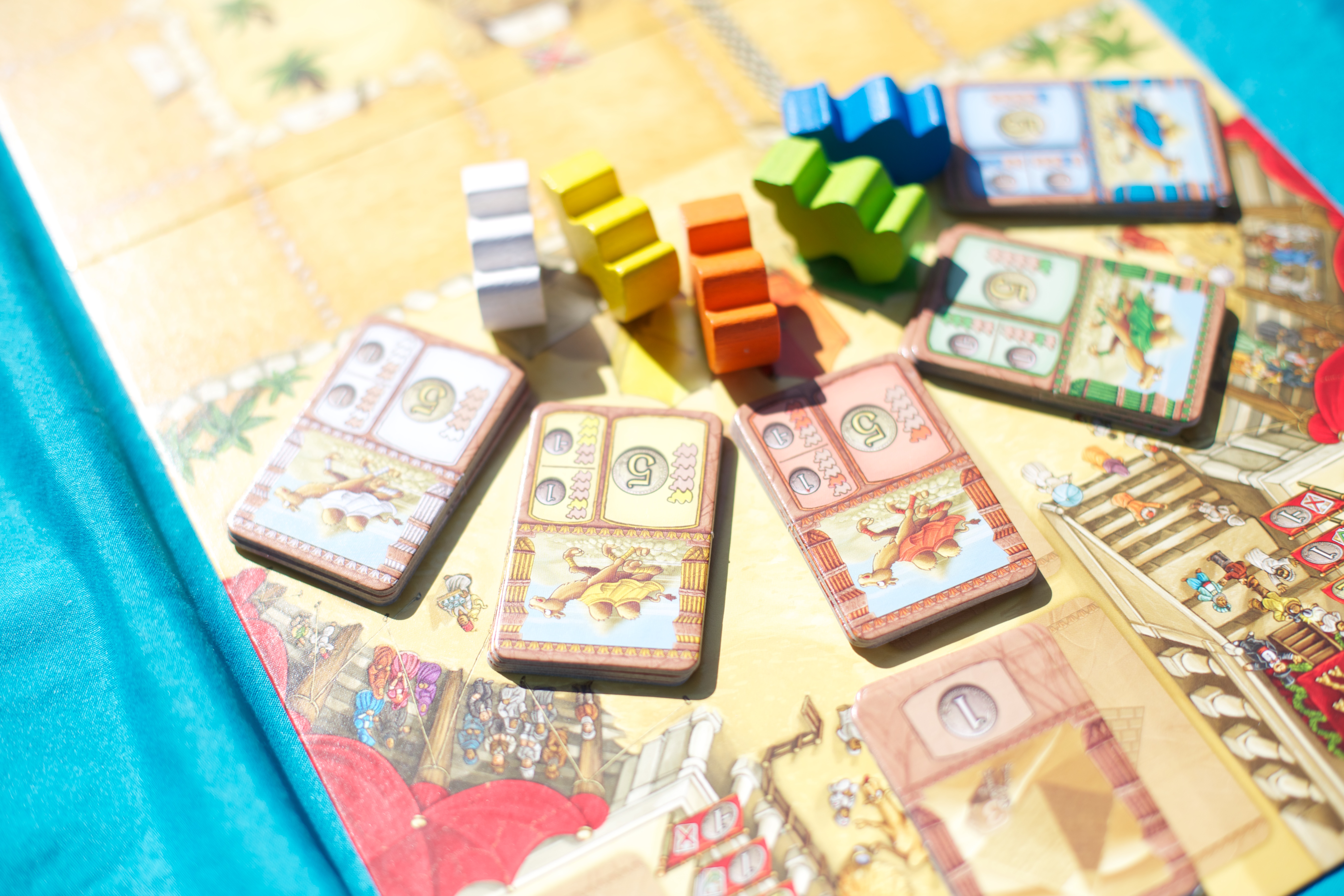
Note: our photographer insists that the bright glaring photographs are supposed to represent the sun in the camel-filled desert. This, we are assured, is definitely on purpose.

Disclaimer: In the interests of maintaining ethics in board game journalism we at the Misery Farm feel that it’s important to make our audience aware that this post contains a high level of pro-yellow camelist propaganda. This does not mean that we aim to denigrate other colours of camel or beings who identify as camels. All camels are equal. Yellow camel is just slightly more equal than other camels.

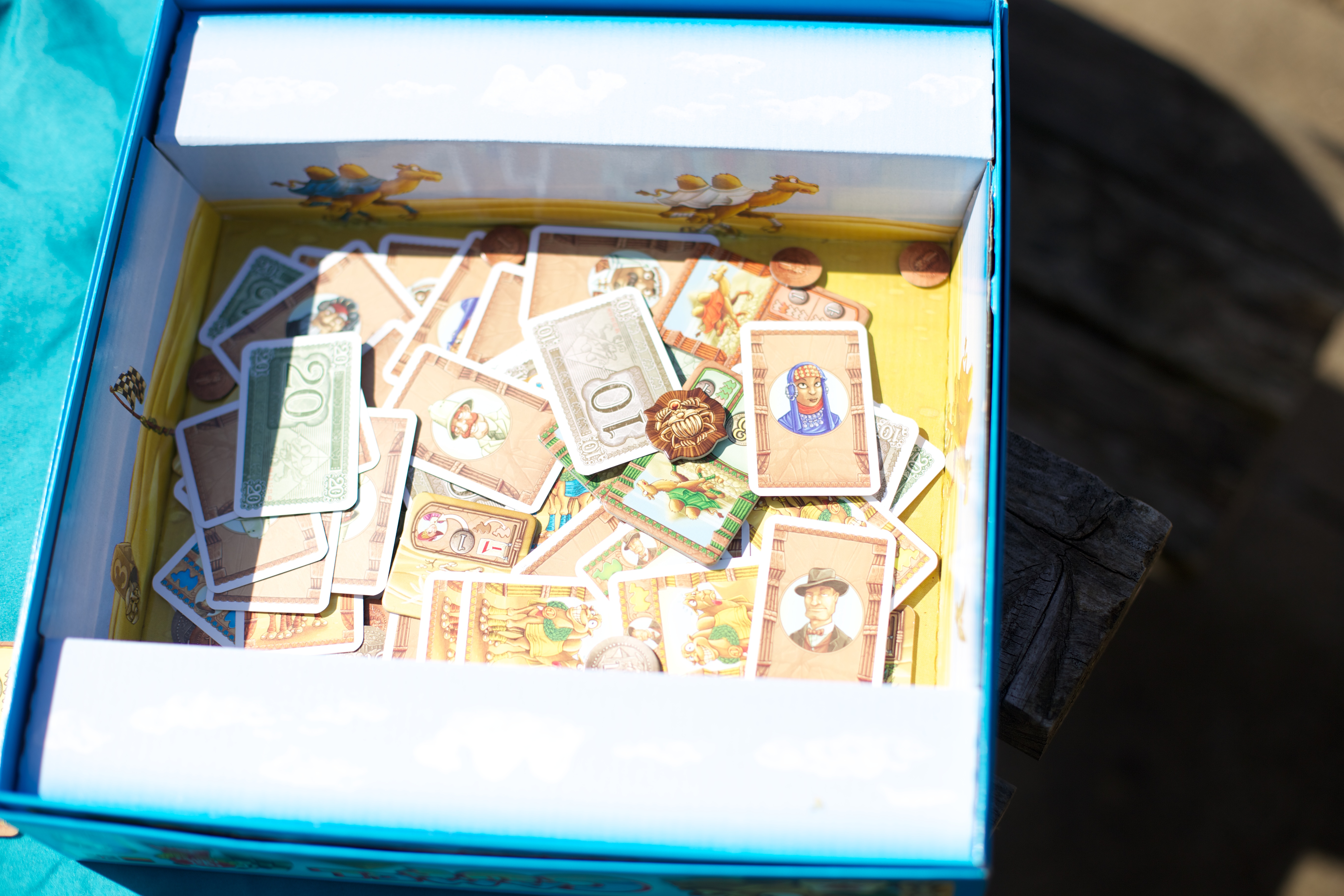
There are several ways in which Lizzy is the villain of The Misery Farm. She wins too often, she’s a little bit too keen to play the bad guy and she has a really awful smug face. These things might all make her seem like a kind of loveable rogue, but there’s one thing that we’ve hidden from you all so far. The real reason she will strike fear into your heart. We’re about to show you the inside of Lizzy’s copy of Camel Cup. If you’re of a nervous disposition, or there are children in the vicinity, look away now.

6D-33-60

Urrrrgh. *shudder* That game even comes with baggies, guys. There’s no excuse for that mess.

Anyway, now that horror is over, let’s get onto Camel Cup.

There are two schools of thought on the name of this game. Some people think that it’s actually called ‘Camel Up’. Perhaps because of the stacking method, in which the camels go ‘up’ and stack on top of each other.

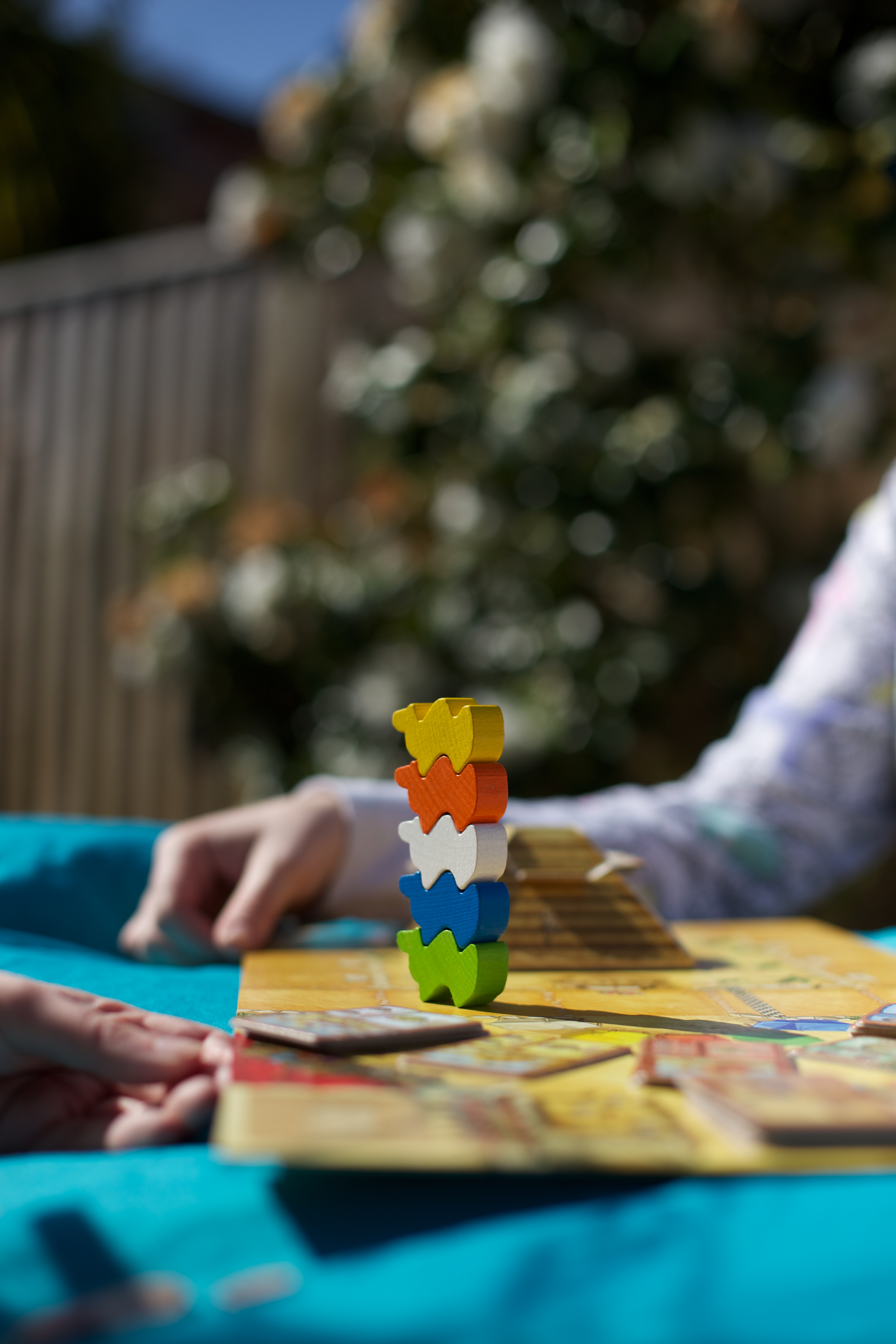
The camels lining up for a bit of pre-race chat

These people claim to be right because of silly little reasons like “that’s what the instructions say”, “that’s what it says online” and “that’s just the actual name, you guys”.

The other school of thought says that the game is ‘Camel Cup’. Because the camels, you see, are racing to win The Camel Cup. These people claim to be right because of excellent reasons like “there is an actual Camel Cup race”, and “we just prefer this name so agree with us or get the hell out of our living room”, and “shut up and play.” The Misery Farm are a part of the latter school of thought.

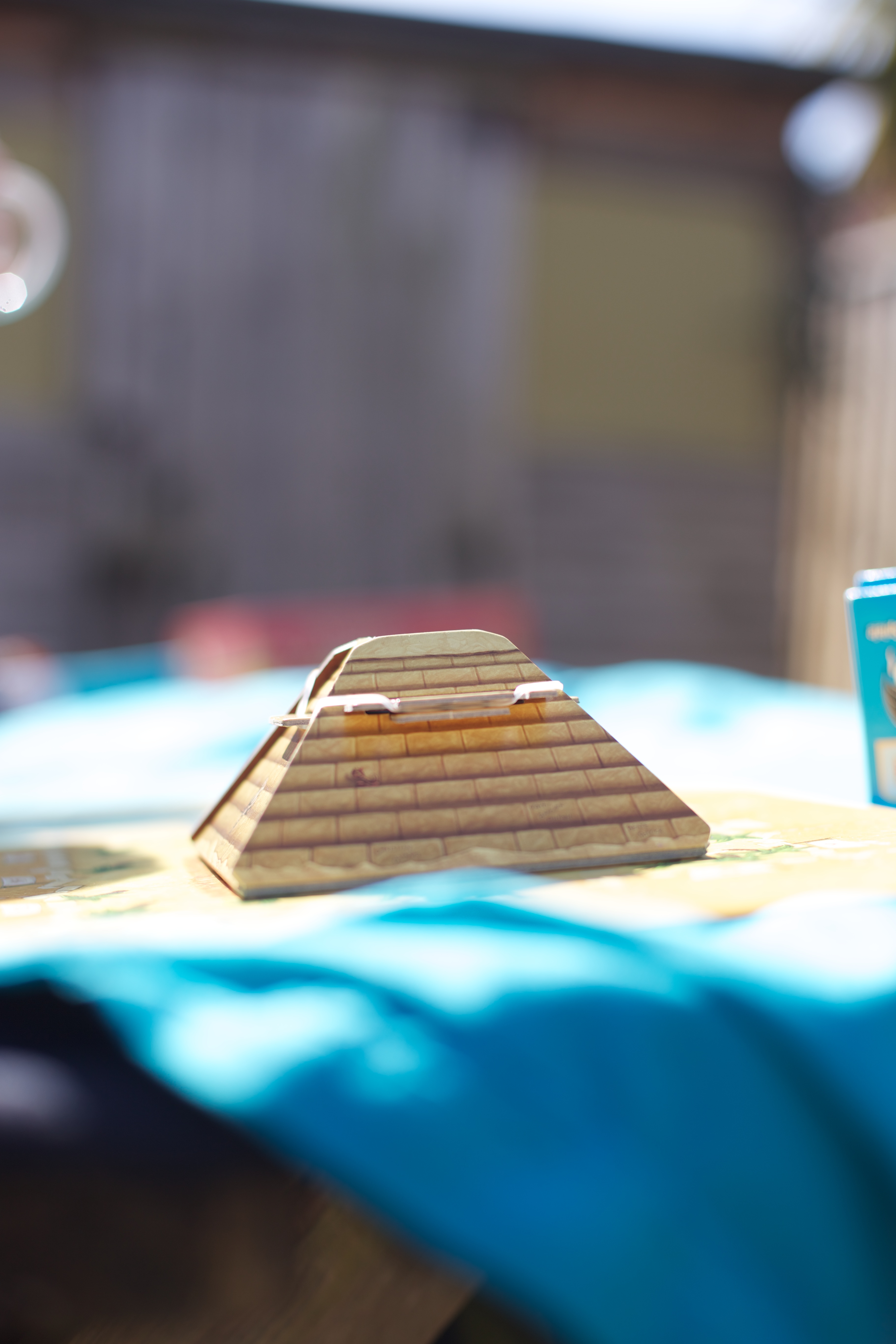
Pyramid-scheme
Pyramid-scheme

Camel Cup won Spiel Des Jahres 2014 (“Game of the Year”. Thanks Bob, that degree in German wasn’t wasted after all.) When you first look at the game, running around a giant convention hall in Germany, then that fact can seem a little surprising. It looks a bit gimmicky: it has some sort of strange pyramid thing scheme going on.

It turns out that Camel Cup is almost certainly the best gambling, camel-racing game you’ll play all year.

In Camel Cup you don’t play as the camels, and you don’t have much influence on how fast each of the camels race around the track. Instead, you’re the Egyptian aristocracy. Your goal is to make as much money as you can by the end of the race, having gambled on which camel will be the final winner, the final loser, and which camels will win each ‘leg’ of the race.

The Egyptian aristocracy

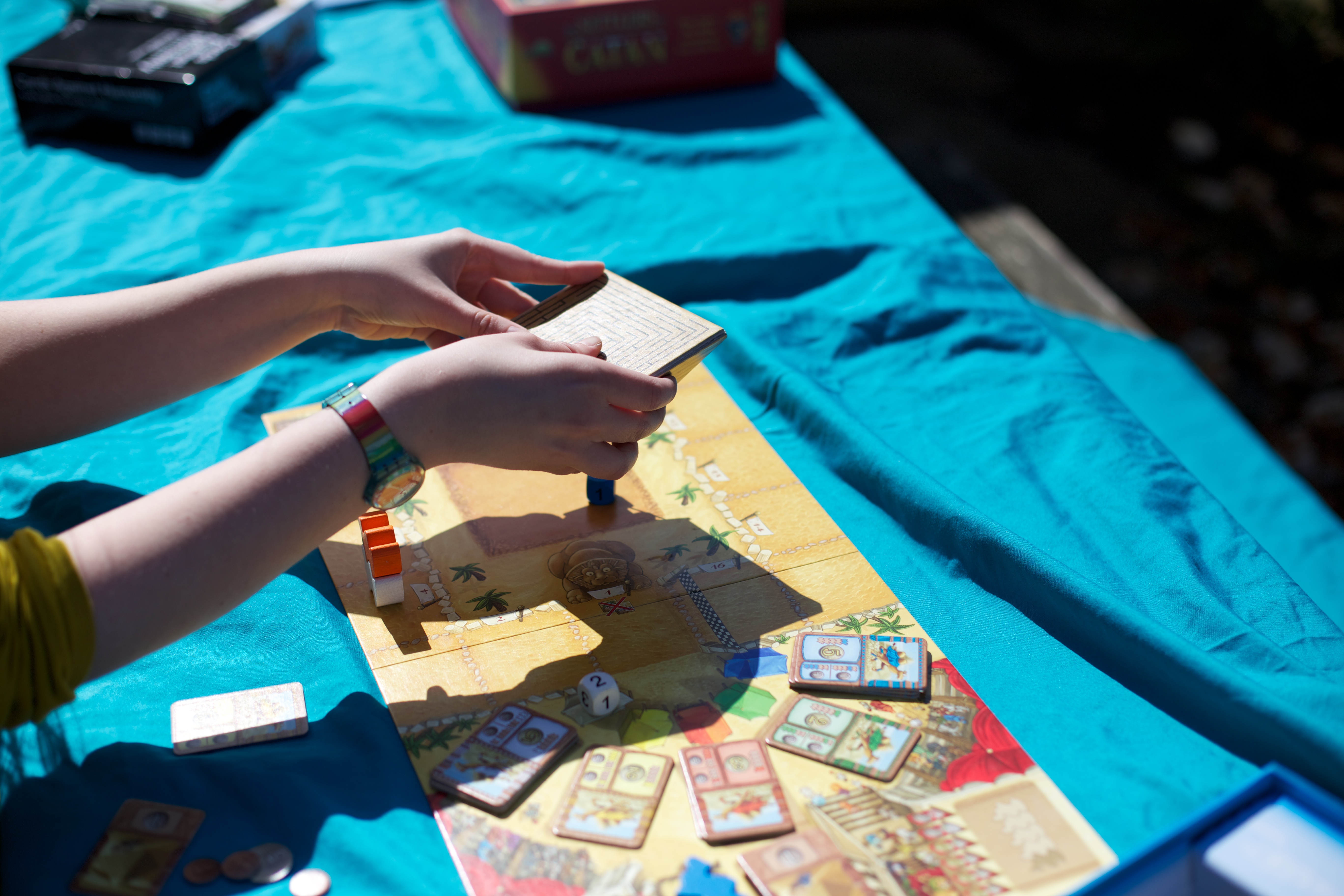
It’s fairly fast-paced, and (hopefully) everyone will do one of four actions quickly and move onto the next person. Two of these actions are gambling (betting on a camel for either the leg or the whole race), one is placing down an oasis or barren dessert sort of token (the one way in which you can almost sort-of influence the race) and the final is to move the camels. That is, make it so that the camels move themselves. You get limited choice in the matter.

“I BELIEVE IN YELLOW CAMEL!” (Lizzy bets on Yellow Camel to win, as is tradition)

“Green Camel is currently in last place… so I think I believe in Green Camel.” (Generic male gaming buddy gambles on Green Camel)

“I think I’m going to move the camels!” (Everyone starts chanting ‘move the camels’ and banging on the table)

The game also features Nigel Thornberry

Of course, I say that hopefully everyone will do one of four actions quickly. Occasionally you’ll get players trying to cheat. By ‘cheat’, of course, I mean ‘actually trying to think about their turn logically before having it’. Don’t do that, it’s a terrible idea. You’ll look like a dick, and it won’t help. Camel Cup can be for up to eight players, so such behaviour is rightly discouraged in our circles, and hurried along by coughing and reminding guilty parties that “Ahem! This is Camel Cup! The fast-paced camel racing gambling game! Get your shit together” until they take their turn. Attempting to mathematically work out the winning and losing odds has no place in this game, for reasons which we will soon make clear.

The magical pyramid of camel-moving

To get any good picture of how Camel Cup plays, it’ll be useful to mention how the camels actually move. At the beginning of the leg, the mysterious pyramid of camel-racing is placed in the centre of the board with five different dice inside it, one for each colour camel. The dice are all numbered 1-3. When some brave gambler chooses to move the camels (cue chanting) she takes the pyramid, tips it upside down and pushes open a little flap so that one single die will fall out. The camel of that colour will then speed that number of spaces along the board! The die is then put aside until the other four are out of the pyramid, so that each camel will get one turn at moving before the dice are all put back inside. When all of the camels have moved once, that’s a leg of the race.

Once the novelty of a pyramid dice-shaker wears off, that can all seem very dull. Some dice are rolled, some camels race at that particular pace. *yawn*

But wait! This game didn’t win Spiel Des Jahres 2014 just for some camels trundling along next to each other at a speed of 1-3 per leg! Oh no. I’ve left out the best bit. The camels… they stack on top of each other.

Woah!
Woah!

Yep. Apparently the race course is so narrow that there ain’t no room for camels to be side-by-side. When a camel trundles onto an already-occupied tile, they’ll just park their camelly behind on top of that first camel. This is a mechanism that makes Briony feel deeply uncomfortable – when she’s claimed a certain spot on the board she expects not to share, or at least to swear at someone attempting to come near her. This is a particular problem in other games like Tigris and Euphrates as she strongly believes in keeping other civilizations out. Everyone else though? In awe.

6D-33-36BUT THEN! When that first camel moves, does she ask the second one to get the hell off? No! She races on with up to four camels on top of her. The implications that this has on the odds are staggering. Instead of moving a maximum of three places, a camel with some lucky stacking could move fifteen tiles.

Staring into the eyes of Yellow Camel

What looks at first like a simple race turns into a crazy one, where the odds a lot of the time are almost impossible to figure out. This is the essence of Camel Cup, and what makes the game so much fun to play. It’s not uncommon to see a camel go from last place to first in one leg, ruining all of your bets and expectations. The game is made by the sheer improbability of it all. It’s made by deciding which camel to bet on just by looking really closely into their souls and seeing which camel really has what it takes (Lizzy deeply believes that Yellow Camel has that X-Factor that’ll take it all the way to the big leagues). It’s made by having all of the enthusiasm in the world for the camel in last place, then actually seeing them win and getting to rub it in the faces of the non-believers.

Having said that, there are several things that Camel Cup is not. Camel Cup is not a lengthy game, nor one for much strategy. Not by board-gaming standards, at least. But that’s ok, because most people’s collections need a place for that kind of game. One that’s fairly quick, fairly simple and doesn’t involve too much thought if you’ve had a long day / are playing with some non-gamer friends / are a bit drunk already at 4pm and can’t quite think straight. It also comes with a Totally Official™ side-game in which players should try to pull faces that match those of the camels on the box art.


10710811_10152401406566161_3131231986079642096_n 6270_10152401406496161_9146959643205959983_n

As you can probably tell, it’s important to play Camel Cup with the right kind of people.

The players need to be willing to get excited about some crazy odds and racing camels, and to not mind the lack of reliable strategy or planning ahead. You need to be able to place a wild bet on a camel just by what feels right. I mean I’m not necessarily saying that it’s your fault if you don’t love the game (you might just have terrible friends). But it might not work so well if everyone’s incredibly quiet, or if everyone’s just received some tragic news.

6D-33-34

The game receives just 2/10 daggers-in-the-back since there aren’t all that many opportunities to stick said daggers into your opponents’ backs. There simply aren’t many ways to encourage a lame camel to victory or stop the juggernaut momentum of Yellow Camel. You can sometimes place a tile which will make it better or worse to land on, but most of the screwing-over will just be done by the luck of the dice and the speed of the camels.

A great game, for its type.

The real winner isn’t Lizzy. Nor, for once, is it board games. The real winner is Yellow Camel.

Tiiiiimbeeeeeerrrr
Tiiiiimbeeeeeerrrr


Credit for the photographs to Photographer-friend BA (Hons), MA, PhD.

Catan: Has anybody got any wood?

Brutus scale: 7/10
Pairs well with: cola and vodka. you know, the stuff you drink when you first start drinking and haven’t acquired much of a refined taste yet. 

6D-33-285

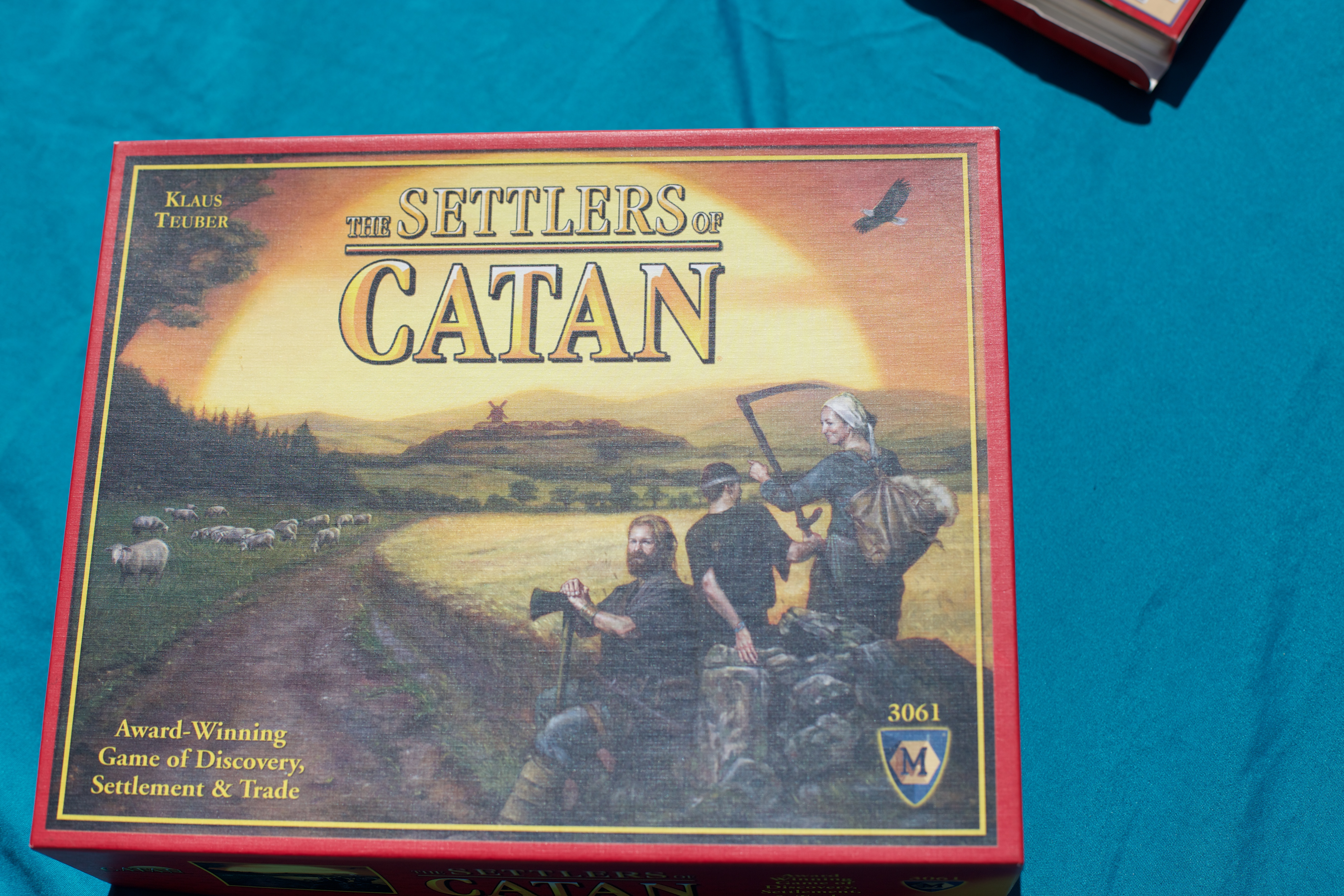
So we’ve just been informed that Settlers of Catan has now actually been renamed to just ‘Catan.’ This is presumably a move to make it ‘catchier’, ‘edgier’, more ‘down with the kids’. It’s also a move that could be described as ‘dumb’ and ‘unnecessary’. All of the expansions are already called ‘Catan: Slightly More Convoluted’ or ‘Catan: Now with Pirates AND Robbers’ or whatever, it just seems a bit redundant.

‘Wanna play some Backgammon?
‘Oh we just call it Gammon, now’,
‘But that’s already a thi-’
‘GAMMON!’

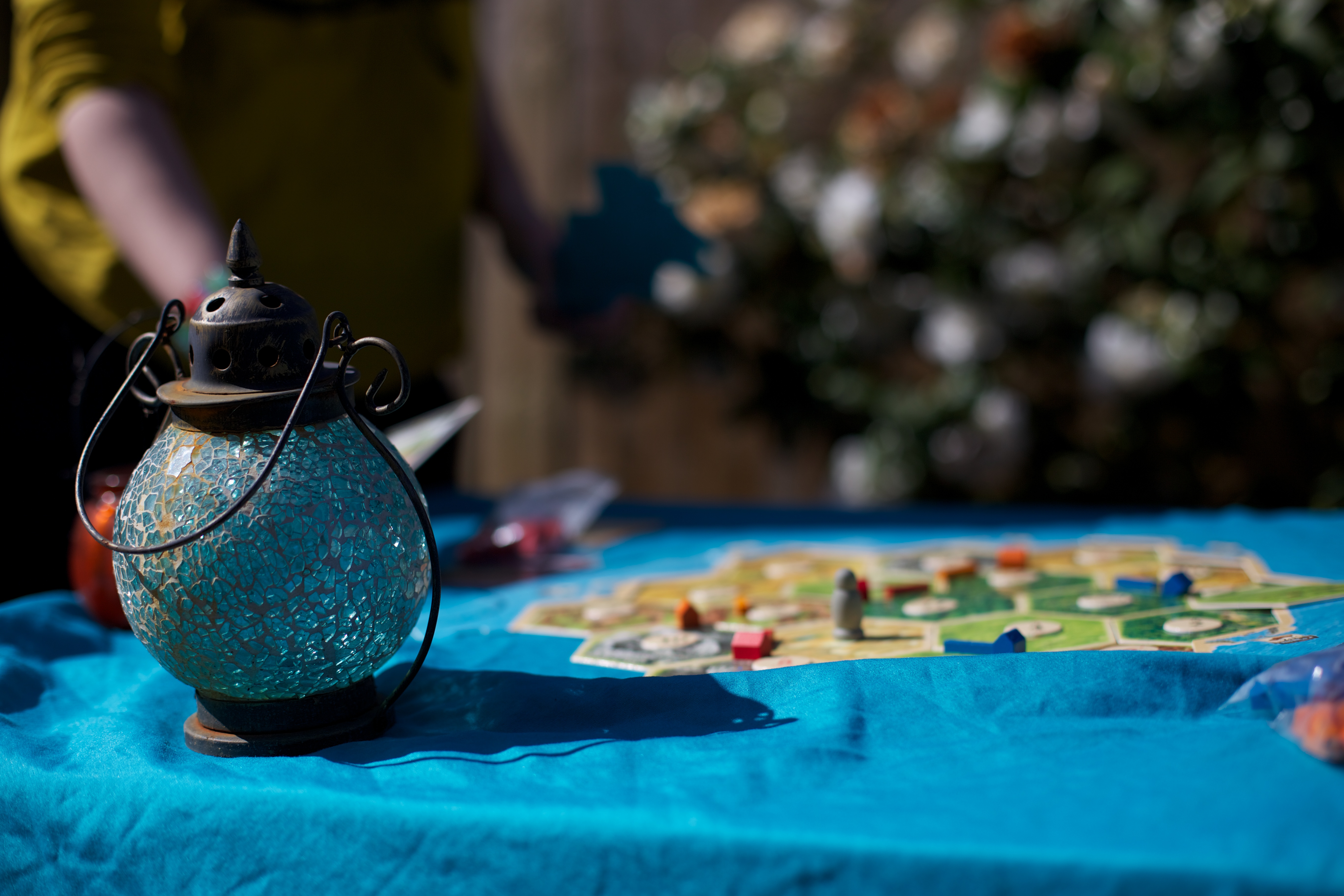
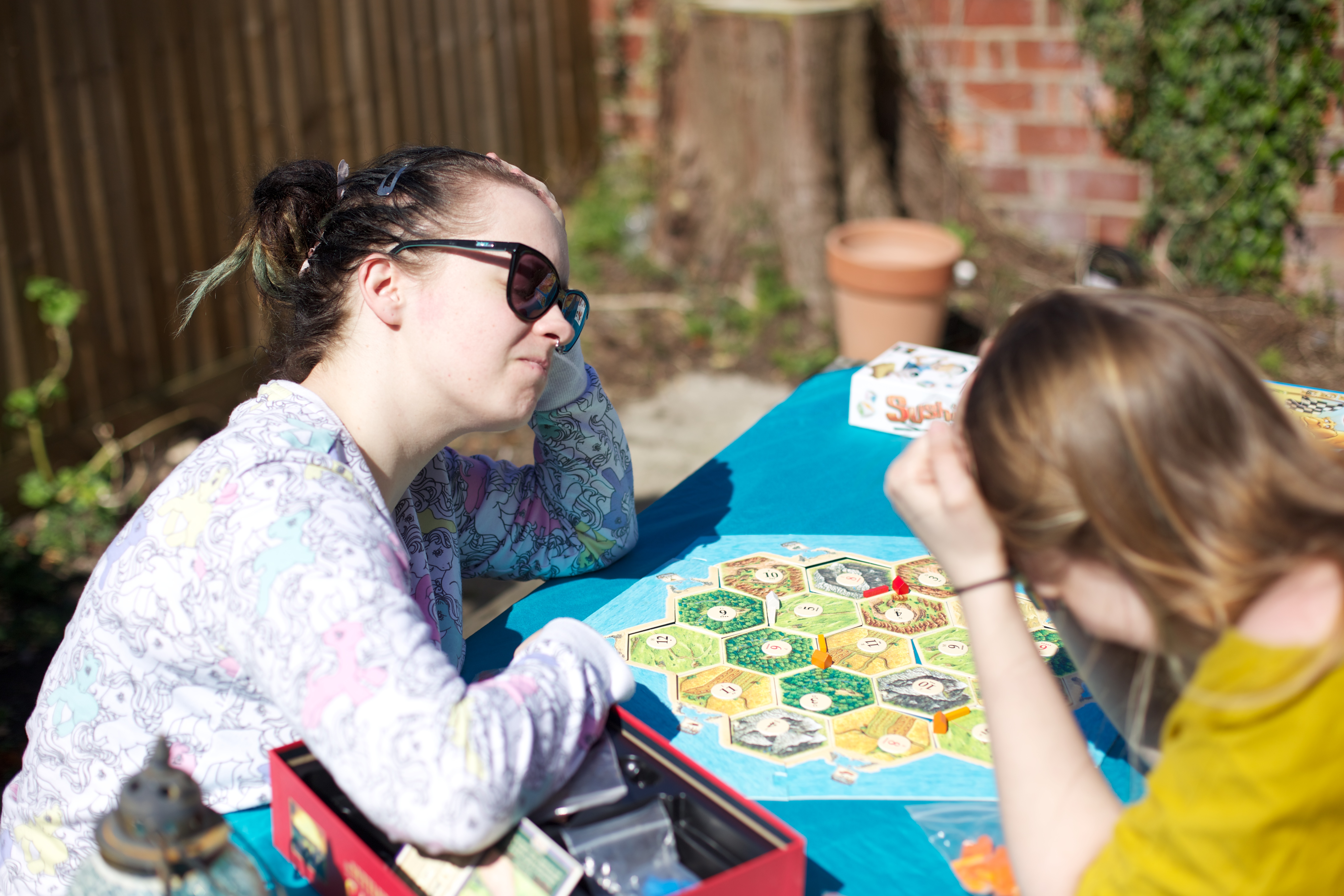
Nice game of Catan in the garden! What could go wrong?

Anyway. Let’s have a show of hands, who hasn’t played Settlers of Catan yet? It’s OK, this is a safe space. There’s no judgement here (except probably from our German readers. Over there I believe it’s as ubiquitous a part of family game shelves as Scrabble or Monopoly in the UK). Until recently, Bob was one of you. In fact she still sort of is. Despite the fact that Catan is THE gateway board game for future board game addicts it just somehow passed her by. There were always newer, flashier games to play, or no one around with a copy handy and a willingness to explain the rules.

Ehehe. Wood, anyone?

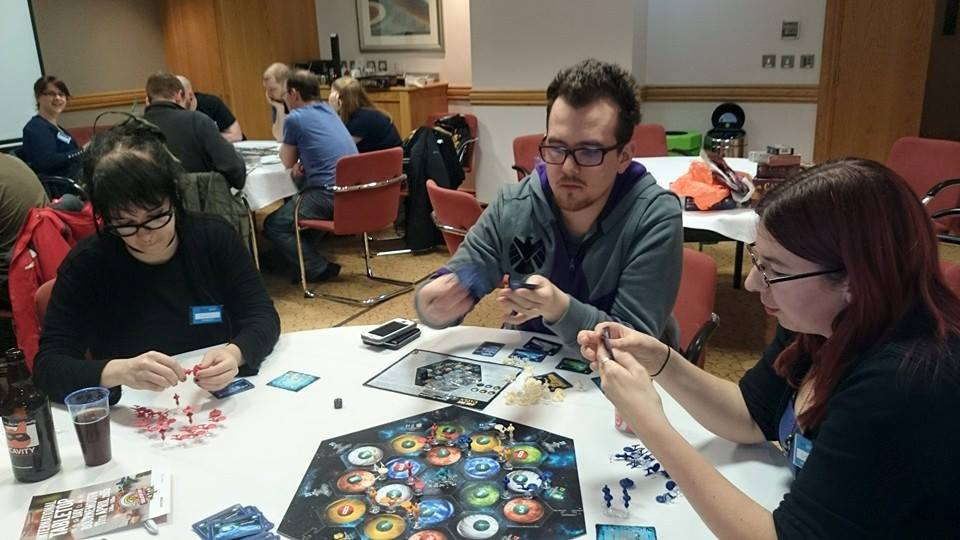
By 2015 this state of affairs had become something of an embarrassment. What kind of board game reviewer hasn’t played Catan? A piss-poor one, that’s what kind. Luckily salvation was on the horizon in the form of a local mini-convention. Lots of friendly local nerds gathered at a hotel to share their (collectively enormous) stash of games, make friends, and carouse until the early hours. When the incredibly friendly and helpful in-house vendor heard of her plight he cheerfully not only conjured a show copy of Star Trek Catan to learn on, but a couple of experienced players at a loose end and willing to teach a newbie. Despite Bob’s ordeal, Briony’s first Catan experience was simply to be told to play it. She then won. Like, by a lot. And since those friends were the only people she knew with a copy, has never been asked back to play it again.

6D-33-269

Catan was one of the first European-style agricultural resource management board games to gain mainstream success. In case you have also lived your life under a rock until now, it’s comprised of a randomised modular board made of cardboard hexagons, so no two games are ever identical. The aim of the game is to build towns and cities which generate resources from nearby hexes, depending on dice rolls. Mo towns and cities = mo victory points. Longest road between settlements also = mo victory points. Instead of making your settlements bigger and more numerous you can instead choose to earn points through development cards, which grant favours like extra roads, resources, or knights. Get the most knights in the game, earn some victory points. Get 10 victory points and you win the game.

The little grey douchecanoe

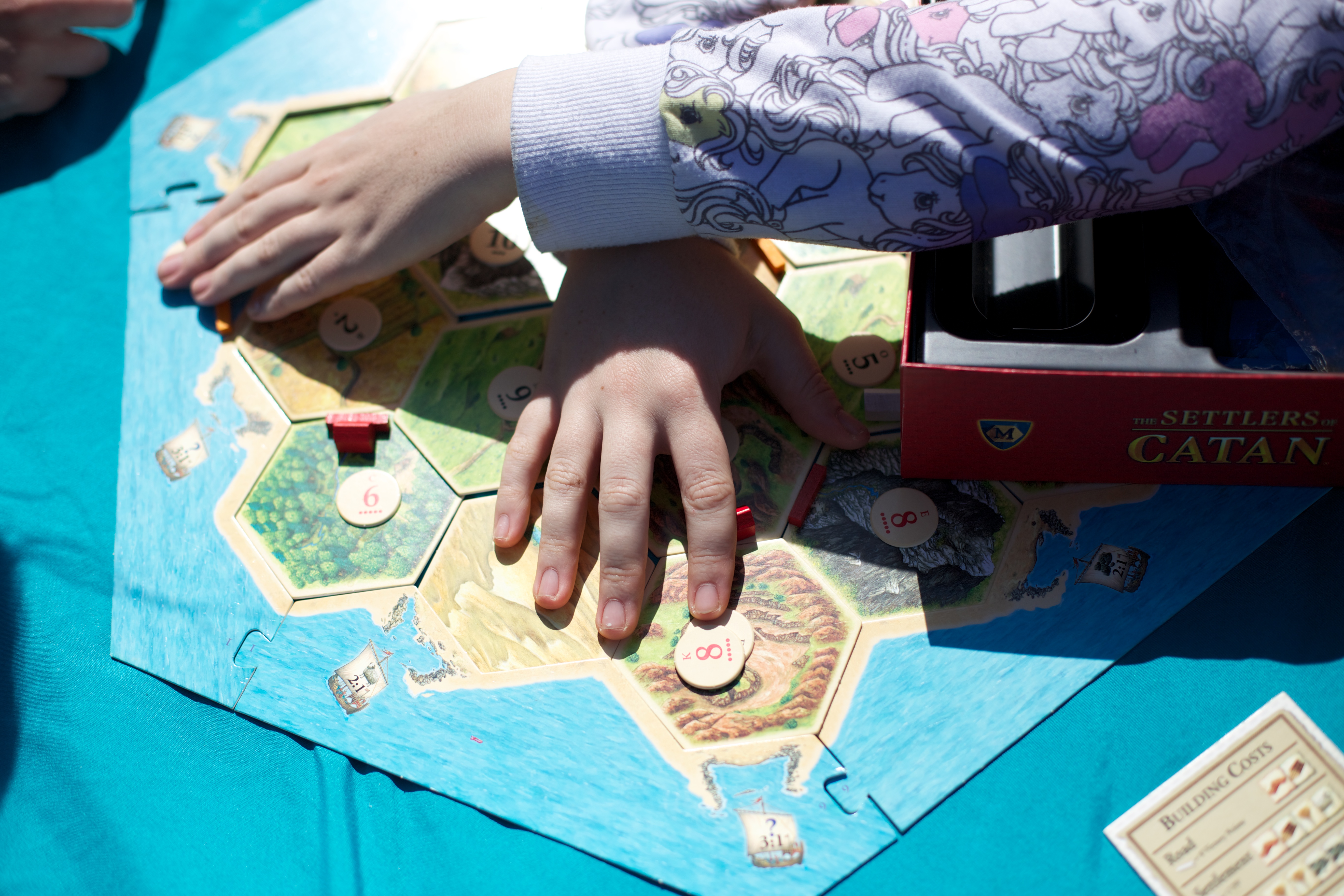
There is also a nasty mechanical implement in the Robber. He’s a dick who shows up every time a seven is rolled. Because every player rolls two dice on their turn, he is statistically likely to show up pretty damn often to annoy the crap out of you. His job is to sit on a hex so that it denies you resources, and steal from you.

Star Trek Catan! Credit to  Richard Harris-Abbott for this one
Star Trek Catan! Credit to Richard Harris-Abbott for this one

Star Trek Catan is pretty much regular Catan with a Star Trek: TOS makeover. The robber is a Klingon battle cruiser. The resources are things like dilithium, tritanium, and oxygen. Roads are itty-bitty starships and towns and cities become outposts and starbases respectively. It’s pretty damn adorable. The only real difference is that the ‘Helpers of Catan’ expansion is integrated into the game in the form of Kirk, Spock, etc. showing up to give you a hand.

It is not an easy game to get the hang of right away. While it doesn’t immediately punish you for every mistake, and strategic errors made in the early game can be overcome, this very much depends on the savviness of the other players. There is no open conflict mechanic, but there are definitely ways to stab your fellow settlers right in their puny, exposed backs, enough for a 7/10 on our ‘Brutus Scale’. This game is war. Gentle, cerebral, agricultural, sly road-blocking war. Any fault made in another player’s turn should be harshly punished, while any obvious strategy should be blocked or made unfeasible. Sun Tzu’s wise advice to ‘know your enemy, especially if it’s Lizzy’ is to be heeded here.

Misery Settling
Misery Settling

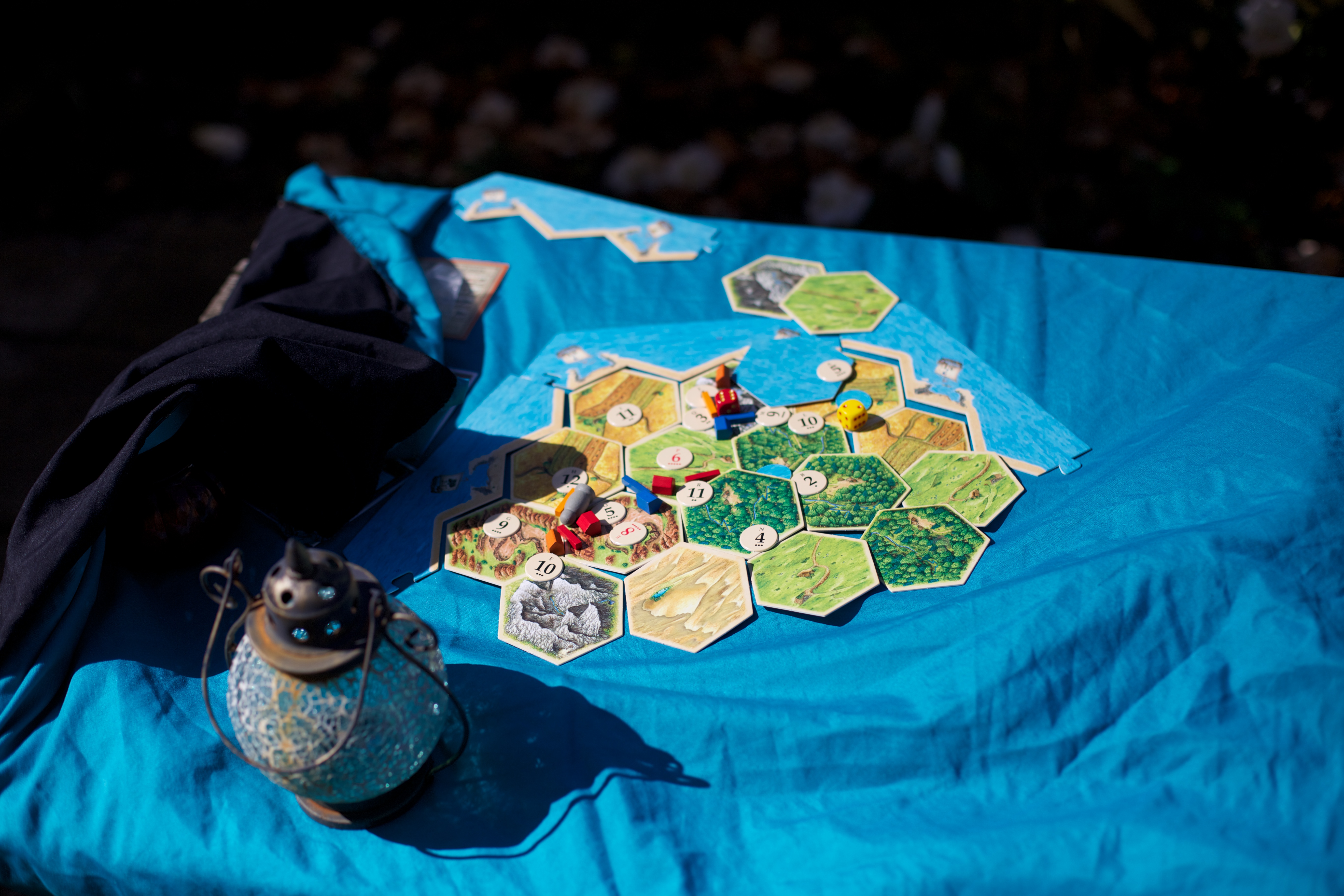
Success means being able to tally this awareness with an overall strategy based on early settlement placement, as well as being flexible when the fucking dice keep rolling nines and you’ve banked heavily on an ‘eight’ hex. A new player is at a distinct disadvantage. Bob’s first game is marked by banter, desperation, and a pair of dice that refuse to roll anything but a seven. You may think this is an exaggeration, and that in any case sevens are the most likely outcome so it’s not a surprise anyway, but really this was ridiculous.

Argh! A terrible gust of wind devastated the island!

After eight turns which included six sevens someone brought out their freshly bought, unrolled Firefly-licenced dice, reasoning that the stacked dice was probably the reason for this being a show copy. Luckily Momus, the god of irony and mockery, was grinning down and sent another two sevens in a row before letting the players get on with the damn game.

Bob managed to earn four whole victory points, and the winner was a Settlers savant who sat down with no prior knowledge of the game just as the rules were finished being explained and asked to join.

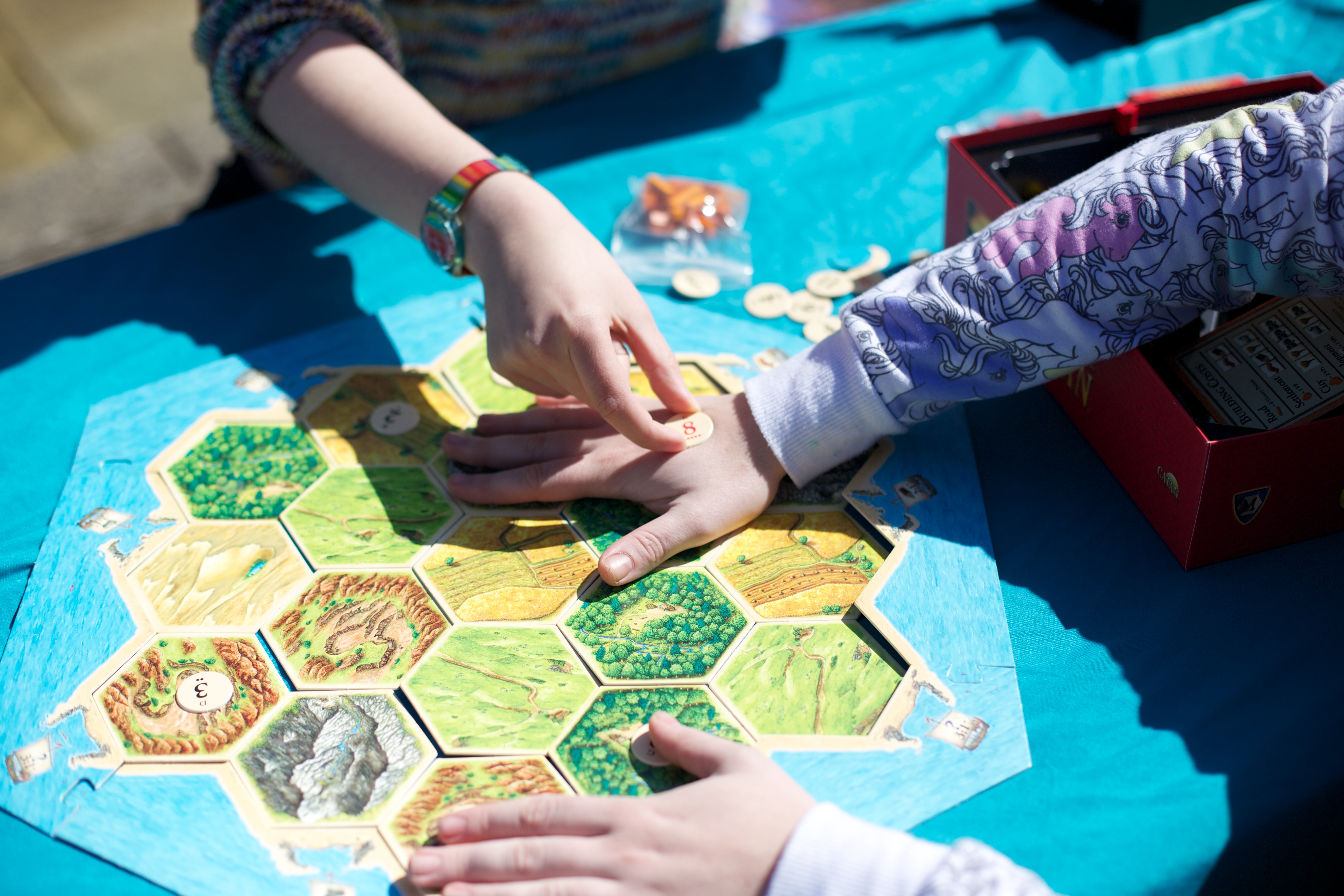
More scenes of destruction

This is not the end of the review, gentle readers. Oh no, Bob had only just whet her appetite for sheep and wheat. Despite a miserable score the potential for fun in Catan was unmistakeable. By sheer coincidence Catan: Creators Edition (the latest Catan ‘videogame’) showed up in the following week’s Humble Bundle along with Ticket to Ride, Smallworld 2, and some other crap that no one cares about. Pennies later, the download was quick and running the game only made Bob’s elderly and increasingly senile laptop fall over and die twice. It includes the original vanilla game, Catan: Seafarers, and Catan: Cities and Knights.

Rebuilding efforts
Rebuilding efforts

In general it’s a faithful but cheap and somewhat nasty port. The rulebook, for example, is dreadful. It has no easily-searchable index, bundles all three versions together in its explanations (confusing as fuck, yo), and is remarkably brief on the details. This is fine if you already know the rules, but not great if you’re trying to find the expanded rules which apply only to Cities and Knights, for example (it looks like there’s a dragon involved? Is that right?).

It does, however, come with some pretty great little game ‘scenarios’, which alter the gameplay to make certain strategies more viable or difficult, and reward you in different ways. There is also a whole gang of computer-generated characters to play against, including knights, mothers superior, craftsmen and nobles. They curse you in different ways when you screw them over by plonking a settlement in front of their longest road, and have a rotation of phrases during their turns. The game also makes a variety of noises to let you know when somethings happening (gained some sheep? Have a sheepy ‘baaa’ noise. Gained some wheat? Have the sound of… uh… some grains? Being scattered? Whatever, they tried.)

Very helpful, Lizzy
Very helpful, Lizzy

Of course the best thing about having a digital version of a board game is that play is much faster, meaning you can play several games in a day instead of doing your PhD research, which all of the misery farmers approve of. Although computers don’t make the same mistakes that humans do, you can definitely begin to identify winning strategies and refine them to work in different situations. ‘Desperate resource-grabbing Bob’ is long gone, having been replaced by ‘longest-road-builder of Catan’ Bob, ‘successful sheep-farmer’ Bob and ‘fuck you and your army I’ve got a monopoly on the supply of wheat so good luck building a city’ Bob. Lizzy better watch her back, harbourmaster Bob’s a-coming.

6D-33-282

Lizzy is tempted to counter that the game is actually a lot better as an app, after you’ve played it your first few times and have been gently welcomed into the gaming world. But that may be because there’s just too much opportunity to ruin each other’s game. If, for example, you’ve earned a reputation as someone who’s ruthless and always wins games, then nobody will ever trade with you. Ever. Even if you’re desperate. Even if they’re desperate. At least the AI on Lizzy’s phone won’t bully her quite that badly.

Hold onto the island! The gentle breeze is back!

Bob is very enthusiastic about Catan. It’s a bit like watching a grown adult who’s never eaten peanut butter before try it, go mad, and refuse to eat anything else for three weeks straight. Suddenly a whole new world has opened up to her, and she tries to tell all of her friends about it, but all of her friends already know about peanut butter. It’s actually quite surprising that she’s eaten five jars of it in a row and neither thrown up yet (metaphorically) nor gotten bored of it.

Soon she’ll realise that peanut butter involves far too much dice-rolling, luck and reliance on other players. Until then, we’ll have to cope with playing more Catan than is healthy. (Are you sure you wouldn’t like a nice game of Caylus? Bob?)

Even this bearded dragon has played the game too much

Briony has only played Catan several times, and unlike Bob has not gotten hooked. Any board game that has memes about sheep trading are way too cool for her, and she prefers to instead to engage with these types of games by turning up, ignoring the rules, being mysteriously silent and then thrashing anyone else without batting an eye. The good thing about this strategy is that you can get away with doing it once, and claiming that it happens as consecutive times. But, she supposes, at least Catan is a good way for normal people to be swayed to the way of the board game nerd.

Credit for the incredibly sunshiney photographs go to Dr Photographer-Friend. Credit for the photographs, that is, not for the sunshine. He hates the sunshine. And happiness.

Letters From Whitechapel: The Case of the Illogically Numbered Board

Brutus scale: Just 1 dagger out of 10
Pairs well with: Gin from your local 1880s London gin distillery.

6D-32-185

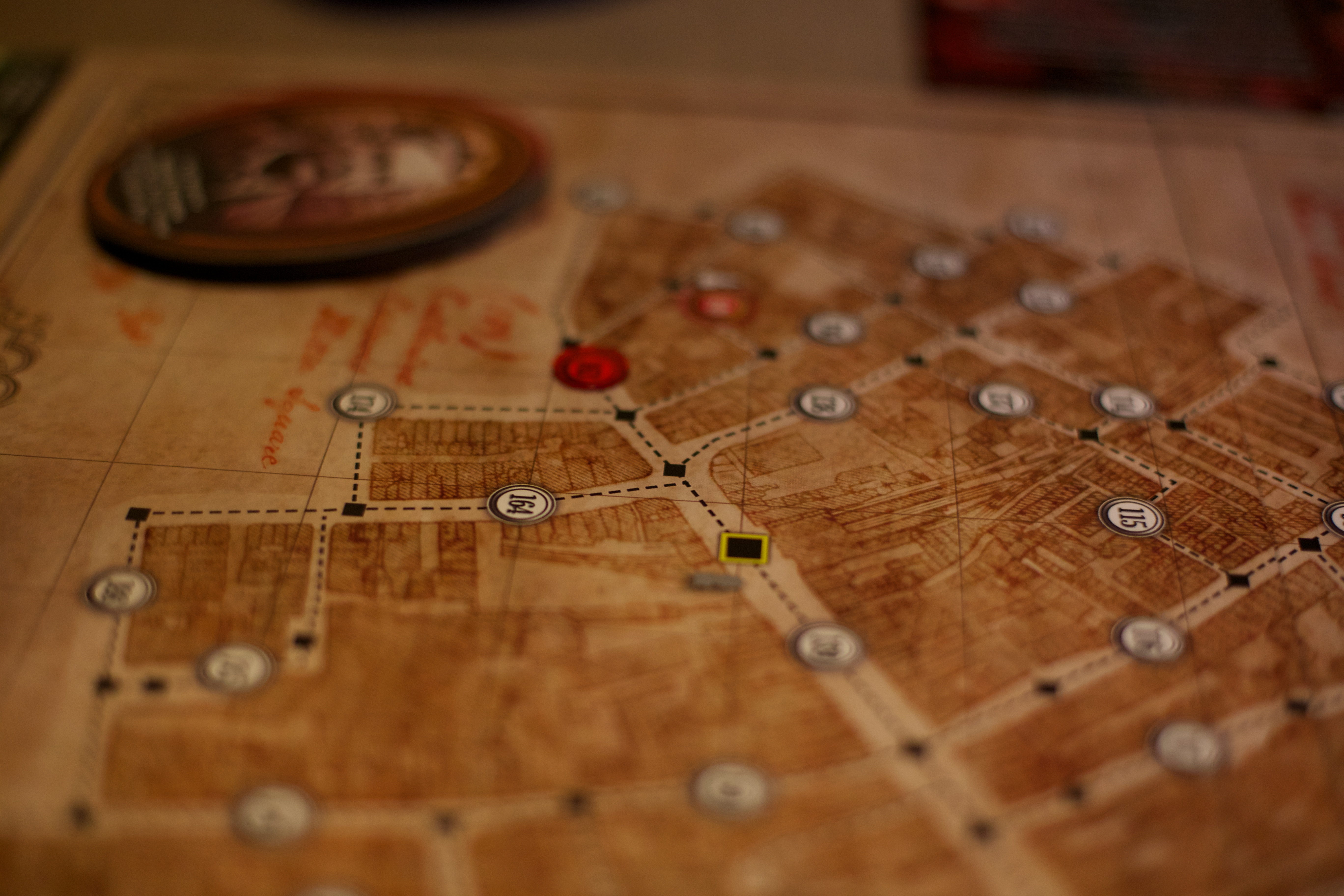
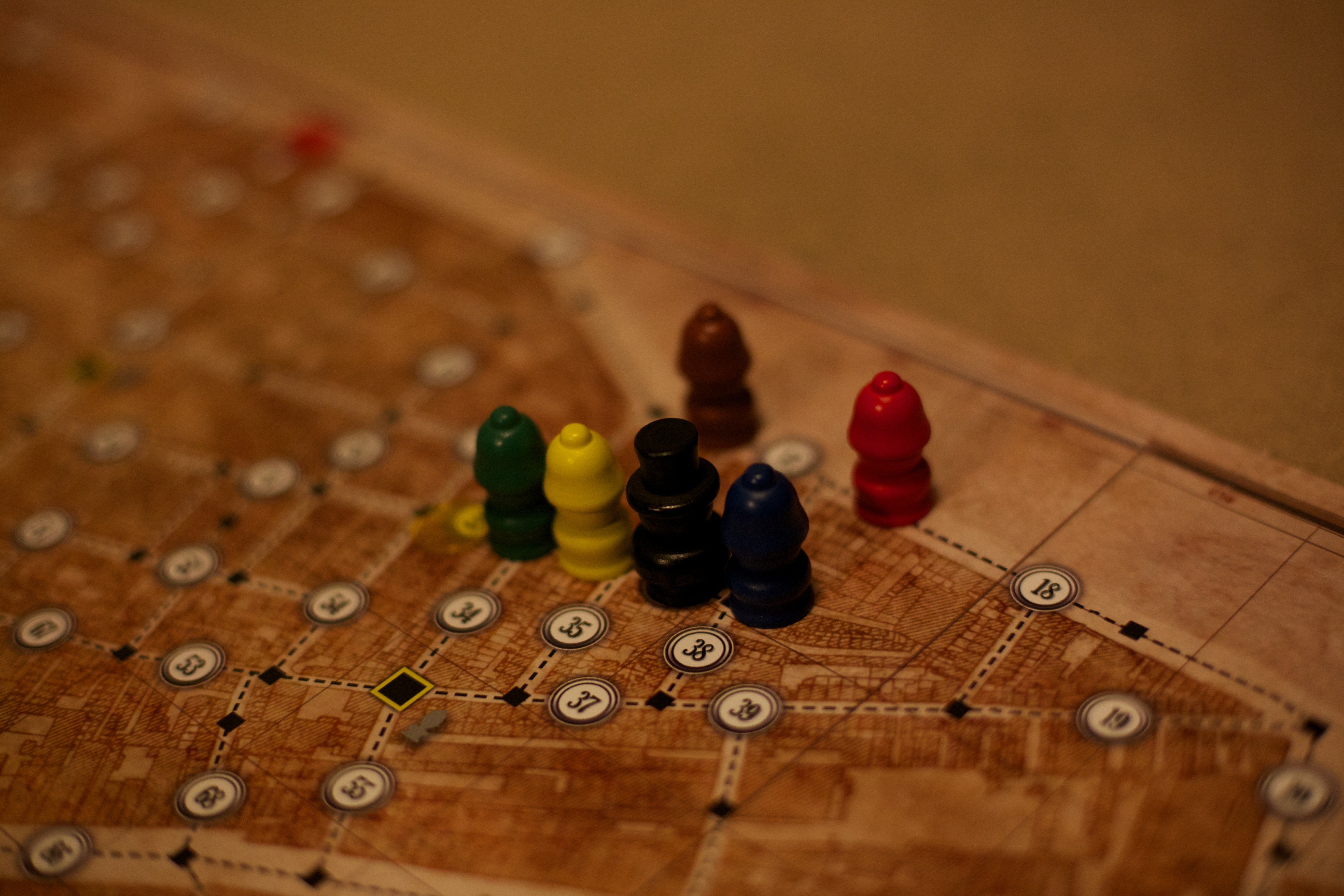
Picture the scene. It was a dark and stormy night (only metaphorically, it was actually a disappointingly pleasant afternoon) and in the area of Bob’s living room designated as ‘Whitechapel’, four frightened looking bloggers and blogger-friends looked on as Lizzy cackled maniacally behind a cardboard screen and took up her role as Jack The Ripper.

Letters From Whitechapel is a mostly co-operative board game. Between one and five of you will play the noble detectives, trying to hunt down and stop the ruthless, psychotic killer before it’s too late. Another of you will play that very same ruthless, psychotic killer. That was obviously going to be Lizzy. Lizzy ‘always-the-cylon’, ‘never trust her in any board game’, ‘what the hell lizzy leave my goddamn skeletons alone’ The Ripper. Suits her.

6D-32-112

She first saw this game on a Shut Up and Sit Down review and had wanted to try it ever since. She incessantly insisted that someone buy it for Gavcon- a mini gaming event hosted by some friends – until eventually the eponymous Gavin relented. She ended up winning the game in a raffle at the end of the night, and went on to play it eight times the following week. You get the idea; Lizzy really likes the bloody game.

6D-32-107The game uses what most people (more on that later) would call some very simple hidden movement mechanics. Jack The Ripper moves on circles, the detectives move on squares. Jack tracks his (or in this case, her) own movements secretly on paper hidden behind a screen-of-doom and tries to get from the murder scene to her house without getting caught. The detectives try to catch her first. They can do this by ‘searching for clues’ on the circles nearby to see if she’s passed through that spot in that round, or by ‘making an arrest’ if they think she might be there.

With us so far? You are? Good, perhaps it’s time to introduce the game from the other perspective. The detectives have all chosen their period-accurate roles. Chief Inspector Donald Swanson (no relation to Mr. Ronald Swanson, and played in this game by our own Dr Photographer) gets the role of Lead Investigator to start with. 6D-32-128Everyone has excellent faith in his leading abilities, since as long as they’re half as good as the moustache in his portrait then it’ll be an easy round. The team quickly scrabble through the fairly administrative first half of the game – the instructions describe this as ‘HELL’ – and Lizzy The Ripper needs to decide when to make her first kill. Oh, yeah, that’s right. She gets her first kill before anyone gets a chance to try to stop her. The game isn’t about saving lives, it’s about the egos of the detectives and the serial killer.

"First Part: HELL"
“First Part: HELL”

She’s mildly indecisive about when to make the kill, possibly for suspense, viz: “… and suddenly! Through the cool summer night’s air you hear a scream… wait, no… sorry guys. CA-CAW! It was actually a seagull. Carry on.” Or possibly it’s just for a chance to make seagull noises. It will forever remain a mystery.

London's most wanted
London’s most wanted
Pool of blood. The scatty focus is supposed to be reflective of the detectives' state of mind.
Pool of blood. The scatty focus is supposed to be reflective of the detectives’ state of mind.

The murder happens at last and an apt transparent red counter is used to mark the pool of blood that’s spilling into the gutters of Victorian London. The team’s faith in C.I. Donald Swanson may have been misplaced, since it’s now revealed that none of the inspectors are very close at all to the crime scene. He’s promptly renamed ‘Chief Inspector Whoops’. There’s already discussion of whether or not they should give up and pretend that they didn’t hear the scream. It’s very far away. Probably nothing to concern ourselves with, nothing to see here folks.

As it became apparent when we played Quantum, Lizzy loves a game with some good and unexpected roleplaying potential. Letters from Whitechapel is one of these games. By the end of her first week of playing each of her housemates had developed a personality and a backstory for each of the detectives.

Our heroes are vaguely aware that a crime may have happened in the distance.

Poor Detective Inspector Edmund Reid’s wife has been arrested several times by mistake, and let’s not even go into the kinds of things that Chief Inspector Frederick Abberline has got up to. Those mutton chops hide a multitude of sins, folks.

You remember earlier we mentioned that The Ripper moves on circles and the detectives move on squares? And that the detectives can try to hunt The Ripper down by looking for clues on adjacent circles? Well, it’s time to have a few words about Bob.

Bob is a competent human being. Bob runs places, plays a damn good game of Glass Road and is doing a bloody PhD. She also has a rare condition called Letters From Whitechapel Blindness (in addition to a serious case of Turn Narcissism, as describe in Caylus). For the love of all that is good in the world, Bob cannot remember which numbered circles she’s supposed to be searching on. Really. It’s embarrassing for all of the players on the game. She’d never see us. Bob’s detectives must just have a really good sense of smell or something. They can apparently check for clues through walls and two streets away.

The guilty party
The guilty party

Coincidentally, Bob isn’t such a fan of this game. You may find her lying on the floor proclaiming that this game is ‘like Minesweeper, but shit’. It’s definitely one that has polarised The Misery Farmers. Briony enjoyed it rather a lot, maybe she’s just pretty good at ignoring the horrific murder of prostitutes disguised by a white wooden game piece, or indeed distracted by the intrigue of what could possibly be in Jack’s house? She reasons what if it’s totally normal, and he has like an elderly mother sharing the house, and has lace doylies, and flushes the toilet like a normal person? What if he has a pet cat? Was that the clue-cat all along Lizzy? Holy shit, Lizzy, was your cat trying to guide us to your capture?

6D-32-148

Meanwhile, another prostitute has been murdered and another round has begun. The team have decided that the best way to make the game fair is to introduce a new rule: for every successful space The Ripper moves, she takes a small swig of gin. Only way to even things out.

“I search for a clue on 68!”
“You find a cat. It miaows.”
“Does the cat have any clues?”
“No, you fool, it’s a cat.”

“I search for a clue on 86!”
“Nothing here but a gentle breeze and a sense of bitter disappointment.”

“I search for clues on 75!”
“No you don’t, Bob. For goodness’ sake, that circle is miles away.”
“Oh, so it is.”

“I search for clues on 70!”
“It’s that same cat from before.”
“Oh damn. Does it have a clue this time?”
“Why yes! It’s playing in some entrails. YOU FIND A CLUE!”

Hot on the trail
Hot on the trail

The detectives eventually employ some excellent guesswork deduction and have narrowed down The Ripper’s hideout. They’re certain it’s on 78. For sure. They don’t have any clues pointing in that direction but they sure are confident. It just looks a bit shifty. Bob, meanwhile, continues to get confused over circles and squares. We decide that if Bob were a supervillain, we could all just infiltrate her lair by dressing up as a black square. She’d never see us.

6D-32-178The team gather their wily crew of detectives round 78 and are “staking out the joint”. No amount of darting through alleys will save our slightly tipsy antagonist now. She has to get home in a certain amount of moves or presumably she just falls asleep where she is on the streets and gets arrested in the morning, losing the game. Time is nearly up. She makes one final dash for it but the detectives have employed a reckless but effective strategy of making random arrests on every circle in the vicinity. Most of Whitechapel has been loaded into their van so far, included several pigeons, the cat from earlier and the baker’s son. Finally, she weeps and Briony makes the fatal arrest.

Lizzy took five victims: four of whom were in the game and the fifth of which was Bob’s gin supply. It was a victory for the good guys.

Lizzy loves the game. Bob does not. Briony is narrative-distracted.

Overall, it was a game that polarised the team. It’s not incredibly high on strategy, but can still be an awful lot of fun. Originally we worried that it might get a bit boring after a while, but the evidence shows that if you like the game then you’ll get a lot of play out of it. We awarded it only 1/10 on our ‘Brutus Scale’ because it’s not really the kind of game for dicking each others’ turns up at all. At least, not on purpose, and not easily.

The team line up for a round of applause.

Credit to Dr Photographer (C.I. Donald Swanson) for the photographs

Le Havre: Misery Shipping

Written by Briony, Bob and Lizzy.

Brutus scale: 4/10 slippery fish-gutting daggers in the back.

Pairs well with: Salty tears. Port.

1384

Le Havre is a game that has been languishing on Briony’s game shelf for far, far too long. It was bought more or less because it was made by Uwe Rosenburg, the same chap who made Agricola and Glass Road (you may know him from our other posts as the King of European gaming and farming misery). Le Havre, named after the French port city, demands that players generate and sell goods from the docks over a shipping line. Although similar to Agricola in many ways, for example in needing you to generate enough food per round, it also brings in other mechanics from trade-based board games. The trading and shipping of goods is extremely similar to Puerto Rico, whereas the buying of transportation for your goods is similar to Gluck Auf.

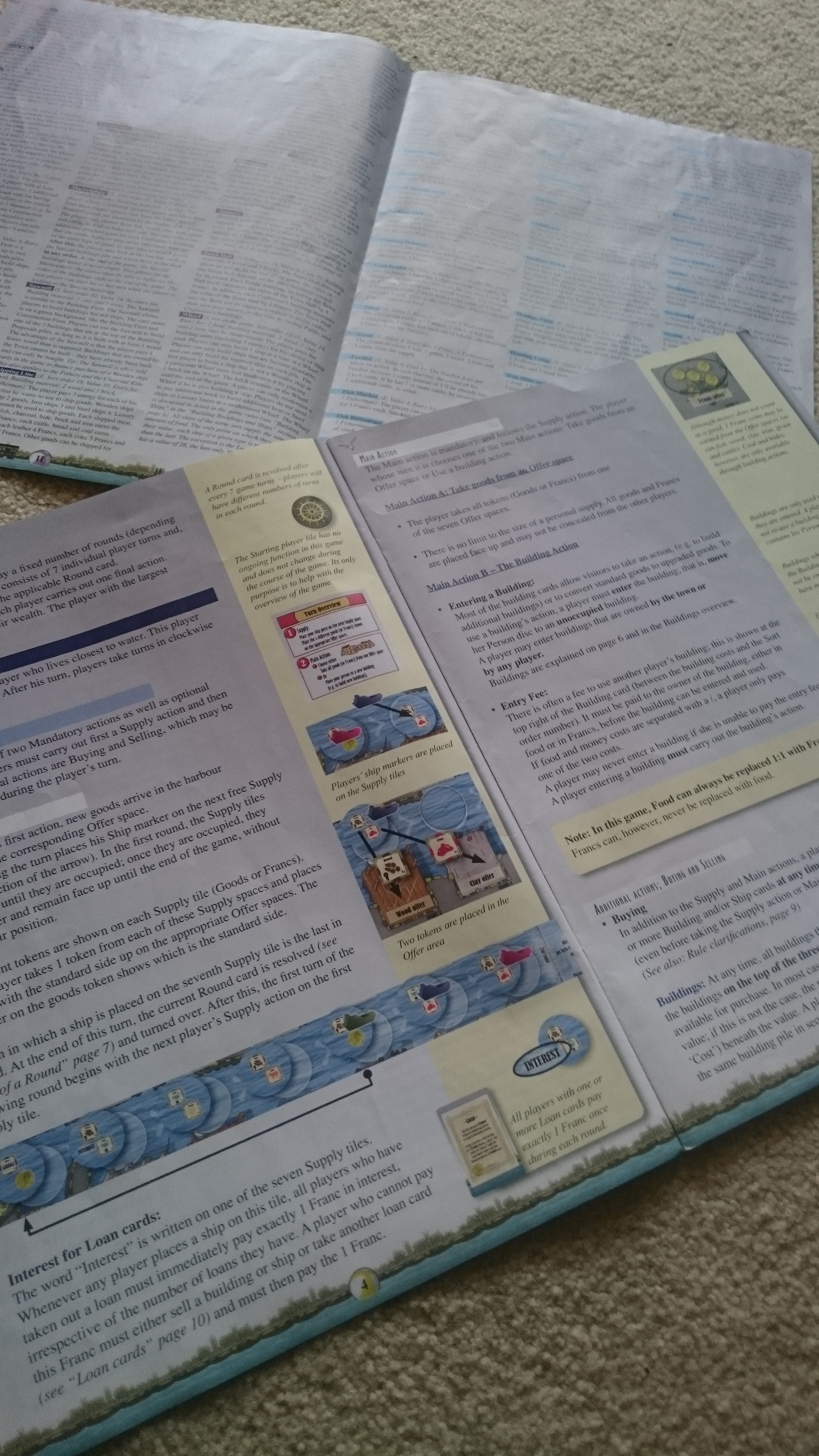
As it’s taken us so long to play this game, and as we haven’t found anyone else who has actually played it before, Briony, Pat and Pete (generic gaming buddies 1 and 2) have decided to dedicate an entire evening to the misery of learning complex rules for the selfless benefit of humanity. DSC_0092They strongly suspect some of the emotional traits of Agricola will have crossed over to this game, but are willing to lay down their lives, or at least good mood, to break some new ground and report back on their findings. Unfortunately, reading the entire rules has taken Pete so long that he’s had to tag out and get a beer while Pat takes over. Briony suggested simply watching a YouTube video on setup and gameplay, but they got less than three minutes in and the YouTubers’ immaculate setup and condescending encouragement to buy extra plastic trays and inserts in the name of personal organisation became too irritating to bear. Today’s misery team were going to have to do it the hard way.

3,000 pieces counts as simple, right?

Fortunately the set-up of the game is relatively simple, including the docks, resources, the town building firms, and the range of buildings on offer. Resources are generated by sailing through the port, meaning that there is a timing critical element to selecting and claiming resources you need. Your ship (the HMS Cardboard Puck) sails to the next available space which restocks the particular item you land on. You may then perform an action: this can be taking all of an available resource, using a building, or constructing a building. And so off we sail down the port, excitement in our hearts at beginning our new journey as a shipping company. (Note: If you really want to feel the joy first hand watch the opening 20 minutes of Muppet Treasure Island before beginning for full effect).

DSC_0091

Early game: the excitement is short-lived. What a surprise. As we generate resources by sailing through the port, it has quickly become apparent that there is not enough food in the early stages. At the end of most rounds there is a harvest, (Much confusion, are your ships farmers? Can you harvest the actual sea?) and then you must pay the amount of food on the round card to sustain your workers. This is only assumed, as there is no explanation as to where this food actually goes. We might just be throwing it in the sea as tribute to Poseidon, who knows. The first few rounds seem to mainly be about generating enough food to last you a few more rounds, so that later on you can invest in building or luxury resources that you may use to build or ship later. This is Briony’s method so far as she believes a massive stockpile of fish and cattle will be worth it later on, and may even look intimidating to the other players forcing them to make errors in awe. Pat and Pete have gone for the opposite: wildly claiming resources and constructing buildings straight off of the bat, cranking up their early game points and constructing some sort of giant building that incorporates all buildings. Who knows what goes on behind those closed doors.

Mid game: The demand for food is ramping up each round, making snack-generation a pressing concern almost constantly. Poseidon is a demanding deity indeed, and doesn’t seem to take the suggestion of going for a sneaky kebab very well. No sir, this man is hangry, and no grease-laden snack shall suffice. This leads to the diversification of strategies, which is a great part of this game, as there are many methods and possibilities to get the resources that you might need. The simplest is to just take them from the offers at the docks, and the more complex using of specialist buildings that allow conversion, purchase, or generation of resources.

As the game is progressing each of us has constructed a wide range of buildings (primarily for victory points as we had little idea about which would be the most beneficial) so almost by accident we opened up a bounty of opportunities for ourselves. Pat has set his heart on buying a fleet of wooden ships more or less because they were there and they were new and pretty. Briony has generated enough meat to last a lifetime and has now begun investing in any buildings she can get her hands on. Literally.

Who wouldn't want a clay mound?
Who wouldn’t want a clay mound?
Expressing sad fisherman feelings.

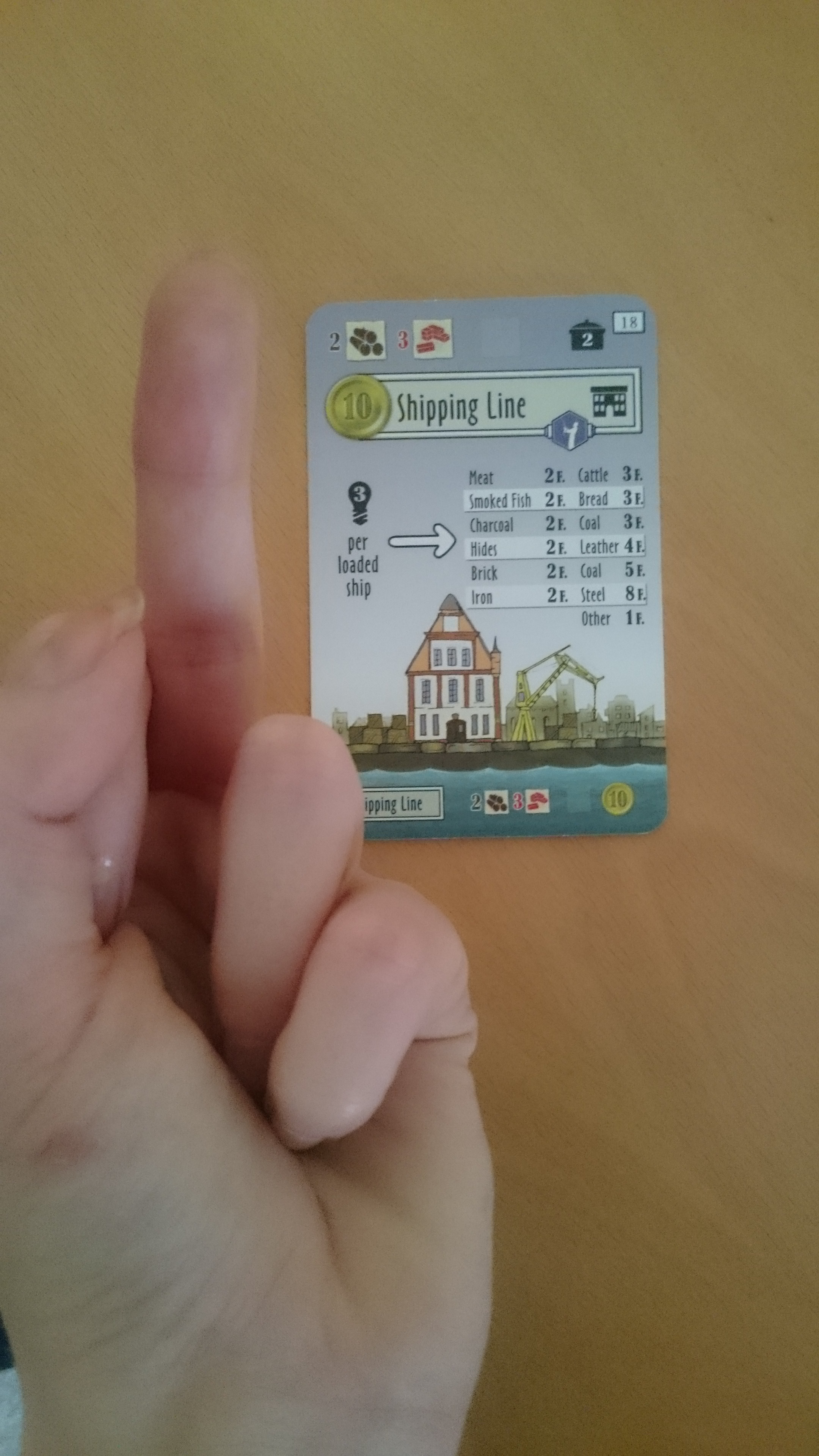
Late game: Shit is going down. Prices, food costs, victory points, everything is now higher than Snoop Dogg at an alpine resort party. Pat and Pete’s wooden armadas provide a set amount of food per round, meaning that they need fewer resources. Briony’s sprawling industrial metropolis continues to grow, which serves to both help generate victory points and convert basic resources into luxury ones. As a result she’s now the first to use the shipping line to sell these goods and make a ton of cash. Unfortunately she spent an awful lot of planning and effort into collecting coal, a resource which was listed on the card as being worth 5 francs, when in fact it turns out there is a printing error. It turns out coal is listed twice, once at 3 francs, and second at 5 francs, which should actually list coke (converted coal) as 5 francs. Briony is a very sad, sooty fisherman. ‘Have mercy, great Poseidon!’ is what should have been called, but by this stage it was more like ‘fuck you, Poseidon. I don’t need to prove shit to you. Get off my back already.’

Endgame: A noticeable effect of constructing literally all of the building cards available is that the port is now brimming with massive piles of resources, including money. Pete has opted to claim huge stockpiles of free wood (feel free to insert* all generic ‘got wood’ jokes here) and clay and is rapidly transforming them into brick to ship, and selling wood in the joinery building. Both are racking him in some big hits of money. Unfortunately there is only one building card that can be used to ship goods (‘the shipping line’), so this is easily the most contended-for card throughout the latter stages of the game. Pat is muscling in on it, and has been shipping cow and coke (that classic combination). As the number of rounds left is ticking down we’re all beginning to hawk everything we can in order to scrape in as many victory points as possible.

If you’ve played Agricola before, you’ll now that scoring can potentially be the most depressing part of the ordeal, with dizzying heights of 11 or 12 winning the game. Now, take that and throw it out of the window. Le Havre has been designed to work in the exact opposite way, with all players scoring well over 100 points. This is probably because resources can be sold for money, as well as receiving money for shipping goods, and counting the cost of your buildings contributing to your final score. Make it rain. Briony has wiped the floor with the others with a closing, and first time playing, score of 271. Fuck you, Poseidon.

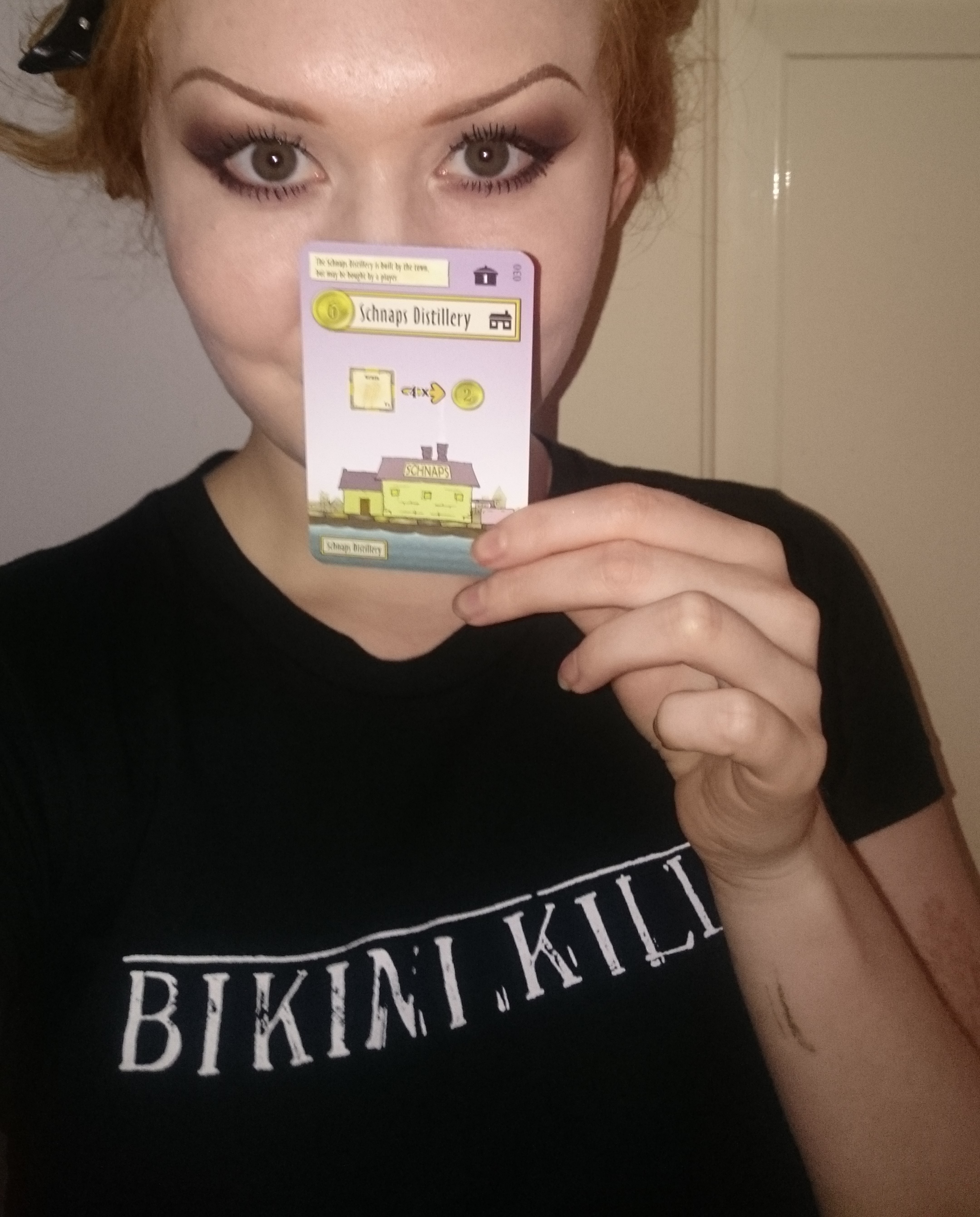
The 'Shnaps Distillery' is a card that Briony fully endorses.
The ‘Shnaps Distillery’ is a card that Briony fully endorses.

In conclusion, our brave reporter and Uwe Rosenberg connoisseur Briony enjoyed this game far more than Agricola for a number of reasons. Firstly, it demonstrates that designers listen to their target audience and feedback, as Uwe has addressed the issue of misery-scoring apparent in Agricola. Despite this, scoring in Le Havre is a little extreme, as it patronisingly cheers you on like an overly-competitive mum at a school football match. ‘LOOK HOW GOOD YOU ARE AT FISHING. GO YOU. SHIP THAT FISH. WOO!’ But you know, that’s okay. It feels quite supportive. Secondly, there is a really wide variety of strategies available that allow you to be very flexible. This consequently means it’s a lot harder to drastically fuck up your turn by miscalculating or not paying enough attention, because chances are there is another free card or action that could have roughly the same benefits. Thirdly, the designs and iconography of the cards, resources and board are really well thought out and themed. And finally, the game is very well balanced and offers more mechanisms, such as selling resources, converting resources to money, and breeding cattle or grain that aren’t available in similar shipping games like Puerto Rico. Definitely check this game out, but be prepared for some intense rule reading and playing a couples of rounds to get the feel of it before diving in to the full version (a shortened one is available too). Or just have a better set of friends who have already played the game before.

DSC_0089

*Feel free to insert all generic ‘insertion’ jokes here.

Top image courtesy of Z-Man Games 

Caylus: Is that a lot of rules or are you just pleased to see me?

By Briony, Lizzy and Bob.

Brutus rating: 6 knives in the back out of 10
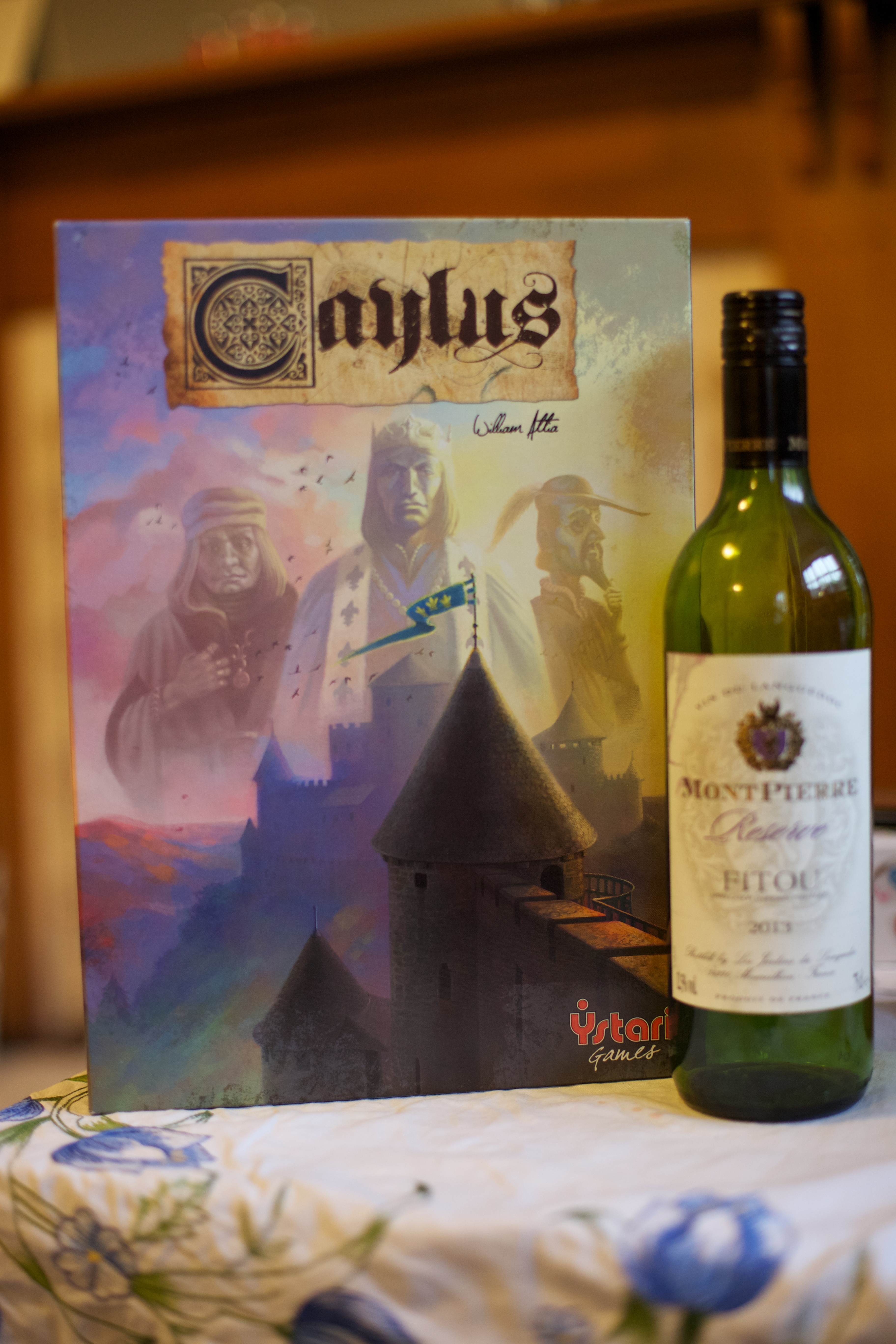
Pairs well with: The best French wine that £4 can buy and a crushing sense of defeat.

The bottle's empty for a reason
The bottle’s empty for a reason

Recently your friend Bob has been ‘Doing Exercise’. This is deeply unpleasant (and if you’d like to charitably sponsor her ill-advised half marathon you are welcome to do so here). Anyway, as part of this whole fitness drive she decided to give ‘Tough Mudder’ training a go. For those of you who don’t know what that is, congratulations. Nor did Bob until last Monday, when she found herself army-crawling across a muddy football pitch with the prospect of push-ups at the end of it, while a group of athletically-attired strangers whooped and cheered her on. The cheers straggled after a few minutes; it’s difficult to stay enthusiastic when you’re standing in the cold watching an overweight goth clumsily wriggle across some grass. It felt an awful lot like PE at school, and even ‘giving it your best shot’ did not make the experience of doing walking lunges while overhead-balancing a car tyre more pleasant.

Getting into the spirit..

It turns out that ‘Tough Mudder’ is just like Caylus. That is, just like crawling along a muddy pitch ‘Doing Exercise’ and wallowing in despair, particularly at yourself and your abilities. Caylus has a reputation that precedes it as being a particularly difficult and frustrating game. It is long, it is punishing, and it wants you to know that it’s all your own fault for getting yourself involved in the first place. And now you’ve fucked up your turn, well done you. “Those jumping jacks/turn order mechanics were just a bit too much for you, weren’t they?” says Caylus. Yup, they were. Once you’ve knobbled yourself over once there’s very little you can do to get your enthusiastic strategy back on track, and instead you’re left to be cynical and grumpy in the corner while everyone else carries on with a lovely evening, occasionally encouraging you not to give up and to stick it out. This introduction to the game might make a person think ‘why would I ever play something that makes me so disappointed in myself, not to mention cold and muddy?’ (OK the metaphor’s getting a bit stretched here), but it is impossible to stress enough how amazing that ‘eureka!’ moment feels when you get it RIGHT. Displacing water in a bath never felt this good.

And now for some game context – ‘The year is 1289. To strengthen the borders of the Kingdom of France, King Philip the Fair decided to have a new castle built. For the time being, Caylus is but a humble village, but soon workers and craftsmen will be flocking by the cartload, attracted by the great prospects and desire to please the King.’

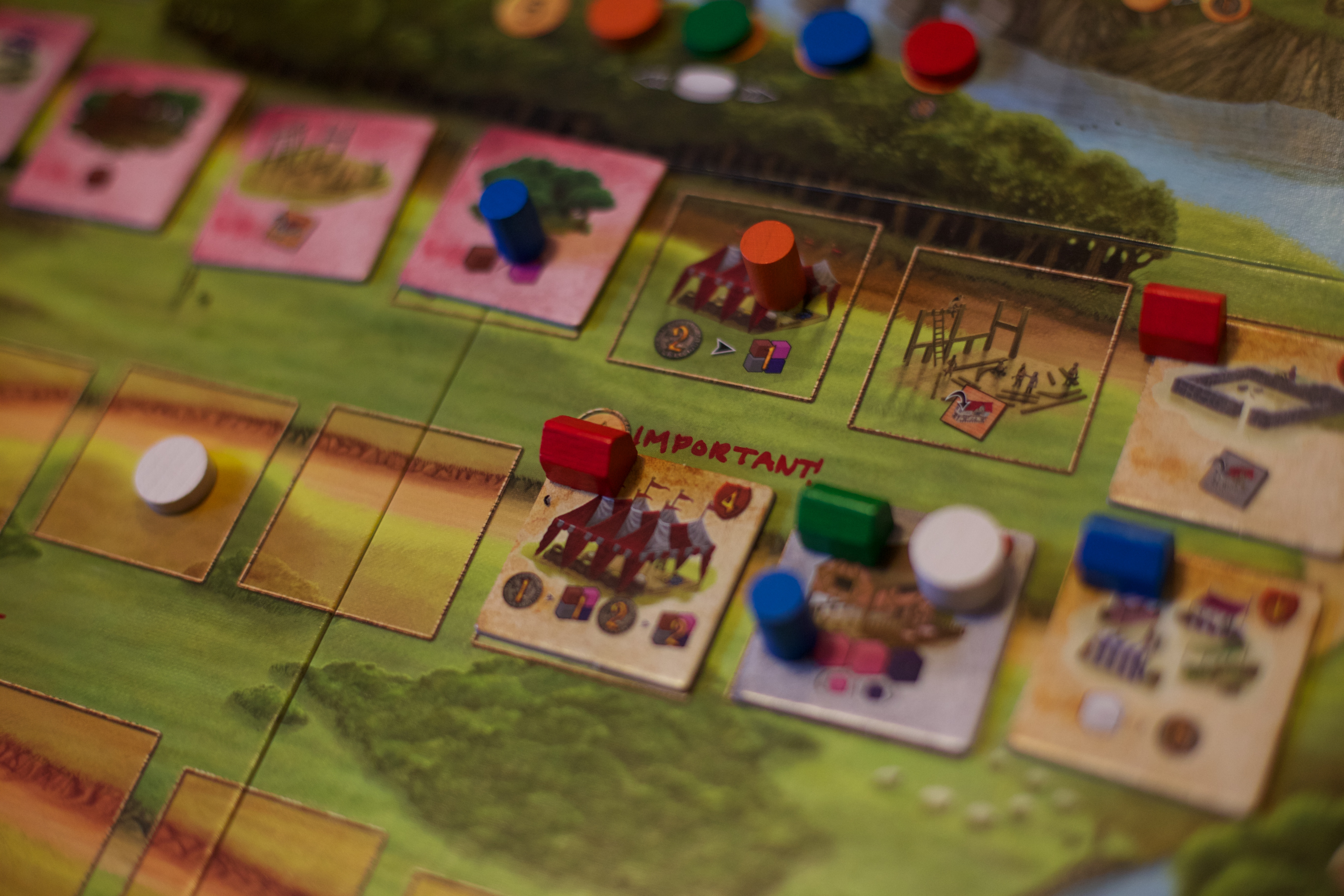
Building things out of your pieces: the real game

Slowly but surely you and your fellow players will be building up the board with buildings and farming resources, turning the village into a thriving mercantile city with a glorious castle dominating the skyline. Also, the castle is going to be built out of pigs. Pigs and velvet. Honestly, you may as well wildly point at the nearest object to yourself and declare that it will become part of the castle. That, my friends, is how castles were build back in the day. Foolproof.

6D-32-72Alongside building the castle you can reap victory points by various other means: gold mining, collecting favours, exchanging money, etc. Going through each of these individually would be deeply tedious and abstract and therefore better left to ‘real’ board gaming blogs (or even (gasp!) the rulebook). Instead let’s talk you through some turns of the game using a recent game between Lizzy, Briony, Bob, and a generic white male gaming buddy (here known as ‘Gord’) as an example. This way you’ll hopefully get an idea of the mechanisms, type of play and how scoring works. From there we’ll highlight some particularly good strategies we’ve come across, and discuss some select ones in a bit more detail. We’ll also discuss the crushing misery of failure. Woo!

You call this a meeple?

A turn of Caylus has a few different phases. Firstly, the worker placement phase in which each player places a worker in turn on an existing building. This lasts until you run out of workers (6), run out of money to place workers (it costs one franc per placement), or you choose to pass (i.e. if there is nothing more you want on the board). The meeples, by the way, are just disappointing cylinders. The pigs are just cubes. We take this to be an artistic statement about capitalism and despair in medieval France.

A pile of pigs, velvet, gold, stone and wood

We’ve kicked off with Briony’s workers claiming a broad range of resources intended for castle building, while Lizzy’s workers are grabbing up some stone and wood and generally sturdy things (stone and wood? To build things with? Ridiculous. It’s almost like she’s seen a building before.) Gord has gone for a construction angle using some architecturally sound pig and wood, and Bob has got some velvet as it is the most flamboyant and least buildy resource available.

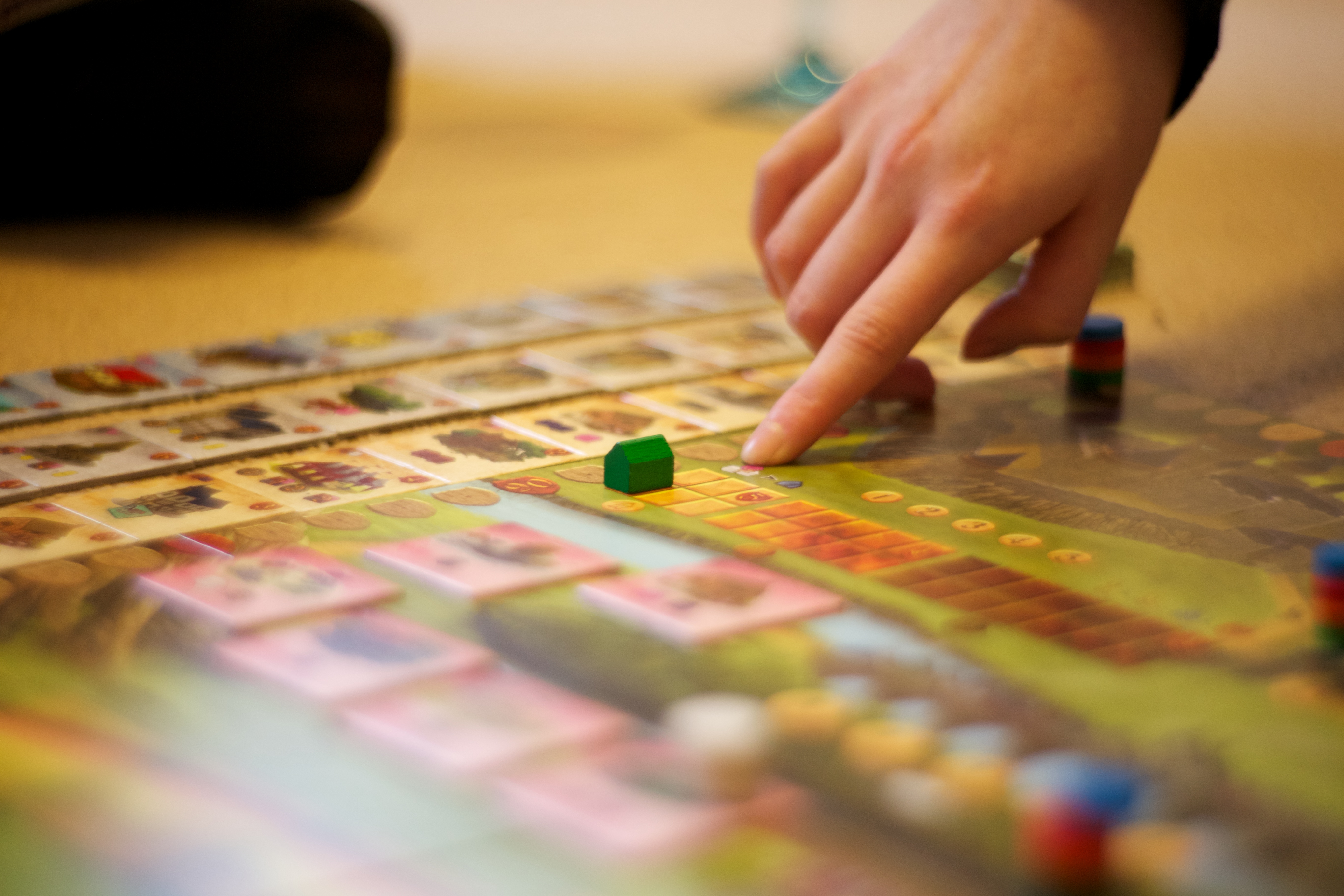
Secondly, there is the job phase. As all buildings are built along a road leading from the castle, the jobs are resolved in the same order as if we are travelling down the road ourselves6D-32-88 (Fortunately we don’t actually have to move for the game, which is good because, ya know, moving). Each building will offer something like resources or the ability to build, and you take the things that your workers were placed on in the order of the road. Order in this game is extremely important, and worryingly easy to forget. To both generate resources and to build stuff you need to work out at what point you are receiving things, which must occur before building in the castle, or having enough resources to build other buildings. We advise the use of the medieval equivalent of a stock-checker at all times.

6D-32-16Thirdly, there is the castle building phase. This can only be done if you place your worker in the castle position during the worker placement phase. A vital part of this is actually having the right resources to build, which sounds simple, but when you’re collecting multiple different things in the previous phase and having to plan out steps far in advance then it’s very easy to accidently pick up a velvet when you really needed a goddamn pig (One of the few games that can trigger the lesser known phenomenon ‘pig-rage’). In order to build in the castle you must have 3 resources, one of which must be a pig, and each of the others must be different types (why, why is a pig a major building resource? This is never addressed anywhere in the rules. This sounds like an extremely inefficient and wriggly way to build a castle. Does anyone have any theories?). Again, a simple premise, but if you organise your stock slightly wrong or spend something you weren’t intending to then it’s pretty easy to rock up to the castle with two pigs and a stone and be disappointed when the king laughs at you. Foolish peon, bringing two pigs with which to build a castle, he needs only one pig! And some velvet! And a rock of indeterminate size!

Another important aspect to bear in mind with castle-building is the extremes that it produces.

Bob's score definitely going in the wrong direction
Bob’s score definitely going in the wrong direction

If you build the most castle in the turn then you receive a favour (which is spent in the favour-reward track of your choosing), however if you place a worker and don’t have the resources to build then you immediately receive minus points. His royal highness is mightily pissed. Bob has demonstrated this consequence beautifully in her very first attempt at getting some victory points, and is now sat sulkily at -2 points, hoarding velvet.

As with many worker-placement games, a viable early strategy is to simply farm resources until they dribble (painfully – in this game they’re represented by wooden cubes) out of your ears. Making more resources happen more easily is therefore an even better strategy, but difficult to do consistently. The very best strategy (that we’ve found), is to be given resources as an idle tax while other players are trying to gather their own. There are three buildings which have this effect, and if you manage to construct all three of them you have effectively broken the game. It’s ridiculous. Especially when you combine it with building green buildings (which have to be built on top of existing non-taxed resources, therefore forcing players to give you extra resources AND generating extra income from green buildings).

A quick break for blog-notes

This is the only real mechanical issue we’ve found with Caylus, but it’s a biggie and is very difficult to stop. No strategy should be that OP, unless there are other big earners that we’ve somehow missed (entirely possible, somehow we don’t get round to playing Caylus all that often). And no, we’re not going to tell you which buildings they are; that would be cheating.

As the game progresses and other players’ strategies become clearer, the daggers come out. Let’s be clear: the biggest dick in this game undoubtedly belongs to you, and it’s aimed at yourself. Even people who are normally competent in their everyday lives can just repeatedly screw themselves over in this game, more than seems statistically probable. You’ll miscount your resources, you’ll forget how to build anything, you’ll even forget when the game ends.

Having said that, there are some excellent ways for other players to knobble you over too, such as by taking the resources that you can see other players eyeing, muscling in on their share of the castle, or by moving a little white token called the Provost. 6D-32-27This little guy, combined with the Bailiff (upon whose head the Provost gently sits), determines how far down the ‘road’ your workers can be placed and have effects, as well as when the game ends. If you can end someone’s turn before they’ve got all the resources or victory points they want, then you can really make their day unpleasant. Luckily, despite the constant shifty eyes and threat of skulduggery as pacts get made and broken, players are often far too focussed on their own misery to try and inflict it on others. That’s what keeps the Brutus Rating at a 6/10.

Despite its typical Uwe Rosenberg-patented Agricola-esque misery this game is, in many ways, perfect. It’s an incredibly ‘pure’ game, in that it relies on a strategic understanding of the mechanics’ abstract interplay. In fact it’s so computational that Chris* maintains it’s not actually a game. We would disagree; its dry strategy, intricate game scenarios and yet almost absurd lack of flexibility makes playing it surprisingly intense. It brings out serious turn-narcissism** as you desperately and meticulously line up your strategy. And when it works… oh god, when it works…. The feeling of relief, pride, and joy is, we imagine, much like giving birth. No exaggeration. This game is definitely not for everyone, requiring a fair amount of time and dedicated concentration, but it’s so very worth it, and makes you genuinely feel like you’ve accomplished something at the end of it.

As a final tip we strongly advise keeping tabs on the timing and resources you have at all times, and be aware of when the round, or even game, will end. Briony has solved this in a rather eloquent way on her copy of Caylus. The kind of eloquent way that was triggered by in-game anger and a sharpie. Be warned, folks, but also enjoy trying new strategies.

HS-1-25

We recommend it more highly than Tough Mudder training, at least.

*Friendly robot boyfriend, see Steam Park and Shinobi-WAT AAH! reviews, previous.

** There’s a fairly well-known concept in the psychology of narcissism called ‘conversational narcissism’, in which a speaker in a conversation pays almost zero attention to the other speakers, instead focussing entirely on what they want to say and simply waiting until a moment when they can take their turn to talk. Bob insists that ‘turn-narcissism’ is the same and totally real, but applies to when you’re waiting to take your turn in a tense game.

Credit and thanks to our pal Dr Photographer for the photos

Glass Road: Why would you build a road out of glass?

Brutus rating: 4 daggers in the back out of 10
Pairs well with: Bavarian beer, some sort of spirit in a flask that can be carried around while toiling in the German forest.

6D-32-209

6D-32-45
But why would they build a road out of glass, though?

Glass Road is a self-proclaimed ‘celebration of the 700-year-old tradition of glass-making in the Bavarian Forest’.* Just hearing the rules being read can make someone on the other side of the room sit up and ask ‘Are you playing Agricola?’. That’s right kids, it’s an Uwe Rosenberg game! For those that don’t know, this guy is arguably the king of European board games. His other offerings include Agricola and Le Havre, a game Briony has owned for more than a year and never played. It is said just looking at the rules booklet can cure insomnia. If you’ve any experience with European board games generally, and Rosenberg’s games in particular, you might reasonably expect this one to be heavy on the worker-placement, fairly abstract, and deeply German. Surprisingly, it’s only one of those things, and even then not as badly as some others**. It’s not even hideously long or punishing, and doesn’t make you curl up in a corner after screwing up your 3 hour long strategy in one single turn.

Let’s take a step back and tell a story. It’s the beautiful tale of why this game makes sense on both a conceptual and mechanical level, and is nerdily satisfying in the same way that all good game-lore is satisfying. Imagine you’re a rural baron in pre-Industrial Germany. You have a fair6D-32-202 bit of land, though a lot of it is green and covered in trees. Lizzy informs us that these are called ‘forests’. You also have lots of extremely hard-working peasants who are happy to do your bidding. They’re invisible, but they’re there, toiling in the harsh German sunshine. For some reason you also have a glassworks and a brickworks. This is a bit odd because you don’t have any of the raw materials to make glass and brick yet, but just go with it. I’m sure you’ll find some sand and mud soon enough.

6D-32-29
Why?

Your neighbourhood barons seem to be making a lot of money off this whole ‘production’ trend, so you decide to jump on board. You hire experts in the fields of farming and food production, irrigation, building, and quarrying to help you turn your land into useable raw materials. You can even get on board with a local feudal lord who has some excellent architects on exclusive retainer (‘The feudal lord is suitably fat. That’s good’ – Briony). Your invisible hordes of hard-working peasants, as soon as they’re given sufficient food and resources, immediately set to it in the glass- and brickworks and before you know it you’ve got some luxury items. These you invest into building factories, luxury second homes, and highly-efficient farming conglomerates. Eventually the buildings and luxury items earn you a bunch of cash moneys and then the game ends. Whoever has the most cash money at the end of the game wins. In this it’s very much like real life, and also extremely like Puerto Rico.

There are, of course, some complicating factors. If your neighbouring barons also want the use of the expert artisans then you will have to split the amount of work they can do. If you hack and burn all your forests to build farms there will be no pristine land to place a successful hunting lodge. If you accidentally over-feed your workers they’ll continue to produce glass and brick even when what you really wanted were the raw materials they were sitting on. Briony has a degree in geography and says that this is sort of how rocks and stuff work: cool stuff is usually underneath other more boring stuff, and it’s a shame medieval peasants didn’t know about taking core samples.

6D-32-192This game is actually kind of adorable and well-designed (though it is, according to Briony, geographically inaccurate). Some of the little resource tiles have unique bits of illustration, and spotting them is a treat. Not gonna lie, it has some haters, who seem to dislike it for the same unusual mechanic that other people love. That is, the big individual cardboard dials that tally6D-32-199 your basic resources (coal, food, etc.) and determine when they get used up and turned into the more luxurious brick and glass. Tzolk’in lovers will probably have some familiarity with this from that game’s corn-and-worker gear machines, while Caylus players will enjoy the familiar feeling of not having tallied their resources properly and fucking up their entire turn. Some people blame this on the game rather than their own fuzzy-minded planning, but that’s on them. A more reasonable criticism of Glass Road is that it has no easy or clear way to tally point-scoring. There’s just an awful lot of counting at the end of the game, again a little bit like fuzzy-strategies during Puerto Rico.

At the start of the game it’s pretty difficult to know what you’re trying to do. However, like most worker-placement games, collecting resources is usually a good start. Each player begins by selecting 5 of the 15 cards which represent your agriculture/industry specialists (a water carrier, a slash-and-burn farmer, a sand-quarrier (is that a thing?) etc.). On playing these experts you will be able to transform the cardboard tiles representing your land (initially representing such useless things as ‘trees’, and ‘lakes’) into resources of charcoal, food, sand, and water. Briony begins by selecting 5 cards more or less at random and plays a fish farmer. Unfortunately she’s apparently either very good or very bad at determining a useful specialist to hire, as both Lizzy and Gord (today’s Generic White Male Gaming Buddy) reveal that they also wish to hire the fish farmer. This means they only get half the use out of their fishing expert. The fish farmer, being a dick, doesn’t like sign a contract of exclusivity saying he’ll finish one job before starting another; he just does two half-assed jobs at the same time. Again, this is much like real life.

6D-32-186Once the great cardboard dials of industry have turned, you may use the product of your workers’ labour to further your cause as a budding capitalist. Buildings have unique effects on gameplay, which can be long-term, such as upgrading your glass factory; one-shot, such as generating a wad of cash; or end-game, giving bonus points with the caveat of certain accomplishments like ‘not turning all your lakes into factory run-off’ or ‘flattening vast swathes of land into sandy Depression-era dustbowl wastes’. Which buildings are more useful and desireable becomes clear as the game progresses. Once Briony and Gord had gotten the hang of their first game she became quite adept at snagging all the buildings that Lizzy wanted.

6D-32-28
Why?

This game requires flexibility as well as forward-planning. A perfectly-devised strategy is likely to go awry as there’s no way to be sure of which buildings will be available to play, or which specialists you’ll have to share with your opponents. This is why Bob loves this game. She has a lot of very clever, strategically-minded friends who can logic out the best path through a game like a shark swimming through custard. Bob has a slightly more… lateral (ass-backwards) approach, picking up whatever strategy looks best at the time and throwing her toys out of the pram when it inevitably goes horribly wrong (we don’t talk about Black Fleet. So many little cubes were lost that day…). Somehow this really works for Glass Road. Unfortunately, Bob was busy cleaning up gaming-snack detritus and sat out this game.

In conclusion, it’s a nicely designed game, with just the right of in-game mechanics. It’s themed well, and has multiple strategies that my lead to victory that keeps intense direct competition to a minimum. The dials, ever becoming more popular in modern board games, certainly give a new dimension to resource collection. We recommend it highly. Also Lizzy wins again.

Laid out in all its glory. image courtesy of boardgaming.com

*Fun fact, you can totally go to Germany and tour the black forest’s monuments to the real glass road. There are glass museums and craft workshops and everything.

**The most unashamedly German board game is quite possibly Glück Auf (and then only until someone with a name like Rosenmüllentheimermassbergsohn invents a game called ‘Strategic Worker Placement in an Industrial or Agricultural Setting’***). It’s set in the Industrial Revolution-era Ruhrgebiet (basically the Black Country of Germany) and is about coal mining profits. The title is traditional German pit-lingo for ‘good luck’.

***’Strategische Arbeitereinstellung in einem Industrie- oder Landwirtschaftsszenario’. Catchy, no?

Photo credit and thanks to Dr. Photographer