Battlestar Galactica: or ‘how to legitimately take out all of those secret grudges you had on your friends with bullying and wild accusations’

Pairs well with: Space whiskey for the humans, some kind of oil-based fuel for the toasters
1

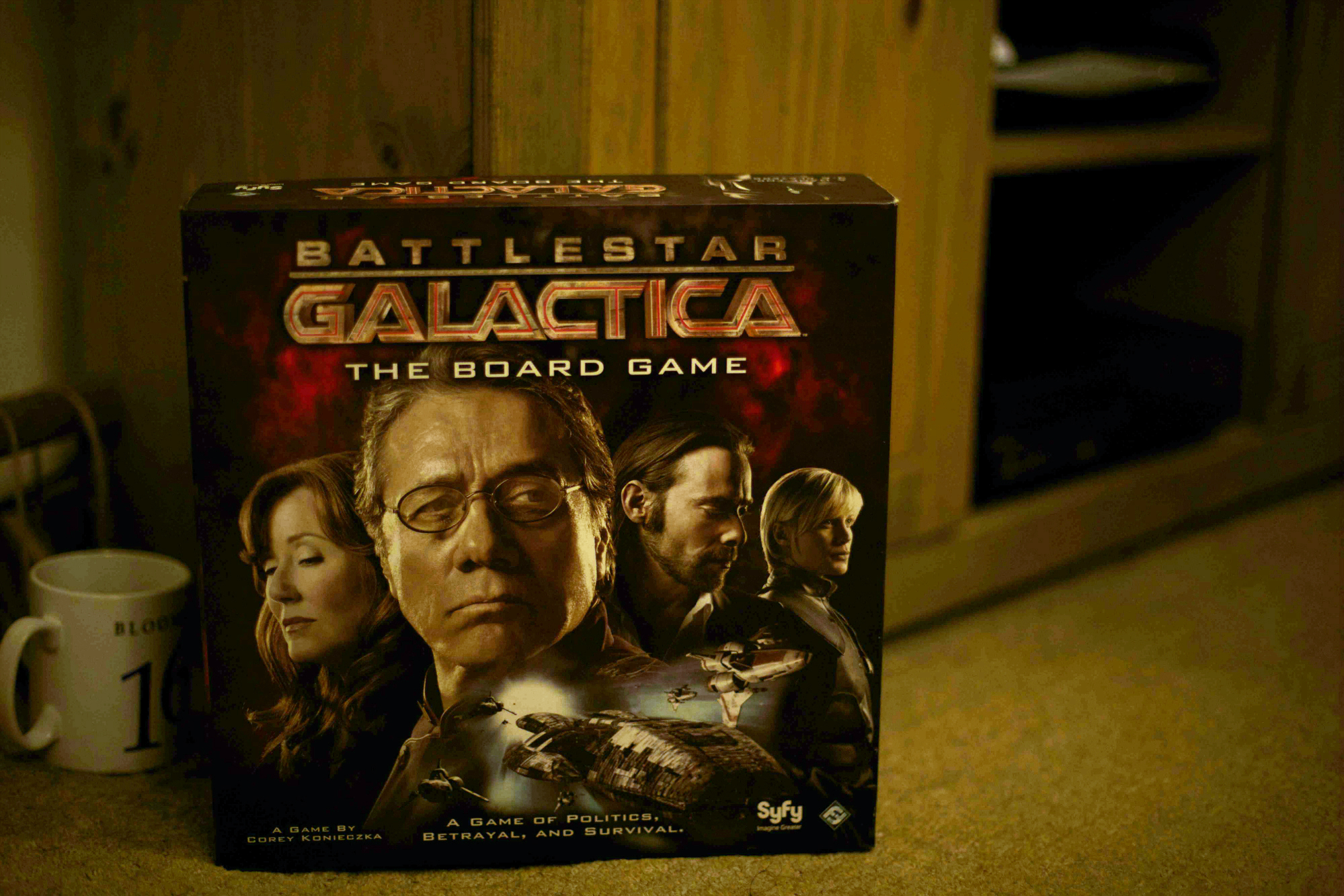
In a fit of hostility we’ve decided that it would be a great idea to take on a traitor game two weeks in a row. Who can say why? Perhaps because once you’ve started stirring the resentment-pot then you might as well keep going until you have a delicious broken-friendship-soup. Or perhaps it’s because games with a traitor mechanic are bloody brilliant.
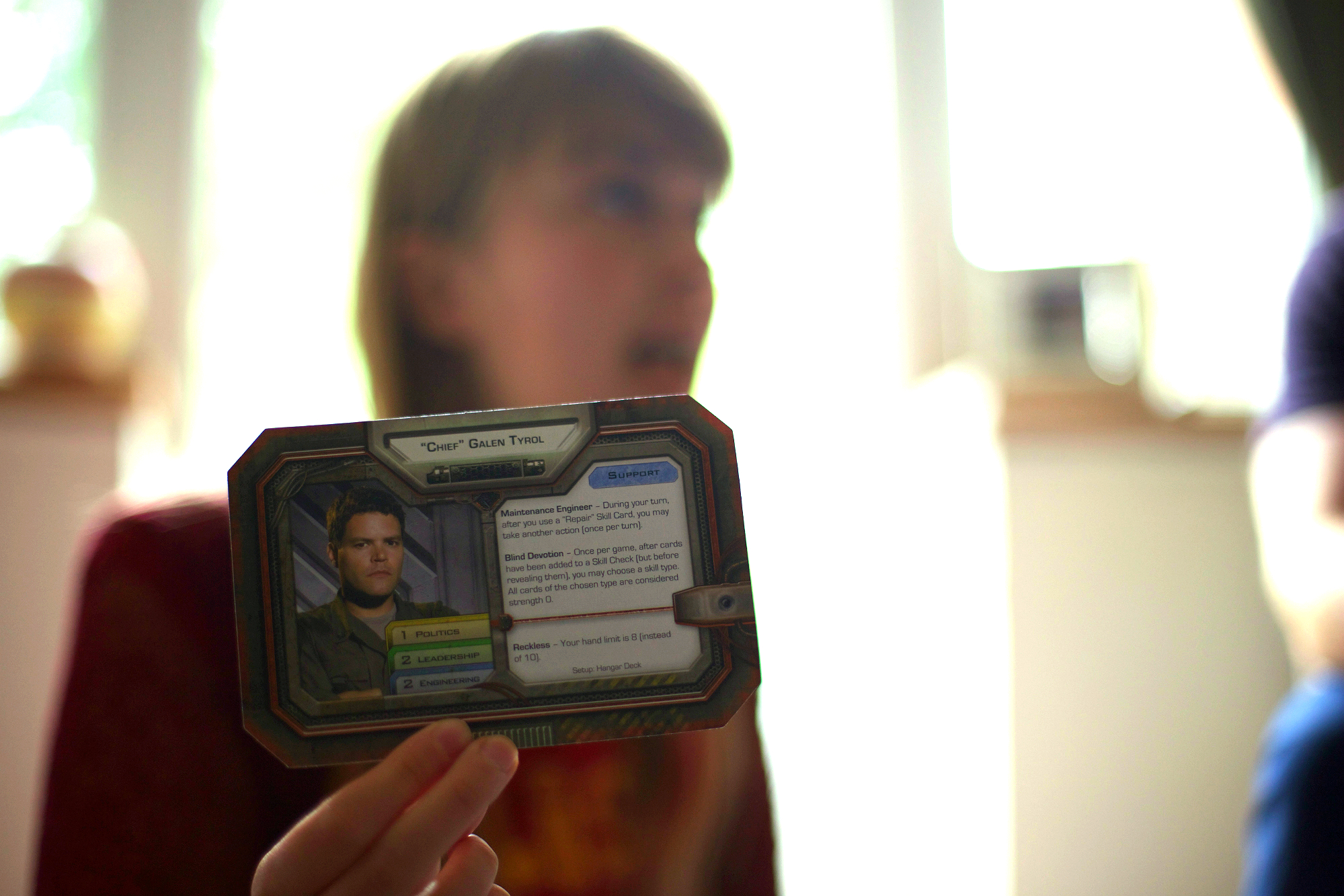
2As far as traitor games go, Battlestar Galactica is one of the greats. A familiarity with the television series isn’t necessary, but is a good idea regardless of your position on board games since it’s pretty damn good. (What’s that? Strong female characters? More than one?! Don’t mind if we do!) As such, we’ve always found it a good game to whip out with a group of friends no matter their gaming experience or level of nerdiness. We have all kinds of gateway drugs board games here.

3A willingness to play along when it comes to shouting at each other always helps, though. Like with a lot of traitor games, a lot of the real fun comes from player interaction, rather than clever mechanics and strategies. But that’s good, and there’ll always be space for those sorts of games too in our board game collections. Be wary about playing it with a room full of very quiet people though: we’ve all had mishaps where we have been the only person in the room accusing, thinking ‘maybe if I get this going, everyone will join in…’, when ultimately the room silently and awkwardly judges you. We have instead worked out through trial and error that you will require at minimum of two louder people (three if possible), who are poised and ready to create a shouting, energy-fuelled, accusatory positive feedback loop between themselves. As they get louder, and the claims get wilder, the other players in the room are drawn in like the event horizon of a black hole.
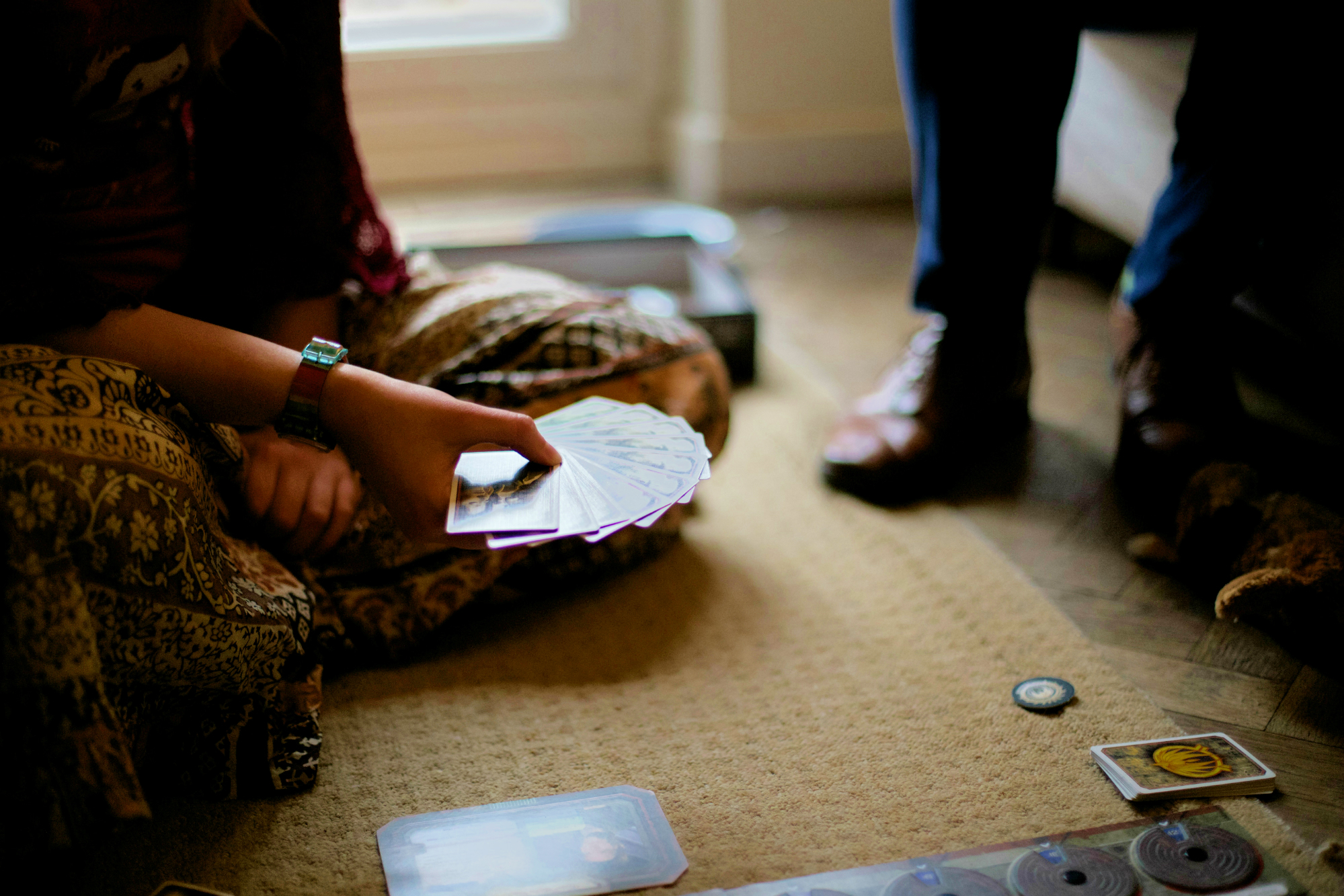
Pick a loyalty card, any loyalty card!

It doesn’t even matter if their accusations are true – say literally anything to gain the room’s unyielding attention. ‘I put it to you could have stolen that cargo before you baked the innocent unicorn into the birthday cake!’

Continuing, the theme is a really well-done sample of the well-trodden trope of “human-makes-artificial-intelligence. Artificial-intelligence-thinks “fuck-this-I’m-a-mother-fucking-bad-ass-robot-I’m-having-you-all-for-breakfast-except-I-don’t-even-eat-meat-because-I’m-a-robot-so-I’ll-just-kill-humanity-and-mount-your-squishy-heads-on-my-wall-as-a-trophy””. Humans are the “good guys” (say The Humans) and Cylons (or “robots” or “toasters”) are the baddies. There tends to be one or two toasty traitors per game, depending on numbers, and traitors will discover their role secretly with hidden cards that are given out at the beginning and in the middle of the game.*
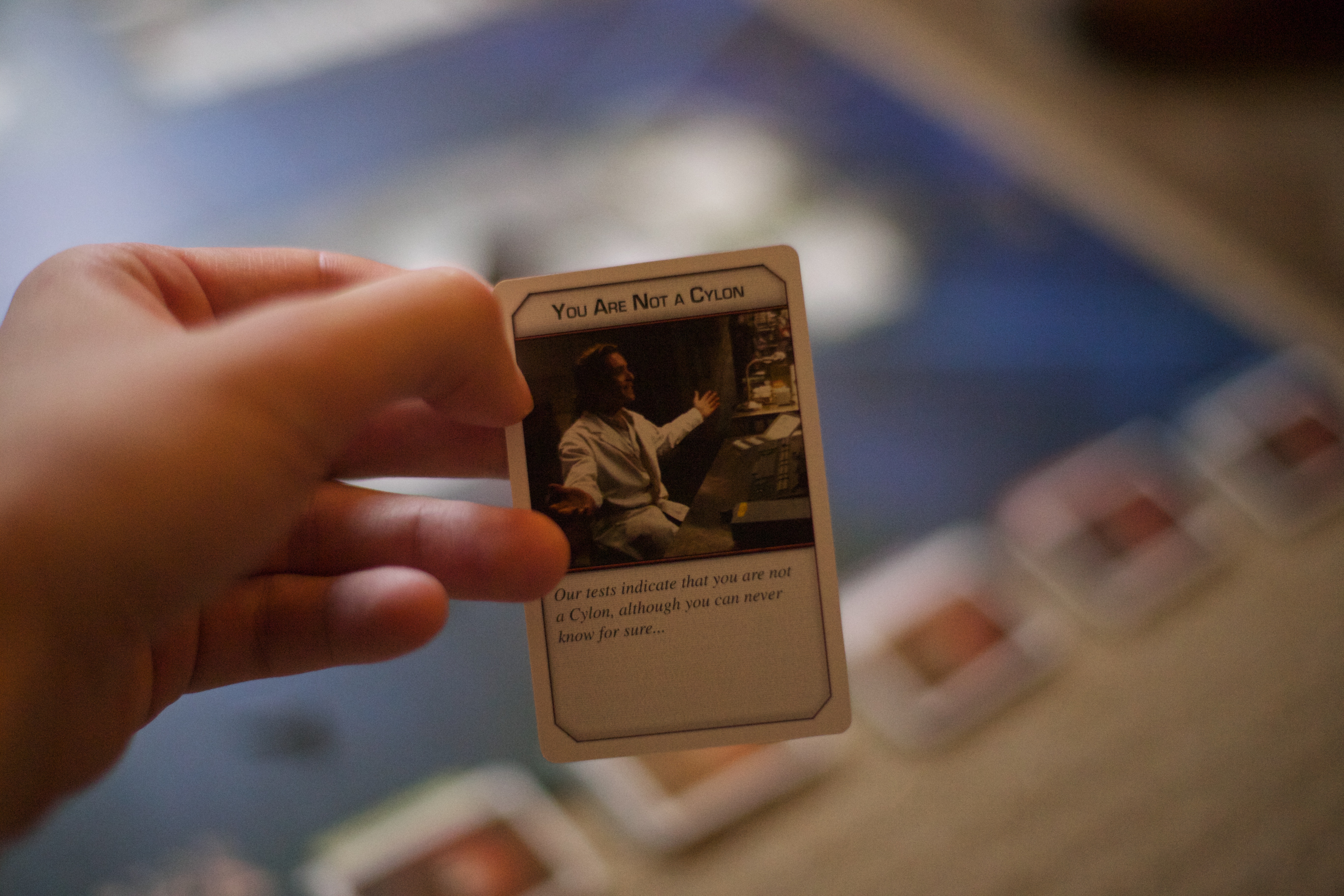
Dr Photographer is a good guy. This time!
Dr Photographer is a good guy. Not in real life, maybe, but in this game.

No matter how much you sit your friends down and tell them to please, carefully read the page in the instructions about what to do if you’re a Cylon, and please all make sure that you understand it all and ask any questions before the loyalty cards are handed out and the game begins, there’ll always be one person who picks their loyalty card, looks at it, looks uncomfortable for five minutes and then has to meekly ask to see the rulebook and shiftily hide which bit they’re reading. This is not a subtle Cylon strategy and we recommend avoiding it if possible.

The sympathiser
The sympathiser

One downside that this game has, (at least, nobody we’ve ever played with has seen it as an upside, that’s for sure) is the way that it deals with certain numbers of players. Camelot, for example, makes the brave move of always having only zero or one traitor per game, no matter the number of players. (It also leaves you with this nifty ability to introduce and lose players mid-game if people suddenly want to join in- genius!) Battlestar has this determination to balance things out, which maybe goes a little bit too far. The Resistance does this to a lesser degree, but still it’s super fucking difficult when everyone is shouting ‘BAD GUY’, and half of the room actually is…

More players (5+) means more Cylons. Fair enough! That can be kind of fun. There are still more good guys than bad guys and there’s an extra level of fun you can have with two Cylons working together to defeat the pesky noble humans.

Playing Battlestar with 5 players is excellent! Two Cylon traitor cards and a lot of fun. Playing Battlestar with 3 players is pretty good too, one Cylon traitor and still enough people for a bit of the ol’ shouting and accusing. With four or six players the game starts worrying that maybe it needs to add more bad guys but also there aren’t enough players for more bad guys, so it says “Shit! We’ll introduce this sympathiser to add instead!”

Let me out of the brig!

Nobody wants to be the sympathiser. The sympathiser is a poor player who gets dicked over at the ‘halfway’ point of the game. If the human team are close to death then the sympathiser is a Cylon who sympathises with them, and gets put in the brig but is still on the human team. If the human team aren’t quite teetering on destruction yet then the sympathiser is a dastardly human who sides with the Cylons but can’t do the full range of Cylon moves. So in attempting to balance out the human vs Cylon ratio the game just selects a player and shits on them a little. Boo, sir.

A team that’s getting along fairly well might find themselves trying, on purpose, to lower a resource to a required level so that the sympathiser that’s about to be chosen will side with them. How does that translate into plot? It doesn’t, it definitely doesn’t.

“Why are you chucking all of that food out of the airlock, Sir?”
“Oh, I was hoping that if we get a food shortage then the Cylons will start to take pity on us.”

I don't mean to worry you all, but this card says
I don’t mean to worry you all, but this card says “Ambush”…

Is there also something a little shitty about being a regular Cylon who only gets their traitor card halfway through the game? After you’ve been trying so hard to stay alive this whole time? Maybe, but that does kind of work as a mechanic. You realise your programming, you realise you’ve just been trying to blend in with the fleshbags and earn their trust, and now it’s up to you to make them pay.
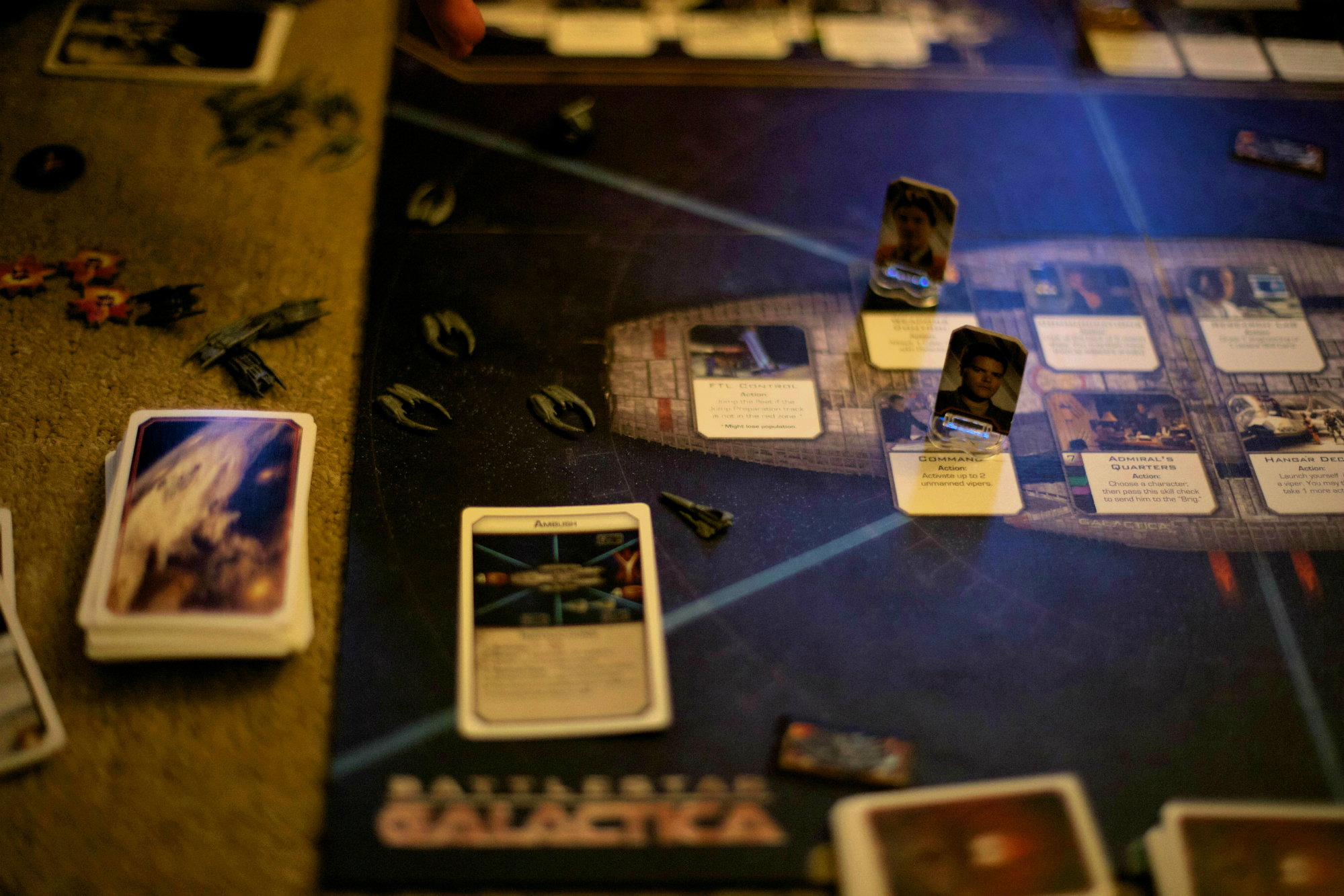
Shit's going down
Shit’s going down

The plight of the humans is pretty damn difficult anyway, as it should be in any co-op game. You don’t want victory to come easy, you want all of your games to be a painful and horrible slog, clawing hopelessly at all your resource dials and trying to stay just about afloat in time to reach the end of the game. Our photographer bought this game over one evening when we’d requested a “small-to-medium sized game”, and he insisted against Lizzy’s protests that it would totally be fine. Several hours later he confessed that, actually, it was just so rare that he’d survived long enough during a game that he barely knew the full length of it.

The card appropriately titled
The card appropriately titled “Loss of a Friend”

Perhaps Lily the dog had the correct tactic when she just waltzed in and knocked everything over. Good girl, Lily.

The gameplay itself has two important rules that aren’t mentioned explicitly in the actual official rules set. Firstly, whenever someone does anything it’s important to determine why, assume that makes them suspicious, and to yell at them for probably being the traitor. This is particularly the case when it’s something that you know they had no choice over.

“OH! You just happened to draw THAT random card, huh? Just what the Cylon would do.”
“OH!! You’re going to the bathroom NOW, huh? Seems like you’re all too keen to convince us of your human functions, huh? cough cough CYLON”
“I saw you touch the toaster this morning, to get toast huh? Lies. You don’t like toast. More like communicating via instantaneous up-link the invasion plans back to the general!”
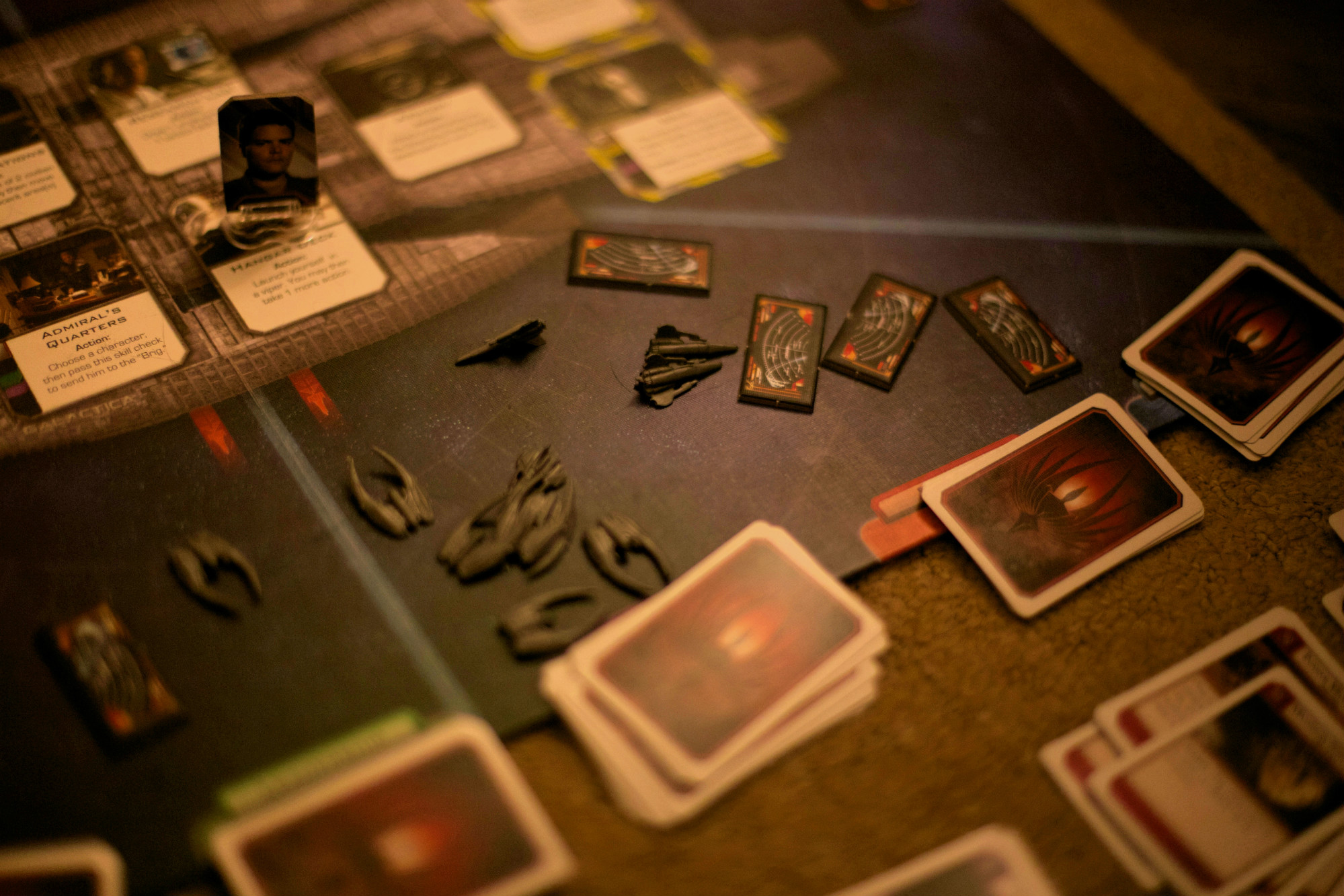
THEY'RE EVERYWHERE
THEY’RE EVERYWHERE

Secondly, it’s important that you make the appropriate noises when you’re trying to blow things up. Every time one of us forgot to make the appropriate “pew pew” noises as we rolled a die to destroy a raider, we failed. COINCIDENCE?**

Appropriately for a team of misery farmers and their friends we ended up losing from too much misery. Losing any one of your four main ‘resources’ will end the game. It’s pretty clear how this works in terms of running out of population (“Guys? Where is everyone?”), food (humans need that to survive, apparently) and fuel (“Ok, ok, we’ll just float around in space… let’s see…”) but it’s not as clear what’s happening when you run out of morale. Mass apathy? Everyone just goes to their room and has a little sulk? Riots, perhaps?

Too much misery
Too much misery

Whatever it was, it got us good. It was an apt representation of our real life selves, as Sophie was just starting to fall asleep in the corner.

It’s a great game for several players and several hours, as long as you have a good team of people keen to accuse each other. Good luck, brave humans. Get your accusatory pointed finger at the ready.

*of course saying that traitor cards are handed out in ‘the middle’ of the game is a generous but loosely-used description. It’s the middle of the game in theory, if the mighty humans are heading for a full game and a victory. It is, unfortunately, also possible for the game to not even reach the point of handing out the second round of cards before humanity gets blasted into oblivion. It maybe wouldn’t be too shocking if this happened when there aren’t even any traitors on board yet.

** Yes.

Credit to Adam “Not the cylon for once” Photographer-friend for the photos. (Usually about 50% game and 50% hamster these days)

Shadows Over Camelot: Knights of the Round Board Game Table*


Pairs well with: Mead (straight from the Holy Grail)

You know the hamster's in the way, right? Sigh. Of course you do.
You know the hamster’s in the way, right? Sigh. Of course you do.

There’s a lot to be said for a game with a traitor mechanic. And that’s not just because we’re a group of ruthless, soulless, naturally traitorous types who like nothing better than to yell accusations at each other across a table, floor or other flat surface. I mean sure, we are that, and such qualities do lend themselves to particularly enjoying traitor based board games, but still. There are also objective reasons to love a traitor game!

For example, co-operative board games, which the team love (see Letters From Whitechapel), can sometimes suffer from a bit of the ol’ problem where one person knows the game slightly better, or perhaps has a slightly better mind for tactics, and so effectively ends up controlling everything all of the other players do.

2 “Hmm, what should I do for this move…”
“Probably go throw a sword in that lake.”
“Well, I could, but also-”
“Yeah but seriously, the lake.”
“K.”

And nobody wants that.

There are several solutions to this kind of problem in co-operative games, but one trusty solution is the traitor mechanic. If there’s a chance that the person offering you advice is secretly a duplicitous scum bag trying to con you then you’re maybe not going to be so ready to take that advice after all.

One of the players has three feet, but that's probably not too much of an advantage in this game.
One of the players has three feet, but that’s probably not too much of an advantage in this game.

This review was written during a particular game of Camelot with Dr Photographer, three other friends not yet quite fully immersed into the board gaming world and a hamster. And Lizzy ‘usually the traitor’ Blogger, there for journalism and science. The Misery Farmers: Having Fun So You Don’t Have To since… earlier in 2015.

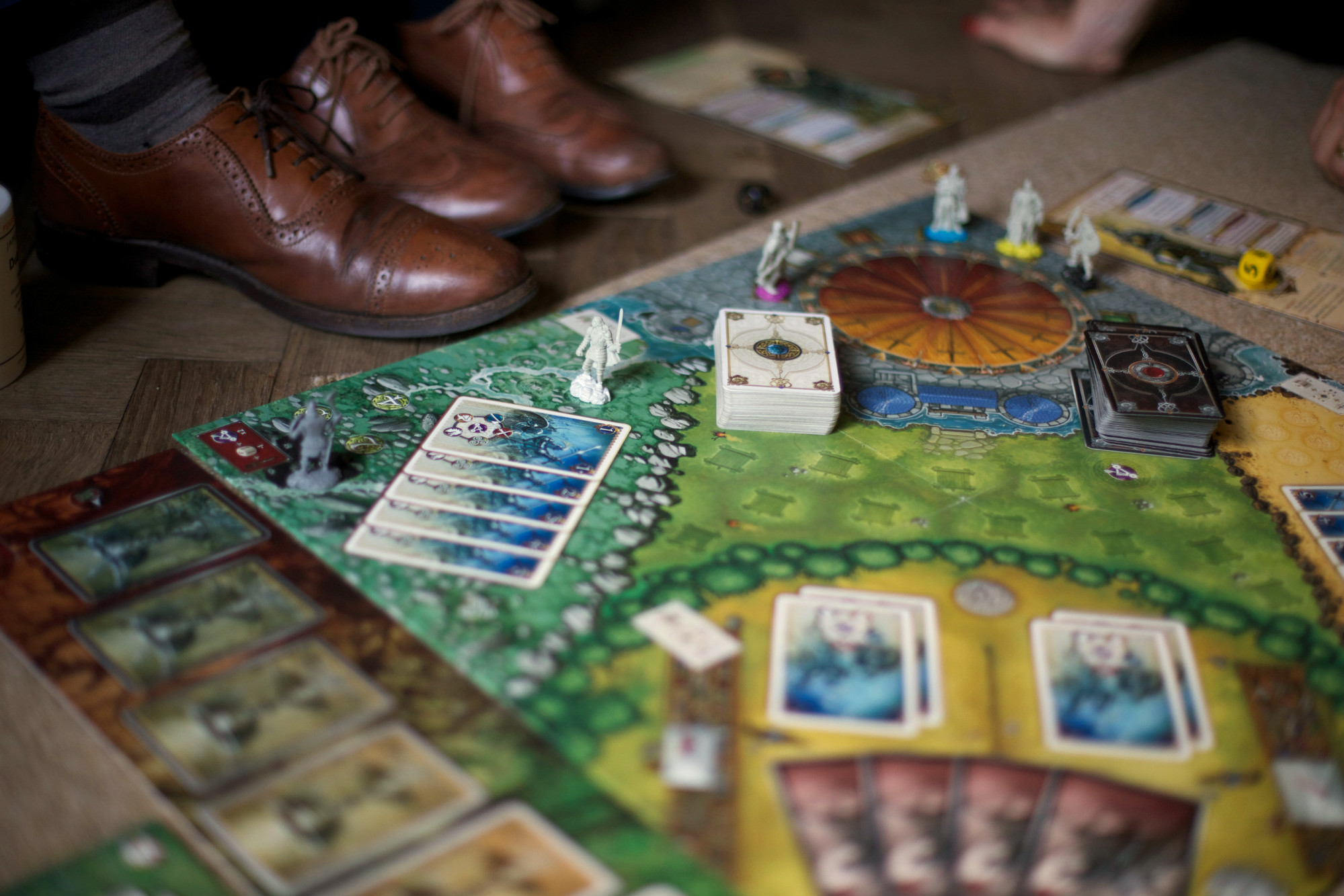
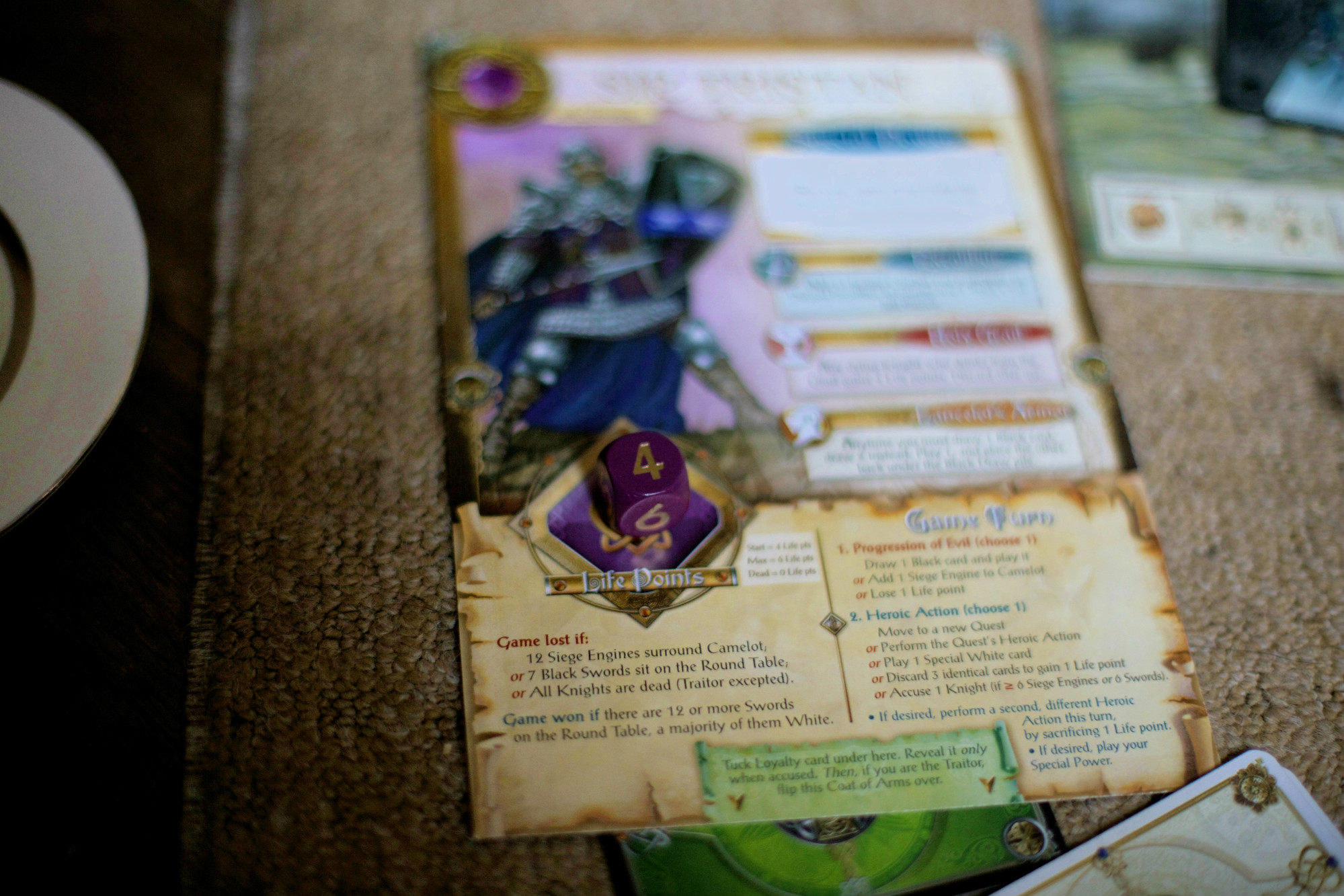
In Shadows Over Camelot the team all play a group of plucky Knights of Round-Table fame. There are several to choose from: these range from the old favourites like King Arthur and Sir Galahad to various lesser-known characters to the farmers such as Sir Tristan ‘the purple one’ or Sir Bedevere ‘the blue one’. (‘Bluedevere?)

TRAITOR GAME?
TRAITOR GAME?

With your character you get a die, a little knight to move around, and a character card with some sorts of special abilities and spiel. Our particular band of plucky adventurers for the evening contained a couple of friends who were still, as mentioned above, fairly new to and slightly wary of all of these board gaming shenanigans, but we had thankfully managed to rile them up get them into the spirit of things with a few rounds of The Resistance first. As such, everyone was ready and willing to start yelling at each other straight from the get-go. Characters were still being dished out when our dear friend Sophie started screaming:

“I’ve seen his card! IT SAYS TRAITOR ON THE BACK!”

Of course, each of the character cards have a ‘traitor’ side on the back with an alternative set of tips and instructions, for if the traitor ends up being revealed. A quick cup of tea and some reassurances later, we persuaded her to stop screaming accusations until the traitor cards had actually been dished out.

“You can be the traitor even if you’re King Arthur?
“Nobody ever suspects King Arthur.”
*Lizzy looks guilty from a previous game*

5

Shadows Over Camelot is an excellent example of a traitor-based game. It has all of the best elements: mystery being one. The traitor card is shuffled into a deck with a bunch of ‘regular old good-guy’ cards and there are always more cards than there are people who receive them. That means that you have no idea whether there’s actually a traitor in the game after all! All of these wild accusations you’re throwing round might all be for nothing. Maybe everything’s fine! Right guys?

It also has the important traitor-game element of hidden cards. The actions available to any brave knight at any given time will be difficult to predict because, quite rightly, players are forbidden to say exactly what cards they have available to them, in terms of specific values and such. For example, one common card is a sword card, which can have a number from 1-5 on it, and the different numbered swords can each be used for very slightly different things. Players aren’t allowed to say specifically which kind of sword they have. (Although they will keep trying to forget this rule and someone (Lizzy) has to play the spoilsport and keep reminding them to shut the hell up)

Tremble before my medium-sized-swords, Saxons!

This does, of course, lead to questionable gesturing and hinting at points which definitely seems to border on maybe not quite following the rules properly.

“Right, I’m making an effort to get rid of these bloody Scots again. I’ve got some… little swords, kind of more like a variety of knives, really. Can someone come and help me out next turn with … uh… some medium sized swords? You know, swords that aren’t that big and aren’t that small… nudge… nudge nudge…”

The beauty of having the full range of options for any one knight hidden from the rest of the table means that it’s always a little bit unclear whether any given person is having a run of bad luck, a traitorous scumbag or are just being plain incompetent.

Almost certainly the traitor

On her first couple of turns, Sir Sophie of new-to-board-gaming fame had trotted off to an area where she could only be of use if she had a 1-Sword card, and promptly in the next turn complained of having no such card and being unable to help. Instead, after only the mildest of chastising, her fellow brave-knaves directed her to the opposite side of the board where some “medium-sized-swords” could be useful instead.

Another round of loyal knightery, holy-grail finding and throwing things into a weird lake later (and other Camelot-themed activities that make the game up) and Sir Sophie’s turn came again. This time, she protested, she was very sad to say that she was unable to help with the current quest at all, the only swords she had on her were 1-Swords!

The keenest of detectives among you will notice that there seemed to be something suspicious afoot.

“Nope, definitely can’t help out over here.”

“Oh, golly gosh, did I say that I didn’t have any of those last round? Oh! Oh my, my bad. I’m just not very used to this game yet. I think the card must have been hidden behind my other cards, sorry chaps!”

It’s a real testament to the team’s faith in Sophie that they all still carried on for several turns believing that she might actually just be playing the game incompetently rather than be the traitor.

Sir Dr Photographer-friend even went so far as to formally accuse Sir Lizzy of being the traitor for what seemed to be ‘the-hell-of-it’ rather than to doubt Sir Sophie. EVEN THOUGH Sir Lizzy had been the only knight to have actually won the good guys any points that far in the game. (definitely not bitter!)

All of the elements of mystery in Camelot not only make for great yelling at your friends but also for great gameplay. The game can be won or lost depending on how many black or white swords fill up the round table at the end of the game, and good swords can be converted into bad ones if you falsely accuse someone of traitorhood or if a traitor remains hidden and undetected right until the end.

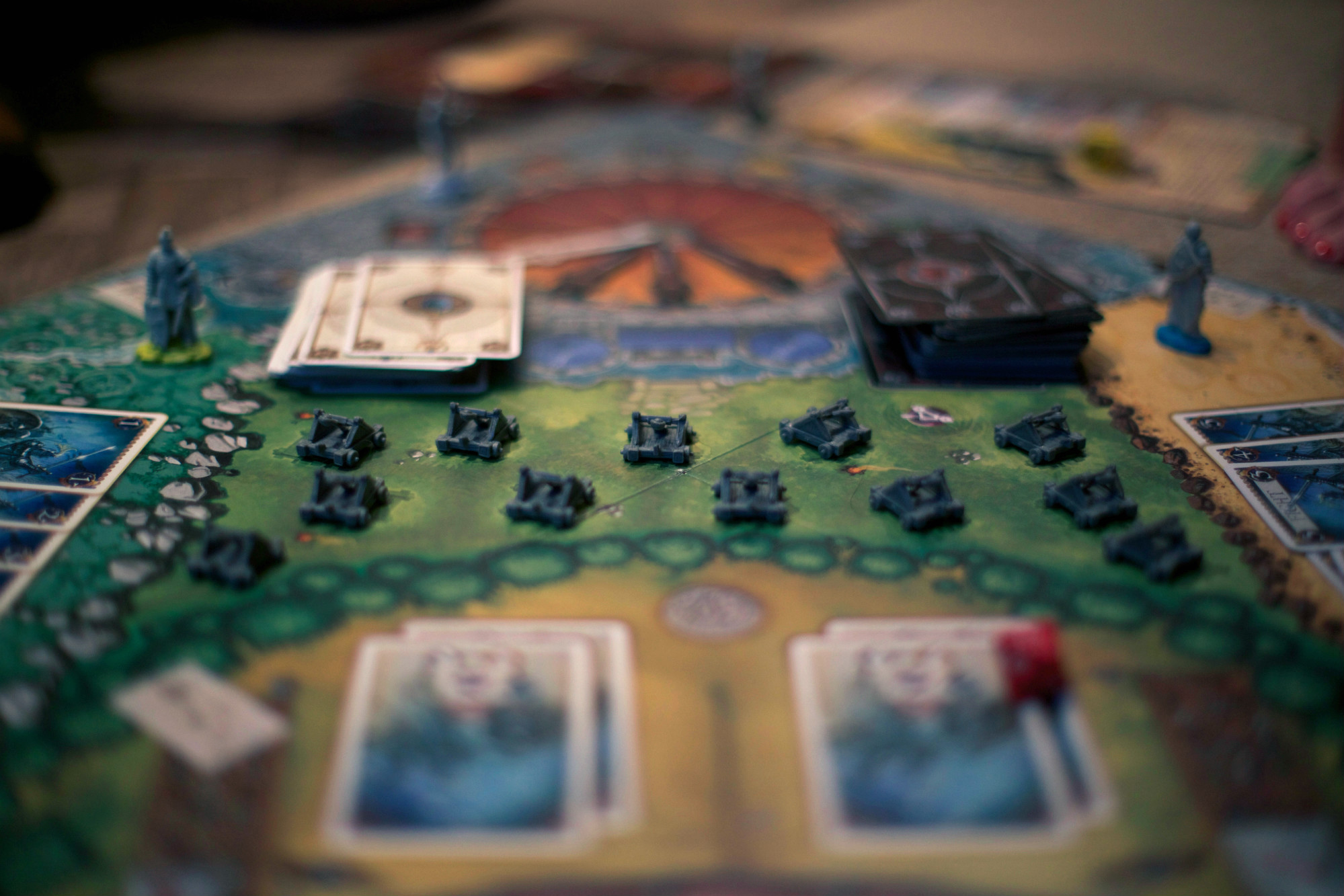
This week the brave knights suffered a crushing defeat at the hands of Sir Sophie of Traitorville. Like any good co-op game there’s plenty of suffering and plenty of horrible ways for the good guys to die. We lost by drowning in enemy siege engines, and we lost shamefully early with no hope in sight.

The crushing defeat.

Luckily, this isn’t necessarily reflective of the game as a whole. We’ve had a fair few victories and a fair few terrifyingly close losses as well.

The real winner is the traitorous scum.

*Sorry to mislead you all so early in the review. We actually played this on the floor.

Credit for the photos, of course, goes to Sir Photographer-friend.

Kingdom Builder: (Queendom Builder?)

Brutus Rating: 2/10 daggers in the back
Pairs well with: A different type of beer for each terrain you build on

6D-37-257

Do you remember that thrill you first had, when you were young(er) and excitable and new to the world of board gaming, and you first discovered that the maps of some games are randomised at the start? Like ‘Woah, this randomised Catan map has all of the brick next to each other, how exciting! Oh and in this one all of the fields are lined up next to mountains, how sweet!’ And then there was Small World, where the lands are the same but the history is different and the races that try to populate it all have different randomized attributes. “Today we’re going to fight with FLYING skeletons? What madness is this?”

No? Just us? It takes us back to childhood memories of those ancient strategy computer games with randomised set-ups. Can we pretend that this fixation makes us endearing rather than sad and odd? Excellent.

6D-37-189

Well, if by chance you ARE excited by that kind of thing, then Kingdom Builder is a game for you! There are several different boards to choose from and you select four at random at the start, each constituting a quarter of your future Kingdom. Even more excitingly, each different potential Kingdom-quarter comes with a different bonus action token, meaning the moves you’ll be able to make in the game will be different. EVEN MORE EXCITINGLY THAN THAT (is it even possible to be more excited?) the way to earn points and win the game is ALSO randomised at the start, through a decently-sized collection of cards.

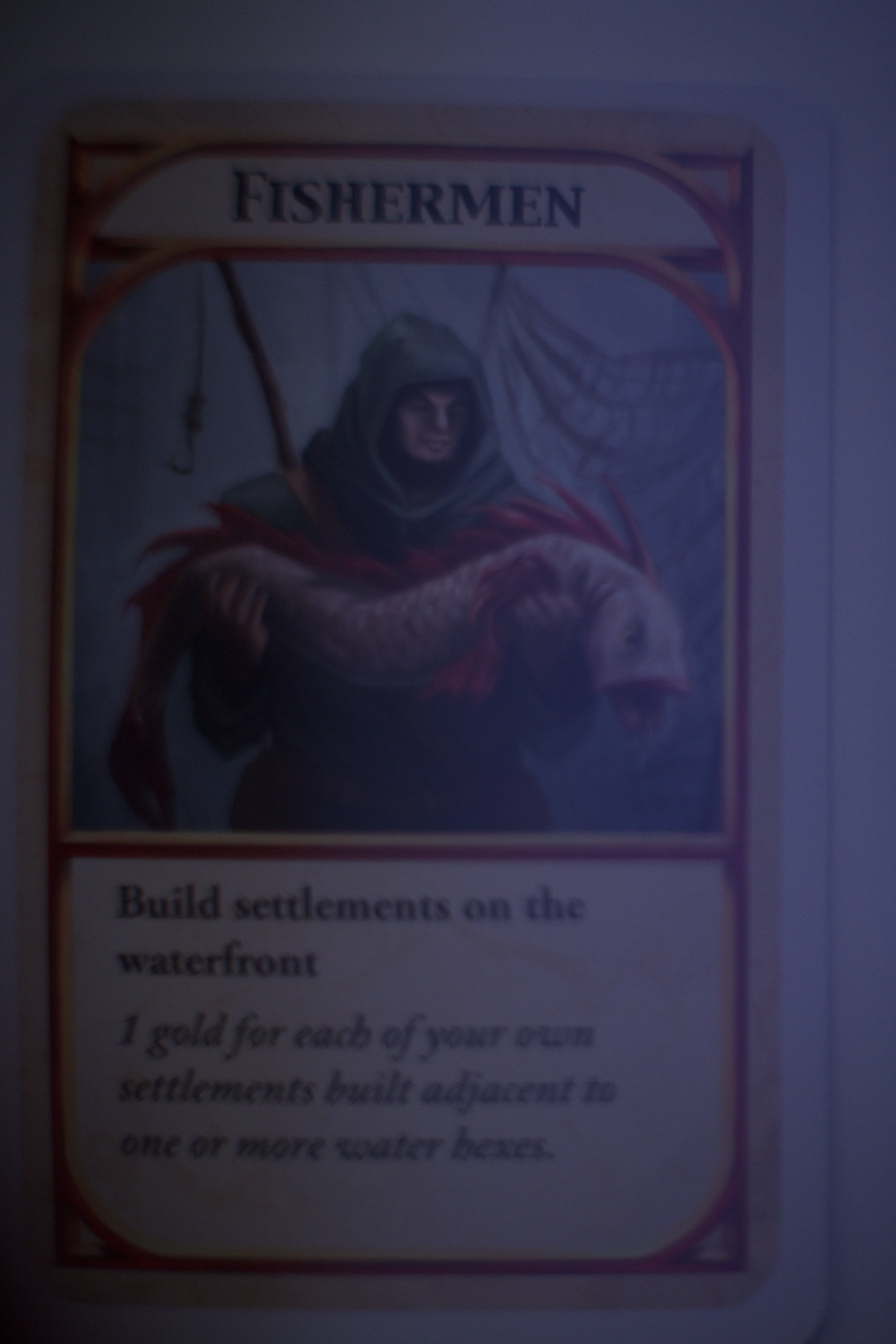
The dark and blurry fishermen
The fishermen in our kingdom were particularly dark and blurry*

In Kingdom Builder you play a mighty kingdom-builder (OK, so it’s not the most roleplaying-heavy game in the world). The aforementioned randomised selection of cards (of which you get three!) determines what kind of people you’re building a kingdom for, thus also telling you what kind of things they’re looking for in a kingdom, thus also telling you how to get points (‘gold’) and some delicious, delicious victory.

If you’re building a town for miners then you’ll probably want some settlements near the mountains, which is where they tend to get their mining did. So a ‘miners’ card will (quite logically) get you one point per settlement next to a mountain.

At the time of writing and photographing we closed our eyes and picked fishermen, knights and merchants. A pretty pleasing group to live with, we all have high hopes for our future realms; got ourselves some food, some income and a solid line of defence. There have been worse fundaments for civilisations.

6D-37-223

So the aim of our game will be to build our tiny little houses near water for our fishermen, connecting different settlements for our merchants and … all in a horizontal line, for the knights.

6D-37-233No, we don’t know why they asked for that. It doesn’t seem like it’d be easily defensible. Do they… do they want to do some jousting, and they want the longest possible run up, spanning the entire kingdom? That can’t be it, because they don’t mind if there are canyons in the way, or how broken up the horizontal line is. Do they just have weirder fixations than even the misery farmers? Who knows! Ideas and answers on a postcard, please.

"Neigh!"
“Neigh!”

Play for this game is fairly quick and fairly simple. There are some snazzy terrain rules which will determine where you can lay your houses, of which you’ll lay a base of three per turn, as well as a few kinds of bonus tokens which will let you take extra actions. These, again, are randomised thanks to the boards that you chose at the start. Many of them are kind of samey (Build more on grass! Yay! Build more on desert! Yay…) but there are one or two which can be pretty game-altering. The horses of this kingdom, for example, are so strong that an entire tiny wooden house can hitch a ride across a couple of hexagons and settle down elsewhere. Literally game-changing.

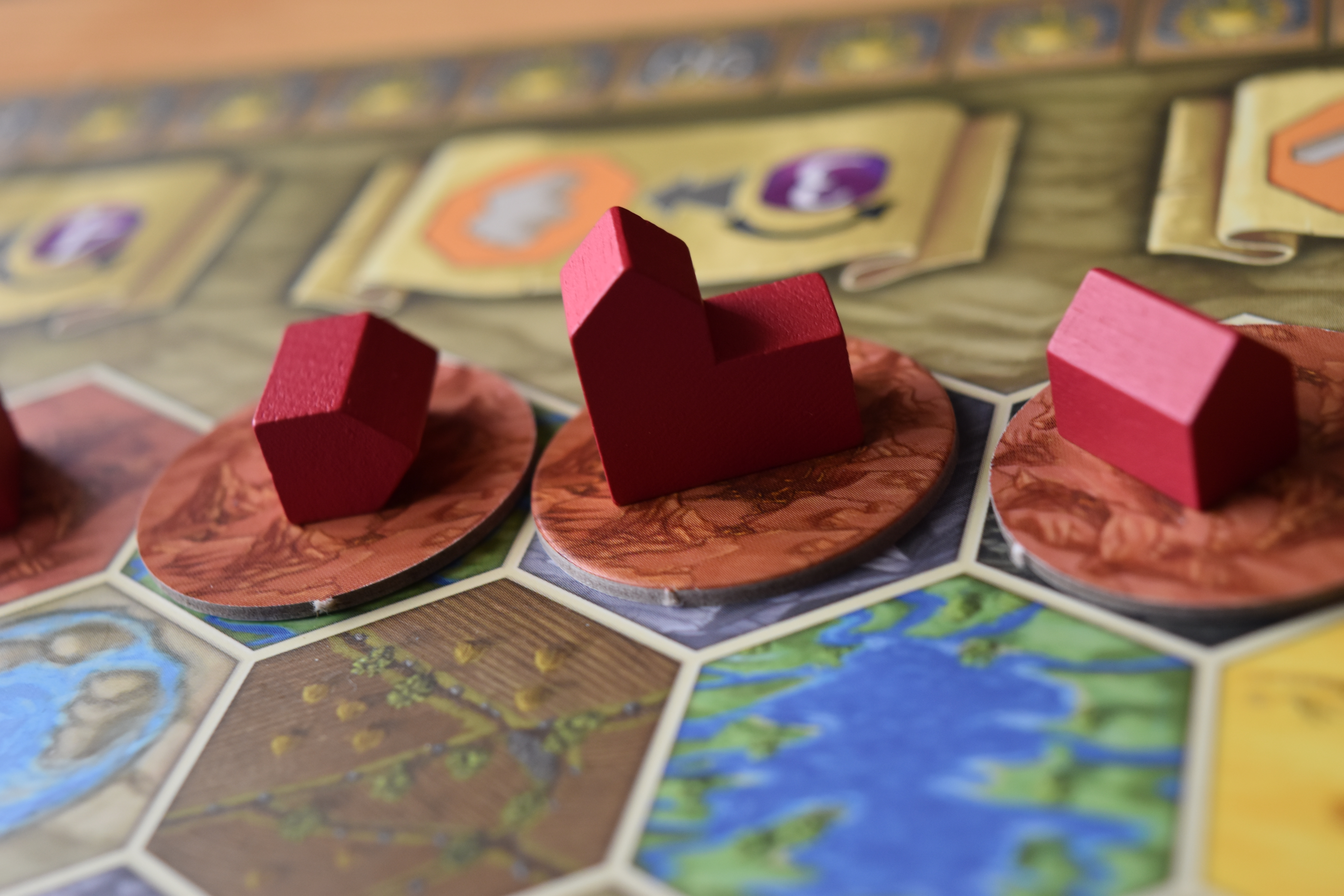
Speaking of those little wooden houses, we should spare a little spot of criticism for the production of some of them. A few of the roofs seem to have collapsed in. Knew we shouldn’t have trusted those bloody fishermen with building the kingdom for us!

Bad work, builder.
Bad work, builder.

The snazzy terrain rules are that you draw a card with a picture of a terrain on it, and that’s where you are destined to build this turn, for three of your settlements at least. It’s unclear why your kingdom is being restricted in this way. Are the people demanding it? It’s difficult to see why a kingdom of fishermen would demand that you build only on the desert for three bloody turns in a row. Besides, what power should they have over you? You’re building a kingdom for them! Go to hell, fishermen! Perhaps instead you only have the materials to build on a certain type of terrain? But then what extra materials would you possibly need to build on the grass that you wouldn’t need to build on the flowers? Ok, let’s just call it some weird superstitious reason and leave it at that. You’re a superstitious kingdom-builder. Done. Let’s not question it any further.

6D-37-252The game is all about making the best you can out of the randomised selection of things that the game throws at you. Mostly in the form of some very annoying terrain restrictions. It’s all randomised in a way that doesn’t seem to leave you too reliant on luck, at least not if you play it right. Sure, having to build your settlements in the sodding canyons for three turns in a row can dick you over a bit but there are measures you can take to avoid it ruining your kingdom too much. Oh you didn’t take those measures and now you’re stuck building in the corner? Well that’s just your own fault.

Very mild earthquake in the kingdom

If you’re not careful you can really feel yourself just getting carried away. A turn itself seems so insignificant, “oh I’ll just waste this one turn building on this bit of desert but I’ll be fine next time”, but then after several turns you can look back and find yourself having just squeezed out a sad turd of a civilization and you’re out of control and maybe you’re not up for this kingdom ruling business after all! Aah! Woe!

This happened in the game we were just playing. Those of you already familiar with Kingdom Builder might look at the photos of the board and think “That can’t be the same game they were describing in the post! There are hardly any horizontal lines at all! If they had Knights they’d be doing terribly!” You’d be right. We were just doing really terribly. We’re rightly ashamed.

Scoring time, score!

Aside from all that, Kingdom Builder is a pretty good game. It’s fairly simple and all of that randomisation we’ve been banging on about for most of this review equates to some pretty damn good replayability. Possibly our favourite game to come out of Essen 2013. Huzzah!

The photographer won again, but whatever. The real winners are the fishermen.

*Lizzy: Can we get some nice photos of some of the bits that make up the game this time? Please? For journalism?
Dr Photographer-Friend: No! Screw you! I’m going to spend most of this time taking photos of this apple and this weird dog toy you’ve been using as a door stop instead. Stop trying to strangle my artistic vision!

Still, credit goes to him again for our photos.

6D-37-27

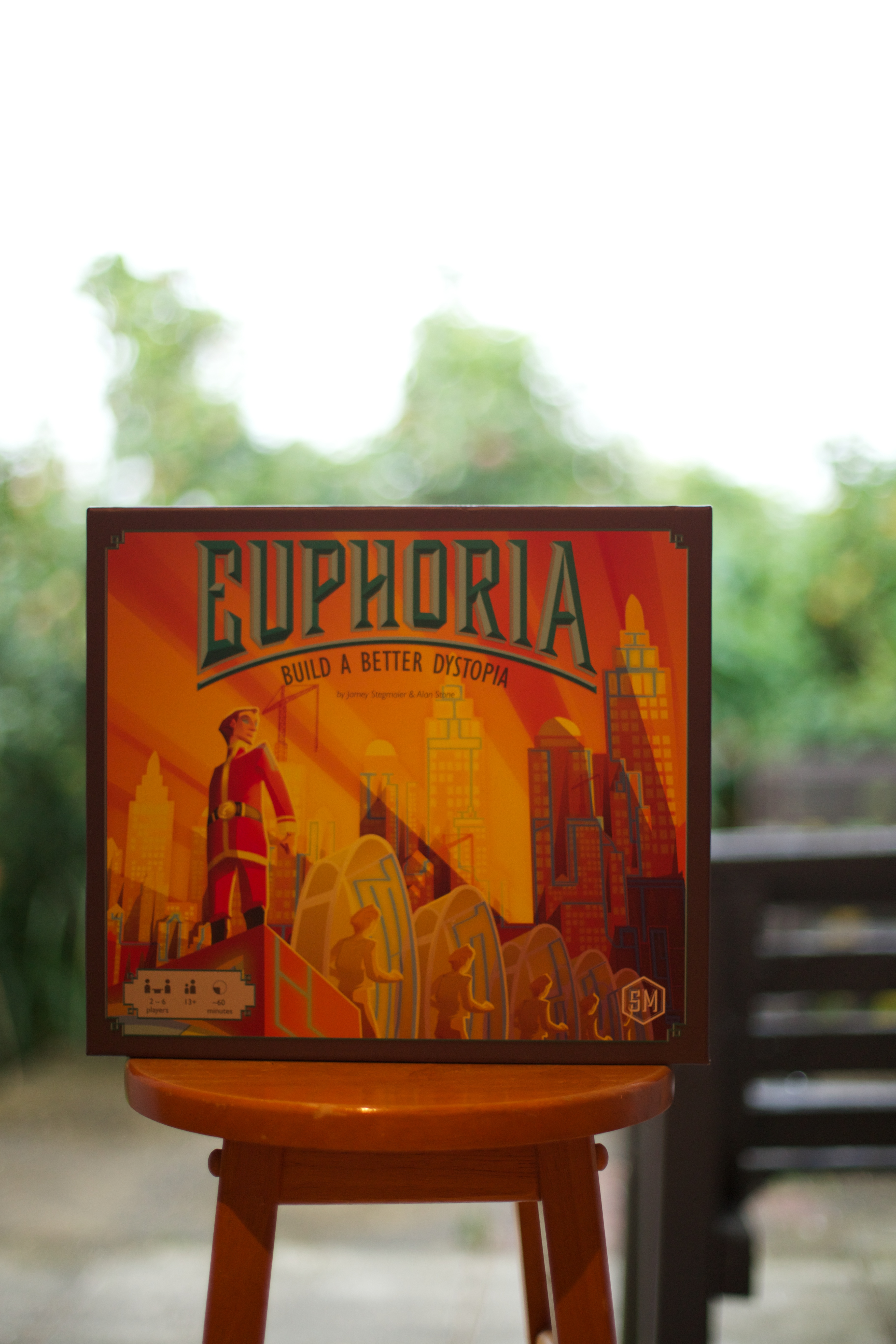
Euphoria: War is peace, Freedom is slavery, Worker oppression is victory

Brutus Rating: 3/10 daggers in the back
Pairs well with: A high dose of soma and a full complement of your water rations, you lucky worker, you! 

6D-37-178

Euphoria represents the misery farmers’ first expedition into the exciting world of Kickstarting board games, and it’s pretty clear why this board game was so successful at getting funded. Dystopian theme? Say no more, we’re sold. Fetch the people-zapper and the keys to The Courthouse of Hasty Judgment, it’s time to oppress some workers. Or ‘liberate’ them or something (we need to work on our spin, guys).

Before we dive in head-first to a review, allow us five minutes of just drooling over these gold bricks:

Oh yeah. Check out this fancy business.

Having the beautiful Kickstarter edition of the game has definitely proved to be a good idea. It gets us these super-neat, extra-nice resources, amongst other things. The gold bricks are really shiny, and satisfyingly weighty! For a while when our friends came over we would literally just drag them over to the board game cupboard to show them how nice the pieces were. Our fellow board-gaming friends, that is, obviously not our normal friends. Board games? What? Us? Nah! Let’s all uh, grab a beer and watch a sport, woo!

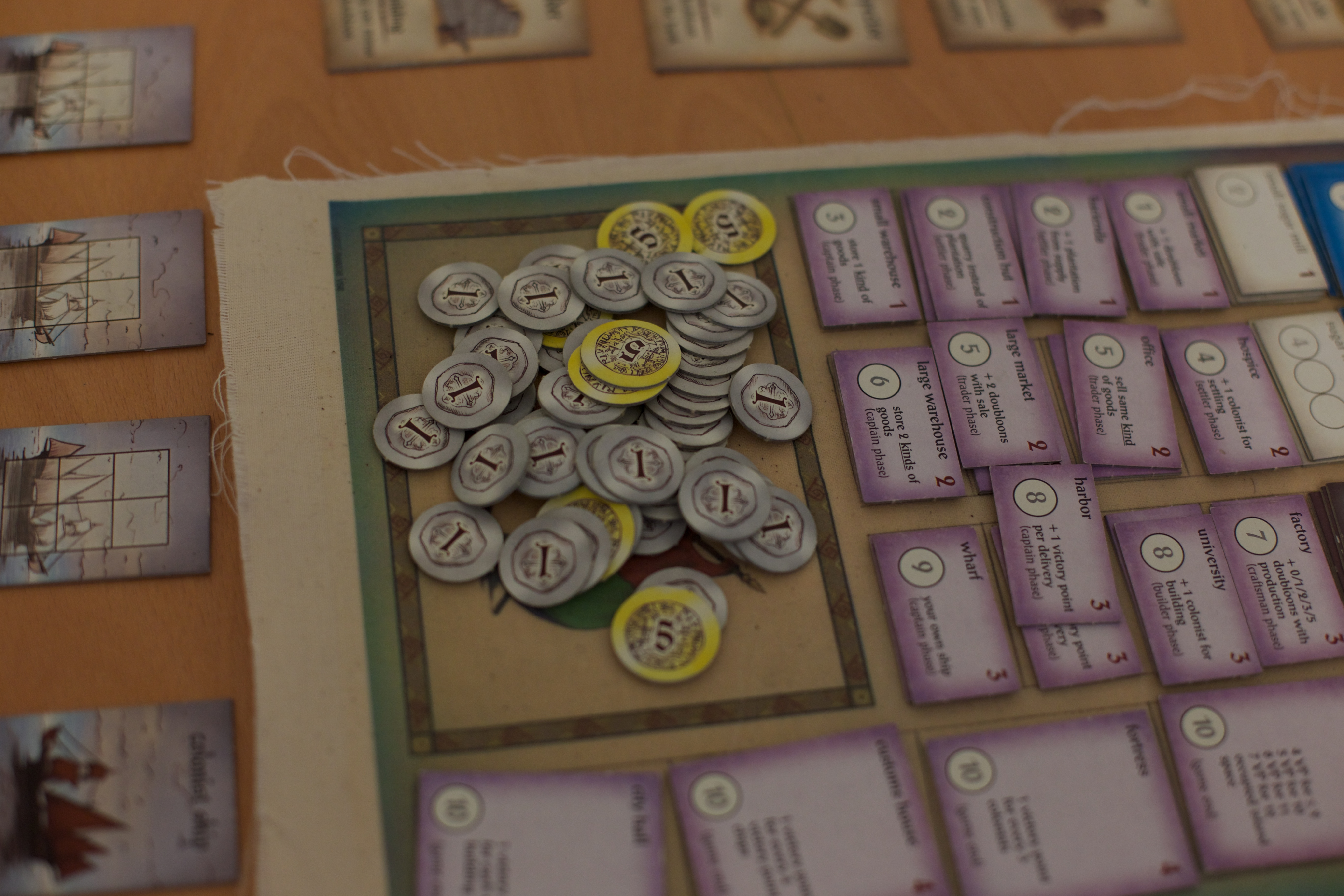
In a move which makes you think “why didn’t I think of this first and make my millions this way?”, the game designers also sell these and a bunch of other neat-looking resources separately to spruce up some of your board game collection. They know their audience, and it’s people who are fascinated by weighty gold bricks. (Us!)

Hubba hubba
Hubba hubba

Right! Enough showing-off about the really nice game pieces. Wait …

(That's not actually where they go, we just kind of stacked them there while we were fiddling)
(That’s not actually where they go, we just kind of stacked them there while we were fiddling)

…ok, now that’s enough guys.

Lizzy:  Hey guys, do I look more dystopian with a mask?
Lizzy: Hey guys, do I look more dystopian with a mask?

Whatever level of the game you buy, Euphoria has some really alluring qualities. Mostly, of course, there’s the theme, which is both inspired and well-executed. Also let’s face it, when you’re trying to convince your novice game buddies that board games really are super-cool and that they should totally play with you then you’re more likely to have some luck with “this really cool dystopian-themed worker placement game, in which you oppress your workers and can’t let them get too smart or they’ll realise what you’re doing them and escape” than “this worker placement game in which you … run a farm! Yeah no really guys, farming board games are great fun, I have like six… hey, where are you going? Guys?”

Apples or goldfish?
Apples or goldfish?

I mean, it’s not that a lot of people aren’t going to love that kind of thing, it’s just that those aren’t really the people who you need to put effort in to lure into the board gaming world. Those are the kinds of friends who are already excited to queue for the latest Uwe Rosenberg game with you or the ones who keep trying to trick you into playing 1853 again. (EIGHT HOURS! EIGHT. SODDING. HOURS. We love an eight hour game in principle but waiting twenty minutes between turns is… aaaaah!)

Workers are a-workin'
Workers are a-workin’

So yeah, Euphoria’s theme will make it stand out from some of your other games.  The afore-mentioned feature of worker intelligence being bad for you is a particularly good expression of it. Your workers are dice, and the number on the dice will have some limited effect on how you can use that worker. The general idea is that a six is pretty canny but a one is quite a few apples short of a wasteland farm. Your overall worker intelligence is tracked elsewhere on the board by numbers 1-6, and if you’re retrieving all your workers and roll their total (plus that number) to be higher than 16? Uh oh! Your workers have been colluding! THAT SMART ONE IS ESCAPING! THEY’VE LEARNED TO THINK FOR THEMSELVES! GET THE ZAPPER!

6D-37-137In real (game) terms this means you get one less worker and one unhappy Lizzy, who has only just saved up enough lightning bolts to zap that worker into activation in the first place! Who let all these workers at the books? Don’t they know that freedom lies in slavery?

Another way in which the game beautifully manifests its theme is the randomized set of buildings that you’ll be able to construct. It’s amazing how much more fun you can have building ‘The Center for Reduced Literacy’ or ‘The Free Press of Harsh Reality’ rather than just ‘another flipping corn farm’. The same goes for your recruits (different from your workers), with names such as Curtis the Propagandist, Julia the Thought Inspector and Jefferson the Shock Artist.

6D-37-172

The two PhD students studying ethics at the table question the 'ethical dilemma' description of the ethical dilemma cards.
The two PhD students studying ethics at the table question the ‘ethical dilemma’ description of the ethical dilemma cards.

Victory in the game is earned by getting rid of all ten of your star tokens and spreading your delicious influence all across the metaphorical dystopian toast. (Dys…toastpia? Or is that spreading it a bit thin?) This can be done a number of ways including building these exciting buildings, playing your ‘ethical dilemma’ cards a certain way (“ ‘Help a friend escape or turn in a friend?’ I don’t think this game understands what an ethical dilemma is”) and just generally spurting your workers and resources at the sections of the board which have a nice handy star on them.

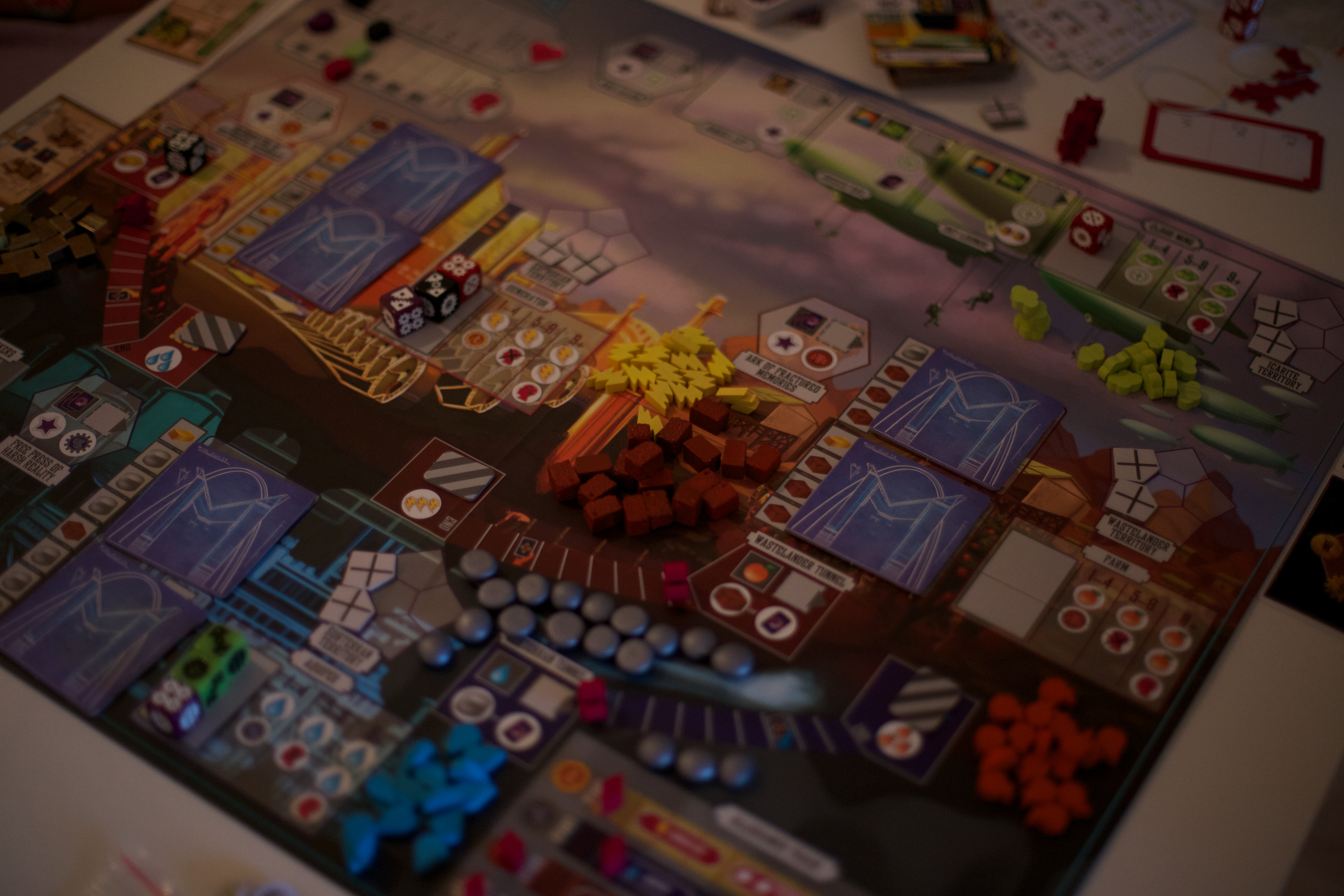
The different range of options for your workers can be a little overwhelming at first, particularly for newer players, and it can take a while to get the hang of what it is you’re supposed to be doing. There are four areas of the dystopia and most of them are fairly symmetrical but with different resources (except the bloody Icarites, they do whatever the shit they like. LET’S MINE A CLOUD FOR HAPPINESS!)

Cloud-mining
Cloud-mining

Basically you want to vacuum up some regular resources and then pump them up into being relics or bigger, shinier resources, both of which you can then end up splashing on some delicious victory star-spurting. It’s not a game with a lot of different paths to victory, so it doesn’t have that same rush of different possibilities opening up in front of you like other games can, but it’s still good.

It’s also mildly difficult at times to keep track of all of the things you’re supposed to be keeping track of:

“Oh, balls! Wasn’t I supposed to be paying some penalty every time I roll a one now because I didn’t contribute to building that diss-assemble a teddy bear factory?”
“Err, how long have I had four cards in my hand? My workers’ morale is far too low for this… you saw nothing, guys.”
“DAMMIT GUYS WHEN WAS THE LAST TIME WE REMEMBERED TO LOSE MORALE FOR RETRIEVING WORKERS?”

Although we’re not necessarily saying that this is a criticism of the game rather than just a criticism of our own competence.

“Why do my workers hate me?”

One more neat and unusual point of the game is the aforementioned worker retrieval method, which differs from most other worker-placements. There’s no set ‘end of a round’ where everyone scoops back their dice at the same time. Instead, you can choose to lower your worker’s morale (morale, unlike intelligence, is something you actually want your workers to have) or pay a penalty to increase it, and then retrieve as many of your dice as you like on your turn. It makes the turns more fluid than a trip to the Subterran Aquifer.

6D-37-147The game earns a ‘brutus rating’ of 3/10, because there’s not too much in the way of screwing over of the other players, which can be refreshing, particularly if you’re playing with us. Having said that, there’s still a little space to gang up on someone *cough Lizzy cough* by all building a shiny building without her, meaning she has to suffer some penalties for a while until she fixes it.

In today’s adventure Dr Photographer won the game. About time too, probably. Lizzy was stunted pretty early on by some damn smart workers, and the other participants just couldn’t wrangle enough shiny things.

The real winner is oppression. DOWN WITH THE PEOPLE! Ahem.

Dr Photographer getting a bit carried away with the dystopian theme there

Credit to our fellow oppressor Dr Photographer for the photos!

T’zolkin: Indiana Jones and the Kingdom of Plastic Cogs

Brutus rating: 7/10

Pairs well with: Sacrificial human blood, but failing that a Bloody Mary.

Such headdress.
Such headdress.

The first thing Briony, or indeed anyone, learns about the game T’zolkin is that they don’t know how to pronounce it. T-olkin? Solkin? That Mayan game? So let’s go ahead and confirm that the correct pronunciation is in fact Z-olkin or tsol-kin. Oh the English language, you and your silent t’s are so amusing and whimsical. Furthermore we should probably confirm that the significance of the name lies in the fact that it represents a particular Mayan calendar and literally means ‘to divide days’.

The kingdom of cogs.
The kingdom of cogs

The game board itself is made up of a series of connected cogs that are all linked to a big-ass central cog. At the end of each turn the central cog is turned once, and thus pulls each connected smaller cog around once also. The central cog represents a calendar year, with each linked cog representing a place or building – these feature a series of resources and/or actions a player may select. Your first few run-throughs of the game will almost certainly begin in the same ‘holy-fuck-the-cogs-look-epic, that-is-some-beautiful-engineering-right-there, I’ve-never-seen-a-board-game-do-this, it’s-so-well-themed (wipe away tear), why-did-I-never-have-an-appreciation-for-Mayan-cogs-before?’ way.*

Then, fairly swiftly, the wonder is followed by: Oh mother of god I can’t use these fucking things. Why did I never had an appreciation for forward planning before?

But don’t worry kids, you’ll get the hang of it. In fact the game has been designed in a way that suggests that they knew that people would often inadvertently try to ruin their own game. This means that there is very little negative scoring, and the cogs have some extra spaces at the end of their cycle which allows players to have a little more time to try and salvage their strategy. Similarly there is always an empty place to put a worker (yes, it’s a classic worker placement game) thanks to the four player limit. We noticed that compared to other resource collection games it really makes you feel like you have options, which sure is nice when someone else has just done what you had been planning for the past 7 turns.

Despite this it gets a fairly high Brutus rating as often someone selects the free cog position you really wanted, making you go somewhere else instead and naturally giving them the ol’ squinty evil-eyes. You also tend you lose track of when you need to take your workers off cogs and in what specific order, making your poor planning frustrating.

The makings of a corn empire

Pro tip about the game: So you probably saw the middle 15minutes of a documentary once, talking about the Mayans and corn, or swords, or the Spanish or something. You seem to remember something about sacrifice? Fortunately, the game doesn’t require actual historical knowledge **. In fact the game is one of those rare grey non-judgemental areas where players can say the stupidest assumptions ‘because they heard it somewhere once’. This will inevitably lead to consulting the interweb machine, and your merry band of gamers will be all the wiser for it.

‘I saw somewhere that the Mayans invented the recorder to help herd llamas, as they dislike the slightly hollow sound’

‘Oh really, Andy. I call bullshit. To the Google!’

Be patient, Mayan chaps..

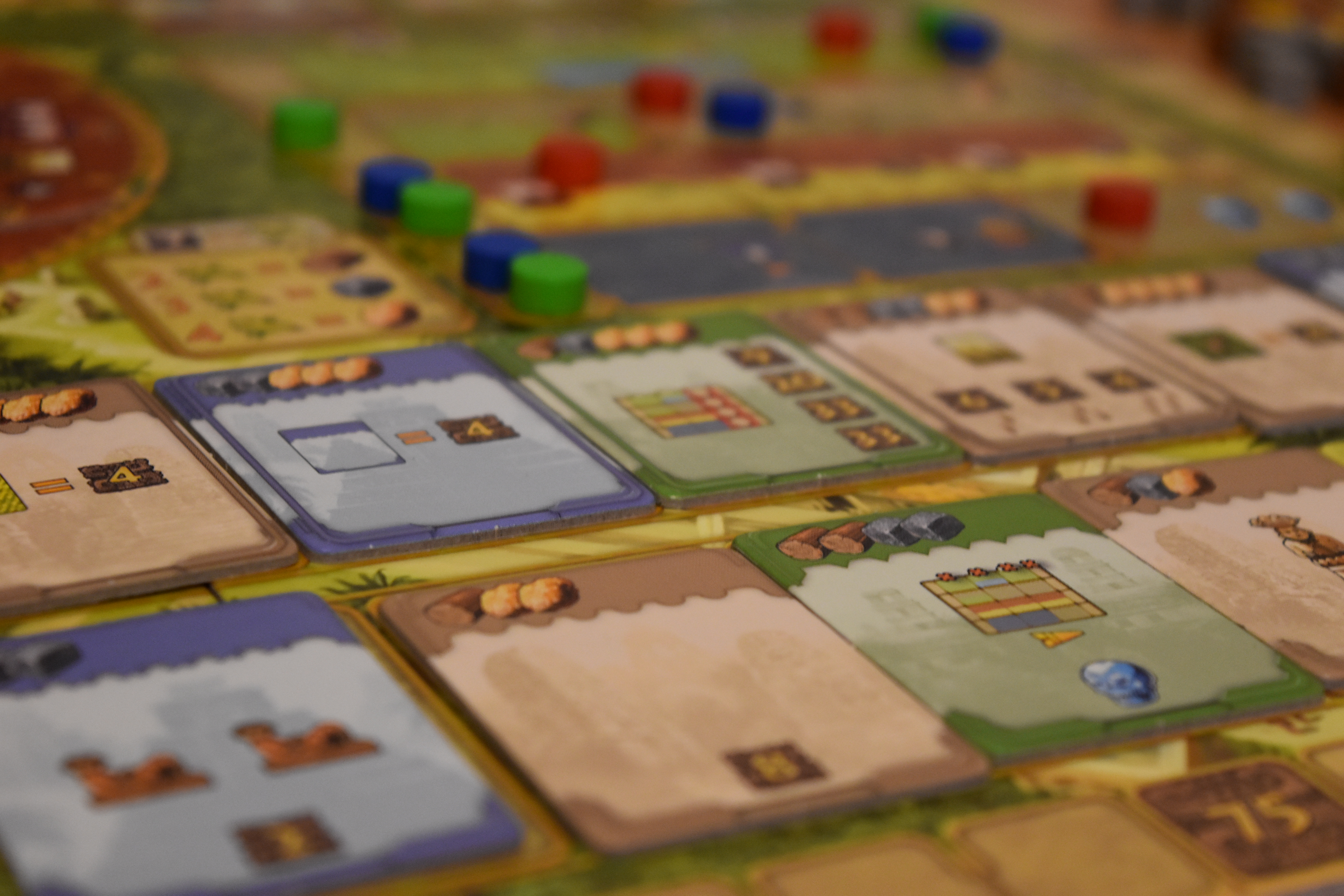
DSC_0182Carrying on, in a player’s turn they have the option to either place workers on the board, or to remove them. You can place or remove as many as you like in your turn. The workers are placed on grooves on a cog of your choice at the lowest possible space (usually the beginning tooth), and the idea is to slowly let your little Mayan chaps rotate around the cog until they reach the action or resource of your choice. This means that the game is hugely reliant on your ability to know how many turns it will be until you can take your worker off to achieve the action you want, and to extend that to all of your workers across the board on different cogs. We imagine this is loosely what it’s like to have a fleet of children and being expected to know where they are, what dietary requirements they have, and what they’re doing at all times. Respect to you parents out there, we find it difficult enough to simply identify which wooden piece is our own on a medium sized board of wooden pieces.

cartman

The sheer availability of strategies and combinations in this game is another reason that the team enjoyed it so much. Each cog, as well as representing a building/area, also has themed resources. This means that if the cog for the collection of corn and wood is mostly full you can turn to different cog for the same resources. In addition to the cogs there are also favour tracks, much in the same design as Caylus or Agricola. By moving up these you can get bonuses in different fields. These include taking extra corn on the corn/wood cog, getting extra resources from the resource cog, getting building bonuses if you build anything, going up temple tracks, and obtaining crystal skulls.

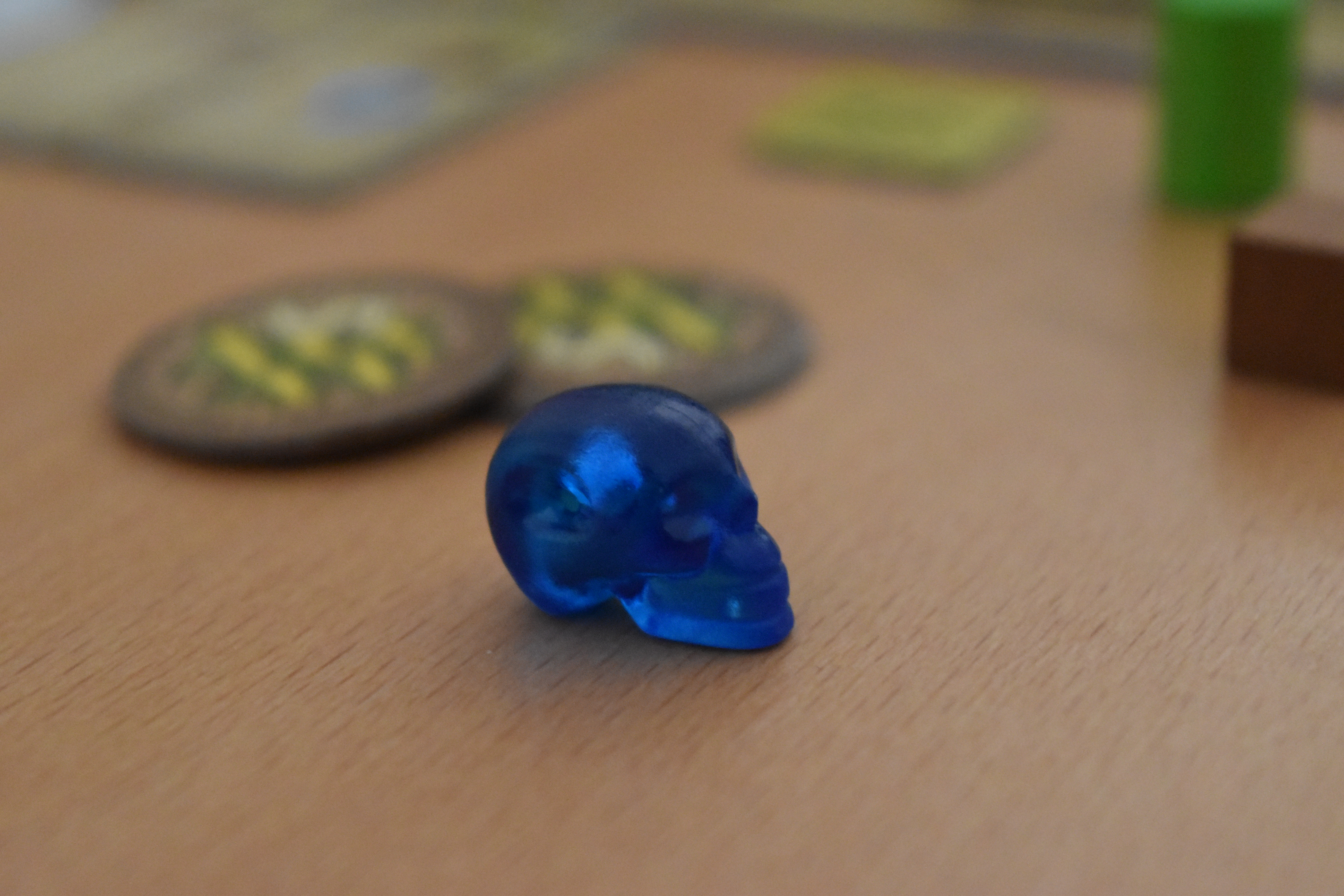
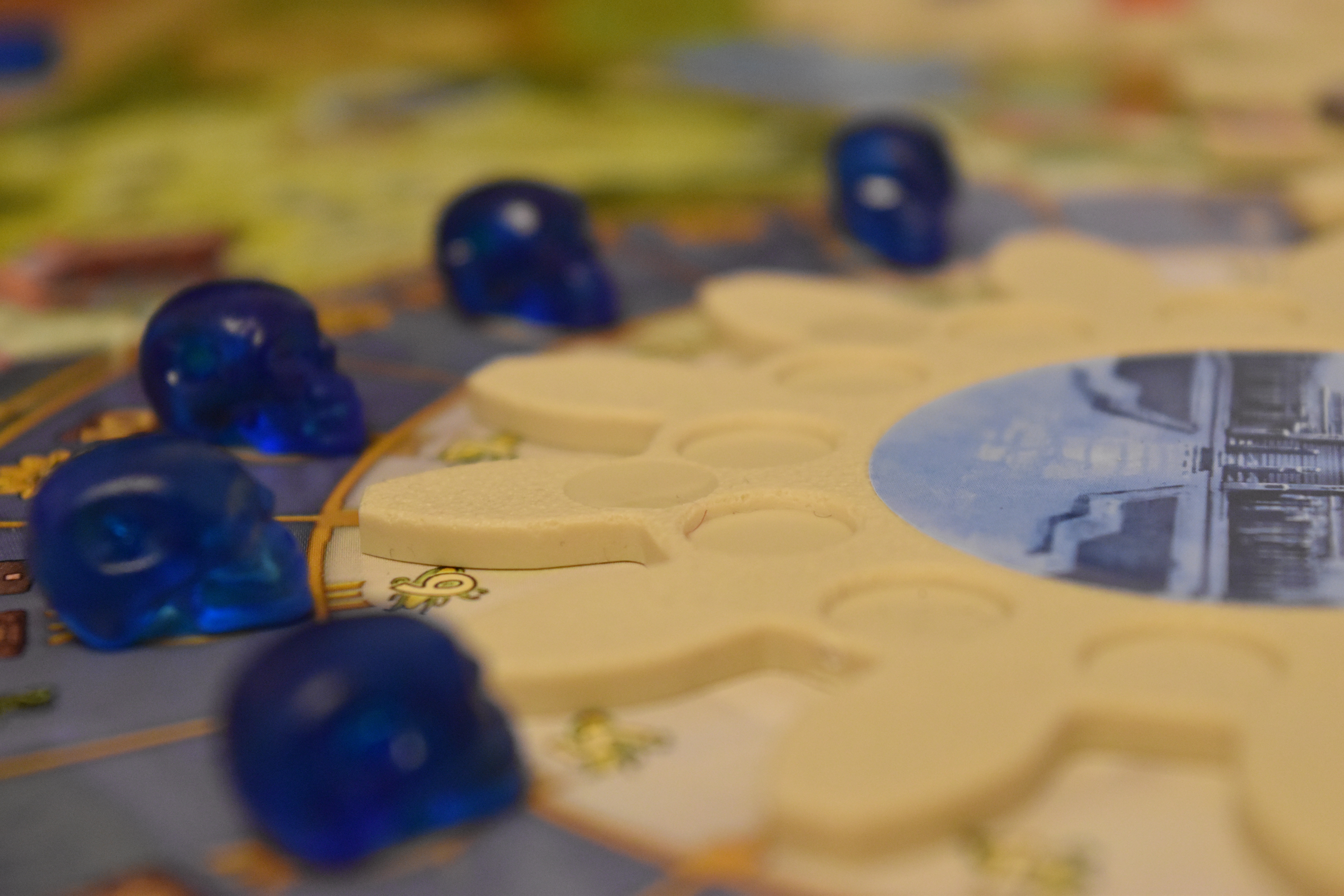
DSC_0190Crystal skulls are the no-fuss-victory-points option of the game. Only there is actually a lot of fuss in obtaining them. They’re a resource that is fairly difficult to get hold of seen as there is only one cog position that offers it aside from gaining them on the favours track. Despite that, there is an entire cog dedicated to the use of them. You can only use this cog if you have an elusive skull, and the longer you leave your Mayan chap on there, the more victory points and extra resources he can get you. When you take him off he has to leave a skull on his place on the cog. This means that eventually the cog fills up with skulls and no-one can use it to get more points.

DSC_0203

Several gaming buddies have so far pointed out that this is like that Indiana Jones film, you know, the fourth one that was all about the skulls. To them we loudly and clearly say, with our fingers in our ears, ‘La la la la la, you must be crazy, there are only three Indiana Jones films.’

DSC_0198

Moving swiftly on there is also a temple track to gain favour with the gods. Briony is currently very aware that she complained about the sheer number of components in Terra Mystica and is now very much praising T’zolkin despite it seemingly having a similar number of components. She still believes that T’zolkin offers a smoother interaction between all of its mechanisms, and therefore a better ability to combine various activities which still isn’t the case in Terra Mystica. She’s willing to admit that maybe she was a little hard on the game, but maintains that T’zolkin is still better. Maybe she just really likes taking part in the over-farming and human sacrificial culture of the Mayan’s, who knows.

DSC_0187

Finally, there are four marked teeth on the central cog. Each time these come along two things happen: Firstly each player must feed their workers two corn each in order to keep them alive, and secondly you obtain victory points and/or resources depending on how far up the temple tracks you are. This is pretty neat because it makes the presence of the temple tracks something more than a mechanism that only serves to boost your points right at the end of the game, and makes it worthwhile to use throughout. The only qualm we have with it is that the resource icon for gold looks suspiciously like a chicken nugget. We’re onto your cultural heritage Mayans, feeding a civilization with 24-piece boxes of chicken nuggets and then blaming the corn when everyone died. Very sneaky of you.

This also makes the building prices rather amusing: ‘4 chicken nuggets and some stone to build this yellow building… hmmm’

In conclusion we enjoy this game rather a lot. Great theme, great mechanics, an awful lot of corn. The uniqueness of the cogs really adds to the game, and the layout and versatility of the different parts mean that there are infinite and transferable strategies available at any one time. Briony strongly believes in maxing out all of the corn, and then using the yellow cog to build everything out of corn and corn alone while everyone else fights over some overrated shiny skulls.

DSC_0185

*Of course, we have seen similar cogs before. Or, to be more precise, similar wheels. Hello there, Glass Road!

** Bob, Briony and Lizzy pride themselves on knowing the colour of Edward Longshank’s socks on the 14th of August, 1247 – the point is we are history nerds. Well, nerds in general.

Jaipur: One of the best camel trading games you’ll play this week!

Brutus Rating: 7/10 knives in back
Pairs well with: Fine wines sipped from golden chalices that you don’t quite have enough of to trade yet.

11716029_10155865989225085_5783316_n

(Poorly lit photos can be blamed on the photographer friend not being around this week. Or maybe on Bob for moving house. Basically, anyone other than Lizzy, who is coincidentally in charge of posting this week.)

11720023_10155865987270085_260705191_n2014 was quite the year for camel games, so it also proved to be an excellent time for Lizzy to receive Jaipur as a Christmas gift. It most certainly ranks in the top three for camel-based-games that she acquired that year, and Briony is inclined to agree that is sure is fun. This review marks the beginning of a new, and duly called for, list created by ‘The Misery Farm’ – Two Player Games Ranked In Order Of How Likely They Might Make You To Split Up With Your Other Half While Spending Time Together.

Huzzah! Never has a more practical and important list been created! We constantly see threads on various sites and blogs that call for good two player games with a lot of specific categories: these range from ‘must be easy to learn because my wife has a short attention span’, to ‘has to be small and portable enough for me to carry this to another country to see my long-distance bae’.

"Show me the goods!" "Here they are!" "Good."
“Show me the goods!”
“Here they are!”
“Good.”

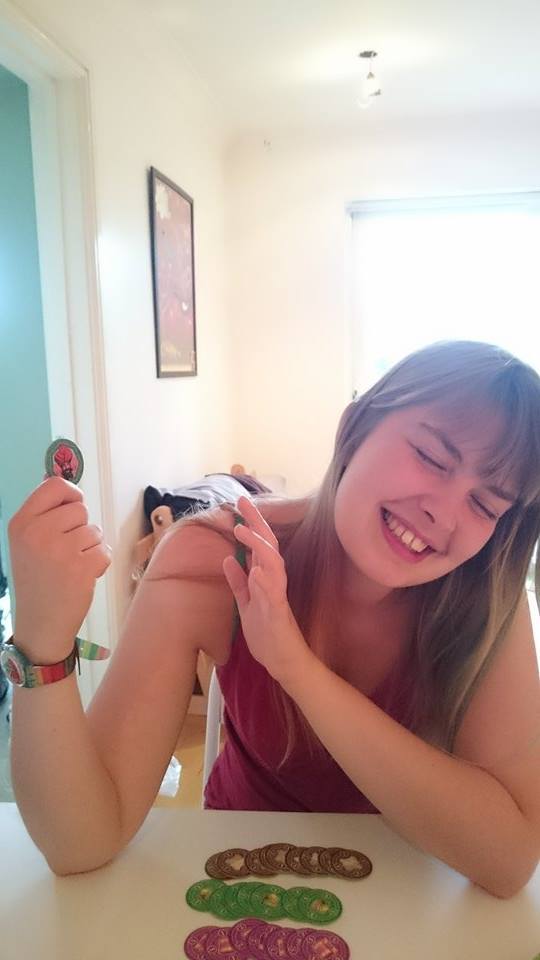
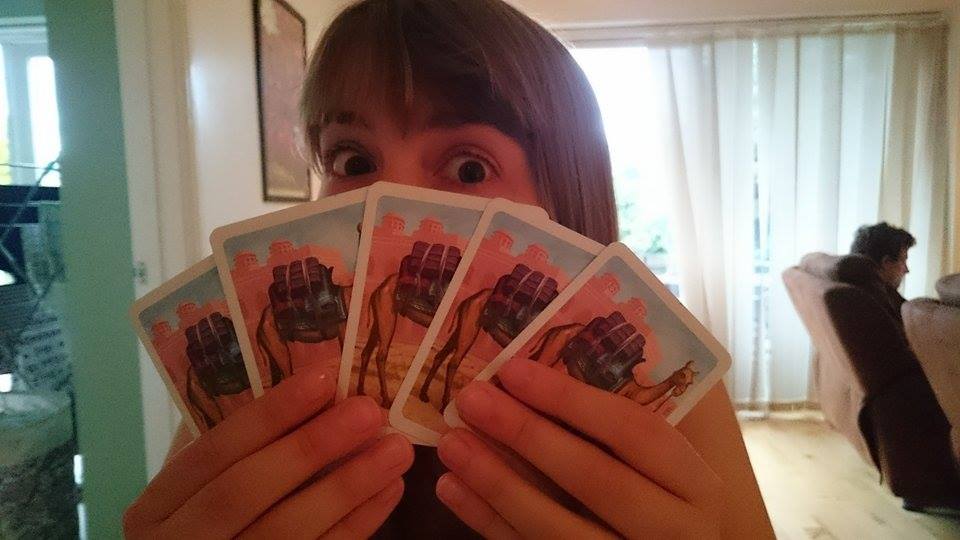
Jaipur is a pretty good two-player card game to kick the list off with. You buy goods, trade goods, trade goods for camels, trade camels for goods, trade goods for other goods, sell goods. Good? Good!

The game is fairly fast-paced and over two or three rounds: best of three is the winner. To win the round – that is, being the best at trading and most impressive to the Maharajah – you get a little token with the Maharajah’s face on, and the first person to please the Maharajah twice is crowned the victor and will forever be employed as his best personal trader. Conveniently, the Maharajah tends to be most impressed by whoever has the most points at the end of the round, so determining who wins is pretty simple.

His Grace's faces
His Grace’s faces

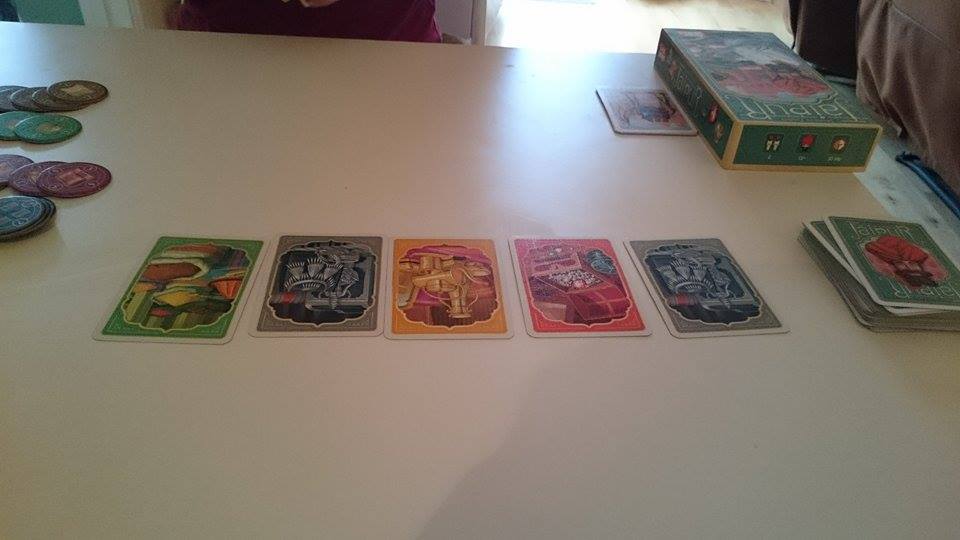
Your goods come in the form of captivating colour-coordinated cards, and you and your other half (and/or nemesis) have a hand of your own and a communal pile of five to compete over.
11715998_10155865989180085_1975058349_nThe best bit about this game (other than the inclusion of camels) is its excellent ratio of rules to strategy complexity, and the fact that it might occasionally remind you of playing card games with your Gran in your earlier years. The rules are fairly quick and easy to learn, just like the game is to play, but the more you play it the more you start developing a complex strategy for how to trade. There are several things that the game gives you to look out for, and winning means balancing strategies and trying to open up as few opportunities as possible for your opponent.

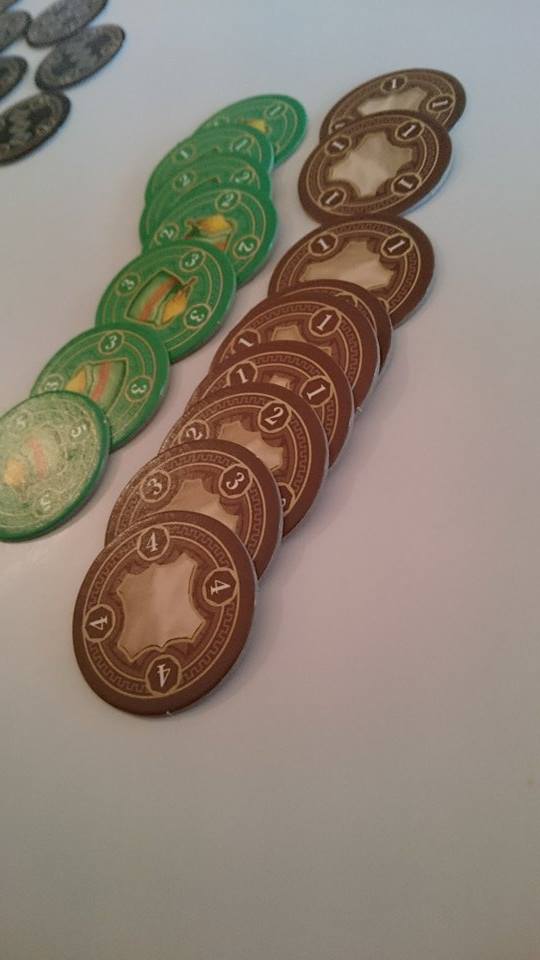
11739755_10155865988975085_779132515_nMost goods depreciate in value pretty darn quickly. You can sell some of that brown leathery stuff, the most common good, but only the first few bits that get sold will be worth a decent amount of points, so if you’re going to sell it then you want to be the first person to do so. But wait! The more you sell at one time, the more bonus points you’ll get, so you want to save up as much as you can before you sell it. This shit gets competitive, yo. You don’t want to be saving up a bunch of that lowish-value [green resource] for ages and then have some arsehole your loving partner sell a single [green resource] first just to take the best price. Knob.

The game gets a fairly high ‘brutus rating’ because most things you’ll do will tend to affect the other player. And if you’re anything like us (or anyone we know. We need some new friends) then you’ll be purposely trying to knobble them over instead of just getting ahead yourself. But that’s ok, because it’s a two-player game! That’s how two-player games should work, and the dicking-up goes both ways and isn’t too extreme.

11741830_10155865987485085_1100015158_nThere are also various other factors which turn the game into more of a rampant strategy-fest. The hand limit is devilishly small, which will leave you regularly cursing. And there are special rules for trading different numbers of goods, and special rules for trading camels. Some goods – the most valuable – can only be traded when you have at least two of them to hand. All of this is pretty simple to learn but, again, makes the game surprisingly tactical.

Another great thing about this game is that despite all of the above it’s really fun to play, and the resentment and hatred for your partner doesn’t build up so much that it’s not manageable. Sure, they’ve traded away the last goddamn silver but at least they haven’t ruined your entire bloody life. This time. The fast-paced nature of the game and the fact that you need to win 2/3 rounds for victory really helps with this. Before long the round will be over, and one of you will be taking your victory-Maharajah token, holding it up to your ear and saying,

“What’s that, Maharajah? You were really impressed with my trading prowess today? Oh, thank you, that’s very kind. No, it really is my pleasure. What’s that? You regret choosing Martin last round? Yes, well, we all make mistakes. Not to worry.”

"Oh Maharajah! You flatter me."
“Oh Maharajah! You flatter me.”

So yeah, you’ll give them a smack on the face once or twice, but there’ll be no permanent damage by either hands or words.

Definitely not missing a token. Don't know what you're on about. Your face is missing a token!
Definitely not missing a token. Don’t know what you’re on about. Your face is missing a token!

Lizzy took this on holiday with her boyfriend and they both came back in one piece. Which is an impressive thing to say any time Lizzy plays board games with anyone, to be honest. Briony has also had a good time playing it with a whole range of people, boyfriend included. So Jaipur gets a good rating not just as a good card game, but as a particularly good game to take away on holiday with you if you don’t want to have any more arguments or breakups than necessary. Good work, Jaipur.

The real winner is the camels.

11721295_10155865988395085_1519231680_n

(and Lizzy)

Misery Farming on the Road goes to Reading to play Legacy: Let Them Eat Cake!

Pairs well with: Tiny fancy glasses of sherry or enormous ones of brandy
Brutus rating: 2 tiny daggers in the back out of 10

6D-35-177 6D-35-176

Our international readers may not be aware, but it is currently an even 3,000 degrees Celsius in England (that’s 98269.6 degrees Fahrenheit for the Yanks). We Brits are utterly unprepared for this. We have no air conditioning, no clothes made of white linen, no enormous straw hats. Your friendly misery farmers are particularly miserable – Briony once got sunburnt in Scotland, while it was raining, and Bob is not much better off.

IMG_0906
Pictured: Stuff

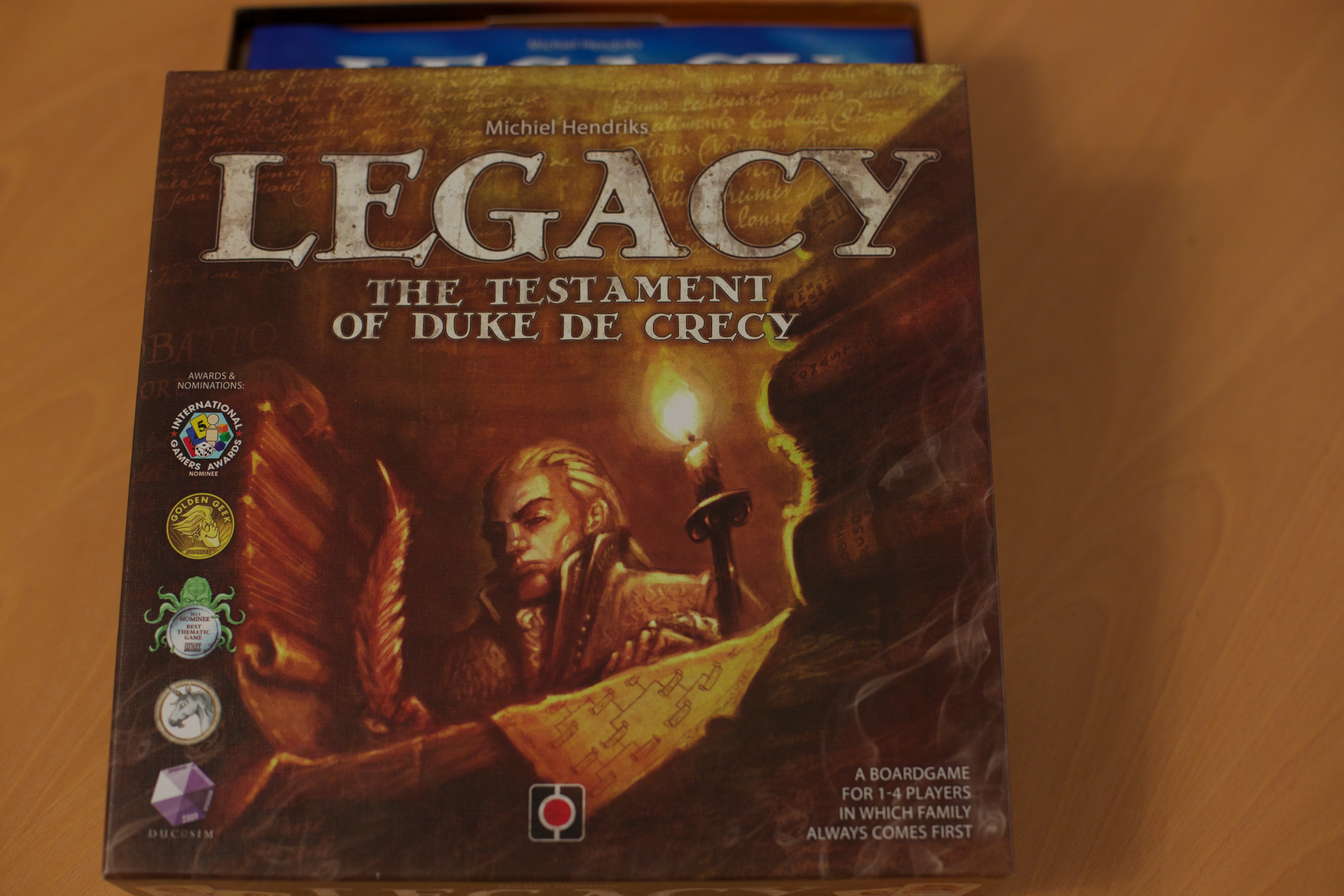
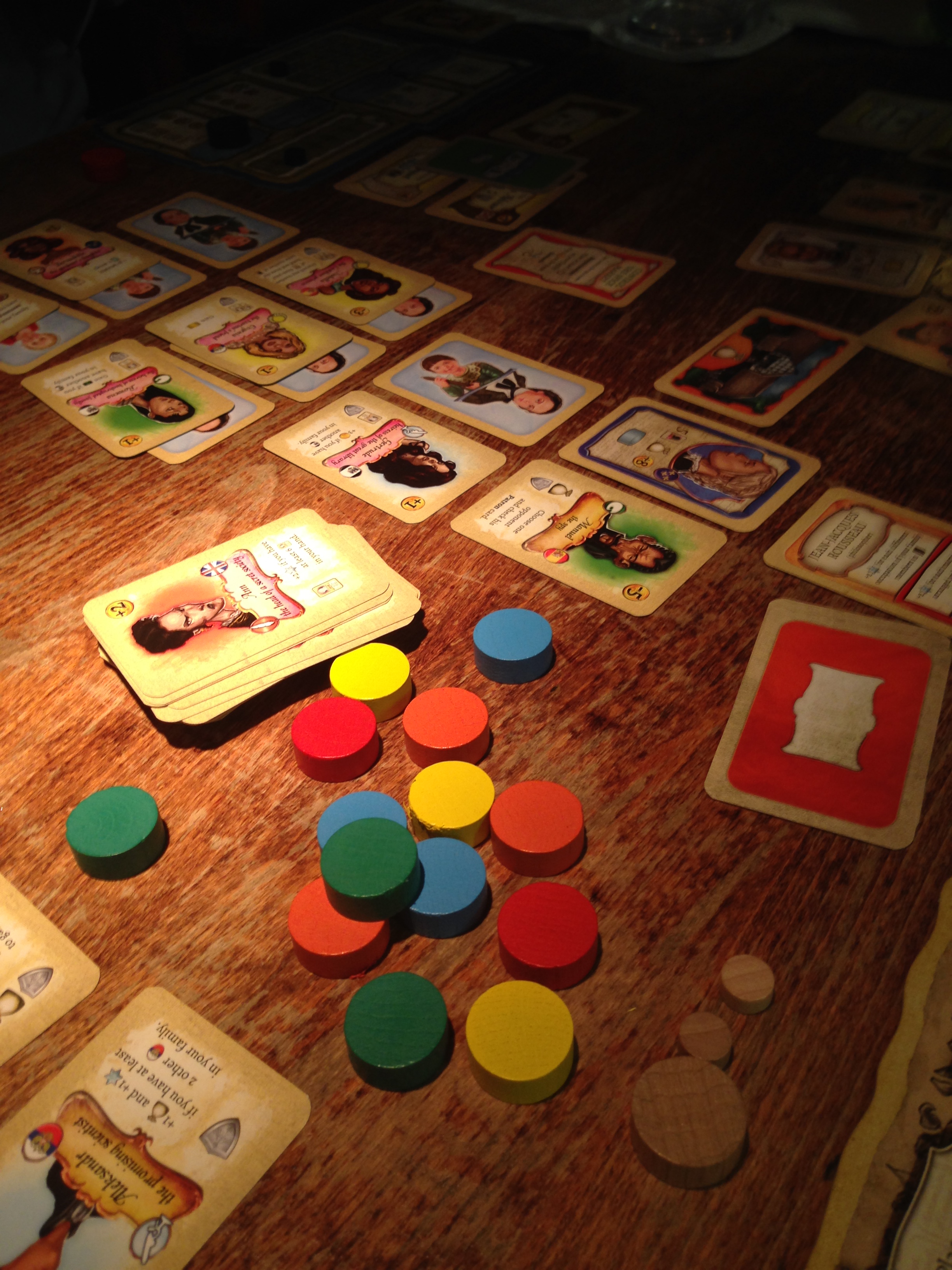
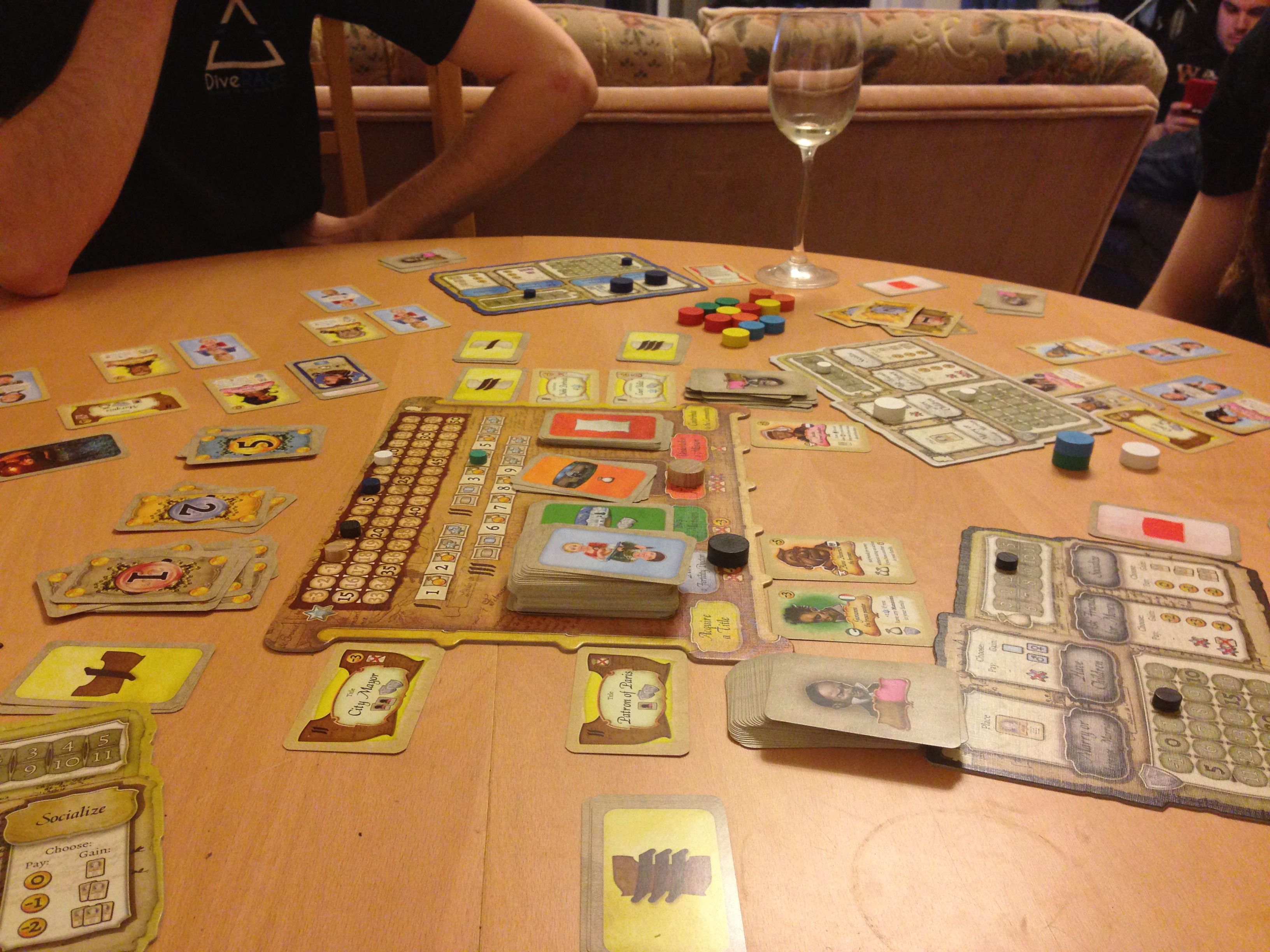
We’ve wanted to review Legacy: The Testament of Duke de Crecy for ages, but had only played it once and with very mixed results. There are few experiences in the world more draining than learning to play a game as you’re playing it by simultaneously reading and explaining the rules, as Bob rapidly discovered. This approach is particularly ill-advised for Legacy, as it’s one of those games which, while reasonably straightforward to play, has an awful lot of stuff on the table. Each player has a board and counters, as well as approximately 568 cards all of which need to be placed face-up and visible for various reasons. And then of course there’s a central board with even more stuff all around it. You need a big table to play this, is what we’re telling you. But you do get to make some nice little family trees out of cards so it balances out.6D-35-181

Apart from anything else, everybody keeps getting distracted by the charmingly-rendered but deeply politically-incorrect artwork. There are 83 unique miniature portraits in Legacy, and presumably in order to stave off death by boredom in addition to severe carpal tunnel the artist (Mateusz Bielski) went for a heavily caricaturised style.

‘Cor, look at the tits on her!’

6D-35-212‘Nevermind the boobs, have you noticed what the moneylender looks like!?’

‘I’m sure his nose is just a coincidence.’

‘Um, alright then, what’s your excuse for the Moroccan then?’

‘Uh… well he has a nice moustache at least!’

IMG_0902
Babbies in arranged marriages

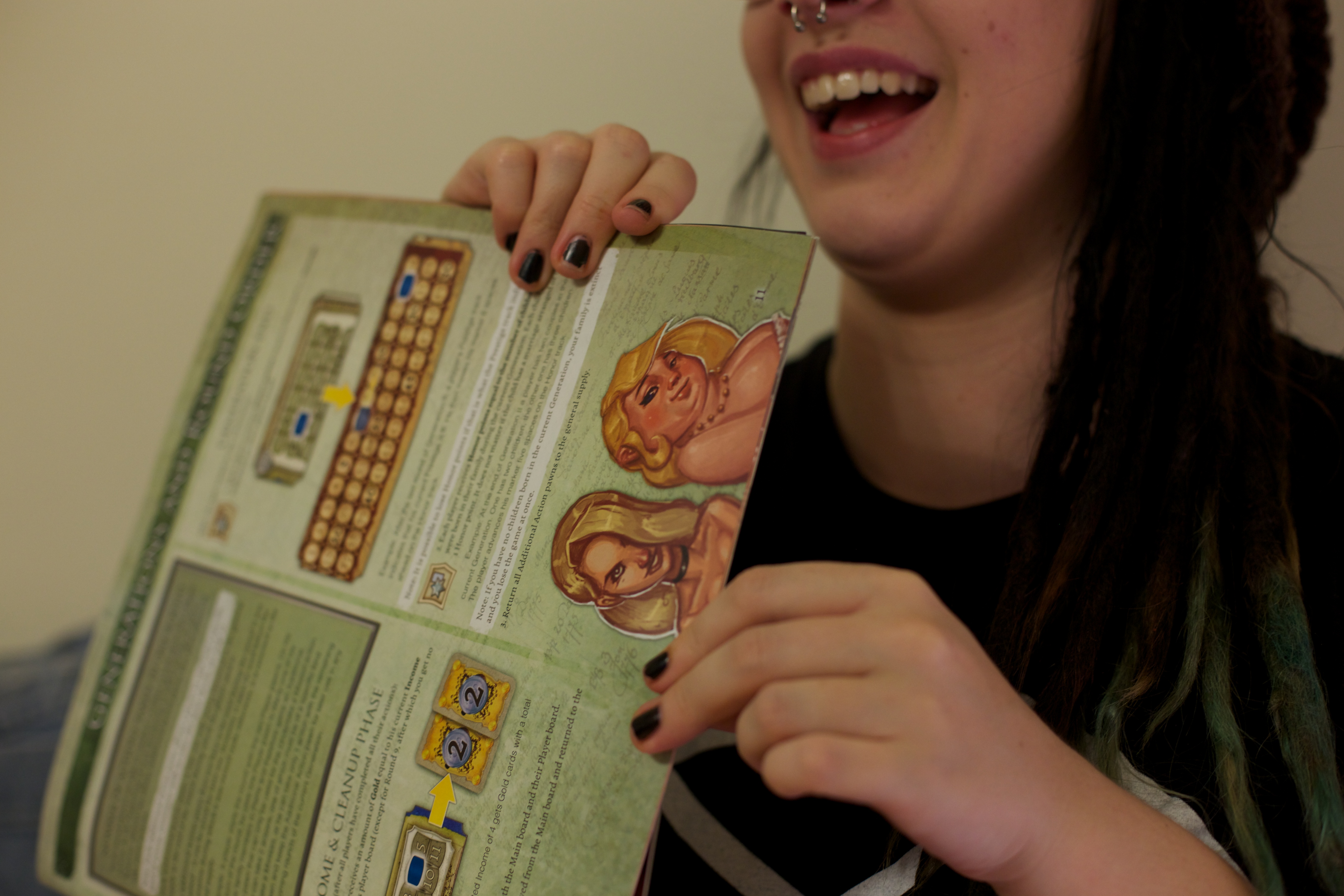
Additionally, the game introduces itself with a beautifully-calligraphied but long letter. Bob should not have tried to read it out loud. Generic gaming buddy Andy questioned whether Anna Karenina (the novel, not the person) had accidentally been snuck in. Briony came close to giving up entirely but stuck around with a superhuman effort of patience for the sake of the farm, sustained by some wine. Part of our reticence was probably due to a mismatch in interests. Your misery farming friends are in their twenties and have expensive cardboard hobbies, intense relationships with gin, and demanding careers. The aim of Legacy is to marry and have lots and lots of babies. This is something that we just don’t quite understand. In fact it was down-right amusing watching ourselves as young adults failing to be young adults set in a different time period: in the end we were grateful to be living in the 21st century.

Essentially it works like this: You play as the head of an aristocratic family desperate to achieve wealth, fame, and honour. You have a secret patron who will reward you with all of these things if you fulfil certain objectives such as contributing to the arts or having tons and tons of babies. There are two kinds of resources in the game; gold and friends. It’s all very French. You can increase the amount of money you have by doing things like begging for cash from your friends or investing in business ventures, and you gain friends by doing things like going to balls and socialising. You can also do things like buy titles, contribute the community (obviously by wasting money on a giant feast, because French aristocrat), or buy a mansion. The main way that you increase your income, gain friends, and earn prestige (which translates to honour – the ultimate victory point of the nobility) is, however, to get married and have babies. Lots and lots o’ babies, as these are actually a resource that earns you victory points per round.

6D-35-243 6D-35-242

The game is played in three phases (‘generations’). In each generation you can marry your characters to friends, and then sprog. Sprogging happens immediately upon marriage and it’s IMG_077650/50 whether it’ll be a boy or a girl. There is also a risk of morbid ‘complications’ arising, during which you must choose who survives – mother or child. You may also visit a fertility doctor to have multiple babies (but you will lose friends in high society to do so) or pay money to choose the gender of the baby. You see, gender is important. It can cost a lot to marry off your daughters, while strapping sons can land themselves a wealthy wife and bring status to the family. Finding the ‘right’ sort of friends to wed can be a challenge as well though – it’s no good marrying off your most beautiful daughter to Paul the pig farmer, despite his impressive fertility.

6D-35-319 6D-35-303

Additionally, friends and relatives interact in different ways. Some of this is due to the secret objective of your patron, who may want your family to be full of artisans or scientists. Some of it is due to the unique characteristics of the friends and family members. Great-uncle Tufty the King’s fifth cousin may bring a lot of cash with him, but he can’t have any children and he’s Prussian, which means that no self-respecting Moroccan or Spaniard will join the family. Your sixth daughter may have wide hips and a charming smile but oh dick-balls there are no good male (yes, it’s a heteronormative game) friends for her to marry so we’re all fucked now.

IMG_0775At the end of each generation the children grow up, arranged marriages finally come to pass, and more babies are born. The table rapidly becomes full of family trees represented by cards, which is satisfying to see and a cool mechanic but definitely takes up too much space. For a three-person game you need a good-size table and any extra chairs you can lay hands on.
Of course it transpired that the first time we played this game we played it wrong (of course) so this week Bob was dispatched to the Reading Board Games Social under strict instructions to play it and play it right. She did manage to play it again, but playing it right…? Eh, close enough. It was, as discussed, very very hot. The RBGS is held in a nice but heavily under-air-conditioned pub called the Abbott Cooke, which serves gastro-pub food, expensive beer, and nice things like free iced cucumber water. And there was cake! Distracting cake!

11261980_10154062192773289_1617188442044898868_n

Every year for their anniversary the RBGS has a cake baked in the fashion of the game they believe will win the Essen Spiel Des Jahres award. As you can see, their vote this year goes to Colt Express, the shooty Western-themed train heist game.

IMG_0774Anyway, between the heat and the cake several mistakes were made. Perhaps this is to be expected the first few times you play this game as while it is not difficult to play, there is an awful lot going on. Lots of symbols and tasks, as well as the long-term strategy you’re trying to keep in your head. We give it two daggers because while dickish interaction with other players is minimal, as with many worker-placement games you can place your workers on a space that another player would rather like and if you could please fuck off and let them hire the fucking fertility doctor they’d be very fucking grateful indeed. Which, naturally, can be quite frustrating.

Sigh
Sigh

Overall, recommended for medium-weight, engaging, vaguely-offensive fun, but try the single-player version before trying to introduce it to your friends, and get a big table.

6D-35-296 6D-35-247

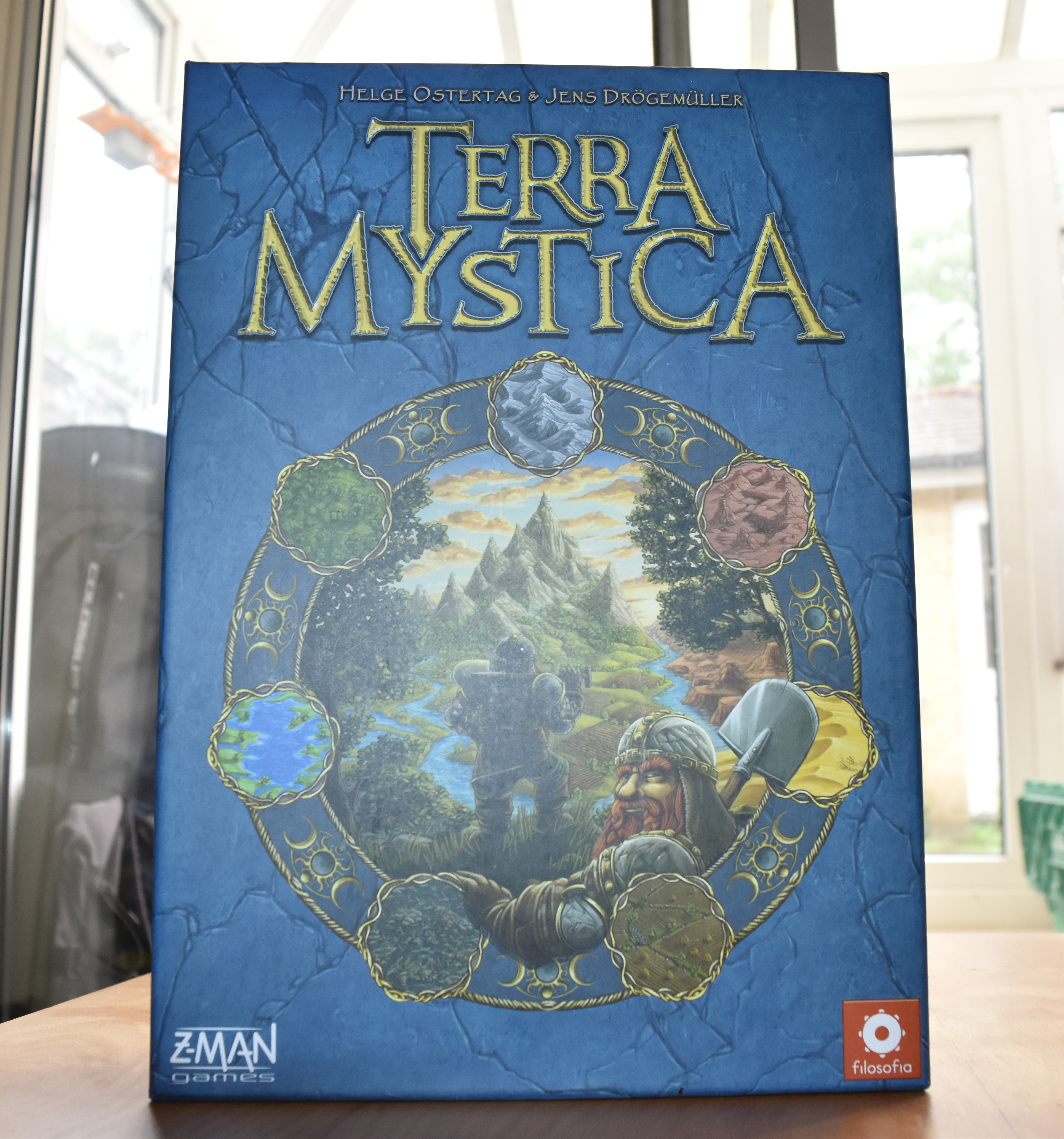
Terra Mystica: Terrain Stereotypica

Brutus scale: 3/10
Pairs well with: A selection of ales representing terrain types. E.g. dark stout for Swamp, pale ale for Grasslands, red IPA for desert, etc.

Contents: Mystery, Dirt and Sulky Opponents.

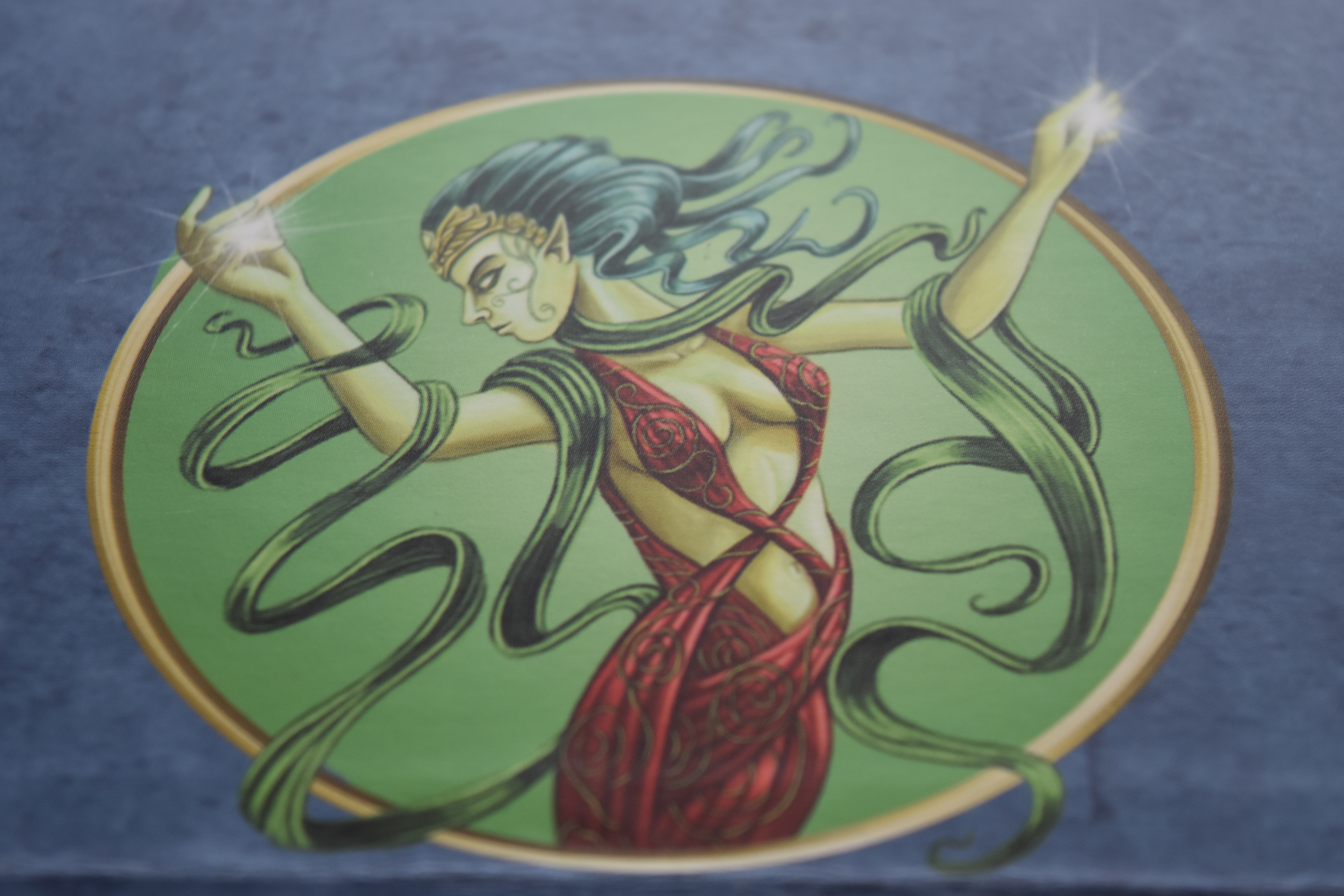
Terra Mystica roughly translates to English as ‘mystical earth’. What’s so mystical about it you ask? Well, for one, the fact that the laws of geography and biology don’t exist is pretty thrilling. And by thrilling we mean no-one cares. It’s another terrain-based board game with different ecologies represented by different tile designs in the style of Small World or Kingdom Builder. Also similar to Small World is that you play as a race/civilisation. Your choices are scantily-clad female races (such as witches), brutish large men races (such as giants), and sneaky stereotyped races (like the dark and plotting alchemists). Many of the available races fall in between these categories, but one thing’s for sure: it will feel like your flippant choice of race has way too much impact on the game.

I am Man, hear me roar.
DSC_0112
I am Woman, my breasts are barely covered.

Each race will have some varying starting resources, and will have a selection of different abilities that come into play throughout the game. This makes playing through as a particular race for the first time really fucking difficult, as three hours into a game you’ll spontaneously realise you should have built something in turn one, but didn’t. There is no way to save it. You’ll just have to suck it up and keep building single houses every turn until the game ends. You are a terrible leader of your people and they know it, and they resent you for it.

‘Sire, what shall we do to make our empire grander? More trade perhaps? Build a mighty cathedral maybe?’

‘No my poor peon, we shall build a small wooden house on a single tile. Forever.’

‘But sire, all of our people have houses, surely we should build something better –‘

‘- Houses! Forever!’

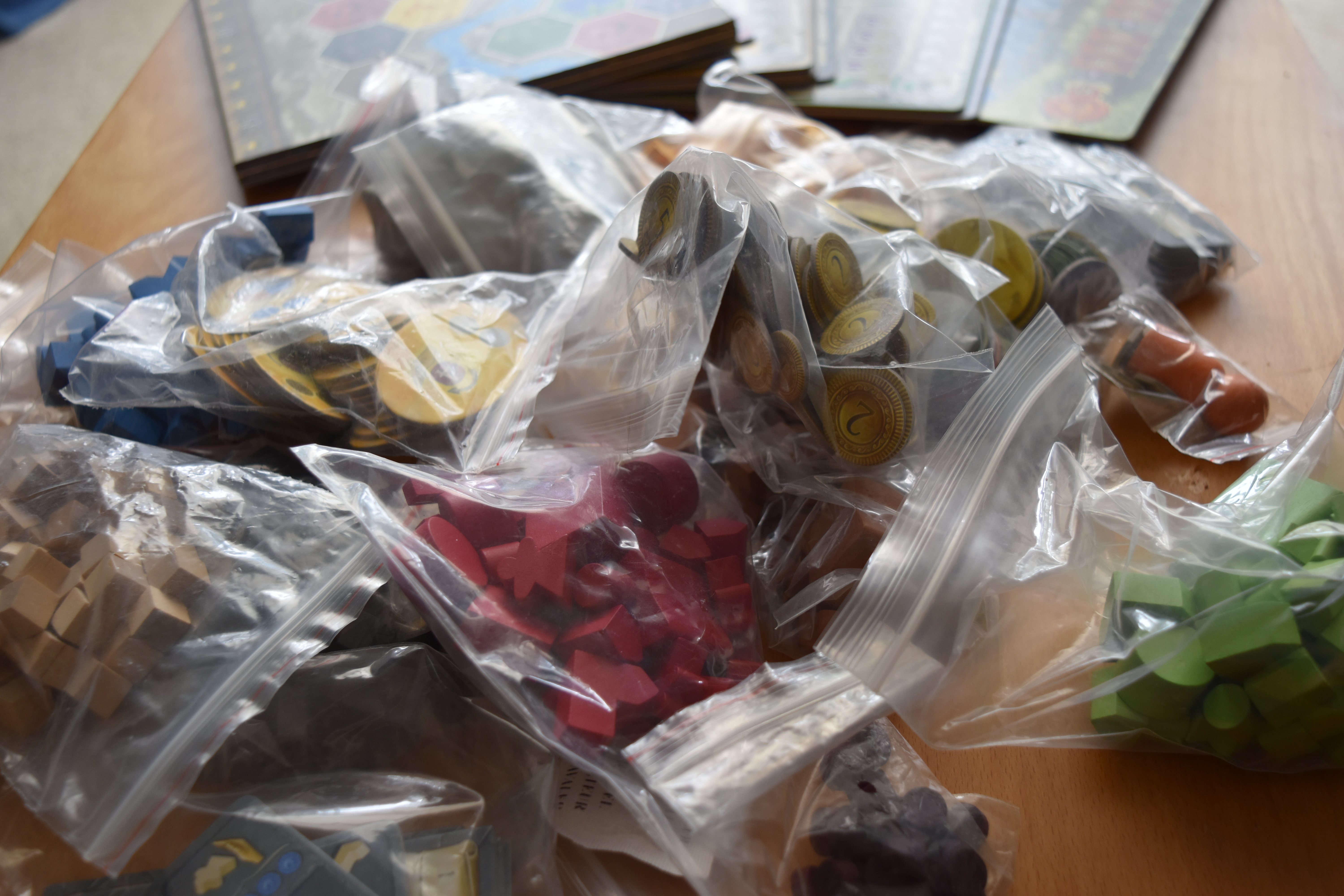
DSC_0123The mechanics of the game are mainly centred on job selection. This will provide you with some sort of resource, and/or an ability that you can tailor your turn to. Each race receives a board with around 5,097 wooden pieces on it, of which you play the wrongly-shaped piece often. In reality there are about 20 pieces, but still, that’s a lot of shapes under your control. Each of these pieces represents a different type of building, or worker, each with build costs that ramp up the better the building you want to construct. Once you’ve selected a job an action phase occurs. This is where the real meaning of the game title is revealed: your race can only settle on a particular type of terrain tile. In order for your city to expand you need to terraform different terrains into your own in order to build on top them. It’s like Civilization or Tigris and Euphrates only worse and a more frustrating drain on your resources.

Imagine you are a small band of settlers looking for the ideal place to begin your great dynasty. You’ve travelled all over the land to find the most fertile, most beautiful, most defensible place. But Gary decides that actually, maybe if we settled on some scorching, inhospitable lava plains, that might be better. Gary is pretty stubborn leader so we’ve had to go along with it. Typical fucking Gary.

Who knew there were so many different types of dirt.
You could have picked any of these, Gary.

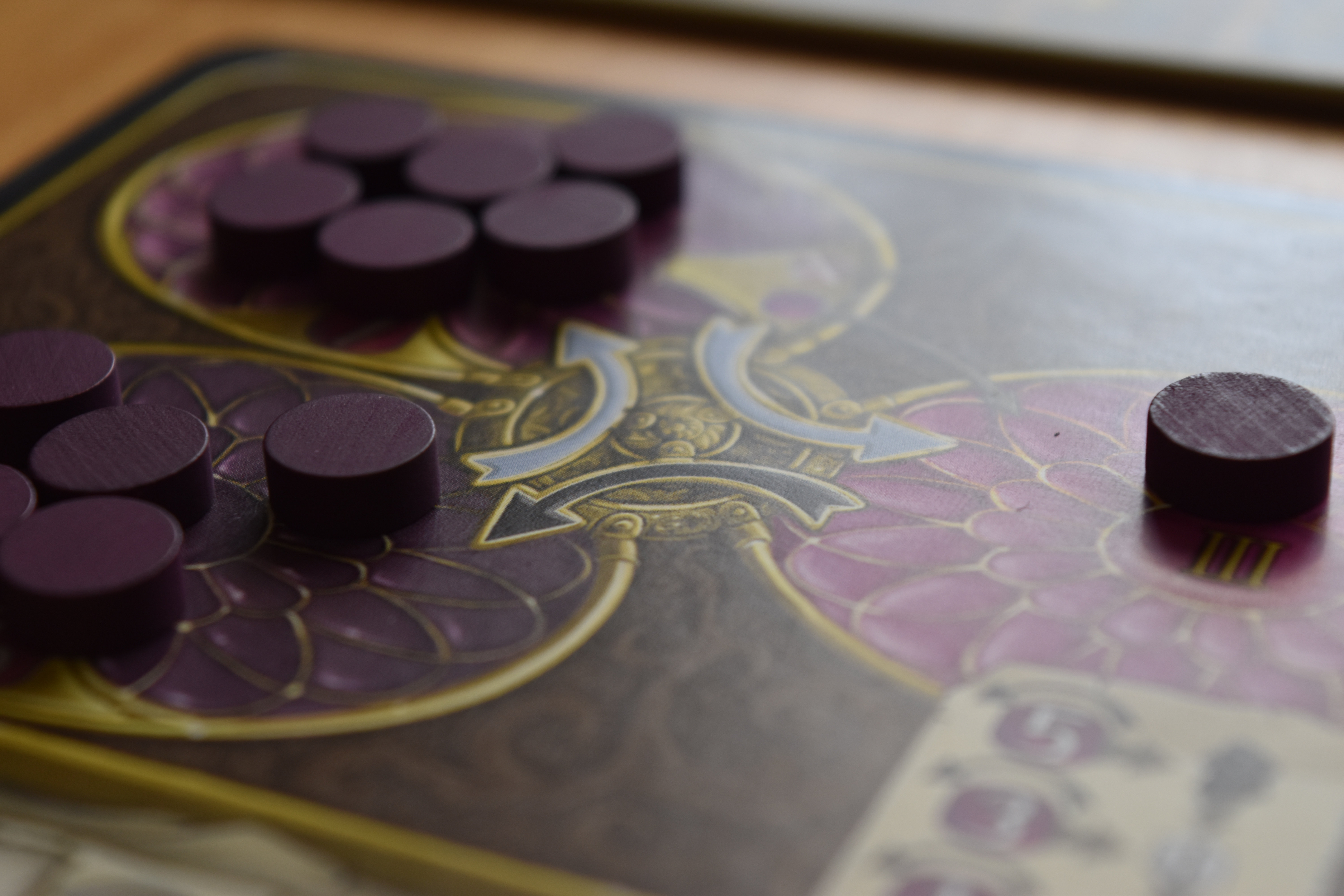
The list of things you can do in your turn isn’t particularly well-structured either – you can more or less keep doing all  of the things you want until you run out of resources (admittedly in some games this is a great thing, but you grow weary of the freedom rapidly). This makes competition with the other players minimal as no one can tactically end turns, or force extra resource spending. However one mechanic that is pretty good is ‘power’. Power is a physical resource in DSC_0116this game, which is purple and stored in some big dishes on your personal board. You can collect/receive it during turns or actions, which means that you transfer a little purple power pellet from one dish into the main dish. When you spend that power, you move the power pellet from the main dish to the beginning dish. In order to generate more power you have to move all of the purple pellets from the beginning dish to the main dish again in a little cycle. It’s a pretty neat cycle which requires forward planning, and allows unlimited but very tightly-constrained regeneration.

DSC_0126Unfortunately it’s only worth doing if you go heavily into a power farming strategy, or your race is particularly good at keeping power generated. For instance, Briony quite enjoys playing as the alchemists as their race ability, once the stronghold (a particularly important bit of wood) is built, generates a lot of power straight up. This means that you don’t have to compete for resources or jobs as you can mostly pay for everything with power, and you don’t have to keep putting a lot of effort into getting the power cycled around the dishes. She also enjoys this race as she’s spent almost every game playing as them, so she’s nailed the routine of what to do for the most effect. Then again she is the sort of person that can spend hours playing the first 100 turns of civilization over and over as one particular race to optimise strategy and timing. Bob simply cannot do this – she claims to enjoy fun.

Tasty bonus tiles.
Tasty bonus tiles.

As the game goes on your settlements begin to expand. Buildings are worth points, and once you’ve accrued enough your settlement becomes a city. This comes with a nice one-off bonus and also allows you to build a stronghold, unlocking a race ability. Along one side of the board there are a series of bonus tiles that offer a selection of lovely things e.g. extra victory points, some resources, a nice compliment about your hair. These are turned over once per round, and will state a requirement such as ‘Gain a buttload of power if you build five perfectly-domed city halls out of lava this turn’. This allows you to plan out your buildings to occur in rounds where you can get the most victory points from them. You can also imagine a giant stroking the bonus card seductively, clad in a leotard and heels for maximum gameshow effect. Whatever floats your boat.

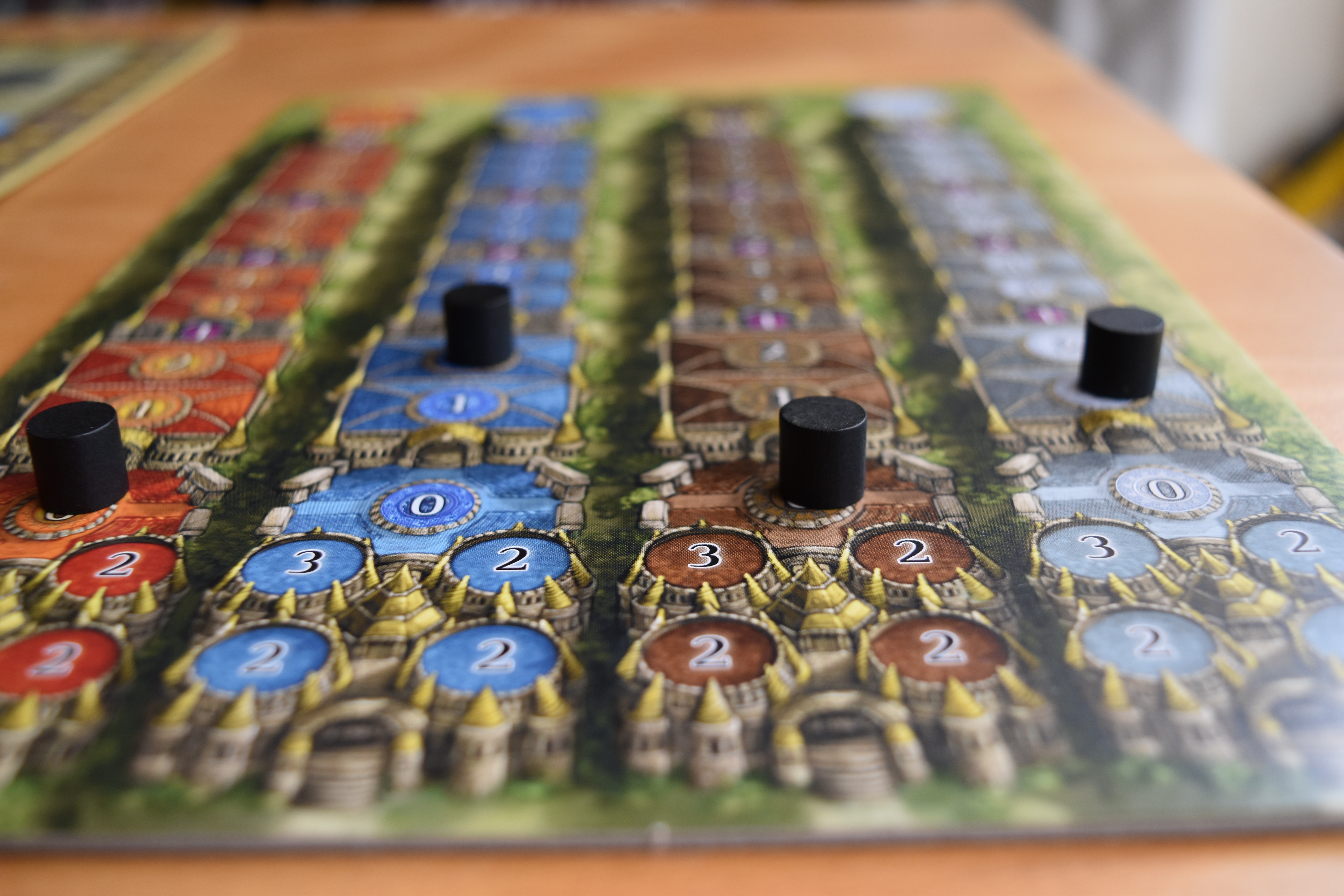
In addition to this there is also an elemental temple track. In this there are four tracks representing each element. In order to go up in these tracks you must have a priest meeple (which can be gained by building certain buildings) or fulfill a job has that rewards you with that resource for free. Priests are sacrifically burned in the ‘totally-not a cult we promise, guys’ temple to push you up the track and also correspond to the bonus round tiles. DSC_0124For instance ‘if you are at least at level 4 in the Earth track gain a free visit from the Emperors of Xenu’*. We’re not particularly sure why this mechanic exists really. It’s adding an extra component to a game that already has a shit tonne of components, and to use would really take a lot of investment. Bob tried it once and even with a very cult-loving race it wasn’t really so much ‘viable’ as ‘fucking irritating’. We also aren’t really sure why they represent the elements… possibly because the earth is made from the basic four elements? Who knows, all we know is that that is bad science and the expansion will probably have a Helium and a Potassium track.

Once the game ends you get some final victory points that add to the ones generated throughout by your buildings or bonus’s. Points are awarded for the biggest city, how far up each track a player is, and some other excuses to have some points. It’s actually quite a nice way to end because it changes the scoring up, makes you feel good for getting more, and that you did better than you had originally thought. Overall the game has some really good mechanics – its downfall is that it has too many of them. This makes picking an effective strategy difficult and requiring a lot of experience with each race. We can’t help but feel that is doesn’t need quite that much stuff. There is a lot of it. Pieces, tiles, bonuses, tracks, races, resources, power, jobs, workers, buildings, giants in leotards – like the contents of a student’s bedroom floor (Nerds have ‘interesting’ university experiences).

Exhibit A - 'stuff'.
Exhibit A – ‘stuff’.

That being said, the two player version of the game is surprisingly good as a lot of the extra guffin is taken out. As a result of fewer players, the game progresses much faster, and you tend to get a grip on your race more quickly. Certainly playing it two player a few times would be the ideal way to understand the game, technique, and races before diving into a monster 6 person epic. Don’t be too put off from playing this game kids, there are a lot of positive reviews of itout there. We just feel like it was so close to being a truly classically epic game, but it got a bit too ahead of itself. Less is more, Terra Mystica, you don’t have to keep putting on extra frilly bits to please your target audience.

DSC_0133


*We respectfully request that the Church of Scientology, hallowed be your celebrities, please not sue us for these jokes. We haven’t got any money for you.


Puerto Rico: The Best Budget Holiday in a Box since 2002

Brutus rating: 5/10
Pairs well with: A refreshing rum cocktail such as a Dark ‘n Stormy or a Mojito.

image source: http://kidsactivitiesblog.com/9601/best-board-games-5

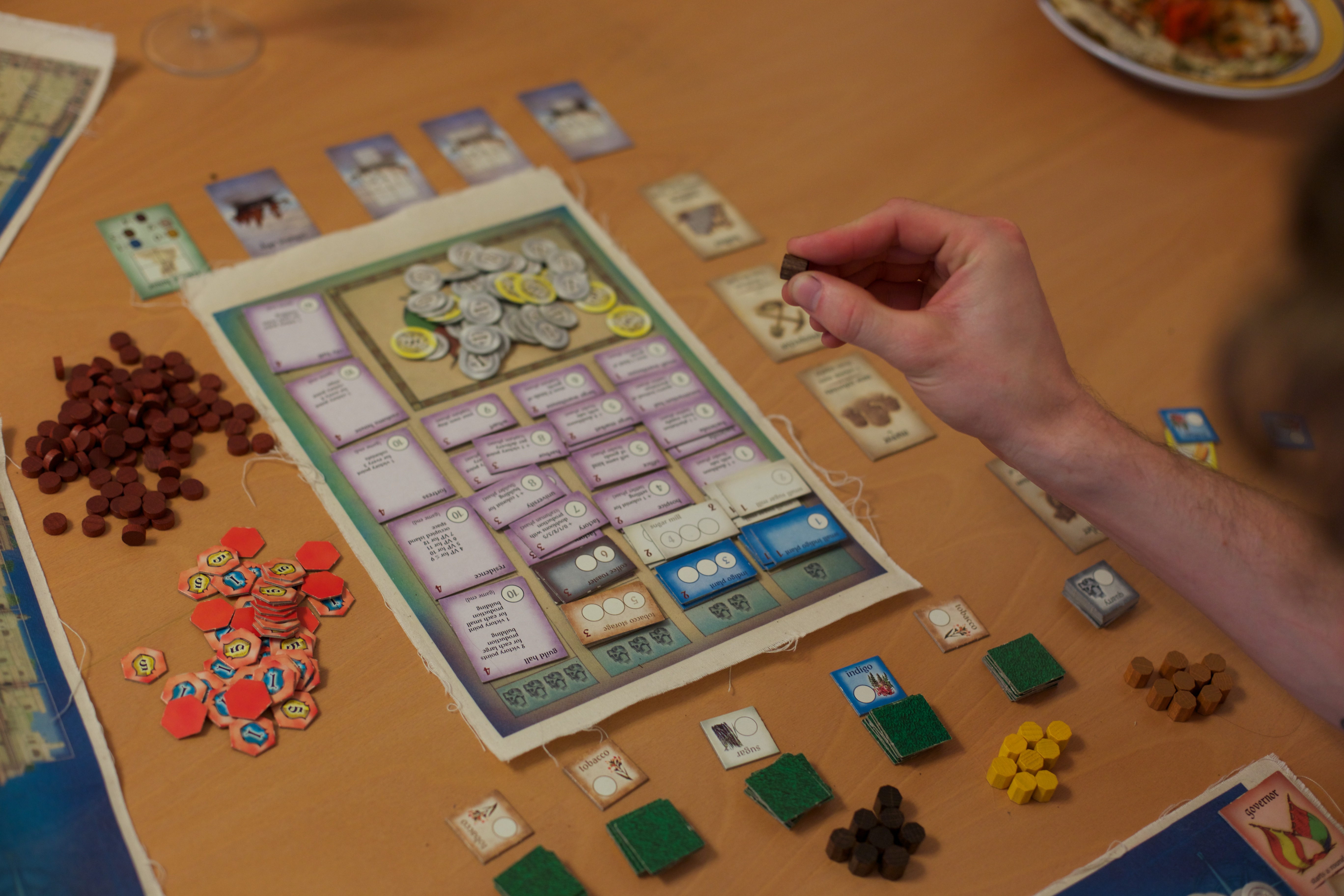
6D-35-160Puerto Rico is an excellent job selection  game (with some elements of worker placement) in which you play the part of a rich colonial governor on the island of Puerto Rico. Picture the scene: Dappled Caribbean light, the distant sounds of a bustling harbour, you sit in the mid-morning heat on the veranda wondering how best to get the ‘locals’ working twice as hard today, which silken suit and wig to wear tomorrow. Your job is to manage the island, its plantations, workers, buildings and trading of goods to far off places. Top notch mercantilism.

'The Locals' ...
‘The Locals’ …
Ships as far as the eye can see. To the end of the table.

Unfortunately there are other players in the game each taking on the same role, and as a result each player has a personal board which depicts the island. It is there that you each do your managing, building, planting and harvesting, competing with everyone else’s versions of the island. However, the docks are shared by all, meaning that one must compete to ship goods and reap victory points. Usually this means taking it in turn to place goods on ships, or to block other players by taking a job first: in the misery farm lounge this can even include pinning your friend down so they physically can’t move their goods.*

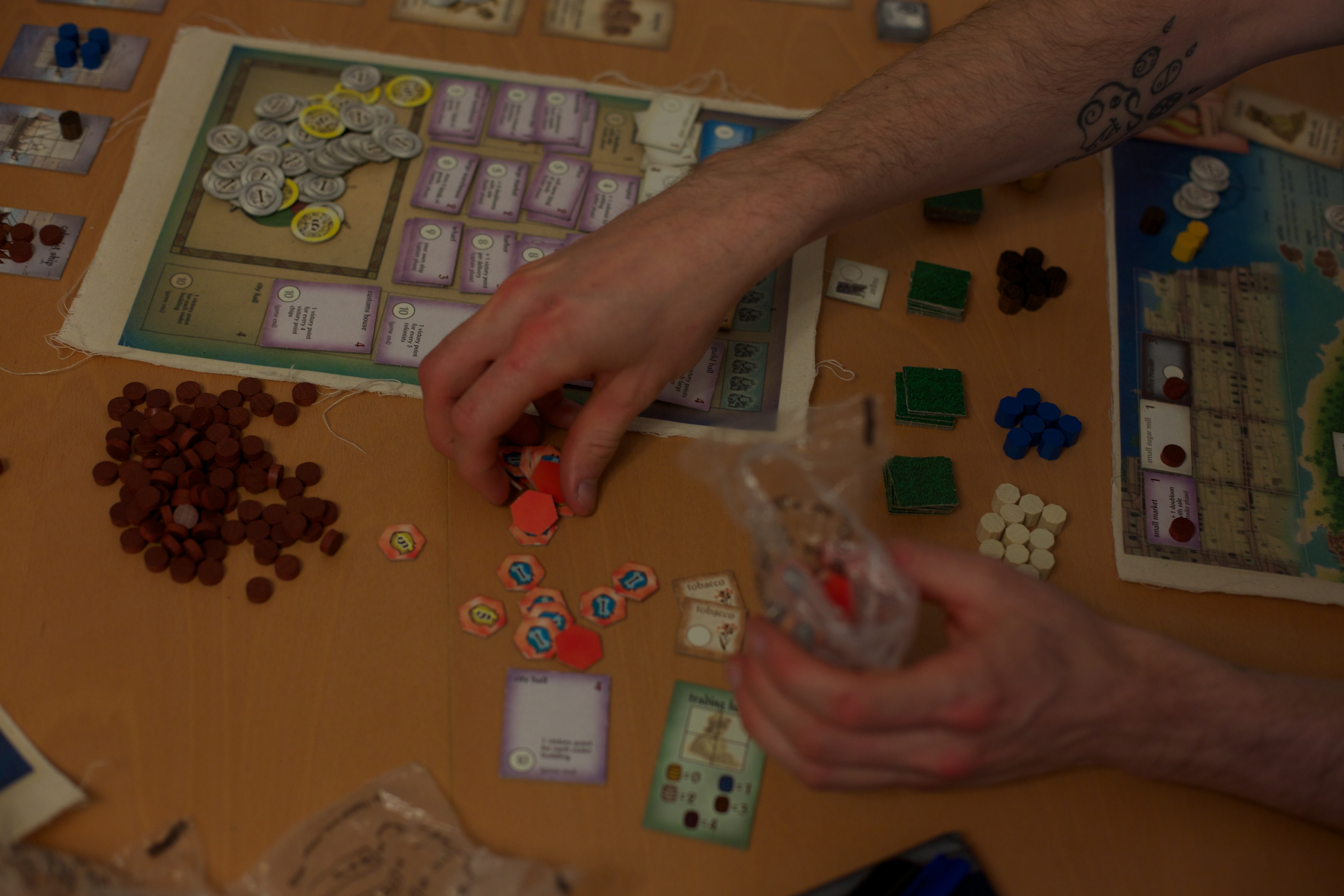
A turn will consist of the player with the first person puck (in Puerto Rico’s case it’s the governor’s flags) selecting a job to perform during their turn. These are pretty self-explanatory, for instance the builder allows you to build (although this does get quite competitive later on in the game as there are only a finite number of a certain type of building). Once the player who picked the job has taken the action, each subsequent player will have a chance to use it as well. The player who chose it first will have a bonus that comes with the job which the other players may not use/receive, for instance picking the builder first will enable the first user to build at the cost of one less doubloon. Once everyone has happily built some things, it moves on to the next person to pick a job.

'What is this bullshit?'
‘What is this bullshit?’

The moral of the story is that there is a great deal to be gained from picking a job first. It’s almost worth trying to stare-out the other players in an attempt to make them question the consequences of picking the job you realllllly wanted. Maybe even slyly announce general threats ‘Gee I sure hope no-one picks the Captain because I’ve been polishing my buckles for days, if I didn’t’ get to wear them for some reason I’m not sure what I would do’ (pause for dramatic effect while gazing off into the distance). For jobs like the craftsman, which allows you to produce the goods you are farming in order to be shipped at a later stage, picking it first allows you to produce extra of any one of your goods. This means more victory points if you manage to ship it.

However the general rule of ‘more goods is always better than fewer’ is often not the case in this game. This is due to two factors, the first is because there are only 3 ships in the docks that may ship only one type of good on each. When the Captain job is picked this means that going by turn order each player can place only one type of good of any quantity (there are five in total) onto a ship. Once a ship has that type, then only the same type can be added to it. Once a ship is full then you cannot add any more goods, which often leaves you with a big pile of resources. This is where the second factor comes in – at the end of a job phase you can only keep two items of goods. Everything else is thrown in the sea, probably as some sort of bribe to Poseidon to keep the trade network running efficiently. As a result even if you’re producing lots of goods, running well-maintained plantations and well-populated island, grabbing the Captain job first is really where it’s at.

6D-35-152
My strategy is ruined: all I can do is drink.

There are a fair few number of strategies for the game that avoid a heavily shipping-based approach though, which is nice for those of us who don’t want to continuously grab the same damn card throughout an entire game. The Trader job is a nice option that involves selling your goods instead of shipping them, meaning doubloons instead of victory points. Doubloons can then be thrown at some buildings which are worth victory points, or have special abilities. The trader post however will only allow the sale of one type of each good, so be vigilant. Again, some good scare tactics come into the ring here as other players may have the same type of good as you want to trade and get there first, leaving you, your lonely barrel of sugar and some misery**. You may also wish to attempt to sneakily trade something that hasn’t been traded yet.

‘Briony do you want to trade anything?’

‘Well, you’ve just traded the sugar, and I’ve only got sugar left to trade with, so fuck you.’

‘True.’

‘Is there a free space for Pete’s phone? How much money would I get on the market for that? I bet it’s more than a barrel of coffee.’

‘Well the rules do say that you can’t trade the same type of good… what am I saying, that’s my phone, we can’t open the doors to creating new resources from whatever is lying around. The living room floor would become a fucking treasure trove.’

‘Good point. It’d re-write history. The British Empire was actually funded by several sweet wrappers, some empty beer bottles and a TV remote.’

Tasty doubloons.
Tasty doubloons.

Trader may be handy for getting rid of left-over goods that would otherwise go in the sea but The Prospector job gives you money in a more direct way if it’s straight-up cash you want. If you do want a heavily shipping-based approach it’s much easier to grow diverse goods so there is a greater chance of shipping most of them. Another viable trick with this is to Captain first, put the good that no one else has on the biggest ship, and then watch everyone be angry. You’ve effectively taken up a whole fucking ship for one barrel of coffee, guaranteeing you victory points and barring anyone else from shipping their large stockpiles of goods. How very British of you.

Your first run through of the game is going to be a steep but fun learning curve. Subsequent play-throughs will actually get more fun as you experiment with new strategies, and work out how those interact with other player’s strategies. Honestly, you could play this game 100 times honing one single strategy and it would feel like a new game each time because of how much the other player’s interactions affect your game***. That actually sounds kind of terrifying to Briony as someone who deeply enjoys being left the fuck alone in her own little corner of the game, but it’s great fun, simple to learn, fast paced, and nicely-themed throughout.**** A game of Puerto Rico is always reliably good, like a fine spiced rum. Enjoy it, and keep enjoying it for many years to come.

Great job governing everyone - lets do it again three times a night for the next month.
Great job governing everyone – lets do it again three times a night for the next month.

*We probably don’t recommend this method because it can often lead to no one wanting to play with you anymore. The Misery Farm get away with it because we have no choice but to continue playing with one another.

** This might be someone’s idea of a good evening in all fairness.

*** In fact, three of our friends actually played this twice a night for 6 weeks. They still love it. Now that is the mark of a good board game.

**** Sometimes, in fact, it is a little uncomfortably on-theme. The workers in this game are little brown cubes which arrive by boat. Yes really.

Sushi Dice: What is the Sound of One Hand Dinging?

Brutus Rating: 2 little fish hooks in the back.
Pairs well with: Sake or Ahasi beer.

6D-33-106

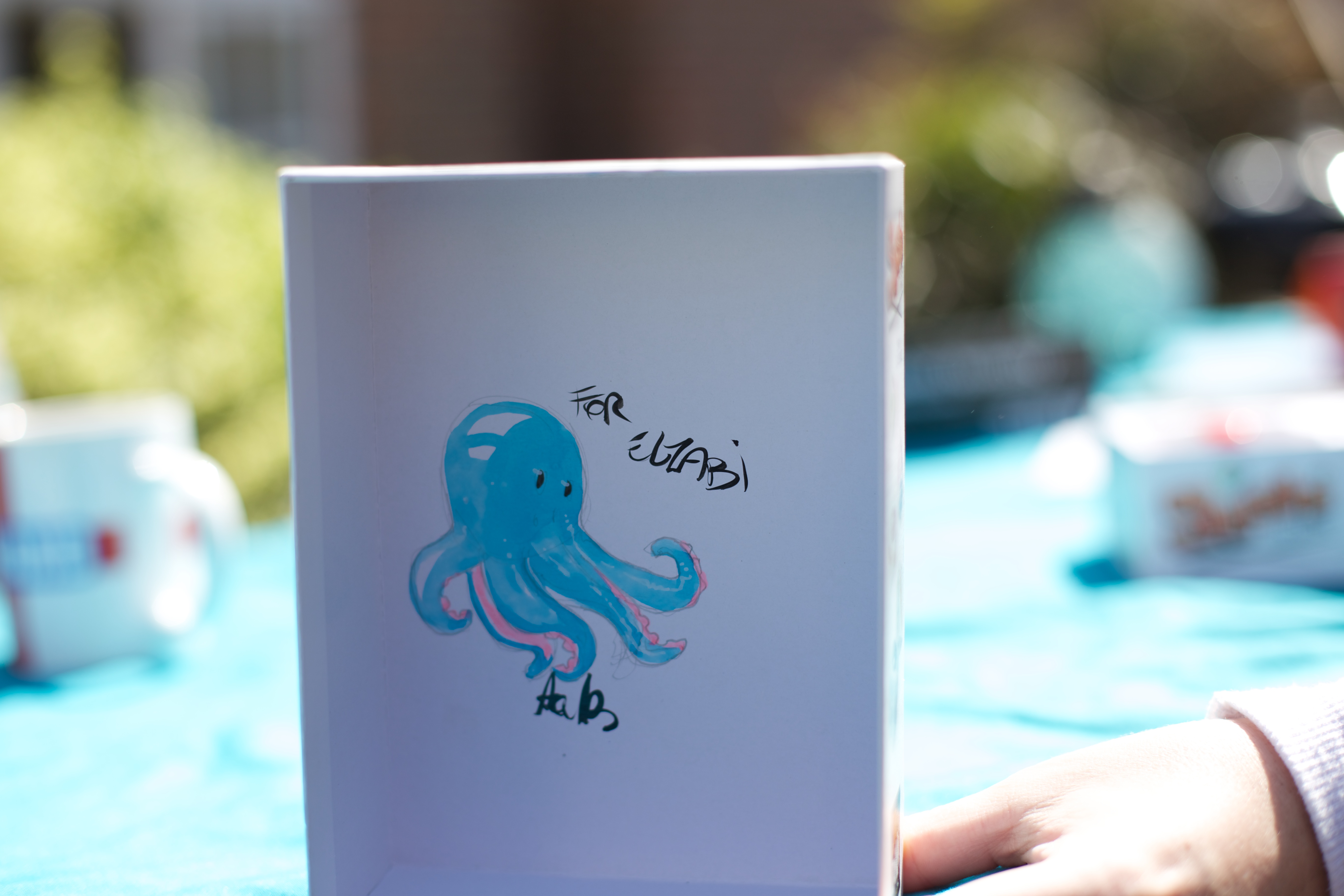
There are two ways to play Sushi Dice. The adult way, and the kids’ way. The adult way goes like this: You go to Essen Spiel with your friends and partner of choice and have a wonderful time (very important stage, this one). While there your friendly robot boyfriend should find the stand6D-33-104 where a new game called Sushi Dice is being exhibit and played (note, sushi is for some reason the current theme of choice for casual games – don’t confuse Sushi Dice for Sushi Go! or Sushi Express or some other nori-based nonsense). The game artist will hopefully be sitting at the stand, churning out little watercolour octopus drawings on the inner lids of games bought then and there. Friendly robot boyfriends know that this makes an excellent gift, and will buy it for their neurotic board game girlfriends (ie Bob).

Later on, when you and your wily gang of nerds are relaxing at a German Brauerei with beer 6D-33-117and bratwursts the length of your arm, you figure out the (very very simple) rules and have a go at playing. The game can be played by any number (>2) of people, but there are only ever two active players at a time. Each active player gets six dice, with are printed with sushi ingredient symbols. Three of the six dice have a star symbol, and three have a black skull.

To play, a deck of cards depicting sushi and other fish dishes (e.g. paella, fish and chips) is placed face down. Three cards are drawn from the top and laid face-up in the middle of the table.

6D-33-149

Players roll their dice until they match the ingredients of a fishy dish and if they get there first they get the dish card. Whoever has the most cards after an arbitrary length of game time wins. Then the round ends and the dice pass to the next pair of players.

6D-33-122Stars are wild. If you see another player get a skull dice you can yell ‘YUCK!’ and they will have to re-roll all their dice. If a non-active player sees both active players roll a skull they can yell ‘CHOP’ and the round ends.

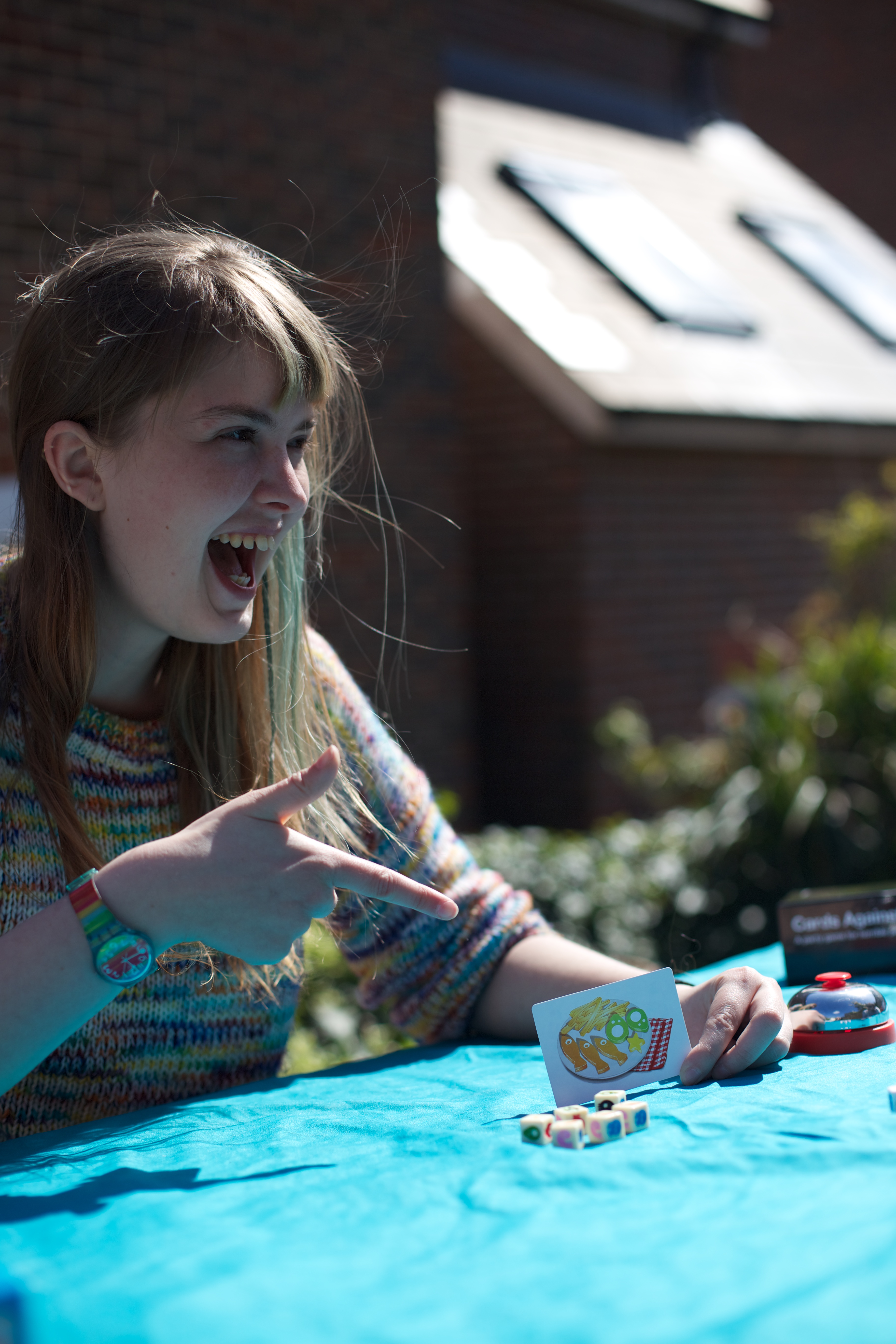
To signify that you, the plucky sushi chef, have completed an order of whichever fishy dish you’ve chosen, you ring the handily-included bell. Of course, when you play the grown-up version you’re in a tap-house, so it’s unlikely that a group of people ringing a service bell would be very popular. So instead of hitting the bell you instead say ‘Ding!’ This swiftly escalates to shouting ‘DING!’ while hitting the table but that’s still way better than being the dickheads with the bell, right?

6D-33-138

Of course, when you play the kids’ version you have to include the bell. Them’s the rules. You also have to become suddenly and tragically blind to cheating. As part of Bob’s plot to indoctrinate the youth of today with geeky values* she has become adept at rooting out decent games which are still child-appropriate.**Sushi Dice is pretty and brightly-coloured, easy to learn, and loud.

6D-33-141

DING!

Kids like loud***.

DING DING DING!

In fact the children Bob played this game with liked it so much they refused to stop playing it even after all the adults had lost interest.

(DINGING intensifies)

The two of them played it between themselves for a good while until the accusations of cheating got out of hand (they were both cheating, and they weren’t even playing to win). Then one of them continued to play it by herself, mainly just to be able to hit the bell every time she finished a combination.

6D-33-154

(DINGing continues, forever, until all meaning and time is lost to the sound of one hand dinging. And every time the bell rings, Bob’s dog barks. She has created a monster.)

That’s what we can consider a success story.


*Parents! Are you worried about your teenage children growing up to be hoodlums and drug fiends!? Well try this remedy on for size: Magic the Gathering! With this collectable card game your son or daughter will never have the money for drugs, and all their friends will commit no greater crime than failing to shower regularly! Hurray!

** Unfortunately she still hasn’t been able to stop saying ‘fuck’ in front of the kids. You can’t fight nature, man.

*** See the Twilight Imperium review for the moment when loud became unbearably loud.


Picture thanks to Dr Photographer