Misery Farm on the Road: Essen Spiel 2015 Day 4 Field Report

Exhaustion looms, but we’re still truckin’. On the final day of Essen Spiel 2015 we offer some final play-throughs and insights, including our considerations for Children’s Game of the Year.

Bob starts the day late, and hungry. The sheer number of games she and Chris have purchased has completely overwhelmed even her giant suitcase and they’ve had to rope in the aid of Friends With Cars to help lug twenty-something board games back to England. Additionally, Saturday night sushi had been completely de-railed when the previously-awesome all-you-can-eat sushi place failed epically in its mission to, you know, serve sushi to hungry gamers*. Deeply disappointing stuff. It took a generous liver-sausage roll and slice of pleasingly stodgy cake to fortify her for the day’s first mission: get Naïade to sign stuff, take a selfie, and draw us a picture.

CRBpZnvWUAATBfD

Mission success, though with many a concerned look. Naïade  is very French, and as such does not understand enthusiasm.

Day 4, game 1: A Study in Emerald
Sanity or victory points.. sanity or victory points..

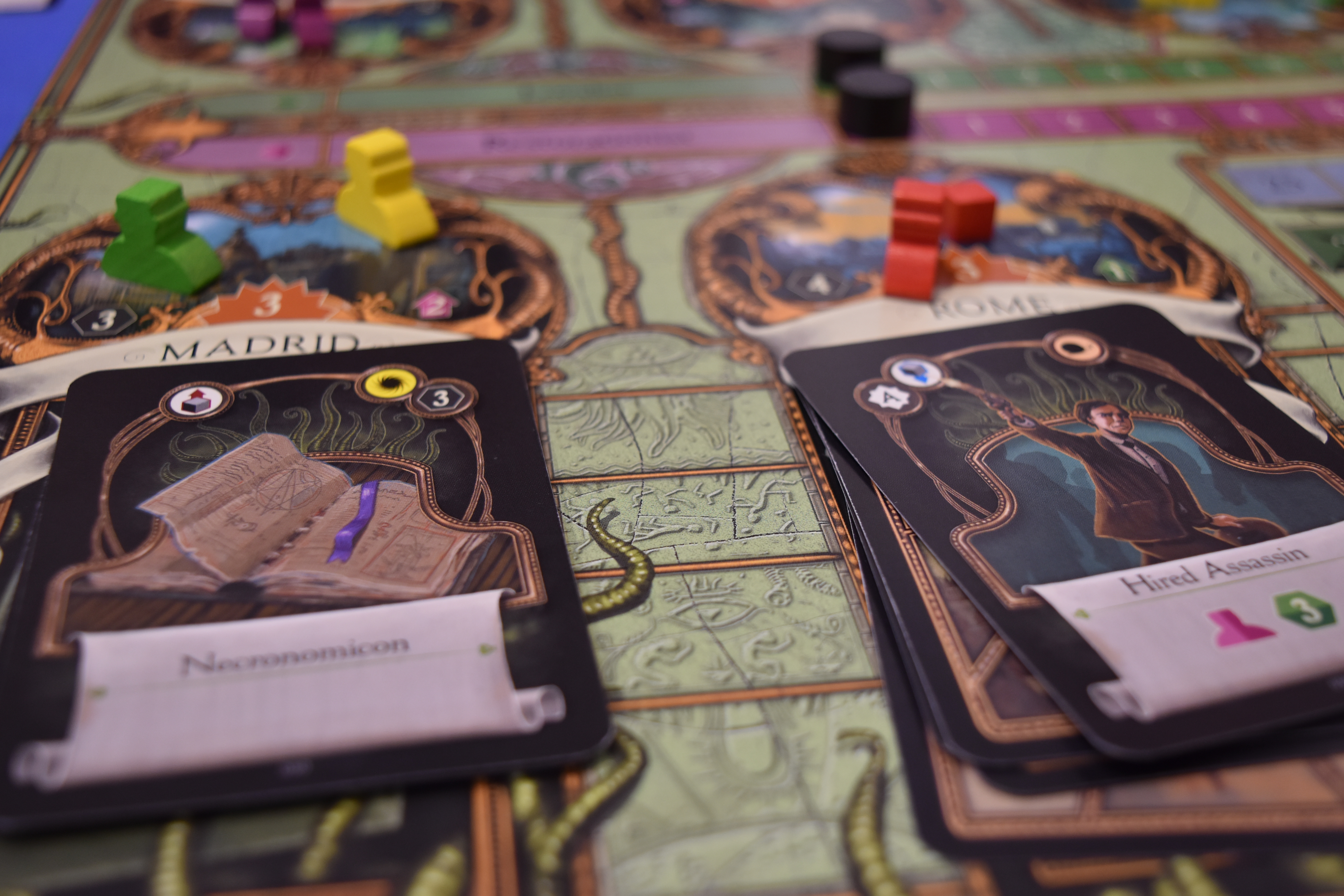
First actual game of the day was the second edition of A Study in Emerald. The game is based on Neil Gaiman’s cult short story of the same name, which is set in an alternate Lovecraftian nineteenth century in which the royal family have been replaced by Great Old Ones. Sherlock Holmes is there, along with a number of figures from history and fiction. In the game, you play (secretly) as either a Loyalist, faithful to the ‘royal family’, or a Restorationist commie intent on bringing down Britannia as we know and love her. The board is divided into locations which allow certain actions with varying ease, as well as a draw pile of cards. It’s effectively worker placement combined with deck-drawing mechanics, to reasonably solid effect.
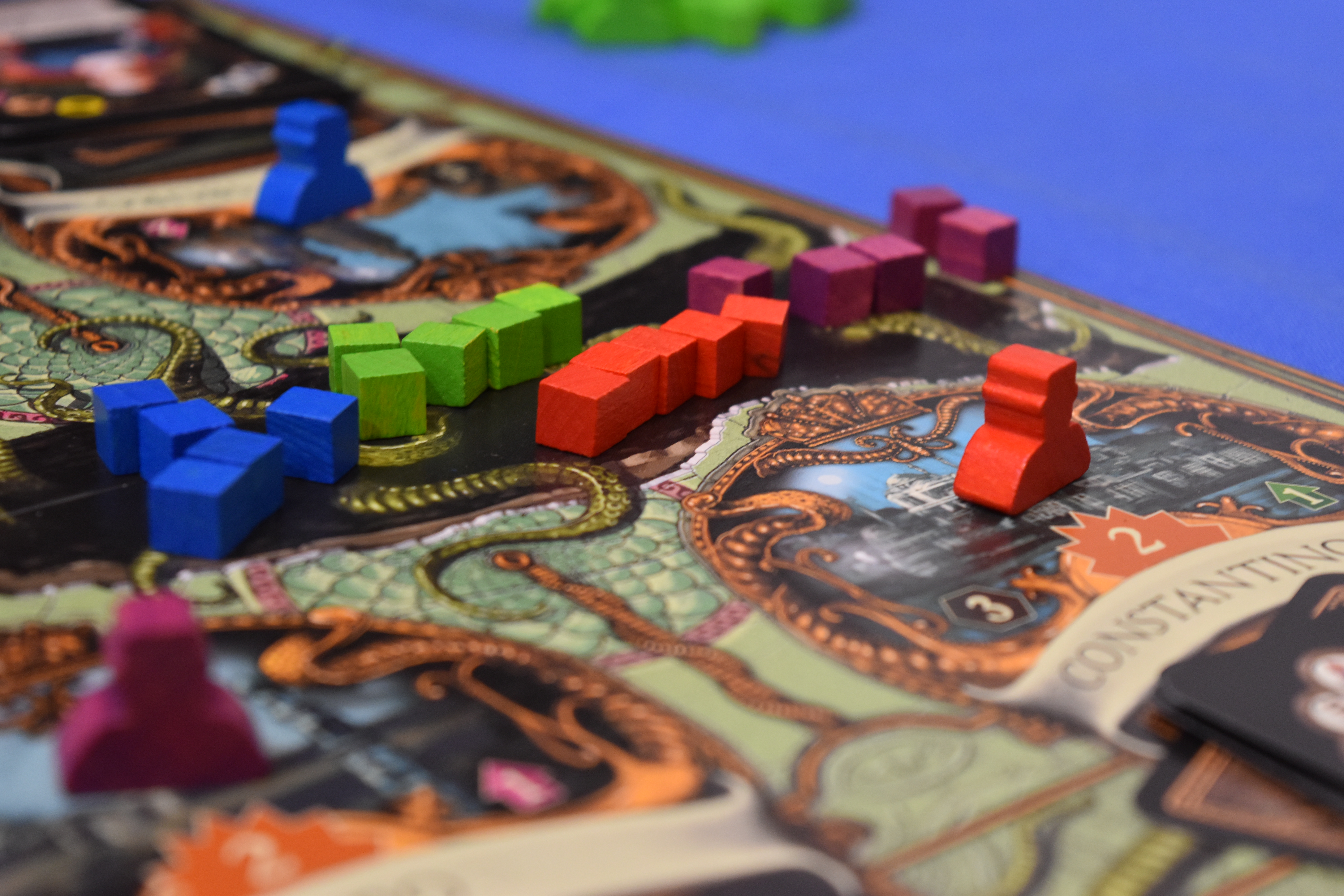
DSC_0438Bob liked it, Briony didn’t. It may be that Bob really wanted to like it as she’d bought it on day one and it had sold out, but equally it’s possible that Briony hated it due to being hungry combined with a shockingly poor game demonstrator explaining the rules**. Certainly it’s simpler than the ‘glorified beta test’ original, and much cheaper and cleaner to boot!

Team Misery divided, and wanting everyone to know about it.
Team Misery, divided and wanting everyone to know about it.
day 4, Game 2: M.U.L.E.

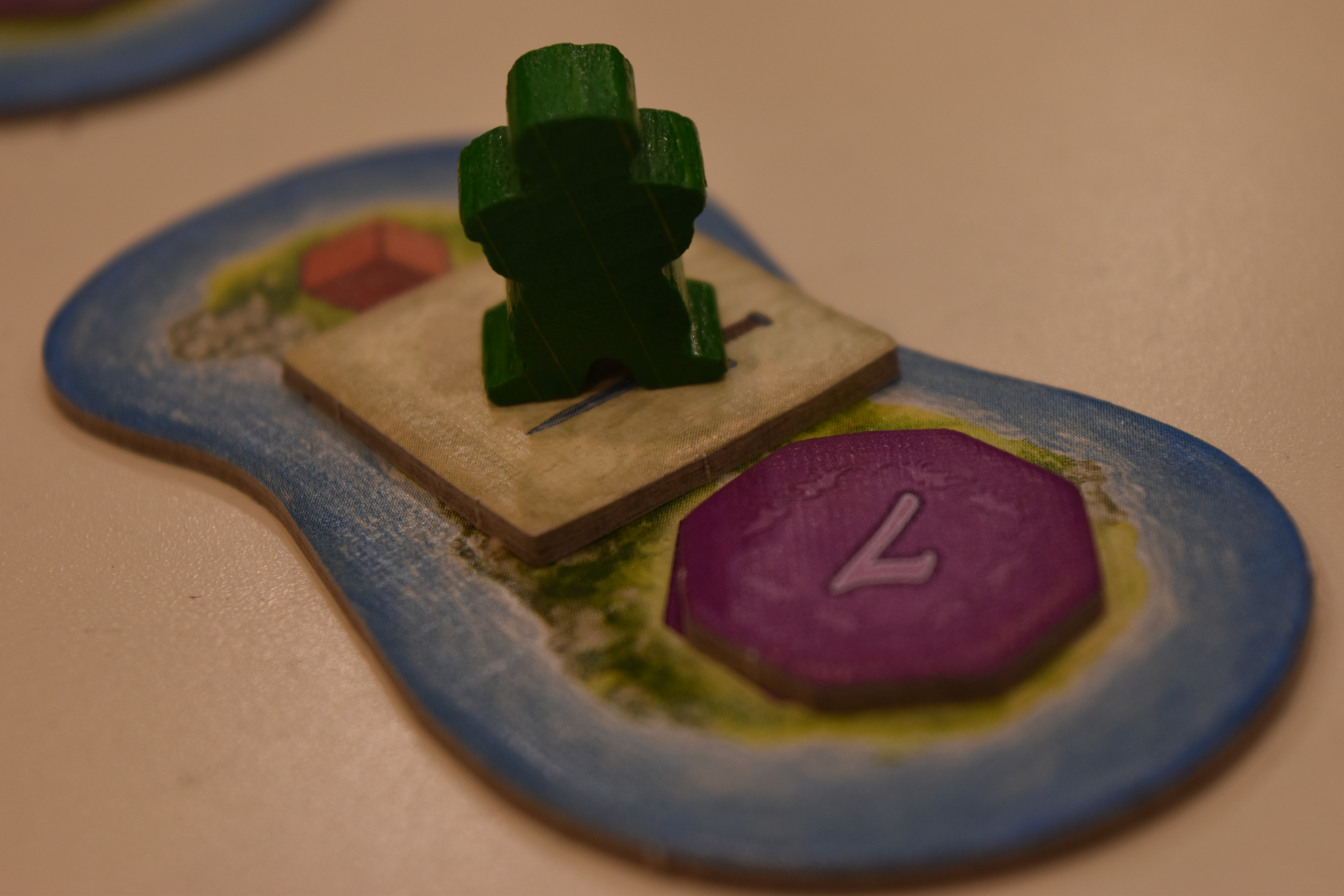
Next, Bob and Lizzy tackled M.U.L.E., the boardgame based on the 1983 Commodore 64(?) game. It is absolutely charming. It starts off as a farming/resource management game set on an unexplored planet called Irata, where all you have for company is a robot-mule worker and your fellow explorers. Then suddenly there’s a capitalist market-trading mechanic and a magic money-generating Wampus and a mystical mine of purple crystals which change value in each game round. The board is busy but in a very Stonemaier-Games way in that all the initially-confusing symbols are actually there to clarify any potential misunderstandings and remind you of available actions. The winner is the Bob with the most space gold, while the loser is the Lizzy who has forgotten what their plan was to maximise their resources.

After that economic thrill ride any form of grown-up game seemed an impossible task. Our brains were just too full to absorb any further information such as ‘rules’ or ‘strategy’ or ‘tasks’, so we took refuge in Push-a-Monster, the award-nominated children’s game of monster-crowding. It’s very simple: try to fit your monster on an already-crowded monster platform, without knocking any monsters off the platform. If you knock a monster off, it gets hurt and has to go to monster hospital, so everyone else gets a point. Best of all is the lack of numbered scoring. No one needs that shit. Instead the monster-points are different sizes so the player with the longest string of monster-points wins. The illustrations are adorable to boot; one of the monsters makes exactly the face that Bob’s robot boyfriend makes when he wants to not be part of the Misery Farm.

10505414_10152401408286161_9040811379626614324_n (1)
Stop. Including. Me.

Two refreshing, addictive little games later and we were ready for more. Not before stopping by the HABALINK stand though, where we found a strong best kid’s game contender in Treasure of the Thirteen Islands. In this tactical children’s game, you explore treasure islands by navigating with your finger, then attempting to follow the route blindfold on a grooved board. If your little airship falls into a groove, you get stuck! If you find treasure, you win! It’s adorable and at least one person bought it.

day 4, game 3: Cash and Guns

Somehow we next managed to grab an eight-person table for Cash n Guns, which was promoting its fresh expansion, a special-edition Cthulhu character with a tommy-gun, and foam Uzi machine guns. The expansion was rapidly scorned as unnecessary, as Cash n Guns is perfectly fun without any extraneous bullshit, and plenty of shoosty fun followed.

Meanwhile, Bob secured a game of ‘Acquire Giant Sausage’, which she promptly then lost by dropping half of it on a surprised passer-by. Strong work, Bob.

CQ9NwHVWwAAxSr7
Pictured: Large sausage.
Day 4, Game 4: Architect
The road to victory. Deed-filled victory.

Briony and co., after being fairly disappointed by the experience of A Study in Emerald went and found a solid worker placement game. Architect fully ticks all of the boxes of worker placement, gasping drought, and being an intricately themed board game. Awesome. In this game you represent a travelling band of folk with different and useful jobs forming a caravan. The caravan travels around small villages and towns in a miscellaneous medieval European region, with a castle located in the centre. The band of travellers must fit the requirements of the specific village/town to be able to build or repair buildings generating prestige points.

Prestige points must be generated to go up each level of the victory track, which will eventually allow a player to win the ultimate prestige from the castle and win a contract. Or something. Honestly we needed a little more coffee to follow the broken English rules, but the game was fun regardless.
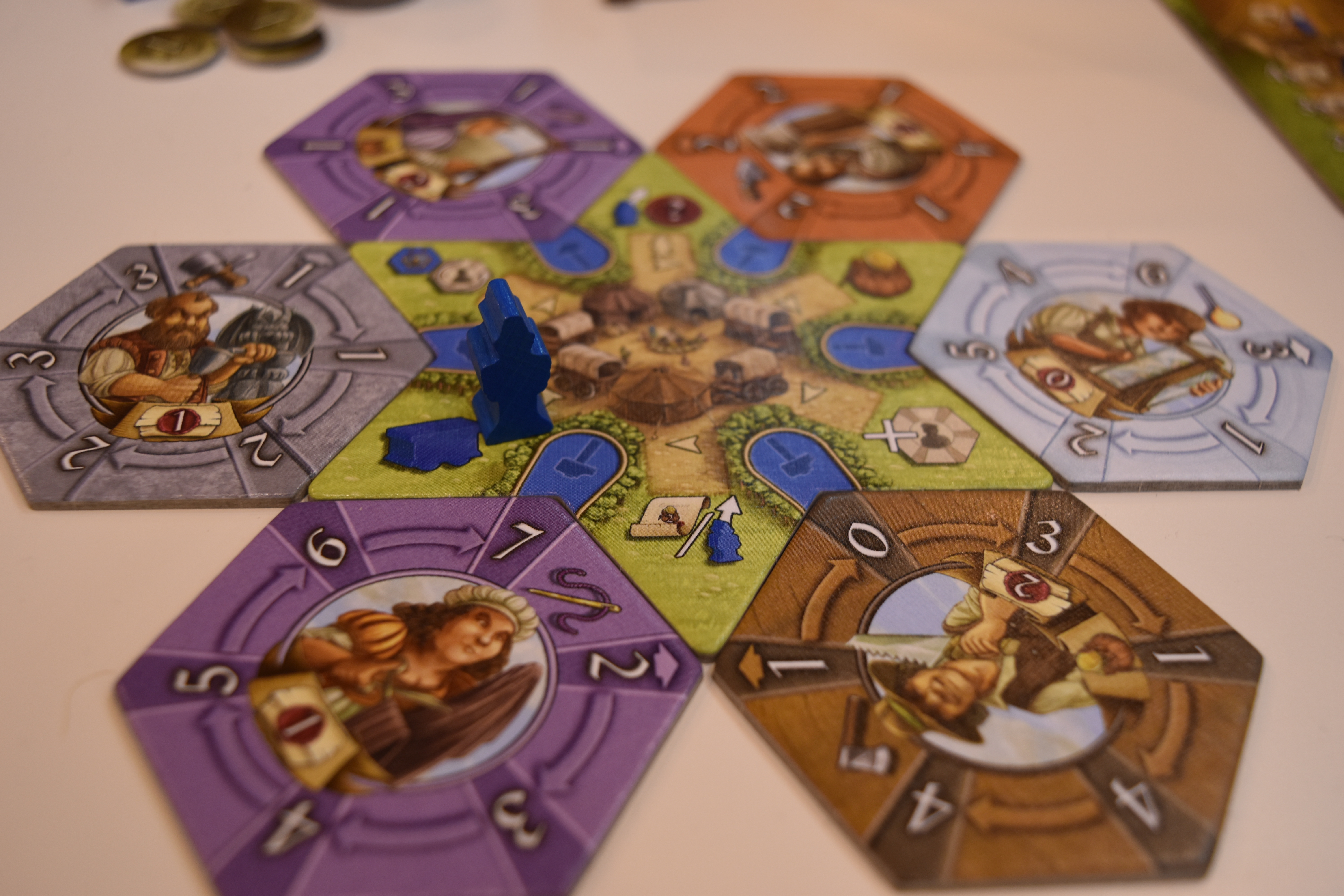
DSC_0450There are a nice number of mechanics in this game – the most unique of which is the ‘worker star’. Workers which you buy have different careers which are denominated by the numbers around the corner. After using them to build something you twist the worker around, showing a different number. Throughout a worker’s career their numbers go down, sometimes plummeting to zero if they’re going through stuff, maybe their wife left them or something.

The actions you are able to fulfil are dictated by the worker star also. But in the end, this game is about generating enough build points to get the castle’s favour. Fortunately the whole team was in agreement that this game was fun, quick, and exactly what we needed at that time during the day.

DSC_0445

day 4, game 5: Elysium

So this was the final game of Essen. Sad times. A band of team Misery longingly searched the halls looking for an empty table where they were able to play a game on their ‘to play’ list, and much to their delight found a free table for Elysium.

DSC_0453

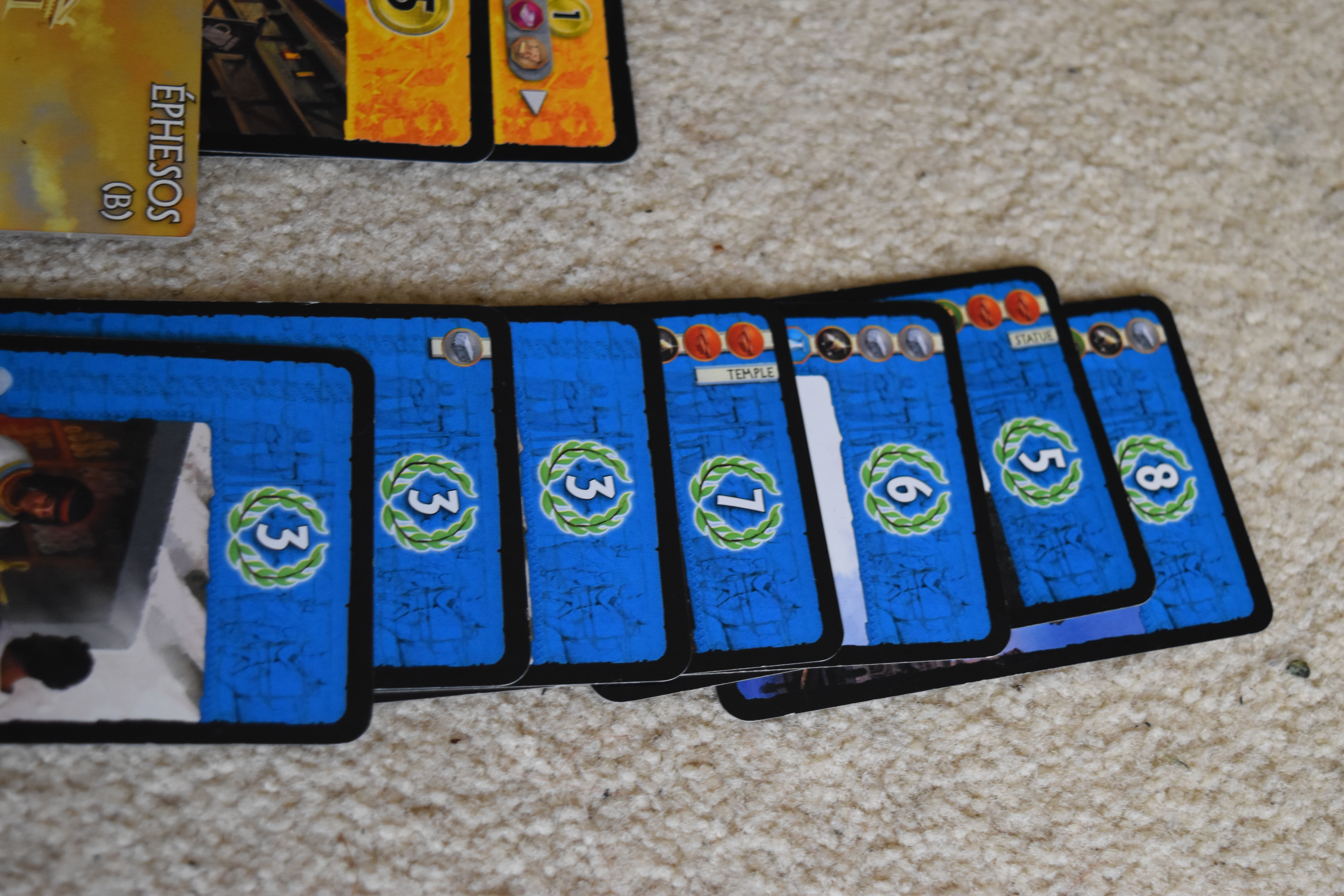
The game is card based, and is heavily focused upon mythology. For anyone who likes 7 Wonders, boy is this your game. Half of the table was excited about its similarity, while the other half was excited because of its twist and difference from 7 Wonders. It ticks both boxes. In fact it won an award at Essen this year (and yet only two gaming tables! Why, Essen, why?!). Instead of representing a nation (as in 7 Wonders), you are a demi-god striving to generate enough myths about yourself to advance to becoming a full God. You have two areas where you may play cards: the mortal realm, and the immortal realm.

DSC_0451Each game plays with 5 gods, and there are 8 in total in the box so there’s variation, replayability and excitement! Your humble misery farmers/demi-gods played with Zeus (a classic), Aphesites (god of metal and hammers, stuff), Athena (owls, wisdom and the Hogwarts postal system), Ares (WAR hurr!) and Dickseidon (aka Poseidon but for serious, this guy is a dick and all his cards are dicks and the illustrations on his cards are dicks and his dick-in-ear scale is measured in kilotonnes).

The game plays out over 5 turns split into 3 phases. First is the ‘Agora’ (or ‘marketplace’. Yeah this game has got its Greek down, yo). This was helped by Lukacs, our excellent and friendly game demonstrator (helpful as we cannot read German rules). After that you move some cards into their immortal realms where their effects disappear but become sets (either by colour or number) and lastly the usual maintenance.

Screw your mortal resources, we need only pillars.

The cards have different coloured symbols relating to 4 actual, physical, coloured columns that each player has on their board. To take a card from the ‘Agora’ a player must have the relevant coloured column. Each card has effects, as you would expect – some of these affect only the player while others affect the player and the others players (not as good, obvi) You can also destroy whole coloured columns with barely an evil laugh. Dickseidon’s cards on the other hand usually do not affect the player but dick over other players (such as losing gold, victory points, discarding cards etc). This game is highly recommended, especially for anyone who likes 7 wonders, mythology and Dickseidon.

Rounding up the day

Finally we retired to a nearby hotel lounge, where our easily-bored but deeply punk friend Pat had secured a few big tables and crates of beer. Codenames, Potion Explosion, and Microfilms*** were all brought out and played to great enjoyment. Codenames remains an instant classic while Potion Explosion is shameless fun, and not just because Lizzy is hilariously bad at it. Microfilms needs… a more thorough explanation than we received. A cousin of [redacted], it relies heavily on keeping your cards secret, so if you don’t understand it you can’t ask what your cards mean. It has potential as a quick three-person game though, and our version comes with highly-professional art!

This weekend (FOUR DAYS IS NOT A WEEKEND -ed.) has been beyond intense, but extremely fun. Really we need to add ‘get enough sleep’ to our survival tips, but somehow between the beer, boardgames, and bratwurst that seems to be impossible. Besides, who needs that stuff when you’ve played upwards of 20 different games in four days? Especially when you’ve been playing with friends as good as ours.

We’d like to extend our thanks to the friends who came with us and made this trip as mad and brilliant as it was: Pat, Chris, Martin, Emma, Sina, Dave, Sam, Charlie, Gord, Mac, and The Reading Boardgames Social guys.** Final thanks to all the wonderful game creators, illustrators, vendors and demonstrators who work so hard and put up with the manic excitement of nerds like us. We’ll see you next year.

*Red Sun sushi, you guys make some delicious food but dear god expecting us to wait an hour for each of five courses is insane. We’re sorry we had to sic Bob and her mediocre German on you, making a complaint was physically painful to our English sensibilities.

** She also strongly dislikes deck building games due to unfortunate circumstances in her earlier years. It’s amazing how difficult it is to like a game again after you’ve cursed it to Hades for a truly terrible experience.

***On a side note, Microfilm has a character that looks hella like Briony. Is she really a Misery Farmer, or is she really the American spy?

Spy-Bri
Spy-Bri

Misery Farm on the Road: Essen Spiel 2015 Day 2 First Reports

Essen Spiel still pairs well with German beer. Who knew. We’ll keep you updated tomorrow.

A summary of Briony's first day.
A summary of Briony’s first day.

Following on from yesterday’s report this post will bring you some coverage of the games played on day two. Each of the Misery Farmer’s have been frankly all over the place today, and a wide range of games have been played, enjoyed and pondered. Briony however has had an excellent day full of fried potato spiral’s and mega-complex games that she is just itching to talk about.

The first game Briony played was actually Liguria on recommendation from Lizzy and others the day before. It turns out painstakingly painting your home city’s Cathedral by travelling from port to port, although seems boring, is actually great. She promptly bought the game and would like to assure all readers that it definitely more fun than it sounds.

Stay off my island, guy.

Day 2, Game 1: Sheriff of Nottingham

In traditional Essen fashioned they played this game because.. well because it was the only table available in the nearby vicinity. Fortunately for the team the game turned out to be a rather fun game about deception and calling your fellow players out.

This is definitely what a medieval crack den would look like.

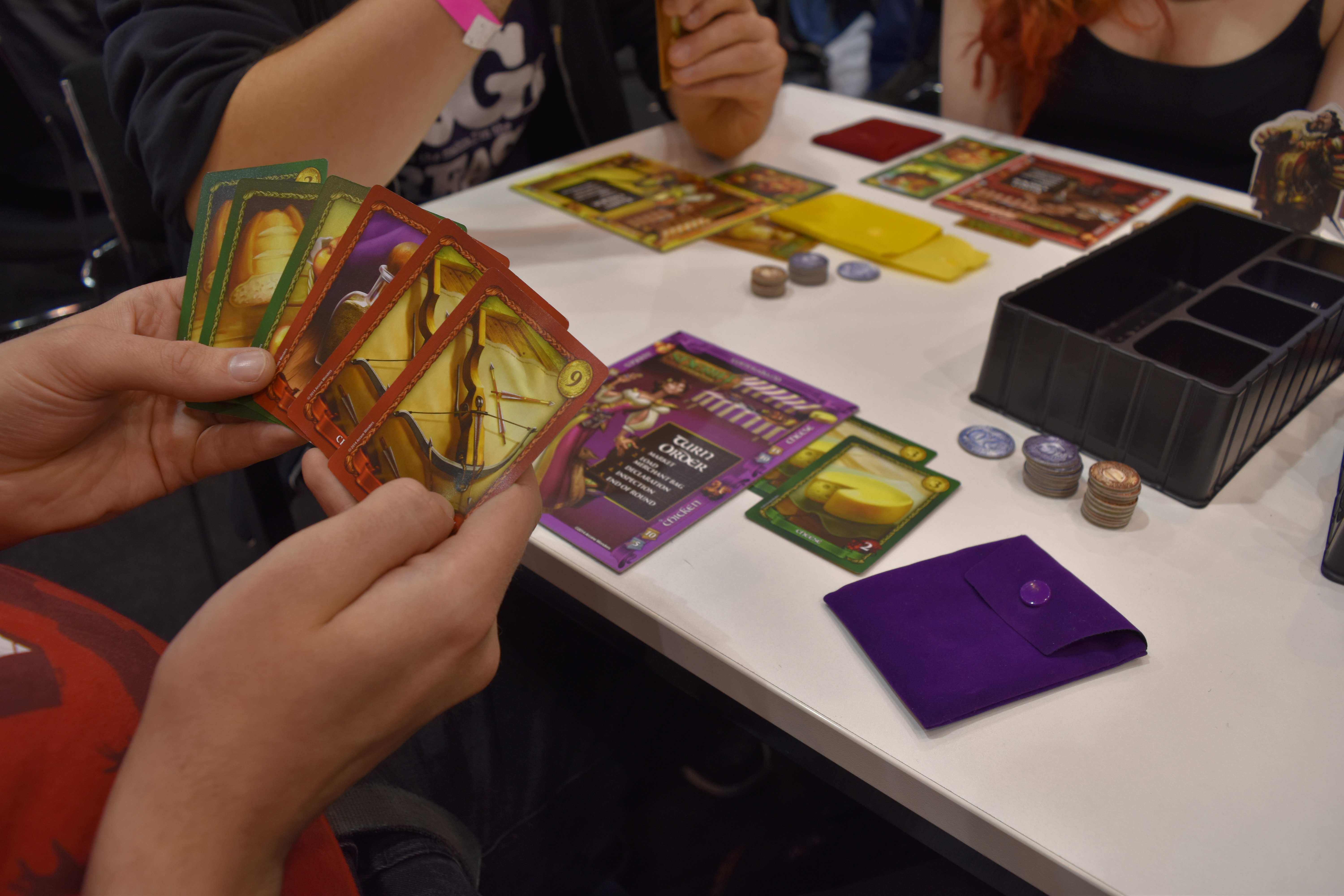
Each person plays a character based in medieval England, overseen by the gruesome Sheriff of Nottingham. A player is dealt a hand of cards which may be green legal goods (apples, chicken, bread, boring things), or red illegal cards (which are not as illegal as they seem. Apparently medieval England really disliked pepper and silk). Each turn a player will select a number of good to put in their ‘swag bag’ which they intend to travel with. The player must declare what is in the bag to the Sheriff, with the intent of getting as many cards through his checks as possible.

The sheriff decides based on your declaration whether he believes you or not, and may challenge to look in your bag. If you lied you can bribe him, but he may decide to take or ignore it. The aim of the game is to lie. Lie all the time, and then tell the truth to backfire on the Sheriff. If the sheriff is wrong about your lie, he must pay you in compensation, if you get away with it you rack up the monies.

The moral of the story is that Sina is terrible at identifying lies, and lost on the most spectacular hands (5 whole apples!).

Worst. Sheriff. Ever.

Day 2, game 2: Andromeda

‘It’s sci-fi themed and it has a free table. We are going here.’

DSC_0358Andromeda, predictably, was strongly generically alien themed. This much was obvious from 50 meters away due to the life-sized plastic alien model, but fortunately for the game it played better than the stall get-up indicated. Each player owns a race of aliens and must explore an ancient abandoned spaceship found floating in the galaxy. The ship has several compartments which must be explored.

Who knew massive dice dependency could be a good thing.

The main mechanic is rolling a handful of dice with different tasks represented. Interestingly, re-rolls weren’t allowed, and the first player ‘made up’ selections of dice to offer the other players in turn. They could choose to accept them, or to pass them on. If the hand of dice was significantly bad and every player passed, the first player who made it automatically has to accept it. This made making particular hands an intriguing mechanic.

Day 2, game 3: Potion Explosion

So far, this game has been the busiest to approach. All of Essen want’s to play this, and their stock has more or less run out at the end of day two. Luckily two members of the Misery Farm cohort and partners have already bought this, and as Briony is currently writing this a game is being played in the background.

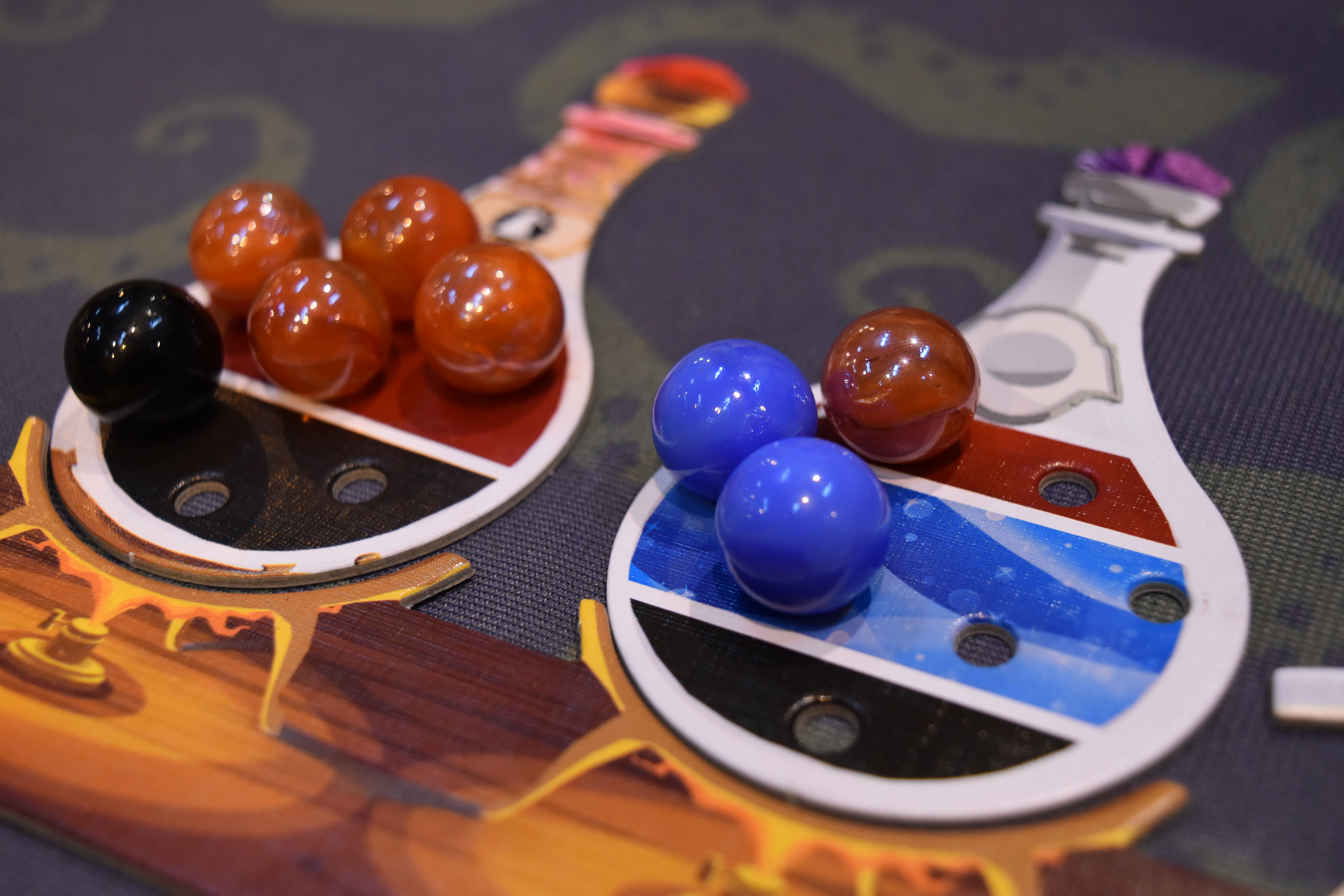
DSC_0419Potion explosion is basically a physical version of bejewelled, played with marbles. Each player has a potion with multiple colour requirements, and they have to select marbles of those colours from the centre magical trough. Once you fill the potion with the correct marbles you can use it’s effects i.e. take two specific marbles, steal another players stock etc. If, when you pull a colour out it causes two colours of the same colour to roll together (know as the ‘explosion’ part), you get to take those marbles too. The idea is to select a marble that gets you the most in your hand to create more potions.

Its fun, fast paced, and colour based. A perfect game to play between epic saga games or simply if you like marbles. Either or, really. The person with the most completed potion’s worth the most points wins.

If only all magic was this easy.

Day 2, game 4: Burano

So many things.
So many things.

This is single handedly one of the most complex board games ever conceived. Team Briony and co. only played 1/4 of the game due to the waiting list being fully booked, and it still partly made their brains melt. The combination of mechanics and strategies are extensive, and are coupled with new mechanics that they had not encountered before such as the resource pyramid (where only certain resources are available at certain times).

The game is based on the island of Burano, in Venice. There is a city in the centre island that has coloured houses (in reality these are the most satisfying coloured cubes ever seen). You each play a family who must fish, make lace (as was the tradition at the time.. mainly for the ladies.. stupid history..), and build more houses on the island. Once enough houses are built players may build roofs to connect houses, making spaces above them to become available.

That’s right kids, it’s a 3D build em up worker placement game. It’s as rare and magical as unicorn to find a fully functioning, beautifully designed one of these, which most importantly actually works.

DSC_0427

Despite the complexity the game is awesome. It’s definitely for the experienced gamer, and there is more or less no way to have a good first season due to the how much the player needs to know to kick things off. In fact it’s complex enough not to go into much detail about it, but fear not, Briony is probably going to sell all of her worldly goods to acquire this game and then write about it in the future.

DSC_0429

Skulls and Roses: The lesser known 80s band

Brutus Rating:  2 knives in the skull out of 10. There aren’t really a variety of options for easy dickery to your opponents beyond the regular subterfuge.
Pairs well with: Pint of ale from a tankard.

6D-41-149_Fotor

The ratio of complexity of gameplay to complexity of strategy can be a good basic indicator for how good a game is. A lot of really good fun can be found in a game if it has some fairly basic steps and mechanics, and is fairly easy to learn, while also leaving room for a relatively more detailed, complex and developed strategy. Less fun can be had, sometimes, for a game that has a lot of detail in the play but not so much wriggle-room for thought-out plans for victory.

This isn’t meant to be a perfect recipe for board games, of course. Sometimes you want to just sit the heck down and let the board game adventure and some luck take you wherever you’re headed. Preferably to victory. Other times you want to get really deep into the nitty and gritty mechanics of a game and work for your delicious glory that way.

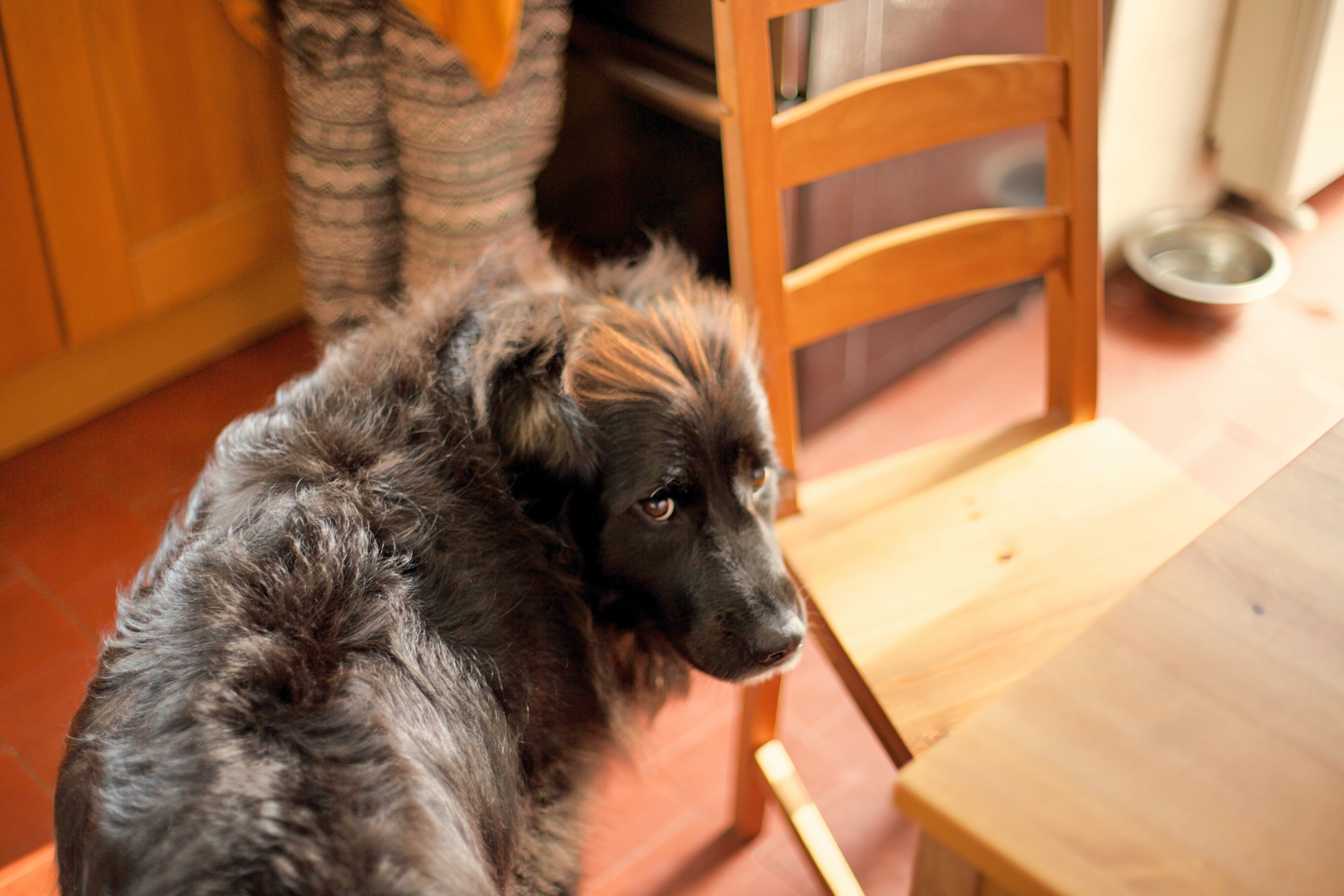
Guest reviewer of the day: Lily the dog

But the play-complexity-to-strategy-complexity formula can still be replicated in a lot of games, including some of the smaller and quicker ones. A good small game is often one that you pick up quickly, has maybe a limited amount of possible ‘moves’, but still lets you develop some excellent strategies for exactly how to play. One of these games is the topic of our review today!*

Everyone present have a skull? Check. You're ready!
Everyone present have a skull? Check. You’re ready!

Skulls is a great game for everyone. After all, everyone has a skull. It’s also pretty damn simple, but you get to develop sneakier and better tactics the more you play.

You’re a member of a biker gang. That’s right, time to whip out the old leather or denim jacket and… I’m not sure, start making motorbike noises and talk about how you miss the feel of the wind in your hair? Presumably that’s what bikers do. You’re competing to become what the rules call the supreme leader. Apparently, biker gangs are run just like North Korea. You learn something new every day!

6D-41-90_FotorEach player in Skulls gets a bunch of circular beer mats with your biker insignia on one side (Which gang are you in today? Panthers? Eagles? Snakes? Weird cow-skulls?) and three of them will have a rose on the other side, the fourth will have a skull. They also get a nice square beer mat with a skull on one side and rose on the other.
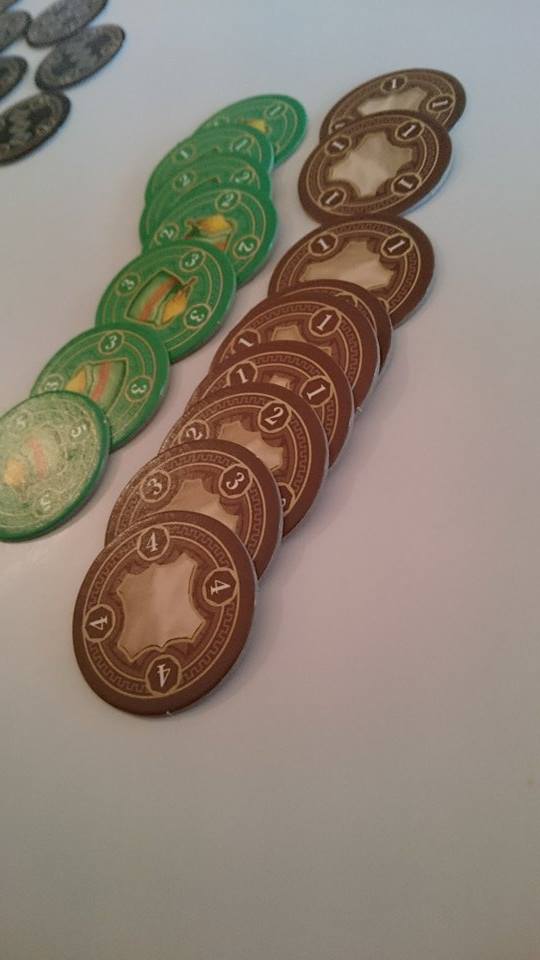
Once you’re done with the formalities of pretending to mistake some of the ‘cards’ for actual beer mats and getting yelled at by the person who owns the game, then you’re ready to begin.

6D-41-148_Fotor

It’s a short game, and it’s a game of bluff. Everyone takes turn placing cards down in front of them (insignia side up, or the bluff part won’t be very effective) and definitely remembering whether you’ve put down a rose or a skull. Eventually one person will decide that instead of putting down a new card they’ll ‘bid’ on how many circular beer mats they can turn over without finding a skull. The trick is, whoever wins the bid (and therefore actually has to attempt to do so) will have to start with their own beer mats first, and starting from the top. Getting it right will lead you halfway to victory (counted by flipping over your square beer mat) and the penalty for getting it wrong is a good mocking and removal of one of your four cards, making it more difficult for you to play. (Particularly if you lost four times… having no cards makes it very difficult to play indeed)

It's actually unclear whether it says 'panthers' or 'punthers'
It’s actually unclear whether it says ‘panthers’ or ‘punthers’

So what you DON’T want to do is forget that you put down a skull and then knob yourself over by bidding as high as possible. Unless you’re trying to lure everyone else into a false sense of security with your incompetence so that you can sweep them all away in the next few rounds. The brilliance of this game is that shit like that can actually happen, and maybe even work!

It’s all about trying to trick everyone into thinking you’ve got a rose when you’ve got a skull, and into thinking  you’ve got a skull when you’ve got a rose. And this isn’t just done by plain old conversation: “Hey you should definitely pick my card. I’ve just put loads of roses down. OR HAVE I?” because, you know, that would be silly. It’s also bluffing through your actions. Bidding really high to convince people that you do have roses, just to have the bid snatched away from you at the last second (just as you’d planned!) so that the winner of the bid will pick your card, convinced that you wouldn’t have done that if you’d had a rose, only to fall down crying when you flip it over to reveal your cunning bluff. TAKE THAT, RICH! YOU NEVER SAW IT COMING! WHO’S YOUR DADDY?

SKULL! GOTCHA!
SKULL! GOTCHA!

It’s also a very reactive game. Because it fits in that part of the collection for small games, ones that you can fit between other games or when you’re busy, and ones that you can play anywhere because it doesn’t have many pieces, you’ll find yourself just intending to play a quick round of it before you start up the Battlestar Galactica or the Eldritch Horror and then realise, an hour later, you’re all still in the kitchen desperately trying to stop Sophie from getting a fourth victory in maybe six games.

You can play it anywhere!

“AHA! Well, Will clearly has a rose because he tried to encourage us to pick his cards”

6D-41-130_Fotor“AHA! Rich definitely has a skull because he was pretending to deliberate, and there’s no way he would have actually been deliberating about bidding higher than five at this stage because that would be MADNESS, so he must have been pretending to deliberate to trick us into thinking that it would be an option for him and to trick us into thinking he has a rose!”**

“Just… never trust Sophie, guys! She’s going to have a skull, she always has a skull! She…. NOOO!”

The spurt of victories from Sophie was quite the surprise. We actually started to wonder if she’d been playing the really really long game, faking incompetence in previous games just to finally show her colours as a ruthless bastard in Skulls and Roses.

All in all, the developed bluffery from Skulls and Roses makes for a great small game, and ranks it pretty well in the ratio of complexity of play to complexity of strategy. Sophie may have played us all for fools but, as always, the real winner is board games.

And Lily the dog.

This review doubles as an educational piece about how difficult it is to take photos of dark dogs in light rooms.

*You’d bloody hope so wouldn’t you, or else what have we been rambling on about for the last few paragraphs?

** Take our word for it, this paragraph definitely makes sense to Skulls and Roses aficionados.

Credit goes to our photographer friend for, of course, the photos. Huzzah!

7 Wonders: For when 6 wonders aren’t quite enough but 8 seems excessive.

Brutus rating: 4/10 knives in the back
Pairs well with: A suitable drink to match your wonder (we recommend buying some of that classic terrible cheap liquor that all tourists buy as souvenirs while wandering around in a hot country. ‘But honey, it’s made with guava – that’s so traditional!’)

DSC_0331

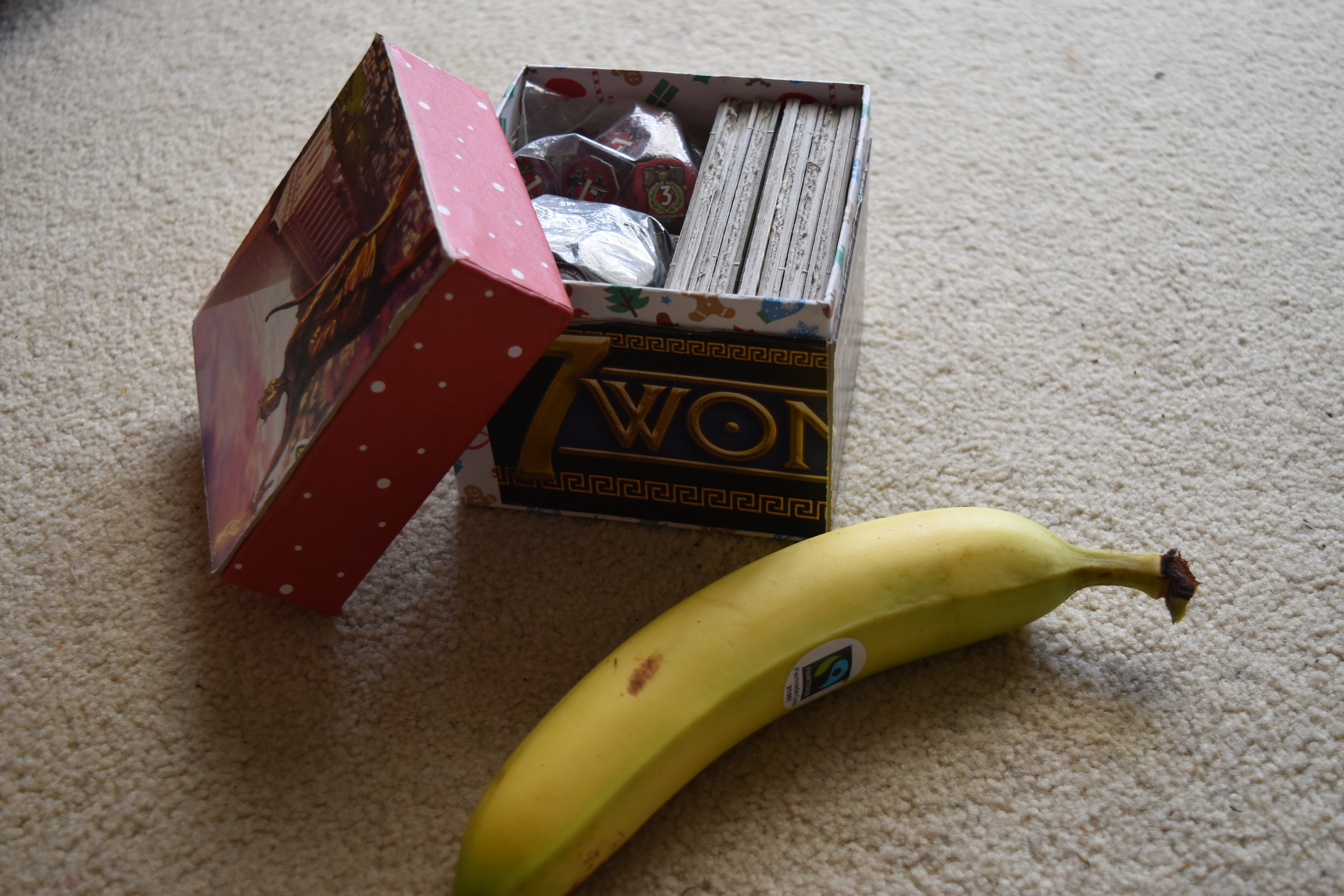
In Briony’s house, the copy of 7 Wonders was deemed too big to carry around with ease. To address this her angry spiky-haired boyfriend Pat spent a week engineering the perfect compact version, presented in a lovely Christmas gift box. The juxtaposition of the Colossus of Rhodes and the Christmas tree works beautifully. To give you some indication of exactly how much more compact it is, here is a fair trade banana for scale.

DSC_0348DSC_0347

Onto the actual game?

Have you ever wanted to control your own Civilization? Order your serfs well paid labourers to build cool stuff that will ensure your name is never forgotten for as long as humanity walks the earth? Cry war when someone upsets you? Wait for your turn patiently while your fellow assholes can’t pick a single card in a three-hour time frame? Good. Although this may sound mightily like Civilization (of which a couple of board games actually do exist) it’s actually 7 Wonders. At least, this week it’s 7 wonders. Can’t speak for future weeks, it’s not like we have a schedule for these things.

DSC_03397 Wonders was actually Briony’s ‘gateway drug’ to the board gaming world. She rocked up to a friend’s house one night expecting pizza, but instead got a lot of cards. At the time her friends explained the rules slowly, as if to a small confused child who couldn’t possibly understand the word ‘wonder’. They concluded ‘We’re all really good at the game because we play it a lot, so don’t worry about getting a low score. You’ll get better next time!’

Unfortunately for them Briony has accrued some 400 hours playing Civilization. She promptly wiped the floor with all of them, and has only been beaten once since. 7 Wonders has remained one of her favourite games to this day.

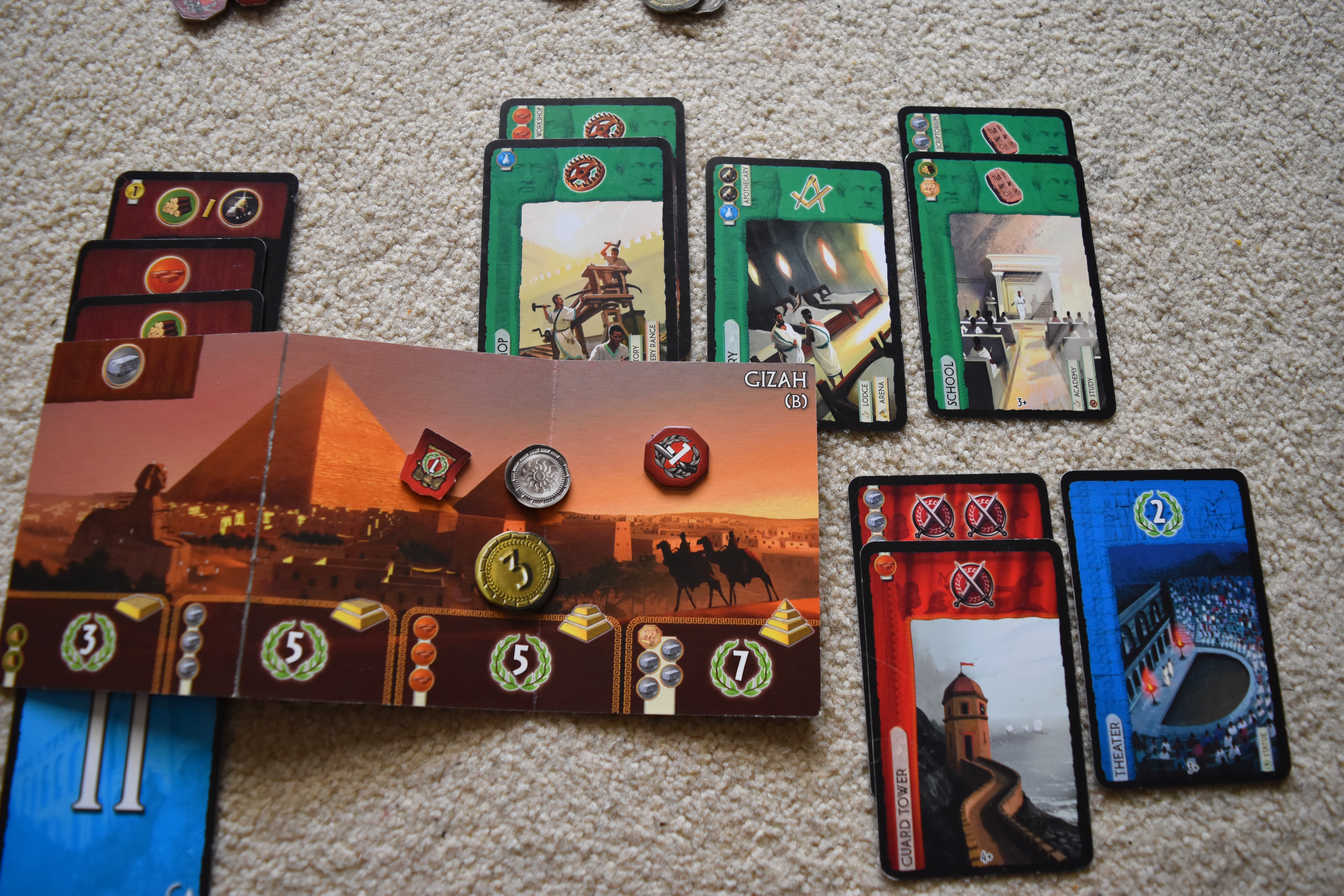
DSC_0337To begin, each player is assigned a great world wonder. One of seven, hence the name, but you probably figured that bit out (It’s not doing the “Five Tribes” trick where there aren’t actually five players and you don’t actually get to play the five tribes, confusingly.) Again, if you’ve played Civilization (the non-board-game version) you’ll already recognise the wonders; maybe you might even recognise them anyway. They differ both in starting resources and the benefits they offer. During the game you can, but are by no means obligated to, build parts of your wonder (they usually have 3 stages), and thus reap some tasty ancient treats.

The game works in three eras. Each player begins with a hand of cards. You look at the cards. You eye them up, rate them out of ten, or ask for their number – whichever is the most effective way of determining a good card for you. Once everybody has selected which card they would like to build, you pass your remaining hand of cards to the player clockwise. Everyone then simultaneously places their chosen card face up and everyone has a lovely time.

DSC_0342Simple. Now, do it again. In fact, keep doing this until you only have two cards left in your hand, then discard one and build the other. Now it the ending of the era, but it’s not particularly like the great works of writing and art suggest. It’s mainly about war, really. Each player has a mandatory fight with the player either side of them. Losing a war means losing points, winning war means winning points. Huzzah!

Well done everyone, we survived an era. Best keep going.

With the start of the second era a new deck of cards is brought out. These cards build on the resources you gathered in the previous era, and will either start racking up victory points or generating larger amounts of resources. The same mechanism as before happens (start with hand, play a card, pass it on, repeat), only this time you pass the cards anti-clockwise. Bet you didn’t see that one coming! Era ends, have some war, next era begins.

DSC_0338This mechanic where everyone picks cards at the same time means that the game is fairly simple, fast, and can sit up to seven players without significantly racking up the play time to the point where you want to claw your eyes out, or go to bed, or have a life, but you can’t because you started playing a nine-hour game. None of that in 7 Wonders. Even better, it manages to do this while still keeping a lot of delicious strategy and giving everyone some good time to think about what to do.

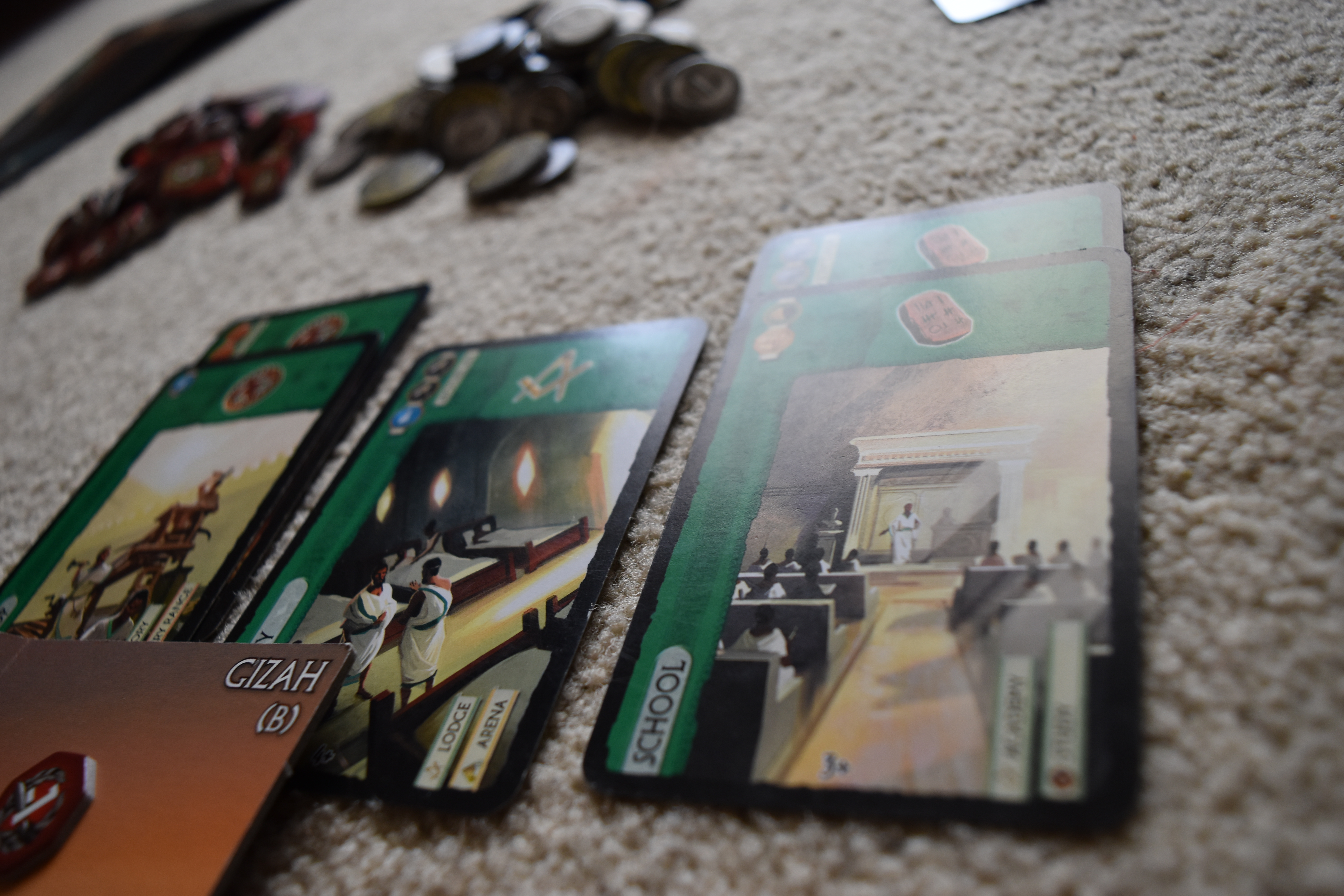
The third and final era is where it gets particularly interesting as all the big cards come out. This is the only era where purple, or ‘victory’, cards emerge, and they have the power to significantly enhance your score if used wisely. During this era it also becomes fairly apparent which major strategy a player has gone for. And by apparent we mean ‘huh, Pete the twinkly-eyed hippie has 739 blue cards. I guess he’s collecting blue’. This is partly where this week’s Brutus rating comes in- there game does still give you a bit of wriggle room for player interaction, mostly in choosing which card you want (and therefore which card you don’t want the player to the side of you to have). If Pete is collecting blue cards then this gives you at least some reason to nab all the ones he needs before he can lay his grubby little paws on them (disclaimer: Pete actually has hands and they aren’t that grubby. Sorry Pete).

DSC_0344It also earns an extra dagger because after each era you have to have a war with the players to your left and right either side, the poor buggers, and if you want those extra victory points you’re going to have to softly jab someone at least a little.

Unless you’re Rhodes, and then you fully jab everyone. Unapologetically.

Of course the problem with this, and with the fighting mechanic, is that you get a bit dicked over depending on where you decided to sit at the table. Lizzy may be a charming barrel of wit and great to sit next to sometimes (we said “may”) but this kind of game could result in everyone scrabbling to get away from her so they don’t have to put up with her meddling in their affairs for most of the game.

DSC_0343Like all things over the great expanse of the centuries, the game will eventually come to an end. Victory is tallied up and your Civilization scores points for various card-related and wonder-related things.

One thing we should mention is the trickiness with how to score science: no-one really knows. It is literally the only complex thing about the entire game. Usually there is some 7 Wonders veteran in the corner who is called upon to interpret and talk with the science cards, and then relays that information back to the rest of the group like some sort of lesser prophet. Fortunately for the rest of us mortals some genius made a thing that does it for you  http://neilsutcliffe.com/7wonders/   If you can figure out how to make it work, the ‘science!’ strategy is a reliably high scorer, though easily ruined if your neighbours are paying attention to what you’re building.

Had enough photos of cards yet?

The game is fast in general, which makes it perfect to play several times in one evening or to get new people into gaming. As was the case with Briony, it can make a pretty good gateway board game, as long as you take the time to explain each component and keep the card-choosing phase pretty quick. Bob actually hated (or thought she hated) this game for years, not having Briony’s Civ experience and finding game frustrating and exhausting as a board game noob. Turns out, she just had really dawdly friends who didn’t make the trading rules clear. In addition, make sure to stop and take in the art work on the cards, if that’s your cup of tea. They’re often beautifully painted scenes or buildings and they add a lot to the game design.

The real winner is history. But also Briony. She’s just really good at Seven Wonders, man.

This week the credit for the photos also goes to her. Good work, Bri!

Just assume that it says
Just assume that it says “Briony Wins”. Convenient blurring, Briony.

Jaipur: One of the best camel trading games you’ll play this week!

Brutus Rating: 7/10 knives in back
Pairs well with: Fine wines sipped from golden chalices that you don’t quite have enough of to trade yet.

11716029_10155865989225085_5783316_n

(Poorly lit photos can be blamed on the photographer friend not being around this week. Or maybe on Bob for moving house. Basically, anyone other than Lizzy, who is coincidentally in charge of posting this week.)

11720023_10155865987270085_260705191_n2014 was quite the year for camel games, so it also proved to be an excellent time for Lizzy to receive Jaipur as a Christmas gift. It most certainly ranks in the top three for camel-based-games that she acquired that year, and Briony is inclined to agree that is sure is fun. This review marks the beginning of a new, and duly called for, list created by ‘The Misery Farm’ – Two Player Games Ranked In Order Of How Likely They Might Make You To Split Up With Your Other Half While Spending Time Together.

Huzzah! Never has a more practical and important list been created! We constantly see threads on various sites and blogs that call for good two player games with a lot of specific categories: these range from ‘must be easy to learn because my wife has a short attention span’, to ‘has to be small and portable enough for me to carry this to another country to see my long-distance bae’.

"Show me the goods!" "Here they are!" "Good."
“Show me the goods!”
“Here they are!”
“Good.”

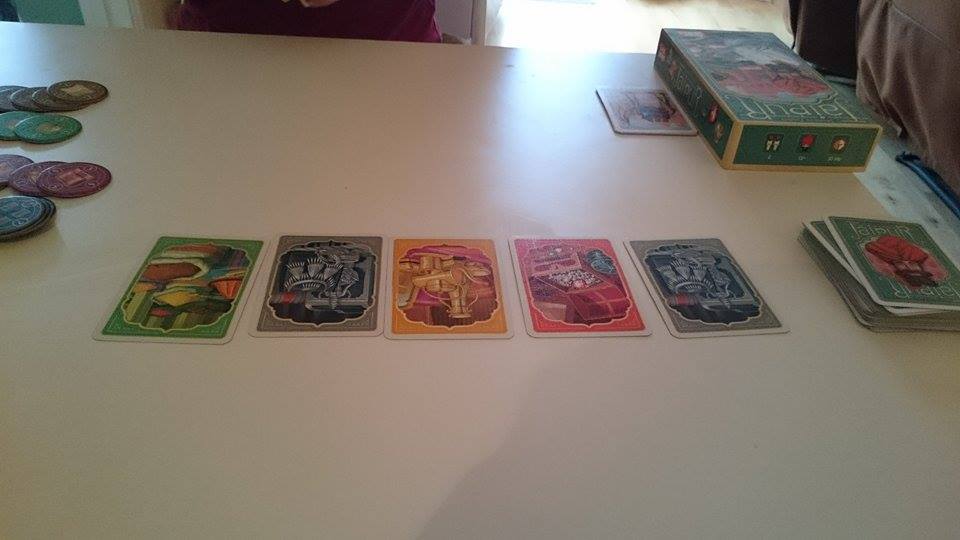
Jaipur is a pretty good two-player card game to kick the list off with. You buy goods, trade goods, trade goods for camels, trade camels for goods, trade goods for other goods, sell goods. Good? Good!

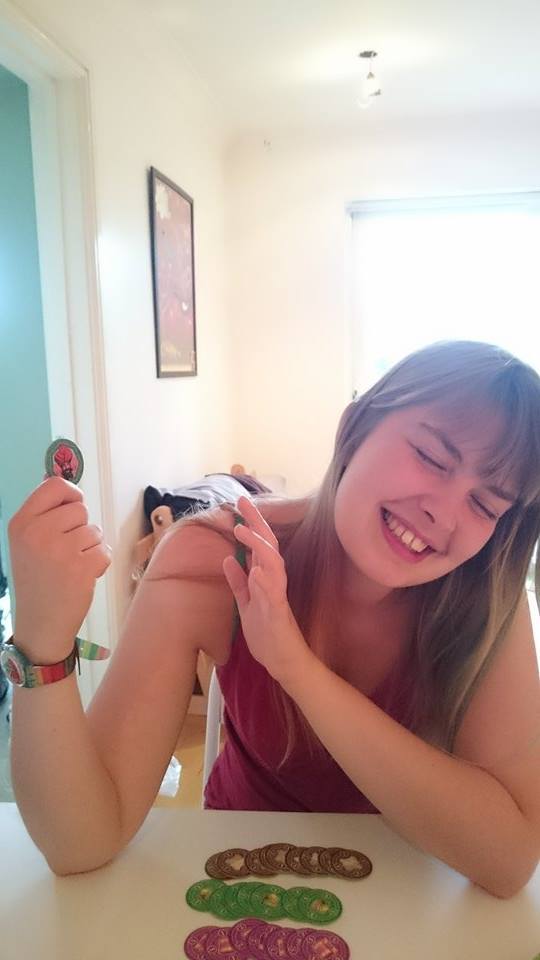
The game is fairly fast-paced and over two or three rounds: best of three is the winner. To win the round – that is, being the best at trading and most impressive to the Maharajah – you get a little token with the Maharajah’s face on, and the first person to please the Maharajah twice is crowned the victor and will forever be employed as his best personal trader. Conveniently, the Maharajah tends to be most impressed by whoever has the most points at the end of the round, so determining who wins is pretty simple.

His Grace's faces
His Grace’s faces

Your goods come in the form of captivating colour-coordinated cards, and you and your other half (and/or nemesis) have a hand of your own and a communal pile of five to compete over.

11715998_10155865989180085_1975058349_nThe best bit about this game (other than the inclusion of camels) is its excellent ratio of rules to strategy complexity, and the fact that it might occasionally remind you of playing card games with your Gran in your earlier years. The rules are fairly quick and easy to learn, just like the game is to play, but the more you play it the more you start developing a complex strategy for how to trade. There are several things that the game gives you to look out for, and winning means balancing strategies and trying to open up as few opportunities as possible for your opponent.

11739755_10155865988975085_779132515_nMost goods depreciate in value pretty darn quickly. You can sell some of that brown leathery stuff, the most common good, but only the first few bits that get sold will be worth a decent amount of points, so if you’re going to sell it then you want to be the first person to do so. But wait! The more you sell at one time, the more bonus points you’ll get, so you want to save up as much as you can before you sell it. This shit gets competitive, yo. You don’t want to be saving up a bunch of that lowish-value [green resource] for ages and then have some arsehole your loving partner sell a single [green resource] first just to take the best price. Knob.

The game gets a fairly high ‘brutus rating’ because most things you’ll do will tend to affect the other player. And if you’re anything like us (or anyone we know. We need some new friends) then you’ll be purposely trying to knobble them over instead of just getting ahead yourself. But that’s ok, because it’s a two-player game! That’s how two-player games should work, and the dicking-up goes both ways and isn’t too extreme.

11741830_10155865987485085_1100015158_nThere are also various other factors which turn the game into more of a rampant strategy-fest. The hand limit is devilishly small, which will leave you regularly cursing. And there are special rules for trading different numbers of goods, and special rules for trading camels. Some goods – the most valuable – can only be traded when you have at least two of them to hand. All of this is pretty simple to learn but, again, makes the game surprisingly tactical.

Another great thing about this game is that despite all of the above it’s really fun to play, and the resentment and hatred for your partner doesn’t build up so much that it’s not manageable. Sure, they’ve traded away the last goddamn silver but at least they haven’t ruined your entire bloody life. This time. The fast-paced nature of the game and the fact that you need to win 2/3 rounds for victory really helps with this. Before long the round will be over, and one of you will be taking your victory-Maharajah token, holding it up to your ear and saying,

“What’s that, Maharajah? You were really impressed with my trading prowess today? Oh, thank you, that’s very kind. No, it really is my pleasure. What’s that? You regret choosing Martin last round? Yes, well, we all make mistakes. Not to worry.”

"Oh Maharajah! You flatter me."
“Oh Maharajah! You flatter me.”

So yeah, you’ll give them a smack on the face once or twice, but there’ll be no permanent damage by either hands or words.

Definitely not missing a token. Don't know what you're on about. Your face is missing a token!
Definitely not missing a token. Don’t know what you’re on about. Your face is missing a token!

Lizzy took this on holiday with her boyfriend and they both came back in one piece. Which is an impressive thing to say any time Lizzy plays board games with anyone, to be honest. Briony has also had a good time playing it with a whole range of people, boyfriend included. So Jaipur gets a good rating not just as a good card game, but as a particularly good game to take away on holiday with you if you don’t want to have any more arguments or breakups than necessary. Good work, Jaipur.

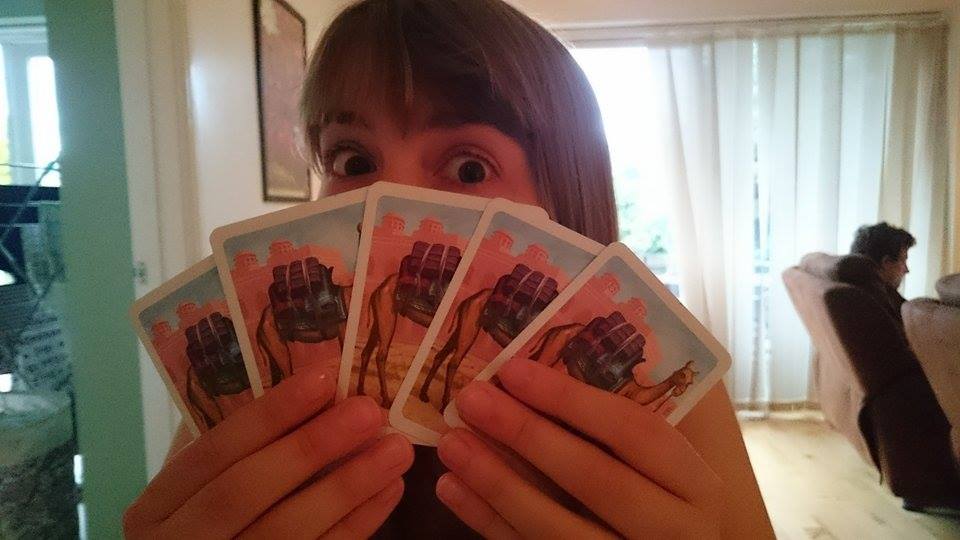
The real winner is the camels.

11721295_10155865988395085_1519231680_n

(and Lizzy)

Cthulhu Gloom: The Clue is in the Name

By Bob and Briony

Brutus Rating: 8 out of 10 gruesome daggers in the back
Pairs well with: Port, red wine, some Edgar Allan Poetry.

Cast your minds back to bygone days of yore. Days when still had a deputy Prime Minister to rein in our cartoon-villain overlord, and the horseless carriage was just coming into vogue (wait, no, too far back). The year is 2012, and your misery farming friends have been invited to a wedding. Well, to the reception anyway. Some of us (Bob) arrive way, way too early and have to find creative ways to pass the time while the proper grown-ups do things like ‘say their vows’ and ‘give speeches’. Luckily the wedding is at one of those fancy hotel/castle/stately home affairs with lots of turrets and nooks for exploring. Bob also finds a similarly left-out comrade in the form of former Call of Cthulhu RPG buddy Joss. Joss has a copy of Gloom, and Bob has a bottle of port and a plan.

Image via Atlas Games

You see, here at the Misery Farm we are all about three things:

  1. Misery
  2. Blanket forts.
  3. Board games (obviously).
Just as nature intended.

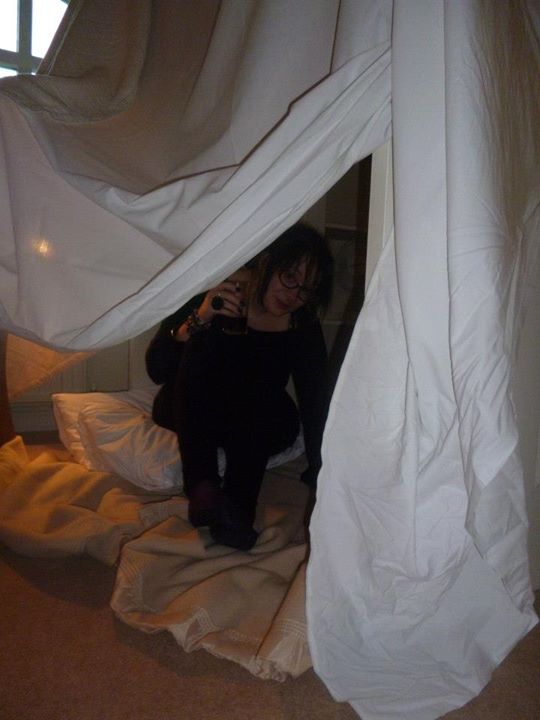
Therefore, it should be obvious that miserable board games in a pillow fort are the best things ever. And hotels, for those of you who don’t know, are prime pillow-fort territory. You simply call up reception and ask for extra pillows and blankets, and before you know it you have yourself a fabulous and comfy little nest – the ideal set-up for a two-player card game. With port.309431_10152381350750317_856648447_n

Gloom is simple, cheap, and portable. Cthulhu Gloom is slightly less simple, but just as cheap and portable.*

The card art is appropriately Gorey-esque.

Both games are based on the premise of winning at misery. Each player gets a uniquely melancholic and gloomy card family and the aim of the game is to make them as sad as possible before killing them off. More sad means more points.

Here’s where it gets interesting. To make your family members miserable (or make other players’ families happy) you play modifier cards on them (see-through plastic, so you can see the modifiers below!), but you must tell a story to explain what happens to make them sad. Luckily there are prompts on the modifier cards so you don’t have to come up with a complete story on your own:

6D-34-97Alas!** Poor Lavinia Whateley, she was travelling a dark forest path, driven in search of she-knew-not-what by dark, insane dreams beyond her comprehension. Suddenly there came before her a clearing, hideously illuminated by the moon, in which she saw mounds and mounds of misshapen mushrooms. And that is how she ‘found some funghi’.’
6D-34-102Then you play the miserable modifier card on poor mad Lavinia and she gets however many negative points it indicates. Once you have deemed a family member to be sad (and therefore point-rich) enough, you kill them off with a ‘sudden death’ card. As soon as a whole family is completely dead the game ends, and you tally your scores. Only dead family members count, so it’s a payoff system between killing them quickly and scoring high. Of course, you can also sabotage other players with some happy points:

6D-34-95
Happy little tentacles.

‘Joy be!*** Lavinia, after her squamous encounters in the dark forest walks through the night and, coming to the edge of the forest, finds before her the incredibly cheerful and fortifying sight of a family campsite. Yes indeed, it was in fact a completely harmless forest in Wales, and a whole host of achingly friendly North-English families are keen to welcome to her to their holiday party. There are breakfast bacon sandwiches and healthy nips of gin all round. And that is how Lavinia came to ‘forget the funghi’.’

6D-34-92
Also pictured: Cthulhu leggings

In Cthulhu Gloom all the family members are based on Lovecraft characters, and modifiers and deaths based on narratives from the stories. Your Whateley family might be minced by Mi-Go or discover a strange new colour. Asenath Waite might finally get revenge on her father, or maybe just show up on your doorstep in the dead of night, dead. Charles Dexter Ward’s infamous cat even makes an appearance, though thankfully with a new name.

When we finally get round to playing it as a blogging cohort it is completely the wrong atmosphere. Late morning on a Sunday and we’re still not quite sure whether what we’re feeling is hangover or just some sleepiness and stress-residue from a busy week of being adults in the competitive world of post-graduate research.****

This mug is inappropriately cheerful for Gloom.

We decide to skip some of the more awkward bits of the rules, mainly because Bob accidentally threw away the rule book and can’t be bothered to find them online. This is not recommended, as the Cthulhu version does have some extensions and changes which means that even seasoned Gloom-players would do well to re-read the rules. There are, for example, full game objectives which will, if fulfilled, add a big pile of misery to your final score. This adds a stealthy strategy element distinctly lacking in the original. Otherwise the expansion mostly just clears up some fuzziness in the original rules like when to play one-off event cards, and how long effects like increased hand-limits last.

Don’t play Gloom, Cthulhu or otherwise, with people who have no imagination. It’s a dire experience as they take so, so long to play the damn card and stop rambling on, and without the stories it can be kind of boring in its simplicity. Do play this game with people who are new to board (card?) games as it’s straightforward and fun but definitely falls into this whole quirky ‘modern age of board games’ era.  Despite the port, this actually doesn’t make a very good two-player game, so we recommend three to four players.

6D-34-147
‘And then they died.’

Bob appropriately wins this game, as she has the darkest lipstick and most morbid outlook. Death to some and misery to all the rest!


* OK it’s not actually that portable. It just looks portable because the cards are clear plastic so you think ‘wow, those are some durable cards, unlikely to suffer any water damage and therefore perfect for pub trips and long car journeys.’ But then you take them to a festival and try to play a game of Gloom in a leaky tent during a sudden rainstorm, but you’re a bit drunk and the tent is full of people and suddenly the cards are sliding around everywhere and you eventually give up on playing but by then you’ve lost a few in amongst the inebriated bodies and sleeping bags. Not that we’re speaking from experience or anything.

** We like shouting ‘alas’ when there’s some fresh woe. Makes the whole thing more dramatic.

*** See ‘alas!’ footnote, previous.

**** Ironically, Bob is actually the furthest-along in her PhD and has spent at least 15 hours this week playing Hearthstone. This was, obviously, a mistake.


Photos by Dr Photographer

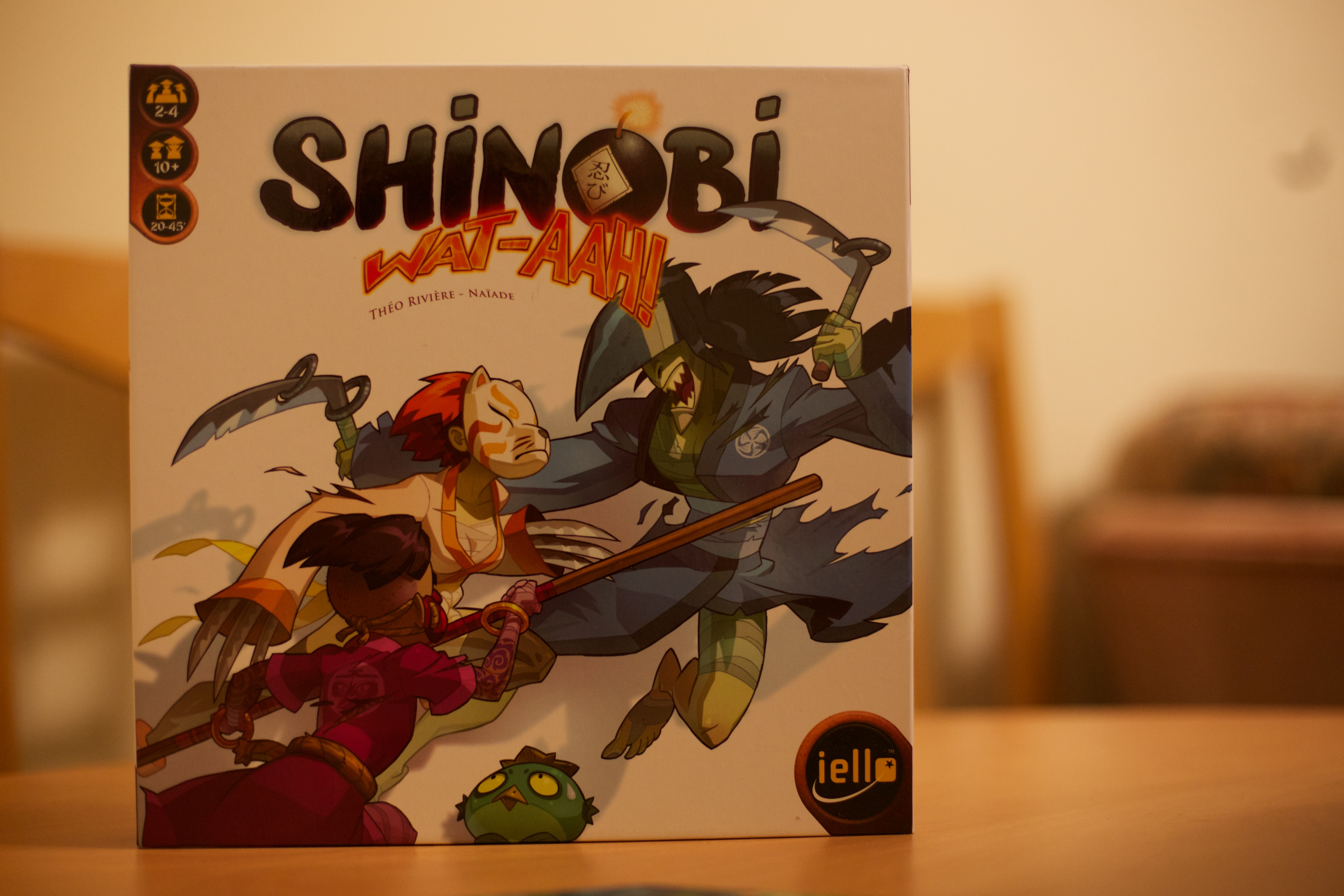
Shinobi WAT-AAH!: Everything changed when the fish nation attacked

By Bob, Lizzy, Briony

Dicks in ear: 7/10
Pairs well with: Sake, meditation, wisdom. All three at once, no cheating.

Note before playing: Everyone always asks if yelling WAT-AAH is part of the game, and, if so, when you shout it. While the parameters for shouting WAT-AAH do not appear in the rules, it is said the shouty samurai spirit has been inside you all along, and all that is needed is for you to free it when you feel the call. We enjoyed a house rule of shouting WAT-AAH whenever you put cards down. Or pick up cards. Or look at someone funny.

Shinobi1

This is a game about ninjas with magic powers. And that’s pretty cool, but much more cool is the fact that this game might even have magical powers of its own. We’re pretty sure it’s impossible not to enjoy playing it. Genuinely, we’ve not found a single person who disliked it, and we know people who dislike everything.

Shinobi7
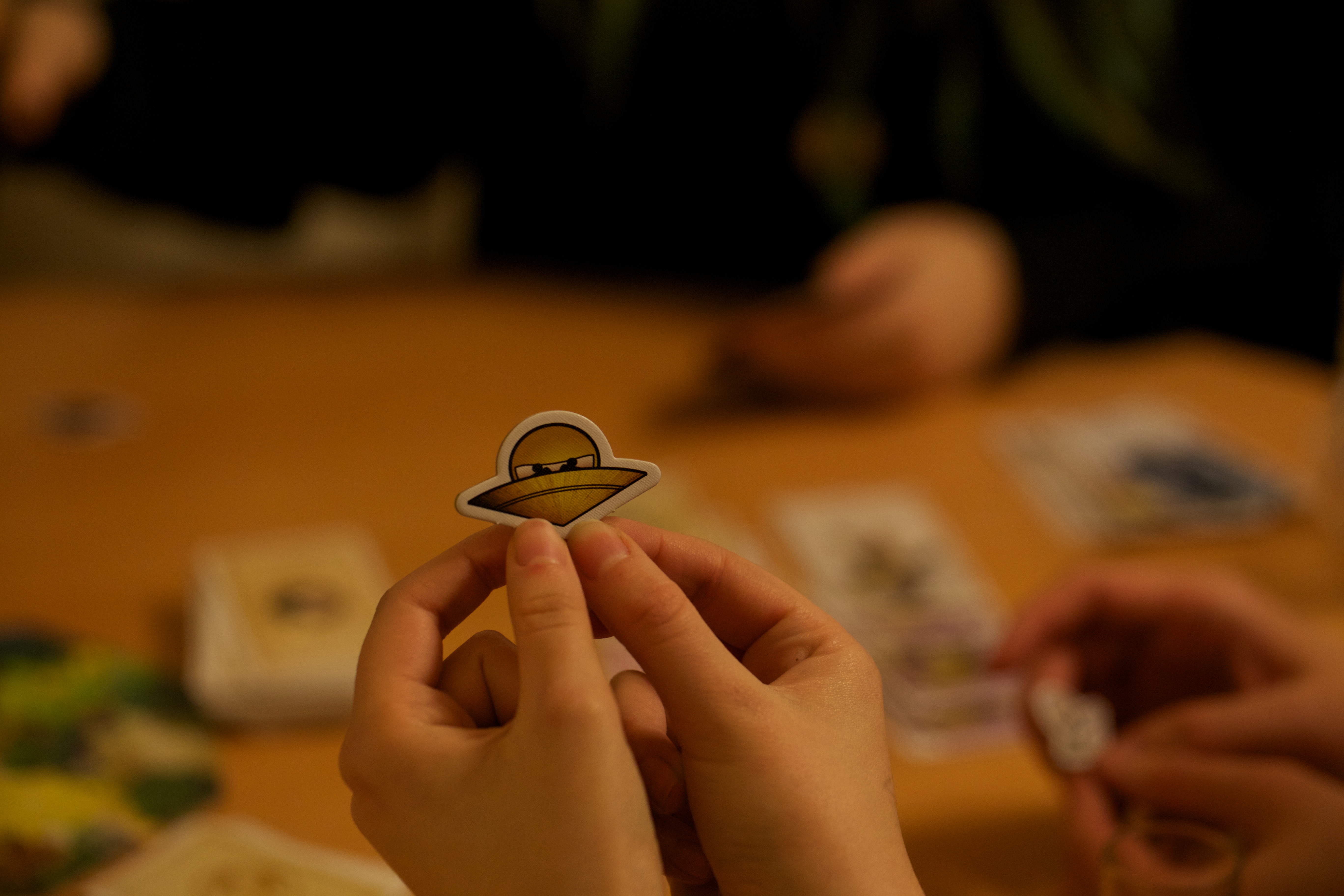
Check out this little guy. Is he an upside-down dude in a hat? Or two tiny men in a plane cockpit?

It’s another Essen find, and a very fortuitous one at that. Essen is a wonderful and exciting four days of board games but it is, nonetheless, four very long days of board games. By Saturday Bob was flagging. She hadn’t slept well in her overheated German hotel room and had more or less twisted her gastrointestinal tract into origami with German ham hock stew and pilsner (from this and the Sanssouci post you might have guessed that she has something of a complicated relationship with Germany. You would be correct). Running through pouring rain to catch our tram to the convention centre did not improve the mood and by the time we Shinobi6arrived, damp and itchy-eyed with tiredness, Chris (friendly robot boyfriend) was detecting all the signs of a classic Bob-style rage-quit (pouting, tearfulness, The Grumps). Worse; we had arrived early in order to be first in line to play Hyperborea and hadn’t even managed to secure first play spot.  Nor, despite a mad dash, did we make it to Tragedy Looper before its first clientele of the day had casually picked up the instruction booklet and started reading (the boardgame convention equivalent of yelling ‘dibs!’).

Chris later confessed that when we spotted an available table with Shinobi WAT-AAH! laidshinobi 11 edit out on it that he was more or less praying that it would be good, or a full-scale tantrum was going to occur. Bob of course informed him that she is an adult woman and she does not throw tantrums,* to which we all obviously agree, but conceded that the appearance of the Shinobi table was still pretty well-timed.

shinobi something edit
Explaining rules is the most fun Bob can have with her clothes on.

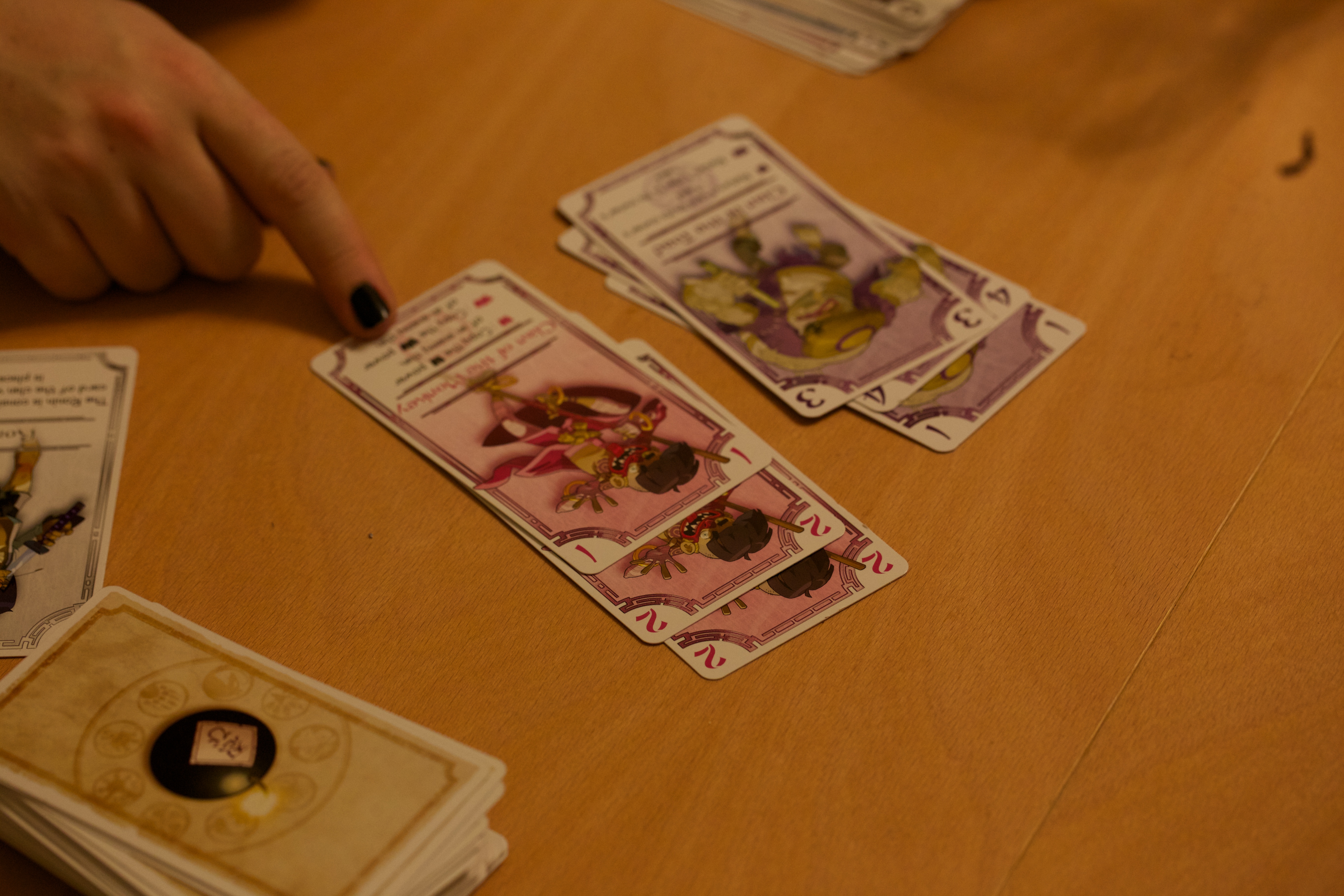
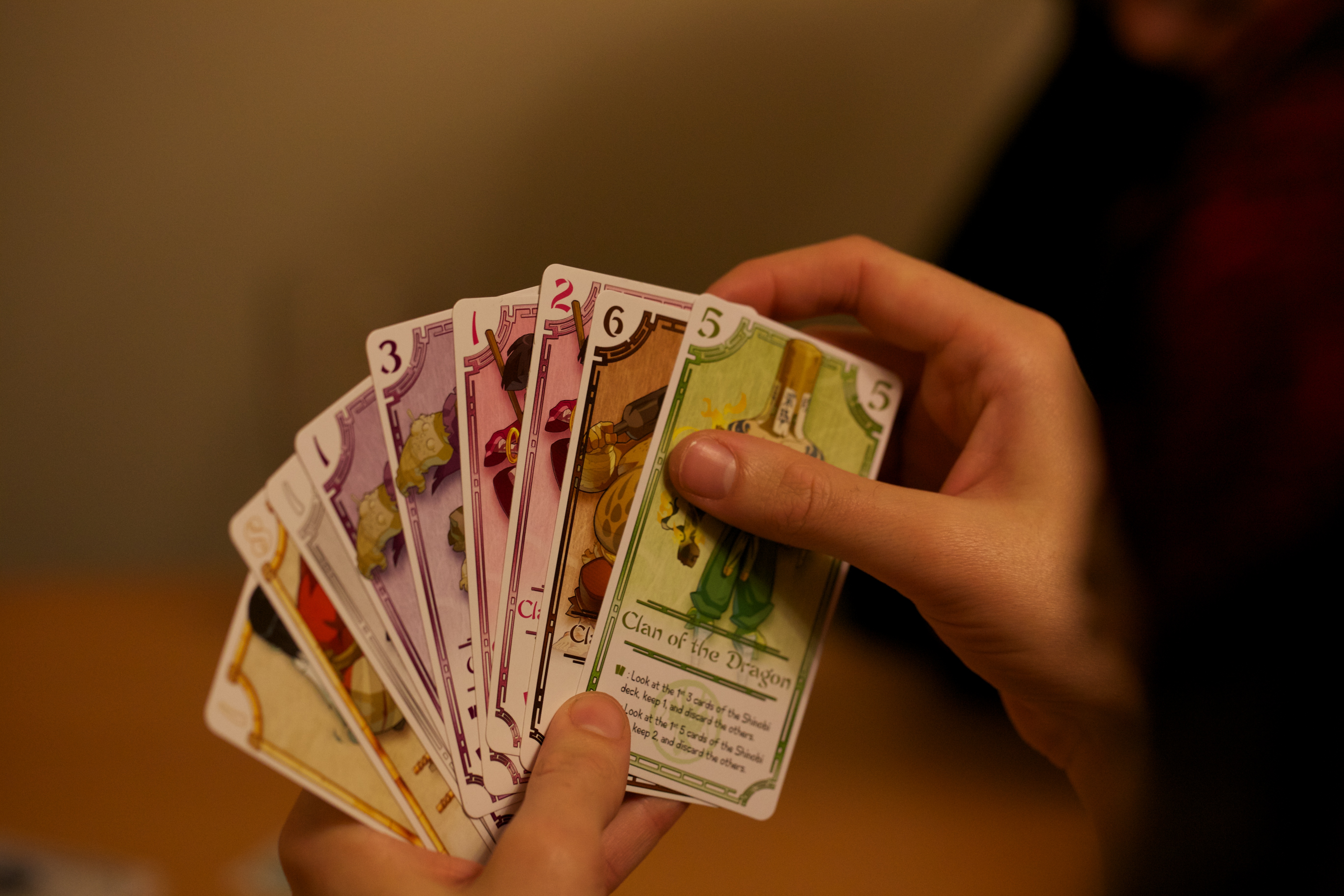
Mechanically it’s a fairly straightforward deck-building card game in which you’re a royal lord (or lady) trying to unite clans of epic fighting ninjas in order to trigger their epic ninja fighting skills so that you may defeat the final demon boss (WAT-AAH!) and place your royal rear upon the Imperial throne. The epic ninja fighting skills fuel conflict in the game as you fuck with other players’ cards, peek through the Jigoku (the discard pile – literally translates as ‘hell’), or copy other clans’ powers. We give it a rating of 7 dicks-in-ear for the irresistible opportunities to knobble each other with these powers. Although some of the clans’ powers are more friendly (pick up some cards, look at some cards, etc) you’ll almost certainly find yourself plotting some nasty moves and stealing an entire hand of cards from someone you sometimes consider to be a friend.

Shinobi10 edit

Shinobi5
Clans!

There are two modes to play in: Grasshopper and Grand Master. In Grasshopper mode you simply play turns until someone has laid four fully-formed clans (WAT-AAH!) on the table. You then tally up the scoring value of each clan on the table and the player with the highest number wins (not necessarily the person who ended the game). Grand Master mode begins the same but after the tally you retain the cards still in your hand (fully-formed clans already on the table get discarded) and receive a number of The Shuriken of Winning depending on your place in the running. You can spend your Shuriken of Winning on cards which will give you bonuses (WAT-AAH!) in the next round, or toward battling the final boss (which could be zombies or creepy old lady-demons or whatever).

You do this for three rounds and then the final showdown happens. The showdown is6D-31- 458 much more anti-climactic than it sounds, as it’s really just a scoring of a the number of shuriken you’ve already put toward fighting the final boss against the (hidden, mysterious) number that they want in order to give you the best possible number of points. There is no epic battle between ninjas and demons, sadly, but interestingly more Shuriken of Winning doesn’t always translate into more winning points.

Shinobi8 edit
Beautiful art

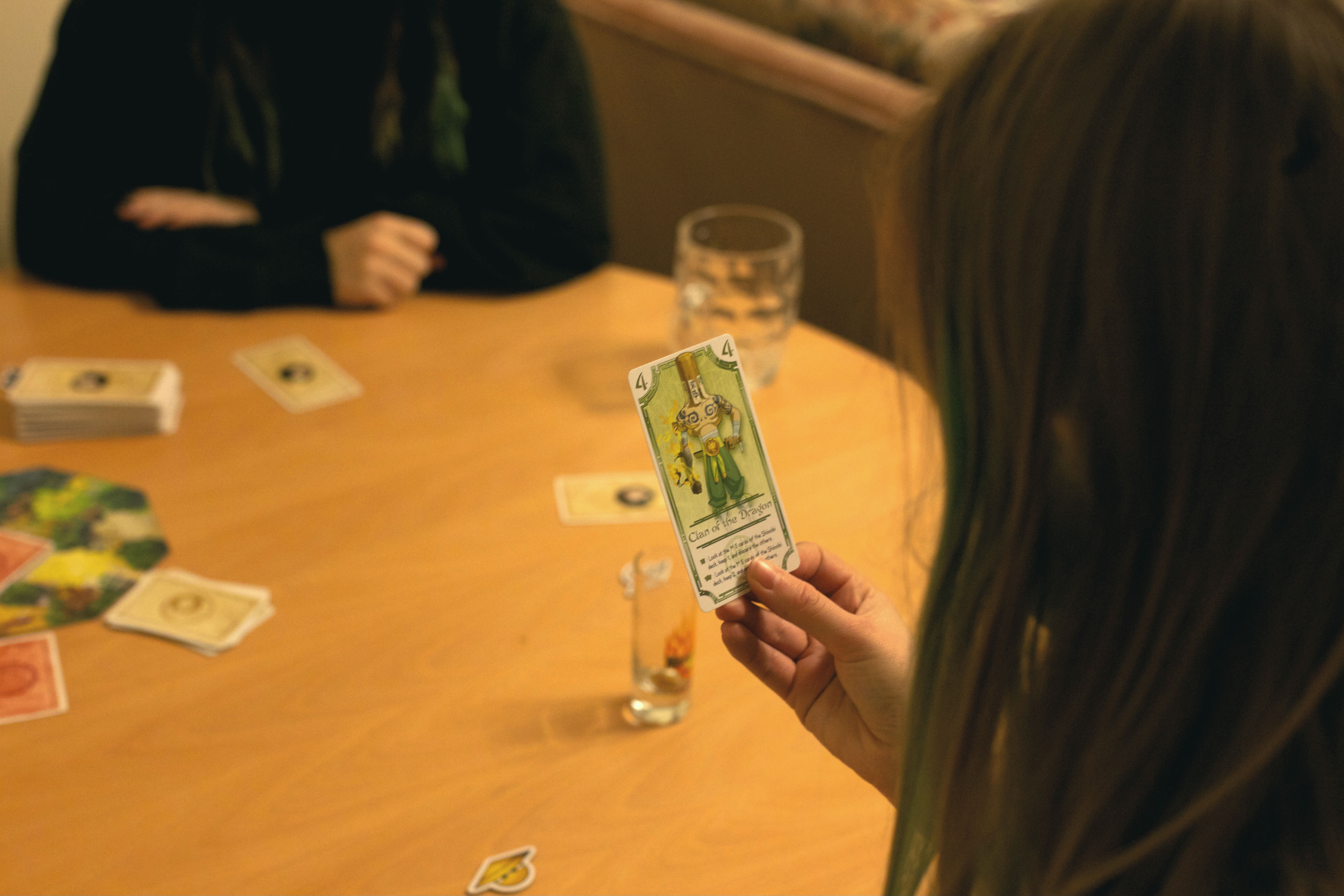
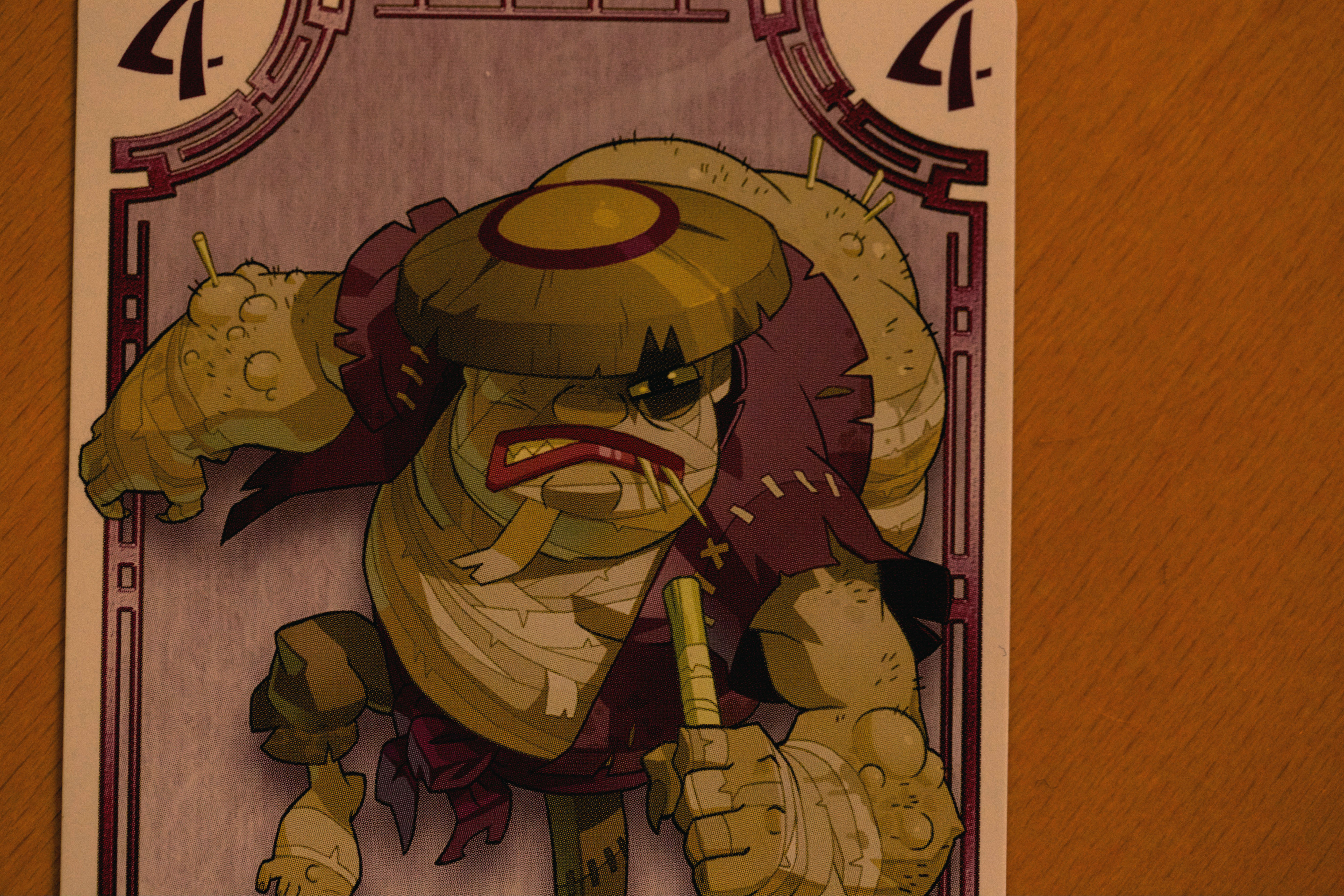
It’s hardly the most complex or rich game in the world, but it is unashamedly fun. It’s the feudal Japanese card game equivalent of a pew-pew video game. Dicks fly everywhere and the art is about as fantastic as you’d expect from the guy who also did Seasons and that most scenic of games, Tokaido. It has a cartoonish feel that is both beautifully detailed and very bold and clean. This perfectly reflects the style of the game – simple, fun, yet with captivating little details. For example the wild cards which can be used to simply make up numbers in a clan are called Ronin – a feudal Japanese term for a samurai without a master or lord. Similarly, the powerful single cards which can be played as one-off additions to a clan are called Yokai6D-31- 462 spirits or supernatural beings present in Japanese folklore. This is exciting if you’re incredibly nerdy and contributes to the immensely satisfying feeling of a well-balanced, well-designed game that just works.  The cards are also taller than you’d expect, which is aesthetically very pleasing. It’s a neat touch.

Price-wise it’s a bargain. For some reason it seems that the more board games cost the more polarising and more rarely-played they become. Everyone will play a round of Coloretto or Hanabi but you actively have to search out friends interested in a game that costs hundreds and takes 6 hours. Twenty quid might not get you meeples of every colour and shape or a giant, detailed board but it will get you a game where even friends whose opinion of pretty much everything is that it’s ‘bullshit’, will sit up halfway through a round and mention how much fun it is.

Lizzy won again. But the real winner is board games.

6D-31- 417
The winner is always board games. And Lizzy.

* She does kind of throw tantrums a little bit. But only when she’s really tired. Or hungry.** Or drunk.

** Before Essen she gave Lizzy a bag of Cadbury’s éclairs, with strict instructions to feed them to her if (when) she got cranky. It was a good strategy.

Image credit and thanks to Dr Photographer