Here at the Misery Farm we are big fans of Big Games. Euro-games that take a bajillion hours and a Masters in applied Logic to wrap your head around. Twilight Imperium, Caylus and Agricola are what we’re about. The only party game we allow is Codenames – casual fripperies like Obama Llama and CAH get cast aside like last week’s empty wine bottles.
Nonetheless we admit that sometimes games that take less than an hour are not only desirable, but necessary. Imagine being in a wine bar with your best friends during those awkward minutes in between sitting down and the first arrival of a round of rich Malbecs to your table. Nothing to soften the acute agony of interaction and no lead-in to broach the latest gossip. Horror. For times like this we have casual games. Stick them in your handbag and never be bored on a train again. Give them a permanent home in your backpack and no flight delay need hold fear again. Wherever you are, you bring the party.
Note: Some fiddly bits included. The Misery Farm cannot be held responsible for lost pieces on rickety train journeys.
Hive
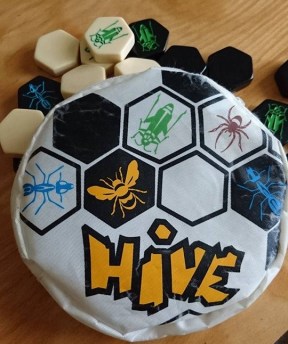
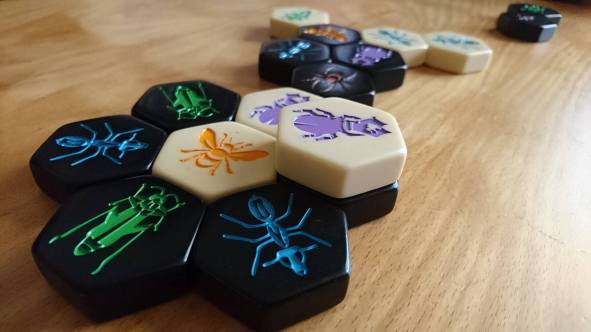
Hive is a two-player tile placement game much in the same style as chess. Each player controls a range of either black or white tiles with different bugs printed onto them. Each bug has a special movement ability, again much like chess. Because of this similarity it makes Hive a good game to play with kids and adults of all ages. The aim of the game is to surround your opponent’s queen bee with tiles*. The game has many varying tactics such as blocking your opponent’s bugs with your own tiles, using their tiles to surround their own bee, or simply pinning tiles down using a beetle. Once placed you can still move any of your tiles around so long as they are freely able to move, and in moving them they do not break the hive mind, i.e. the tile doesn’t connect other tiles to the hive. Similarly to chess games of hive will keep your brain engaged and constantly testing new strategies on your opponent**. The more you play the better you will become until your ragtag army of unyielding and undying insects can take over the world friends willing to play you.
Dobble

Dobble is a very fast-paced card placement game which has more than 7 ways of playing. The deck is made up of circular cards with a selection images printed onto them. On every single card features one image that will match with any other card in the deck. All of the games are centred on the idea that you need to find the one matching image between one card and another which can become infuriating and impossible under pressure***. There is no player limit for the game which instantly makes it a party classic especially when combined with shouting, laughing and intense time pressure. The sheer simplicity of the cards is enough to enthral any scientists among you into working out algorithms and new games, and for everyone else to simply become better at identifying objects under pressure. There should probably be a noise warning on the tin however, as you will definitely find your whole party sometimes shouting incoherent nonsense. This makes it a great game to play with kids, as not only is it simple but children spend a lot of their time shouting incoherent nonsense anyway.


Bananagrams
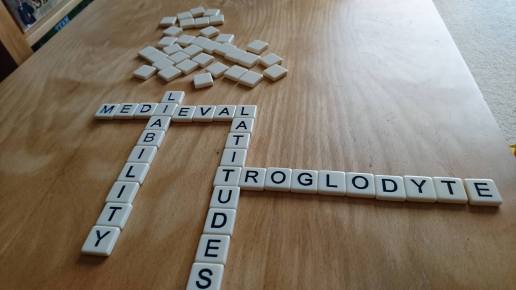
 Bananagrams is probably a game a lot of people have seen while Christmas shopping as it’s sold in a lot of stores that don’t even specialise in games. Usually when we see a game like this we instantly assume it’s terrible – Monopoly and Trivial Pursuit notoriously belong to this same category and have hurt us in the past. Rather amazingly Bananagrams is actually fun. It’s a game very similar to Scrabble where players are given a set number of tiles (usually 21 but depending on number of players) and must make connecting words with them. Unlike Scrabble there is no point scoring system, and instead to win the game you must get rid of all of the tiles in the central pool first. You do this by using all of your hand tiles and then shouting ‘PEEL!’**** Each player will then take an extra tile from the pool and continue trying to form words. For the player who shouted this means that you now have only one letter to get rid of, and fortunately the game allows breaking up and reforming words. The game pitches your intellectual Scrabble ability against that of time pressure and the abilities of the other players. This can be a bit distressing when you think you’re doing really well but it turns out you’ve only been laying two and three letter words, whereas your friend opposite has practically written a novel*****.

*In the animal kingdom this would probably mean ripping the bee limb from limb and taking over the colony in cold blood, but we’ll leave that part to the nature documentaries.
**Incidentally there is an online version of the game available through Steam. In this you can play against varying levels of difficulty against the computer, play online, and also pass and play. It also has excellent music.
***At the Misery Farm we found that certain people***** were ‘blind’ to particular items regardless of how many times they came up. The game sizes the items differently on each card to throw you off even more, but still, item blindness continued.
***We strongly encourage you to try this in a number of different voices and accents. Bonus points for knowing ‘peel’ in another language.
****The joke is on them though – ‘Fuck your five syllable words, it’s all about peeling the most. I can peel better than all of you! FEEL THE PEEL!’
***** It was Bob. Bob still can’t tell colours and shapes apart. Five year olds would have a great time playing against her.

 Star Wars: The Card Game is a two-player deck building game. It is set loosely during the height of the Empire’s control in a way that allows the different card affiliations to have beef with one and all of the others at the same time. Although not plot-specific, the decks will feature characters, places and events that occur during the novels, films and general Star Wars universe.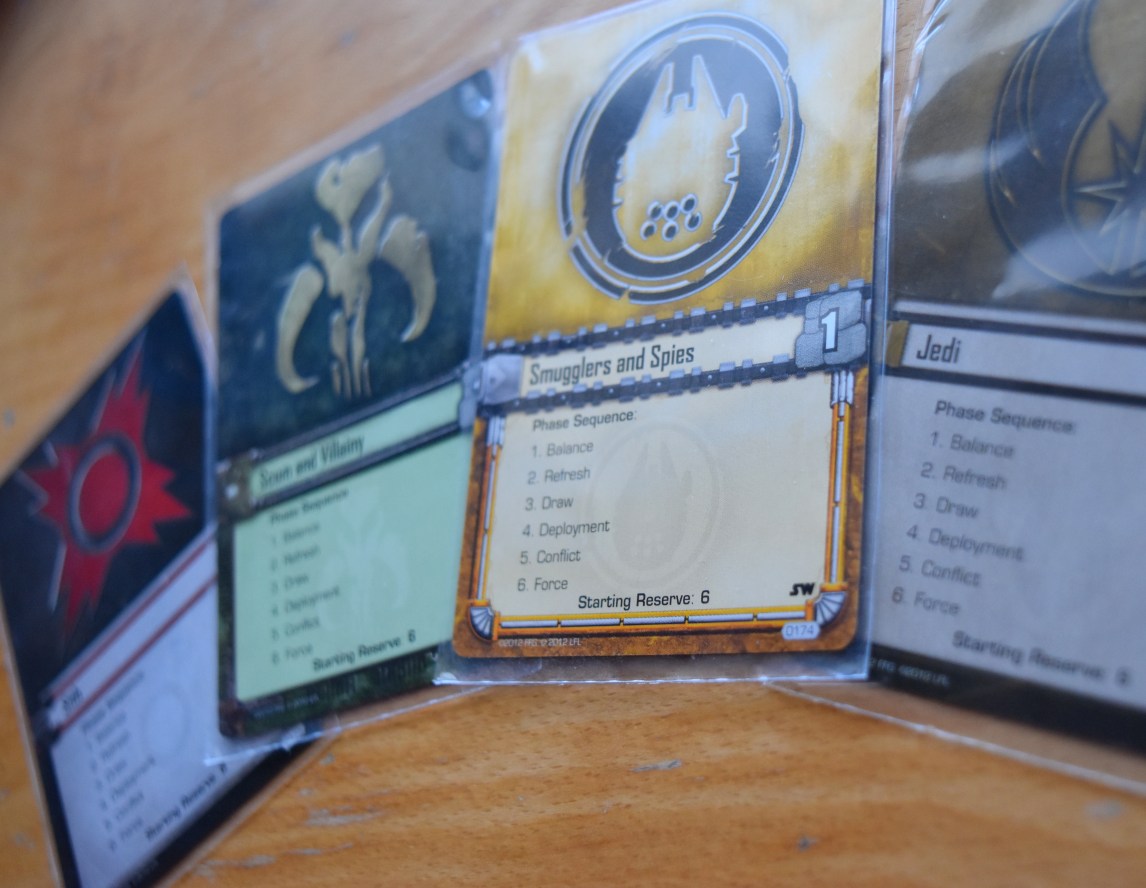
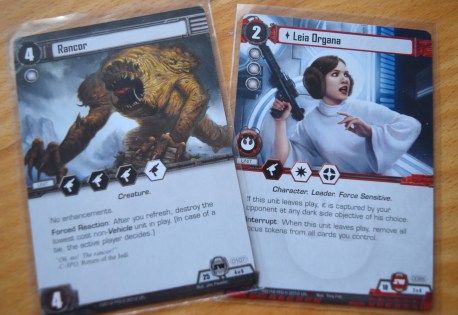 Units cards, like Chewie, are used for attacking and defending in engagements and may also contribute to balancing the force (don’t worry, we’ll come back this like Han Solo comes back to bars). Enhancement cards do what they say on the tin – play the card to do or get a better thing, or to improve existing cards. Event cards are sudden effects which are played directly from the hand instead of having to be placed in the play area first. They usually cost resources or cancel effects of other cards. Finally, fate cards are similar to event cards but usually have more powerful effects. You can only play these during a certain phase, and when used correctly can be a game-changer***.
 During setup you’ll also pick and layout three objectives. These are what the game is really all about: each player will be trying destroy their opponent’s objective cards. A light side victory requires the destruction of three objective cards (even though more may be played throughout the game). A dark side victory occurs if the death star dial advances to 12. This is a dinky little clock which will advance once per turn, and twice if at the beginning of the turn the dark side of the force is more powerful.

 The force struggle phase happens at the end of each turn, in which players commit cards to the force. Whoever has the most committed points to the force means that for that round, the force will be changed to their side. Committing cards to this however means being unable to use them in the later stages of the round.
 In conclusion the game is very well thought out and balanced. The art, and range of characters and cards are excellent. It is a constant struggle from beginning to end, but once you get better at it it feels like you have the might of the Empire emanating from your very being. Unfortunately, like similar deck-building games such as Magic the Gathering, it’s going to take a while for you to get really good, kid, and until then you’ll need to be prepared to loose a lot. But it’s ok, even the best Jedi loose sometimes.


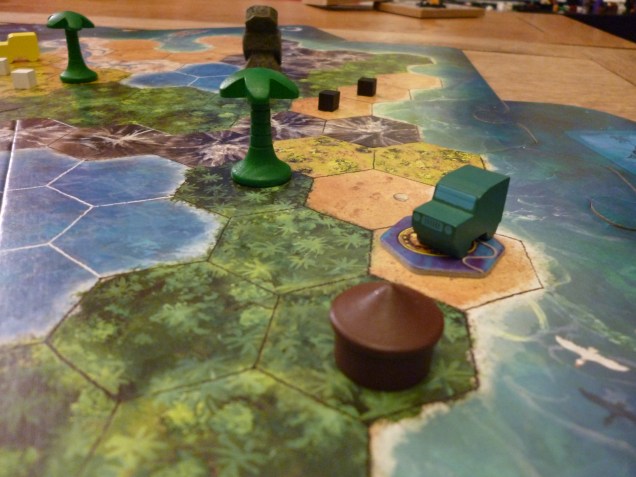
 There are four treasures up for finding at any one time: brown, grey, white, and black. There will be more hidden around the island, ultimately, but presumably you only have enough room for four maps at once, the rest of your pockets being filled with snacks and maybe a board game to pass the time. To find one of these four you will gradually hone in on their location by playing cards which eliminate possible locations until only one remains. The treasure is then dug up and shared out among not only those who dug it up, but also those who contributed to discovering its location (because, of course, researchers share academic credit).
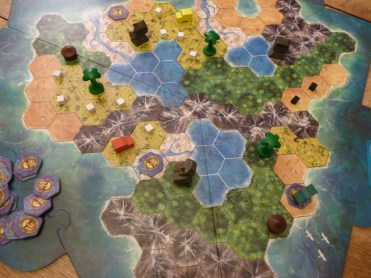 The game doesn’t encourage you to be unhelpful to your expeditions. In fact, it does quite the opposite. Every time you help narrow down the location of a treasure you’ll get a bit more of a share of that treasure. Or, as we call it, “put another finger in the pie”. You’ll want to have your fingers in a variety of pies, particularly earlier in the game, to get yourself a lot of treasures, and the quicker those treasures are found then the quicker you can stick some new fingers into some new pies, you see. Pie treasure for everyone.
 In a startling return to scientific inaccuracy, there’s a chance that the treasure you discover could contain some horrible curses, which can only be protected against with magical amulets or appeased by giving up your greatest treasure (in-game treasure though, obviously. You needn’t be prepared to offer up your firstborn just to play). As soon as a curse comes up then there’s no more of that treasure for anyone, no matter how many of the fingers you had in that pie. That’s why it’s best to not keep all your
 There’s something really satisfying about a game of Tobago. Not just working out locations of treasures, but also the gameplay more generally is rather nice. Those mysterious, giant stone heads that we mentioned at the beginning of the game will spurt out delicious amulets now and again, which make it worth pootling about in your Jeep a little more to collect them. They can enable you to double up some moves and work out some pretty tasty combos, as well as just saving you from the worst effects of the curse cards.
 Misery Farming