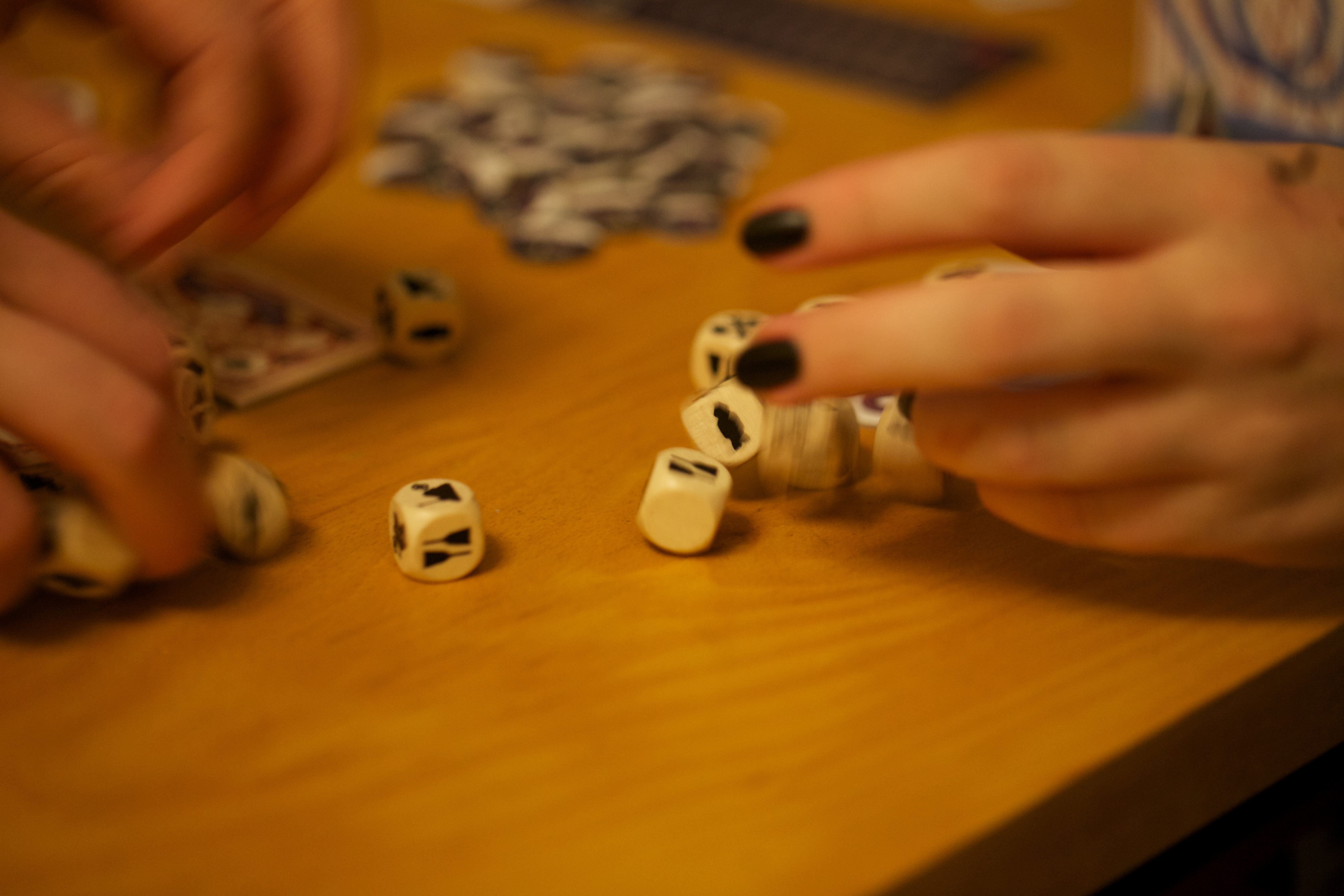
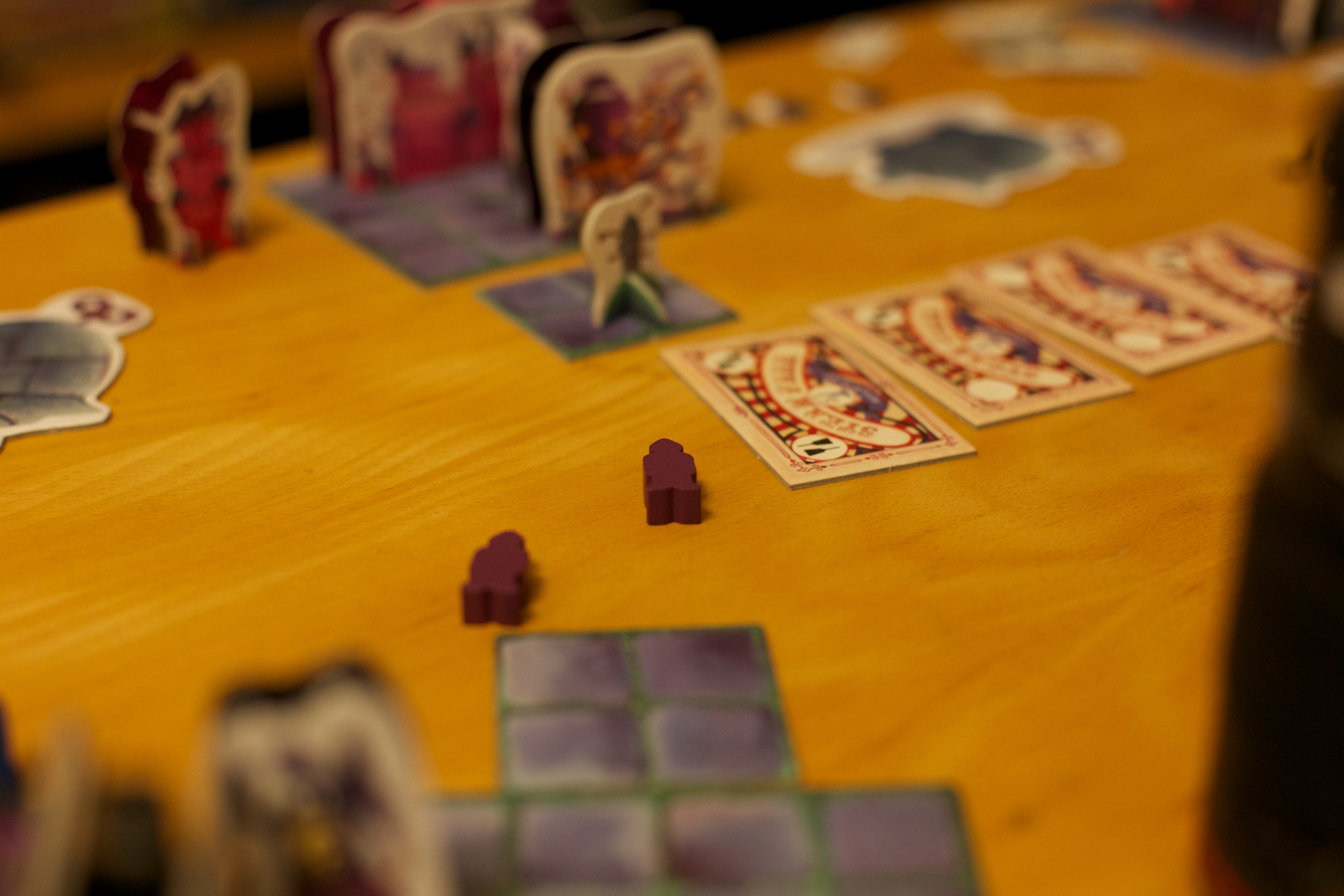
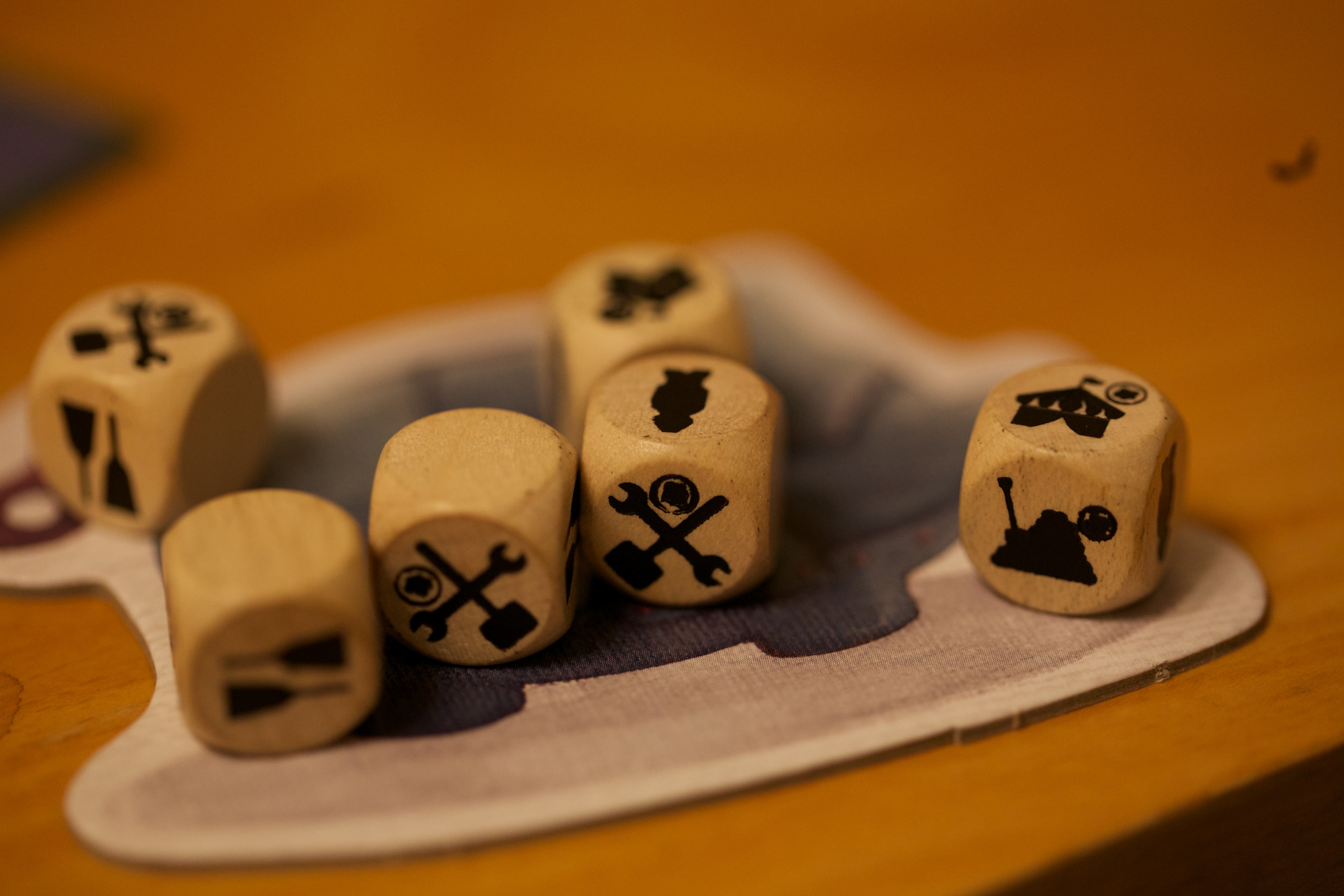
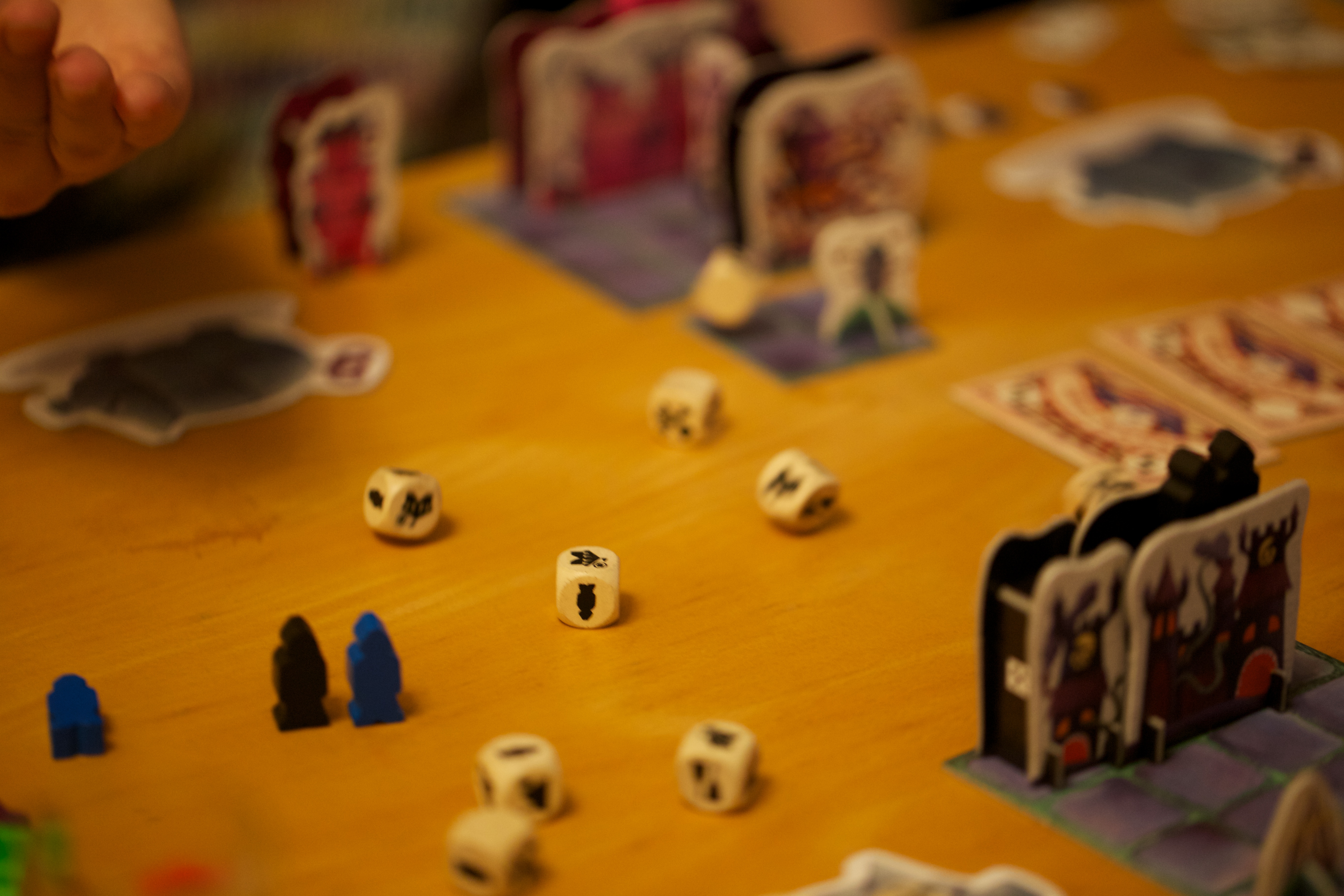
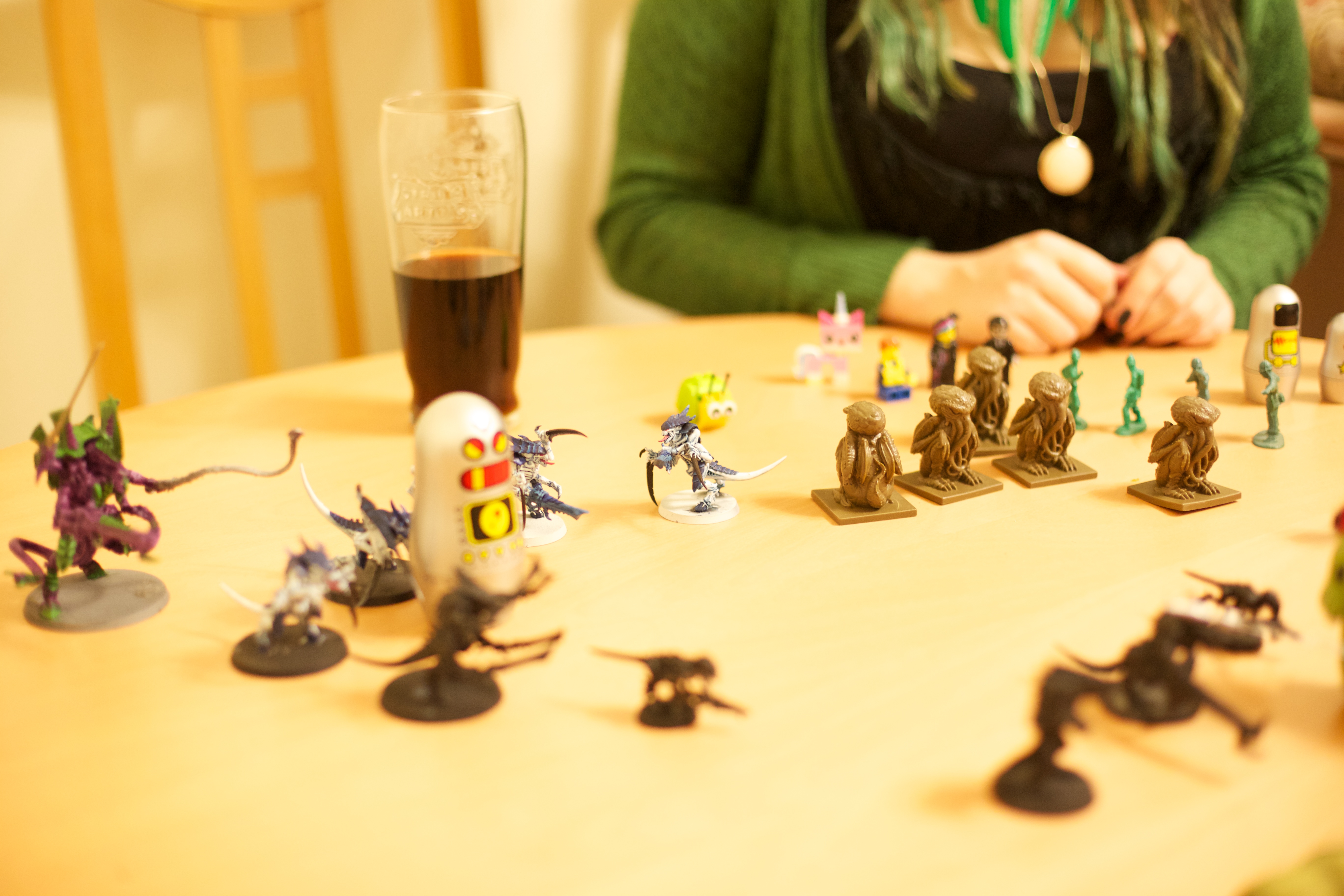
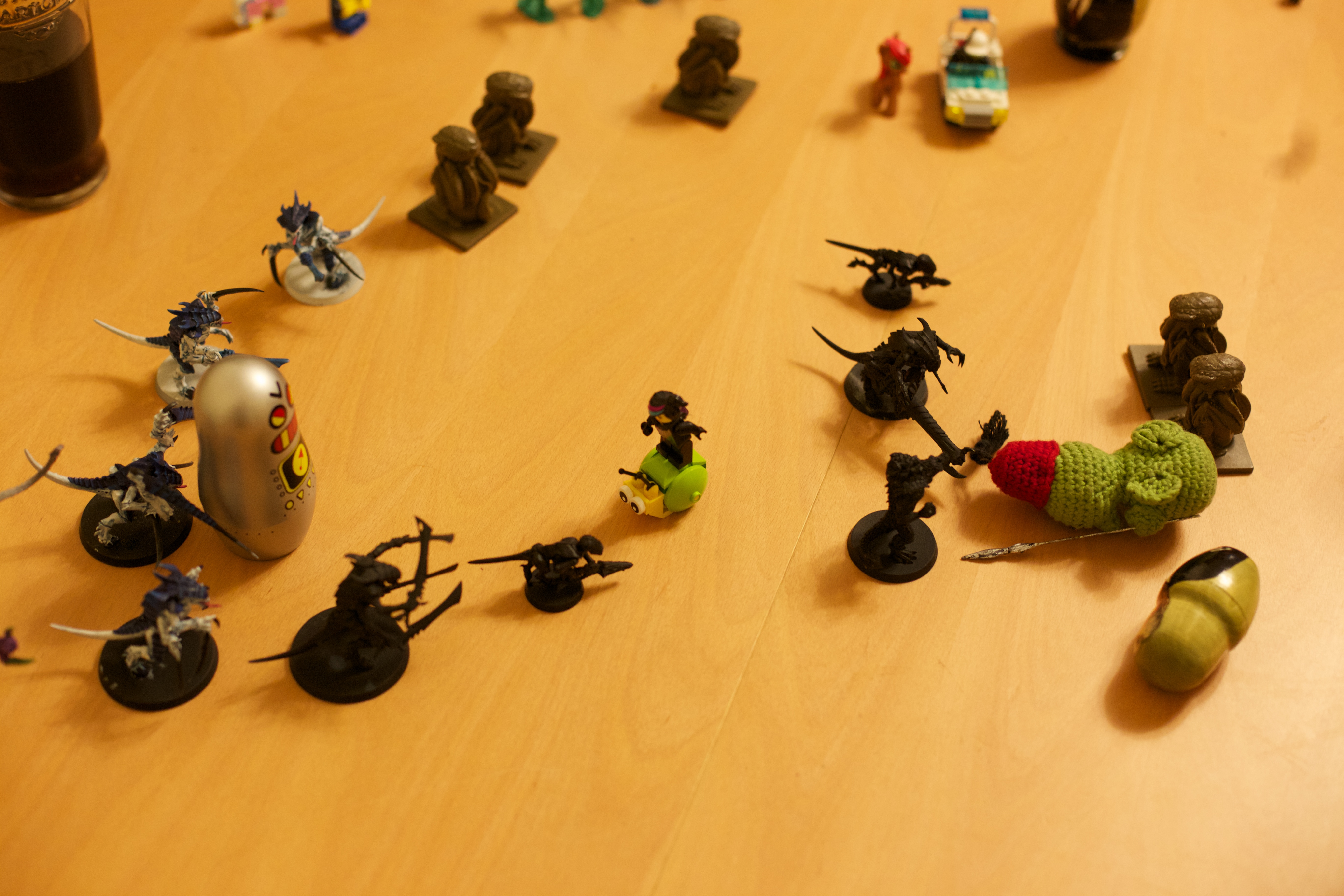
Caylus: Is that a lot of rules or are you just pleased to see me?

By Briony, Lizzy and Bob.

Brutus rating: 6 knives in the back out of 10
Pairs well with: The best French wine that £4 can buy and a crushing sense of defeat.
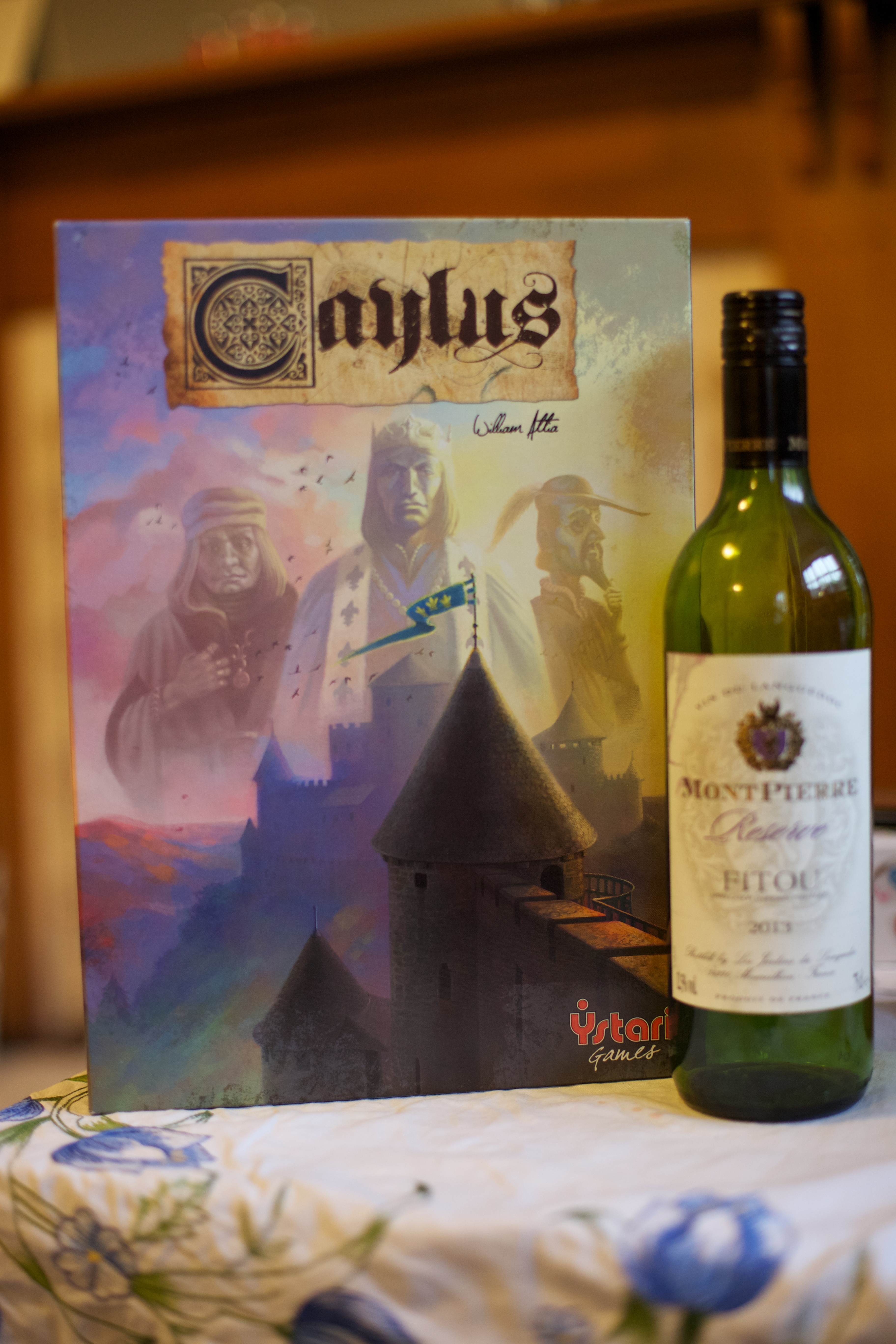
The bottle's empty for a reason
The bottle’s empty for a reason

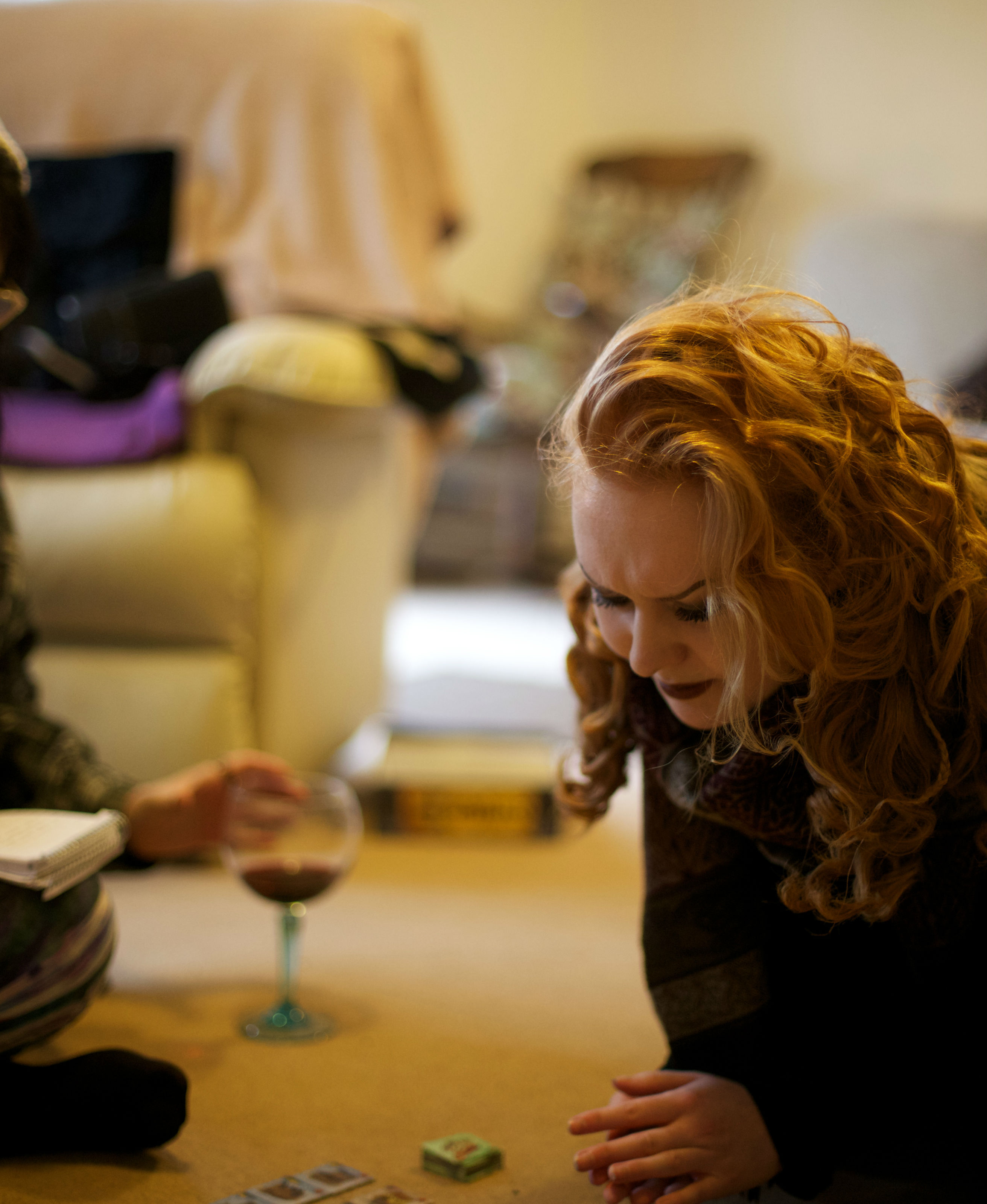
Recently your friend Bob has been ‘Doing Exercise’. This is deeply unpleasant (and if you’d like to charitably sponsor her ill-advised half marathon you are welcome to do so here). Anyway, as part of this whole fitness drive she decided to give ‘Tough Mudder’ training a go. For those of you who don’t know what that is, congratulations. Nor did Bob until last Monday, when she found herself army-crawling across a muddy football pitch with the prospect of push-ups at the end of it, while a group of athletically-attired strangers whooped and cheered her on. The cheers straggled after a few minutes; it’s difficult to stay enthusiastic when you’re standing in the cold watching an overweight goth clumsily wriggle across some grass. It felt an awful lot like PE at school, and even ‘giving it your best shot’ did not make the experience of doing walking lunges while overhead-balancing a car tyre more pleasant.

Getting into the spirit..

It turns out that ‘Tough Mudder’ is just like Caylus. That is, just like crawling along a muddy pitch ‘Doing Exercise’ and wallowing in despair, particularly at yourself and your abilities. Caylus has a reputation that precedes it as being a particularly difficult and frustrating game. It is long, it is punishing, and it wants you to know that it’s all your own fault for getting yourself involved in the first place. And now you’ve fucked up your turn, well done you. “Those jumping jacks/turn order mechanics were just a bit too much for you, weren’t they?” says Caylus. Yup, they were. Once you’ve knobbled yourself over once there’s very little you can do to get your enthusiastic strategy back on track, and instead you’re left to be cynical and grumpy in the corner while everyone else carries on with a lovely evening, occasionally encouraging you not to give up and to stick it out. This introduction to the game might make a person think ‘why would I ever play something that makes me so disappointed in myself, not to mention cold and muddy?’ (OK the metaphor’s getting a bit stretched here), but it is impossible to stress enough how amazing that ‘eureka!’ moment feels when you get it RIGHT. Displacing water in a bath never felt this good.

And now for some game context – ‘The year is 1289. To strengthen the borders of the Kingdom of France, King Philip the Fair decided to have a new castle built. For the time being, Caylus is but a humble village, but soon workers and craftsmen will be flocking by the cartload, attracted by the great prospects and desire to please the King.’

Building things out of your pieces: the real game

Slowly but surely you and your fellow players will be building up the board with buildings and farming resources, turning the village into a thriving mercantile city with a glorious castle dominating the skyline. Also, the castle is going to be built out of pigs. Pigs and velvet. Honestly, you may as well wildly point at the nearest object to yourself and declare that it will become part of the castle. That, my friends, is how castles were build back in the day. Foolproof.

6D-32-72Alongside building the castle you can reap victory points by various other means: gold mining, collecting favours, exchanging money, etc. Going through each of these individually would be deeply tedious and abstract and therefore better left to ‘real’ board gaming blogs (or even (gasp!) the rulebook). Instead let’s talk you through some turns of the game using a recent game between Lizzy, Briony, Bob, and a generic white male gaming buddy (here known as ‘Gord’) as an example. This way you’ll hopefully get an idea of the mechanisms, type of play and how scoring works. From there we’ll highlight some particularly good strategies we’ve come across, and discuss some select ones in a bit more detail. We’ll also discuss the crushing misery of failure. Woo!

You call this a meeple?

A turn of Caylus has a few different phases. Firstly, the worker placement phase in which each player places a worker in turn on an existing building. This lasts until you run out of workers (6), run out of money to place workers (it costs one franc per placement), or you choose to pass (i.e. if there is nothing more you want on the board). The meeples, by the way, are just disappointing cylinders. The pigs are just cubes. We take this to be an artistic statement about capitalism and despair in medieval France.

A pile of pigs, velvet, gold, stone and wood

We’ve kicked off with Briony’s workers claiming a broad range of resources intended for castle building, while Lizzy’s workers are grabbing up some stone and wood and generally sturdy things (stone and wood? To build things with? Ridiculous. It’s almost like she’s seen a building before.) Gord has gone for a construction angle using some architecturally sound pig and wood, and Bob has got some velvet as it is the most flamboyant and least buildy resource available.

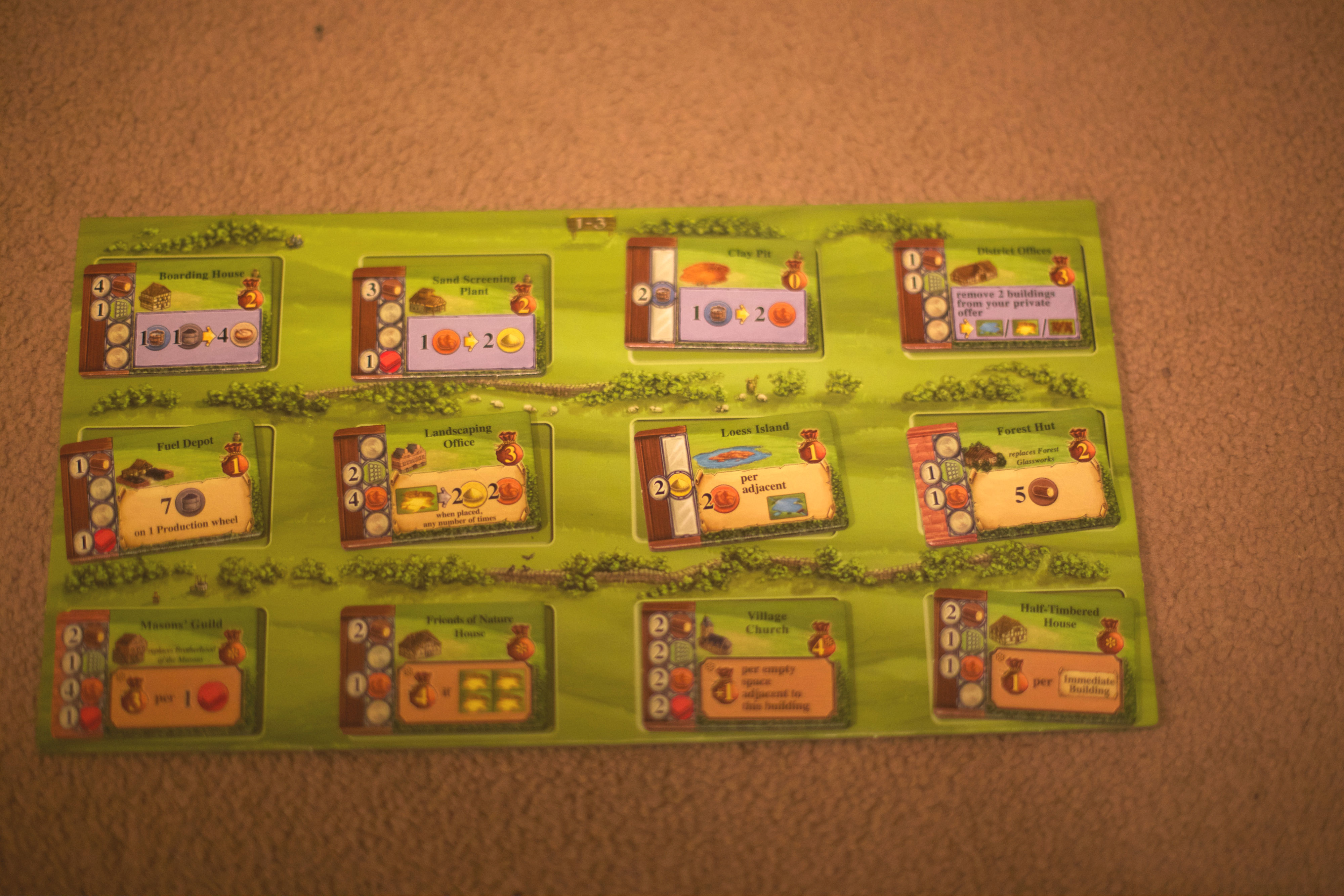
Secondly, there is the job phase. As all buildings are built along a road leading from the castle, the jobs are resolved in the same order as if we are travelling down the road ourselves6D-32-88 (Fortunately we don’t actually have to move for the game, which is good because, ya know, moving). Each building will offer something like resources or the ability to build, and you take the things that your workers were placed on in the order of the road. Order in this game is extremely important, and worryingly easy to forget. To both generate resources and to build stuff you need to work out at what point you are receiving things, which must occur before building in the castle, or having enough resources to build other buildings. We advise the use of the medieval equivalent of a stock-checker at all times.
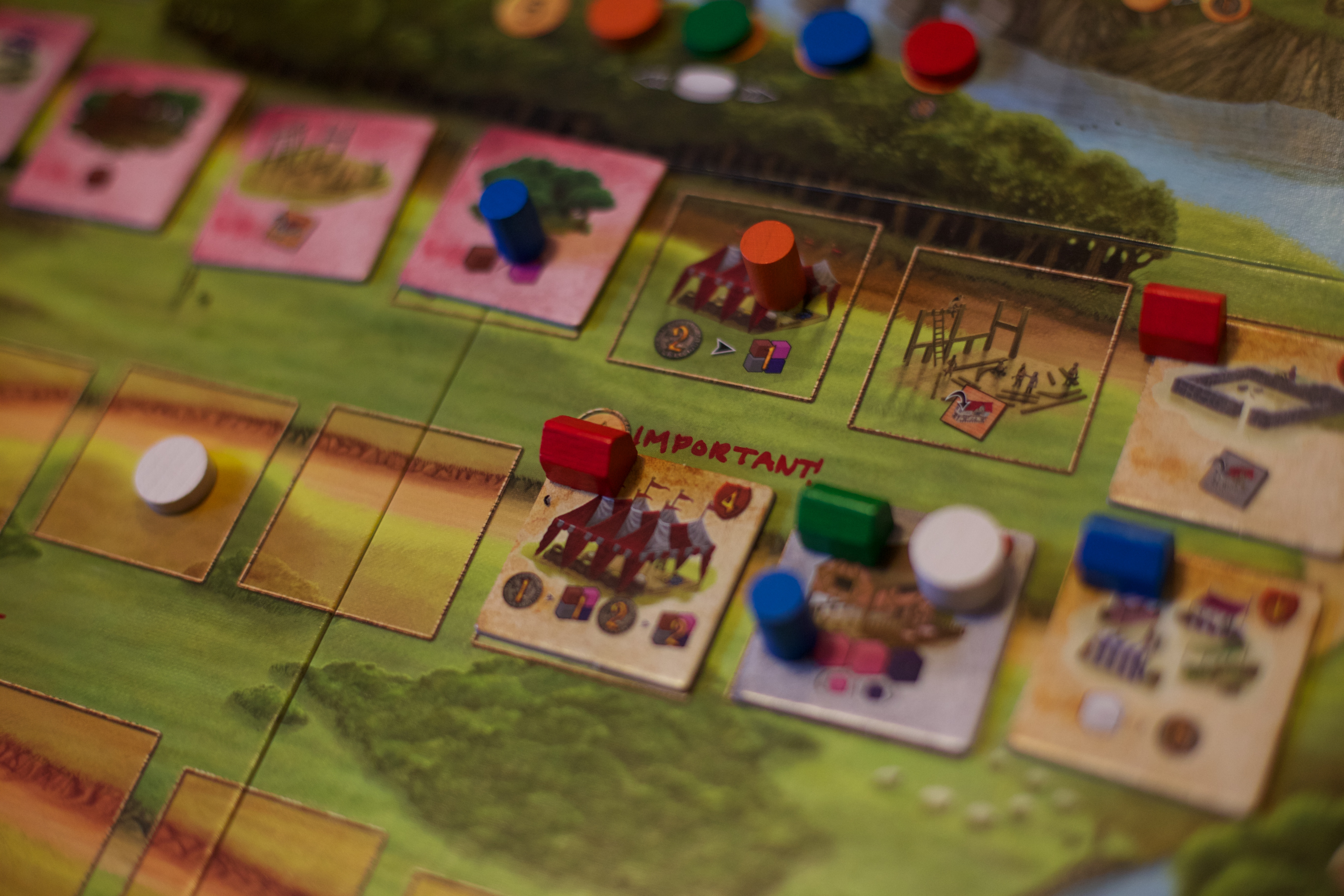
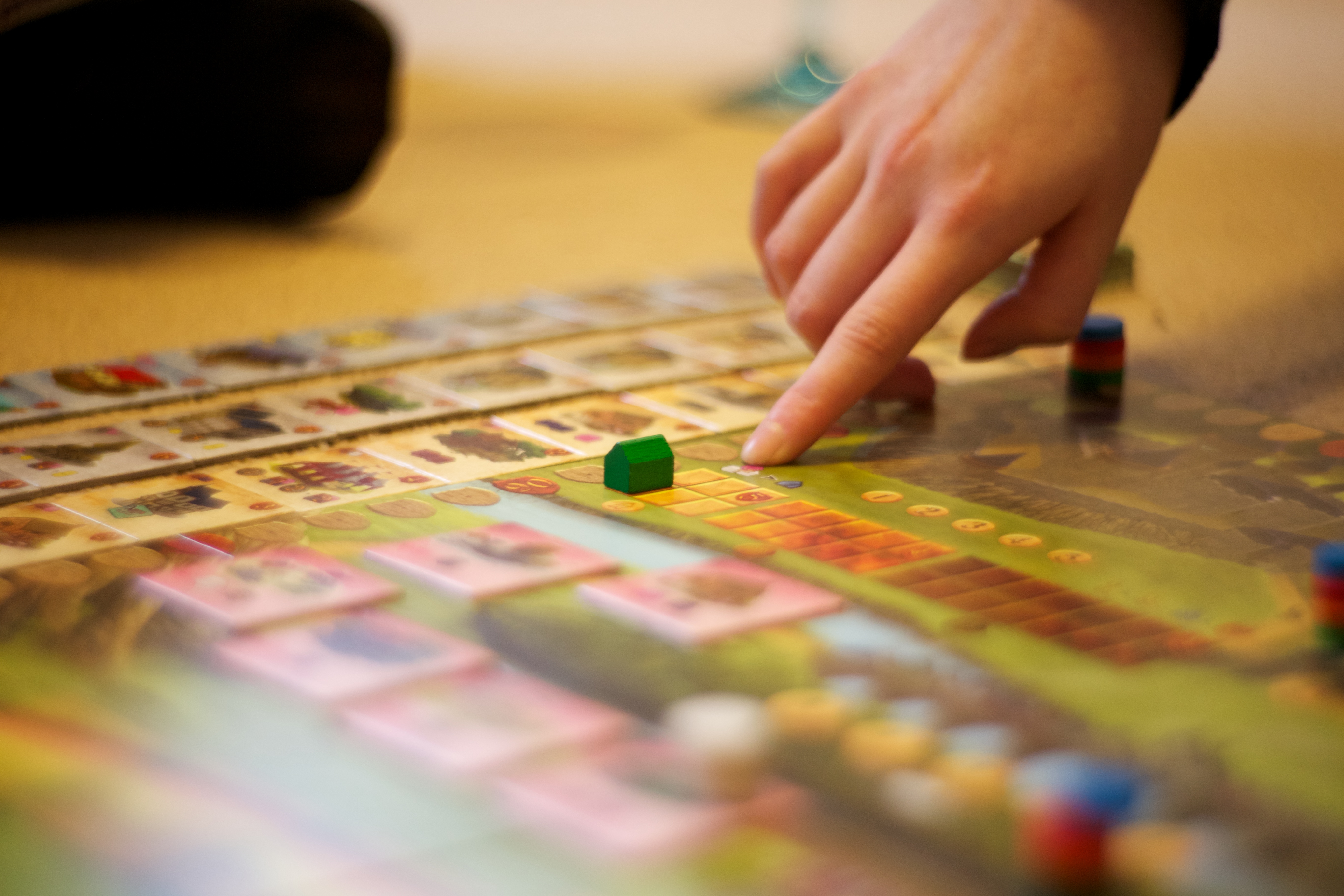
6D-32-16Thirdly, there is the castle building phase. This can only be done if you place your worker in the castle position during the worker placement phase. A vital part of this is actually having the right resources to build, which sounds simple, but when you’re collecting multiple different things in the previous phase and having to plan out steps far in advance then it’s very easy to accidently pick up a velvet when you really needed a goddamn pig (One of the few games that can trigger the lesser known phenomenon ‘pig-rage’). In order to build in the castle you must have 3 resources, one of which must be a pig, and each of the others must be different types (why, why is a pig a major building resource? This is never addressed anywhere in the rules. This sounds like an extremely inefficient and wriggly way to build a castle. Does anyone have any theories?). Again, a simple premise, but if you organise your stock slightly wrong or spend something you weren’t intending to then it’s pretty easy to rock up to the castle with two pigs and a stone and be disappointed when the king laughs at you. Foolish peon, bringing two pigs with which to build a castle, he needs only one pig! And some velvet! And a rock of indeterminate size!

Another important aspect to bear in mind with castle-building is the extremes that it produces.

Bob's score definitely going in the wrong direction
Bob’s score definitely going in the wrong direction

If you build the most castle in the turn then you receive a favour (which is spent in the favour-reward track of your choosing), however if you place a worker and don’t have the resources to build then you immediately receive minus points. His royal highness is mightily pissed. Bob has demonstrated this consequence beautifully in her very first attempt at getting some victory points, and is now sat sulkily at -2 points, hoarding velvet.

As with many worker-placement games, a viable early strategy is to simply farm resources until they dribble (painfully – in this game they’re represented by wooden cubes) out of your ears. Making more resources happen more easily is therefore an even better strategy, but difficult to do consistently. The very best strategy (that we’ve found), is to be given resources as an idle tax while other players are trying to gather their own. There are three buildings which have this effect, and if you manage to construct all three of them you have effectively broken the game. It’s ridiculous. Especially when you combine it with building green buildings (which have to be built on top of existing non-taxed resources, therefore forcing players to give you extra resources AND generating extra income from green buildings).

A quick break for blog-notes

This is the only real mechanical issue we’ve found with Caylus, but it’s a biggie and is very difficult to stop. No strategy should be that OP, unless there are other big earners that we’ve somehow missed (entirely possible, somehow we don’t get round to playing Caylus all that often). And no, we’re not going to tell you which buildings they are; that would be cheating.

As the game progresses and other players’ strategies become clearer, the daggers come out. Let’s be clear: the biggest dick in this game undoubtedly belongs to you, and it’s aimed at yourself. Even people who are normally competent in their everyday lives can just repeatedly screw themselves over in this game, more than seems statistically probable. You’ll miscount your resources, you’ll forget how to build anything, you’ll even forget when the game ends.

Having said that, there are some excellent ways for other players to knobble you over too, such as by taking the resources that you can see other players eyeing, muscling in on their share of the castle, or by moving a little white token called the Provost. 6D-32-27This little guy, combined with the Bailiff (upon whose head the Provost gently sits), determines how far down the ‘road’ your workers can be placed and have effects, as well as when the game ends. If you can end someone’s turn before they’ve got all the resources or victory points they want, then you can really make their day unpleasant. Luckily, despite the constant shifty eyes and threat of skulduggery as pacts get made and broken, players are often far too focussed on their own misery to try and inflict it on others. That’s what keeps the Brutus Rating at a 6/10.

Despite its typical Uwe Rosenberg-patented Agricola-esque misery this game is, in many ways, perfect. It’s an incredibly ‘pure’ game, in that it relies on a strategic understanding of the mechanics’ abstract interplay. In fact it’s so computational that Chris* maintains it’s not actually a game. We would disagree; its dry strategy, intricate game scenarios and yet almost absurd lack of flexibility makes playing it surprisingly intense. It brings out serious turn-narcissism** as you desperately and meticulously line up your strategy. And when it works… oh god, when it works…. The feeling of relief, pride, and joy is, we imagine, much like giving birth. No exaggeration. This game is definitely not for everyone, requiring a fair amount of time and dedicated concentration, but it’s so very worth it, and makes you genuinely feel like you’ve accomplished something at the end of it.

As a final tip we strongly advise keeping tabs on the timing and resources you have at all times, and be aware of when the round, or even game, will end. Briony has solved this in a rather eloquent way on her copy of Caylus. The kind of eloquent way that was triggered by in-game anger and a sharpie. Be warned, folks, but also enjoy trying new strategies.

HS-1-25

We recommend it more highly than Tough Mudder training, at least.

*Friendly robot boyfriend, see Steam Park and Shinobi-WAT AAH! reviews, previous.

** There’s a fairly well-known concept in the psychology of narcissism called ‘conversational narcissism’, in which a speaker in a conversation pays almost zero attention to the other speakers, instead focussing entirely on what they want to say and simply waiting until a moment when they can take their turn to talk. Bob insists that ‘turn-narcissism’ is the same and totally real, but applies to when you’re waiting to take your turn in a tense game.

Credit and thanks to our pal Dr Photographer for the photos

Glass Road: Why would you build a road out of glass?

Brutus rating: 4 daggers in the back out of 10
Pairs well with: Bavarian beer, some sort of spirit in a flask that can be carried around while toiling in the German forest.

6D-32-209

6D-32-45
But why would they build a road out of glass, though?

Glass Road is a self-proclaimed ‘celebration of the 700-year-old tradition of glass-making in the Bavarian Forest’.* Just hearing the rules being read can make someone on the other side of the room sit up and ask ‘Are you playing Agricola?’. That’s right kids, it’s an Uwe Rosenberg game! For those that don’t know, this guy is arguably the king of European board games. His other offerings include Agricola and Le Havre, a game Briony has owned for more than a year and never played. It is said just looking at the rules booklet can cure insomnia. If you’ve any experience with European board games generally, and Rosenberg’s games in particular, you might reasonably expect this one to be heavy on the worker-placement, fairly abstract, and deeply German. Surprisingly, it’s only one of those things, and even then not as badly as some others**. It’s not even hideously long or punishing, and doesn’t make you curl up in a corner after screwing up your 3 hour long strategy in one single turn.

Let’s take a step back and tell a story. It’s the beautiful tale of why this game makes sense on both a conceptual and mechanical level, and is nerdily satisfying in the same way that all good game-lore is satisfying. Imagine you’re a rural baron in pre-Industrial Germany. You have a fair6D-32-202 bit of land, though a lot of it is green and covered in trees. Lizzy informs us that these are called ‘forests’. You also have lots of extremely hard-working peasants who are happy to do your bidding. They’re invisible, but they’re there, toiling in the harsh German sunshine. For some reason you also have a glassworks and a brickworks. This is a bit odd because you don’t have any of the raw materials to make glass and brick yet, but just go with it. I’m sure you’ll find some sand and mud soon enough.

6D-32-29
Why?

Your neighbourhood barons seem to be making a lot of money off this whole ‘production’ trend, so you decide to jump on board. You hire experts in the fields of farming and food production, irrigation, building, and quarrying to help you turn your land into useable raw materials. You can even get on board with a local feudal lord who has some excellent architects on exclusive retainer (‘The feudal lord is suitably fat. That’s good’ – Briony). Your invisible hordes of hard-working peasants, as soon as they’re given sufficient food and resources, immediately set to it in the glass- and brickworks and before you know it you’ve got some luxury items. These you invest into building factories, luxury second homes, and highly-efficient farming conglomerates. Eventually the buildings and luxury items earn you a bunch of cash moneys and then the game ends. Whoever has the most cash money at the end of the game wins. In this it’s very much like real life, and also extremely like Puerto Rico.

There are, of course, some complicating factors. If your neighbouring barons also want the use of the expert artisans then you will have to split the amount of work they can do. If you hack and burn all your forests to build farms there will be no pristine land to place a successful hunting lodge. If you accidentally over-feed your workers they’ll continue to produce glass and brick even when what you really wanted were the raw materials they were sitting on. Briony has a degree in geography and says that this is sort of how rocks and stuff work: cool stuff is usually underneath other more boring stuff, and it’s a shame medieval peasants didn’t know about taking core samples.

6D-32-192This game is actually kind of adorable and well-designed (though it is, according to Briony, geographically inaccurate). Some of the little resource tiles have unique bits of illustration, and spotting them is a treat. Not gonna lie, it has some haters, who seem to dislike it for the same unusual mechanic that other people love. That is, the big individual cardboard dials that tally6D-32-199 your basic resources (coal, food, etc.) and determine when they get used up and turned into the more luxurious brick and glass. Tzolk’in lovers will probably have some familiarity with this from that game’s corn-and-worker gear machines, while Caylus players will enjoy the familiar feeling of not having tallied their resources properly and fucking up their entire turn. Some people blame this on the game rather than their own fuzzy-minded planning, but that’s on them. A more reasonable criticism of Glass Road is that it has no easy or clear way to tally point-scoring. There’s just an awful lot of counting at the end of the game, again a little bit like fuzzy-strategies during Puerto Rico.

At the start of the game it’s pretty difficult to know what you’re trying to do. However, like most worker-placement games, collecting resources is usually a good start. Each player begins by selecting 5 of the 15 cards which represent your agriculture/industry specialists (a water carrier, a slash-and-burn farmer, a sand-quarrier (is that a thing?) etc.). On playing these experts you will be able to transform the cardboard tiles representing your land (initially representing such useless things as ‘trees’, and ‘lakes’) into resources of charcoal, food, sand, and water. Briony begins by selecting 5 cards more or less at random and plays a fish farmer. Unfortunately she’s apparently either very good or very bad at determining a useful specialist to hire, as both Lizzy and Gord (today’s Generic White Male Gaming Buddy) reveal that they also wish to hire the fish farmer. This means they only get half the use out of their fishing expert. The fish farmer, being a dick, doesn’t like sign a contract of exclusivity saying he’ll finish one job before starting another; he just does two half-assed jobs at the same time. Again, this is much like real life.

6D-32-186Once the great cardboard dials of industry have turned, you may use the product of your workers’ labour to further your cause as a budding capitalist. Buildings have unique effects on gameplay, which can be long-term, such as upgrading your glass factory; one-shot, such as generating a wad of cash; or end-game, giving bonus points with the caveat of certain accomplishments like ‘not turning all your lakes into factory run-off’ or ‘flattening vast swathes of land into sandy Depression-era dustbowl wastes’. Which buildings are more useful and desireable becomes clear as the game progresses. Once Briony and Gord had gotten the hang of their first game she became quite adept at snagging all the buildings that Lizzy wanted.

6D-32-28
Why?

This game requires flexibility as well as forward-planning. A perfectly-devised strategy is likely to go awry as there’s no way to be sure of which buildings will be available to play, or which specialists you’ll have to share with your opponents. This is why Bob loves this game. She has a lot of very clever, strategically-minded friends who can logic out the best path through a game like a shark swimming through custard. Bob has a slightly more… lateral (ass-backwards) approach, picking up whatever strategy looks best at the time and throwing her toys out of the pram when it inevitably goes horribly wrong (we don’t talk about Black Fleet. So many little cubes were lost that day…). Somehow this really works for Glass Road. Unfortunately, Bob was busy cleaning up gaming-snack detritus and sat out this game.

In conclusion, it’s a nicely designed game, with just the right of in-game mechanics. It’s themed well, and has multiple strategies that my lead to victory that keeps intense direct competition to a minimum. The dials, ever becoming more popular in modern board games, certainly give a new dimension to resource collection. We recommend it highly. Also Lizzy wins again.

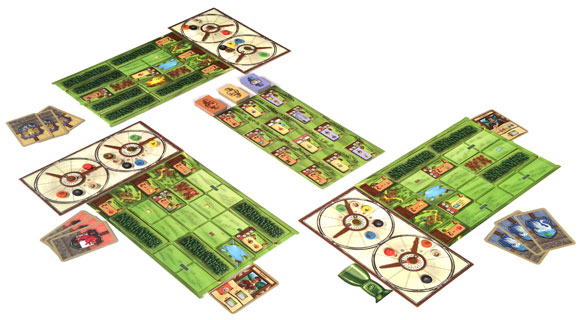
Laid out in all its glory. image courtesy of boardgaming.com

*Fun fact, you can totally go to Germany and tour the black forest’s monuments to the real glass road. There are glass museums and craft workshops and everything.

**The most unashamedly German board game is quite possibly Glück Auf (and then only until someone with a name like Rosenmüllentheimermassbergsohn invents a game called ‘Strategic Worker Placement in an Industrial or Agricultural Setting’***). It’s set in the Industrial Revolution-era Ruhrgebiet (basically the Black Country of Germany) and is about coal mining profits. The title is traditional German pit-lingo for ‘good luck’.

***’Strategische Arbeitereinstellung in einem Industrie- oder Landwirtschaftsszenario’. Catchy, no?

Photo credit and thanks to Dr. Photographer

Steam Park: Robots Just Wanna Have Fun

By Bob, Briony, and Lizzy. Go team!

Brutus Rating: 2 or 3 grubby knives in the back, depending on the number of players.
Pairs well with: Oil, petrol

6D-31- 360

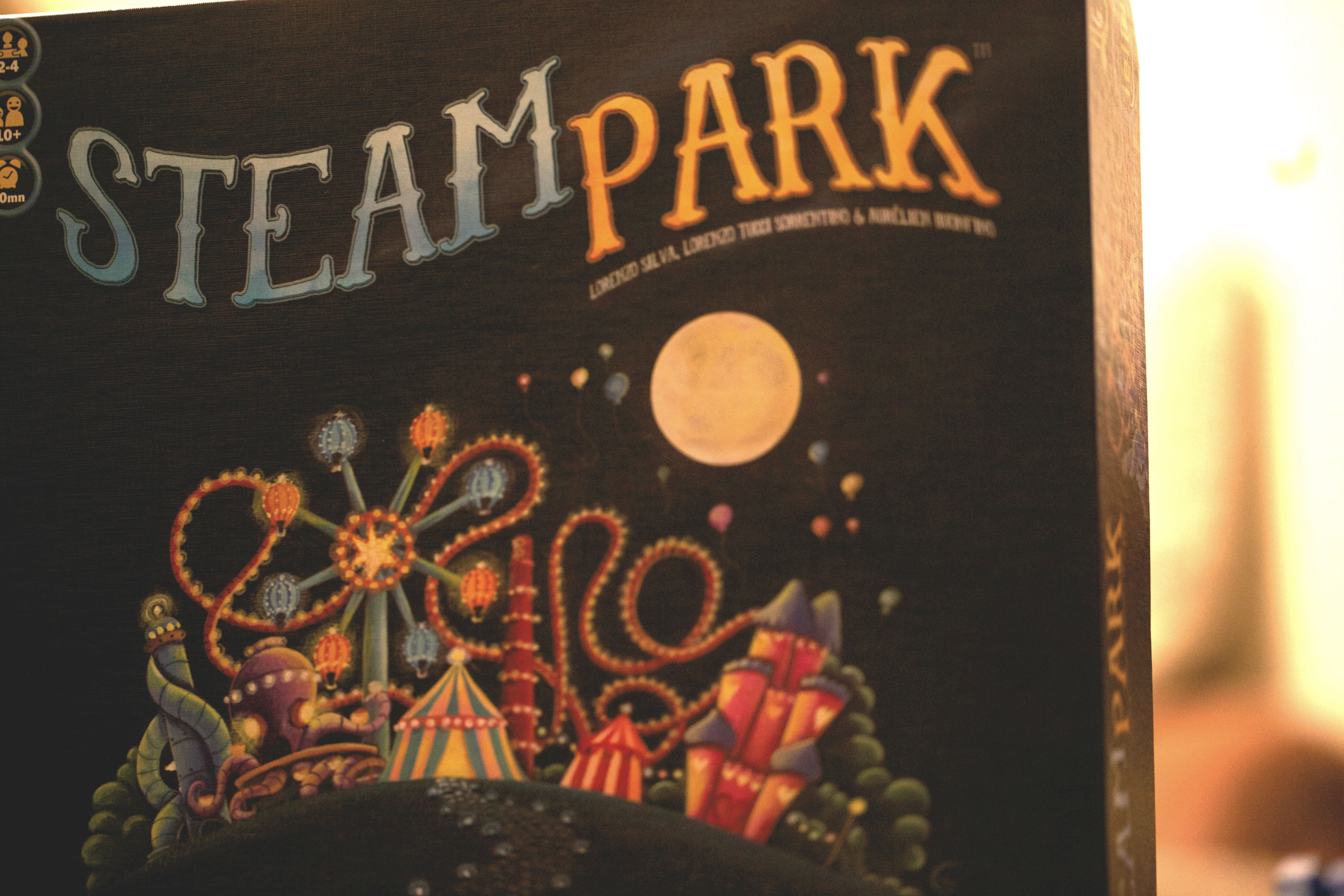
Steampark is a beautifully steampunky game in which you can build your own little rollercoaster theme park with such mechanic-altering extras as casinos, tents and toilets. If there’s one thing Briony has learned from years of Rollercoaster Tycoon, it’s that you should never ever think “that’s enough toilets now”!

06_steam-toilet
Though in this game you can actually only build one toilet. What would your robot guests do with more toilets, anyhow?

Yet another Essen find; this one is light, frenetic, and sometimes blackly humorous, bordering on the dystopian. Bob obviously had to buy it as it was the gothest game at the convention.*

Team Awesome Blog came together with our generic white male friend (this one we call ‘Andy’ for short) for a game together as we wrote this review. For the sake of maintaining a strong sense of ethics in board-games journalism we should disclose that we forgot to invite Dr Photographer to play on this occasion and all of the photos are reconstructions.
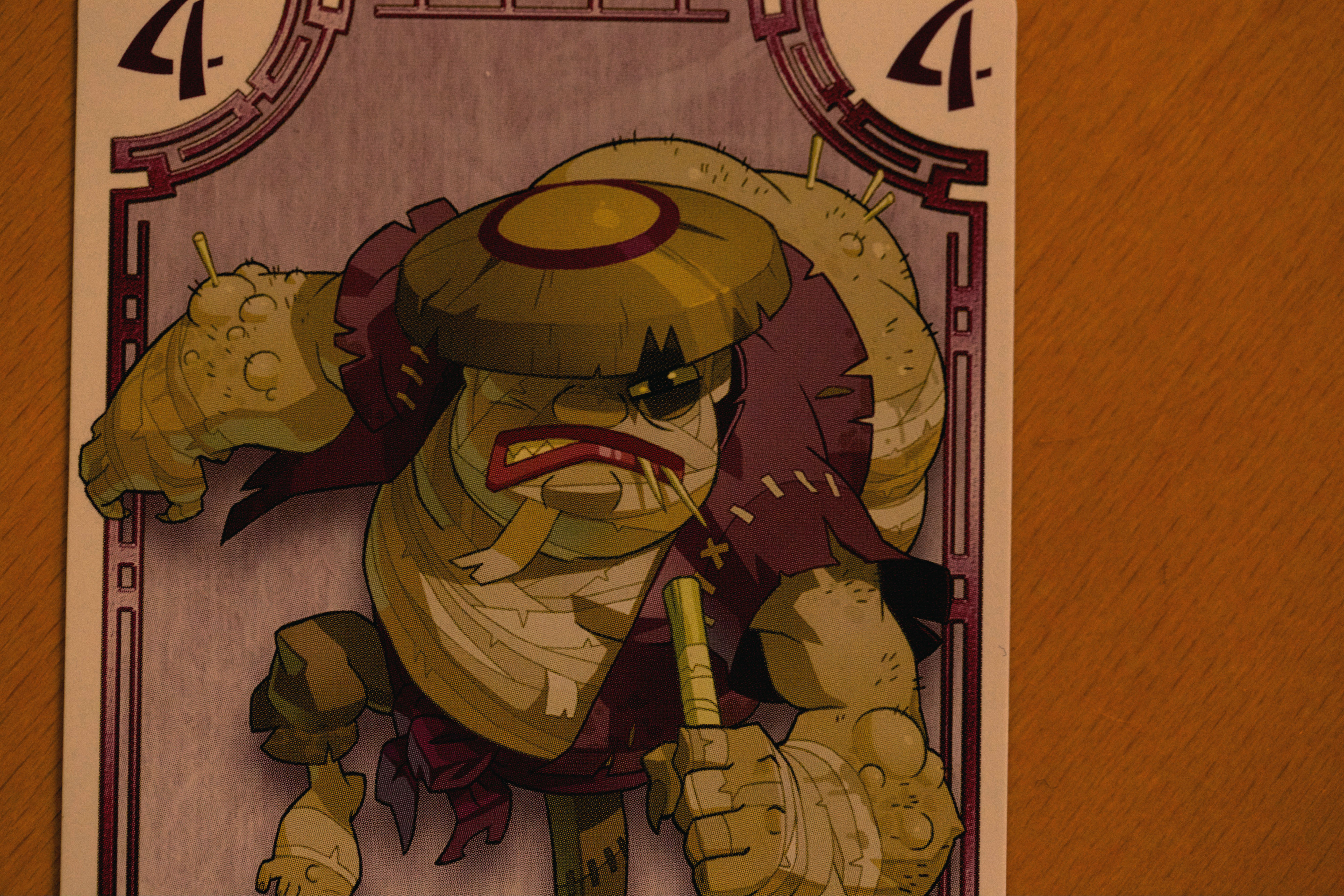
As the many, many pieces of game are unpacked Briony looks more than a little apprehensive. 6D-31- 344She is, after all, the team’s dice-hater and the handfuls of dice coming out of the box do nothing to alleviate her fears. Contrary to popular belief, it’s entirely possible to develop post-traumatic stress disorder from playing Risk, Warhammer and Blood Bowl too many times. Dice! So many dice!

Plethora of dice aside, there are some friggin’ awesomely-designed rollercoasters and tents and such, easily making up for it. It’s a very enticing game.

Right, we should cover the rules. Each player is allocated a plot of land in the form of a grid of squares on a small board, on which they can construct their steampark. Rollercoasters, or any other buildings, cannot be built within one square of anything else, making board-space efficiency a good part of the game. Each player also receives a buttload of dice (that is now the official measurement of ‘too many’ dice. It’s approximately 6). Instead of numbers the dice have a different symbol on each face which corresponds to an action you can take during your turn.

6D-31- 353There are 4 pucks in the middle of the table which only become available once a player has finished rolling their dice, and which determine turn order. The sooner you finish rolling your dice, the better puck you pick. This phase is particularly stressful as all players roll at the same time, and can re-roll the dice as many times as they like in order to get what actions they need, until there’s only one player left to roll.

Seems nice, right? Light-hearted fun? Forgiving of bad rolls? No. Instead, it becomes a stressful dice race!

Suuure, Briony says. She could get the perfect set of dice she desires with enough time, but Bob 6D-31- 319has already finished rolling and can now grab the first player puck! Panic for everyone! This gives her park-building benefits, while getting the last puck actively punches you in the guts by filling your park with ‘dirt’. Ultimately the dice-rolling stage is more like the ‘throw your dice around the room, swearing violently, resenting anyone who looks remotely calm or close to finishing, madly panicking to find said dice, praising the ones who rolled correctly, and hoping that everyone else is having as much bad luck as you’ stage. Andy’s method has been to roll a perfect selection of dice and then knock half of them off of the table. We’re going to rename it ‘The Panic Stage’.

In addition you must place your rolled dice onto a flat cardboard mechanical piggybank otherwise they don’t count. Because that’s what all the other board-games are missing…

6D-31- 356
Wind-up piggybank dice mats. Officially the future of board gaming.

We’ve given this game an ambiguous Brutus rating because of the way that taking a puck can royally screw your competitors. In a larger game this won’t make too much difference: if one extra person finishes ahead of you then you’ll maybe have just a small amount more dirt in your park. If it’s a two-player game then the difference is much greater, lending a distinctly more cut-throat flavour to the game.

6D-31- 347Back to our team play-through. ‘The Panic Stage’ is over. Looking around the table we each have 6 dice which represent the actions we would like to take for that turn (or to the nearest approximation of that). Now each player can do stuff and things according to this, beginning with whoever has most effectively managed the Panic Stage to get the first-player puck. Unfortunately, Bob doesn’t actually know what to do with this mighty privilege, and a chorus of sighs ensues. Briony got the last place puck as she was writing (taking one for the Misery team), and as such this is all of the suck. To better deal with her frustration she decides to build a super-awesome octopus-coaster. It’s holding tiny teacups with its tentacles. Adorables.

In the interests of staying calm, let’s move onto some of the scoring components of the game. Lovely, rational scoring. Or not. Victory in this game is determined by cash moneys (what is the point in running a steampunk theme park if not the money?), which is made by having little robot meeples ride your theme park rides, forever.

6D-31- 318
Don’t worry about them, they don’t get bored or run out of money or anything, they’re robots.

You also have two cards that have a bonus feature for scoring, for example ‘For every purple rollercoaster you own, take 5 more money at the end of a round’. These are essentially your 6D-31- 347victory cards. Playing a victory card is one of the options given by the dice. The dice decide all, and it is supremely irritating when you’ve especially built a purple octocoaster to please your victory cards, then forgotten to make sure that at least one of your dice allows you to play a victory card. Once every player has finished the round ends and you collect your park revenue, which is the sum of all of the things you have built plus any bonuses from cards. And then there’s dirt. Dirt is bad (but calling other players ‘dirty’ is fun). Dirt is made by the meeples riding your rides, by building rides, by being too far back in the turn order, by making the eighth ‘Tim Burton’s theme park’ joke of the evening, etc. Dirt seems to build up more rapidly than you can clear it away by rolling the appropriate dice, and punishes you at the end of the game by taking away your revenue. Dirt is bad.

6D-31- 333There is another slight hitch in our fantastic upcoming parks. You know when you’ve built your first attraction in Rollercoaster Tycoon and it’s utterly underwhelming? Think, Ferris Wheel. This is the current state of your mechanical park. In order to get a really awesome park you need to invest both into getting more people to ride the rides, and in park maintenance. To get more people (or, in this case, fun-consuming robots) you should roll the ‘get visitor’ action with the dice, and then selecting randomly from coloured robots in a bag. Only robots of the same colour can ride on a correspondingly coloured ride so there is some mileage in a strategy that has attractions of many colours. There’s some chance involved with this but being persistent pays off.

How many rounds does a game of Steampark have you ask? 6? Does it ever really end? Those robots are going to be riding and having fun forever while you age and eventually die. But for us mere fun-lacking mortals we only get 6 rounds to make our parks the best.

And here’s the happy ending to our playthrough:  Briony stopped writing and turned her game 6D-31- 324around, winning the first player puck for most of the game. This is a viable strategy because you can almost always find a use for all of the dice mechanisms, even if they’re not ideal. Andy slowly but surely generated little more than a pile of dirt, and is probably still sat there quietly contemplating his little mound. Bob and Lizzy were solid throughout, but victory was ultimately Briony’s. The real winner, as ever, was board games.

In summary this game has some great design aspects and some cool mechanisms. To be honest there are slightly more mechanisms than necessary, but that doesn’t draw away from your goals. It’s simple to learn and has a relatively short play time with a distinct lack of hatred for your fellow players. I recommend trying it, and at the very least you should find someone who owns it and stare at the pretty little components in awe.

Why is there a one-robot Tunnel of Love? Why indeed.

*In fact Chris (friendly robot boyfriend) very nearly simultaneously bought it for Bob as it was the gothest game at the convention. Being deeply predictable sometimes has its dangers.

Photos credit to Dr Photographer
The toilet art is directly from the Horrible Games website

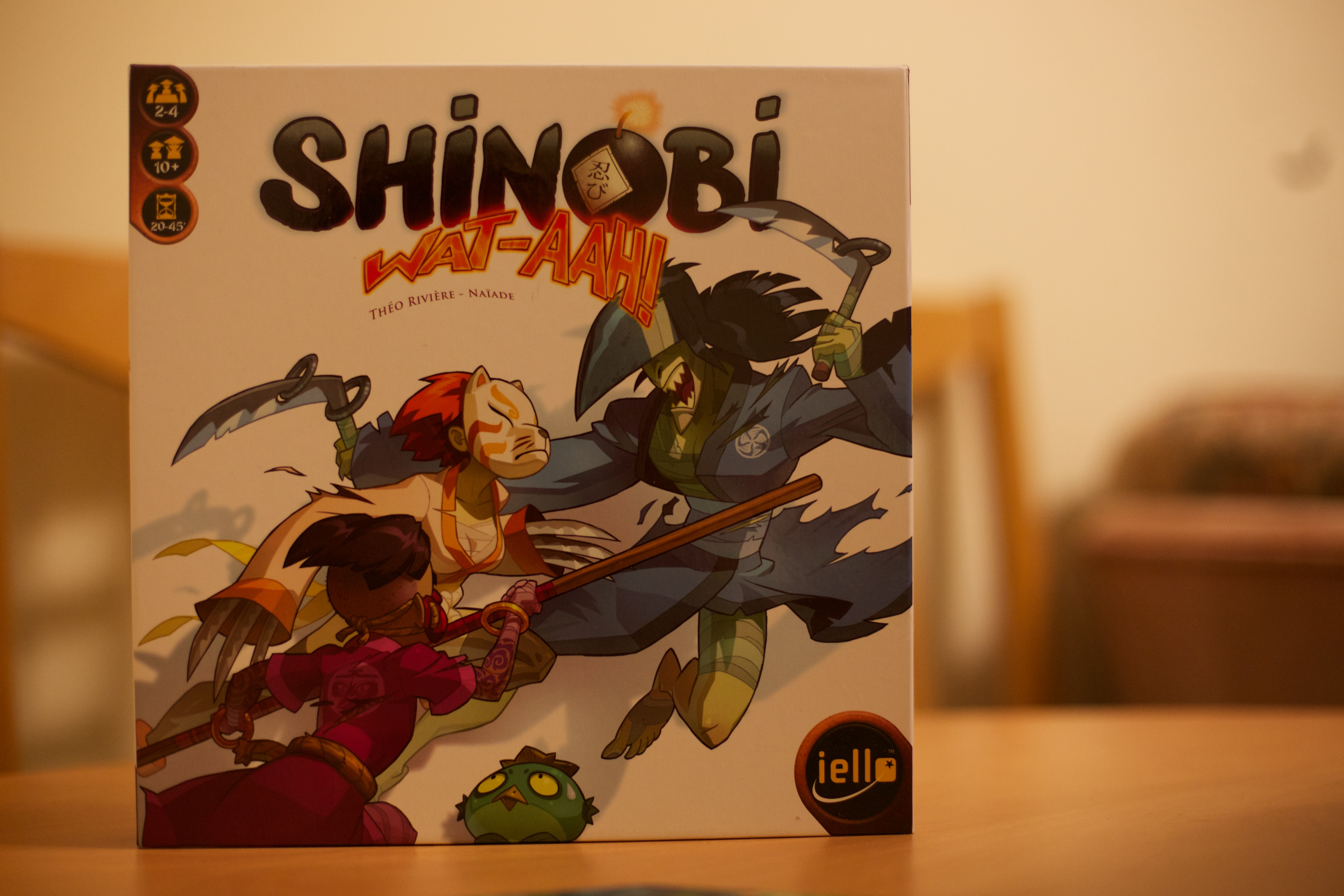
Shinobi WAT-AAH!: Everything changed when the fish nation attacked

By Bob, Lizzy, Briony

Dicks in ear: 7/10
Pairs well with: Sake, meditation, wisdom. All three at once, no cheating.

Note before playing: Everyone always asks if yelling WAT-AAH is part of the game, and, if so, when you shout it. While the parameters for shouting WAT-AAH do not appear in the rules, it is said the shouty samurai spirit has been inside you all along, and all that is needed is for you to free it when you feel the call. We enjoyed a house rule of shouting WAT-AAH whenever you put cards down. Or pick up cards. Or look at someone funny.

Shinobi1

This is a game about ninjas with magic powers. And that’s pretty cool, but much more cool is the fact that this game might even have magical powers of its own. We’re pretty sure it’s impossible not to enjoy playing it. Genuinely, we’ve not found a single person who disliked it, and we know people who dislike everything.

Shinobi7
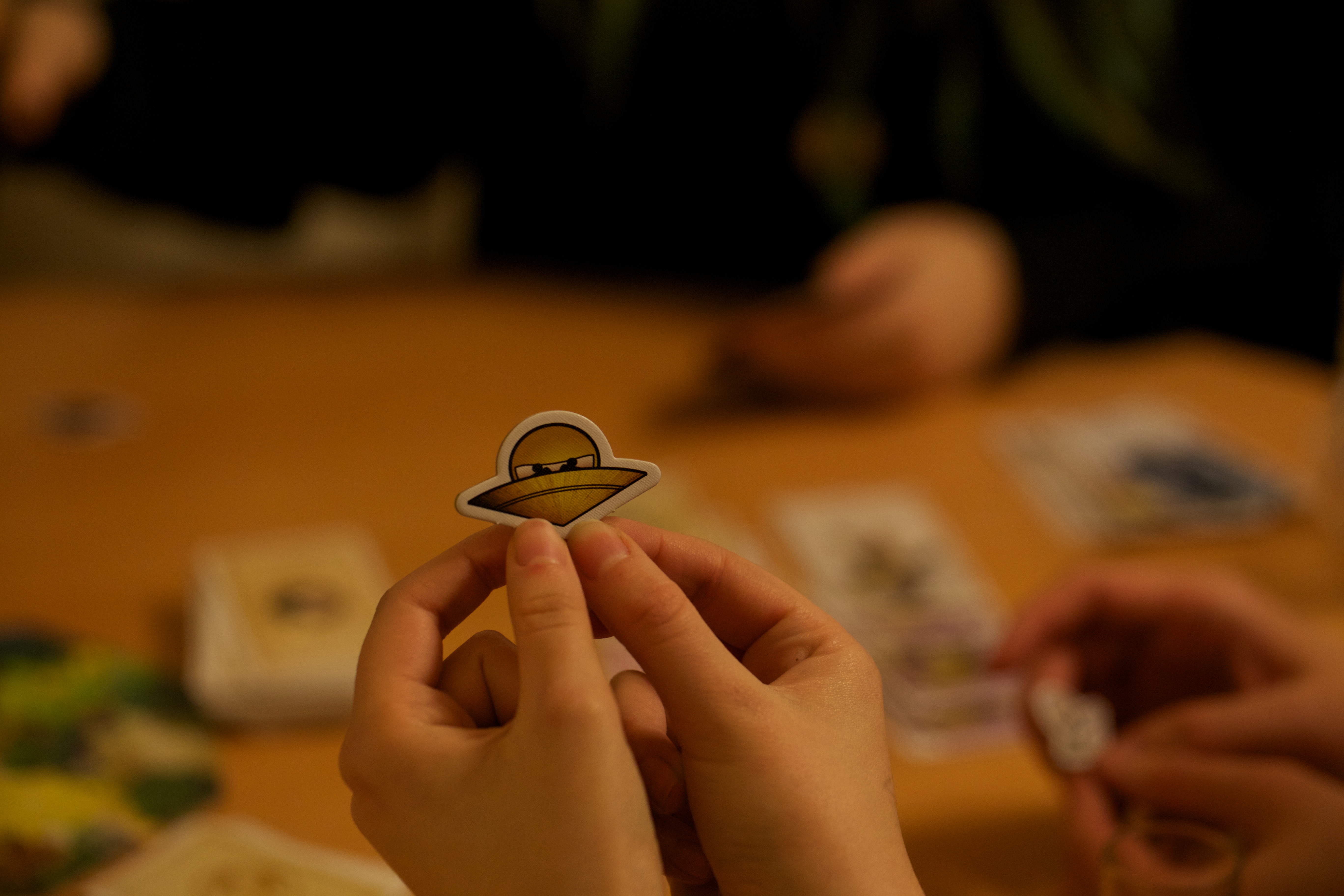
Check out this little guy. Is he an upside-down dude in a hat? Or two tiny men in a plane cockpit?

It’s another Essen find, and a very fortuitous one at that. Essen is a wonderful and exciting four days of board games but it is, nonetheless, four very long days of board games. By Saturday Bob was flagging. She hadn’t slept well in her overheated German hotel room and had more or less twisted her gastrointestinal tract into origami with German ham hock stew and pilsner (from this and the Sanssouci post you might have guessed that she has something of a complicated relationship with Germany. You would be correct). Running through pouring rain to catch our tram to the convention centre did not improve the mood and by the time we Shinobi6arrived, damp and itchy-eyed with tiredness, Chris (friendly robot boyfriend) was detecting all the signs of a classic Bob-style rage-quit (pouting, tearfulness, The Grumps). Worse; we had arrived early in order to be first in line to play Hyperborea and hadn’t even managed to secure first play spot.  Nor, despite a mad dash, did we make it to Tragedy Looper before its first clientele of the day had casually picked up the instruction booklet and started reading (the boardgame convention equivalent of yelling ‘dibs!’).

Chris later confessed that when we spotted an available table with Shinobi WAT-AAH! laidshinobi 11 edit out on it that he was more or less praying that it would be good, or a full-scale tantrum was going to occur. Bob of course informed him that she is an adult woman and she does not throw tantrums,* to which we all obviously agree, but conceded that the appearance of the Shinobi table was still pretty well-timed.

shinobi something edit
Explaining rules is the most fun Bob can have with her clothes on.

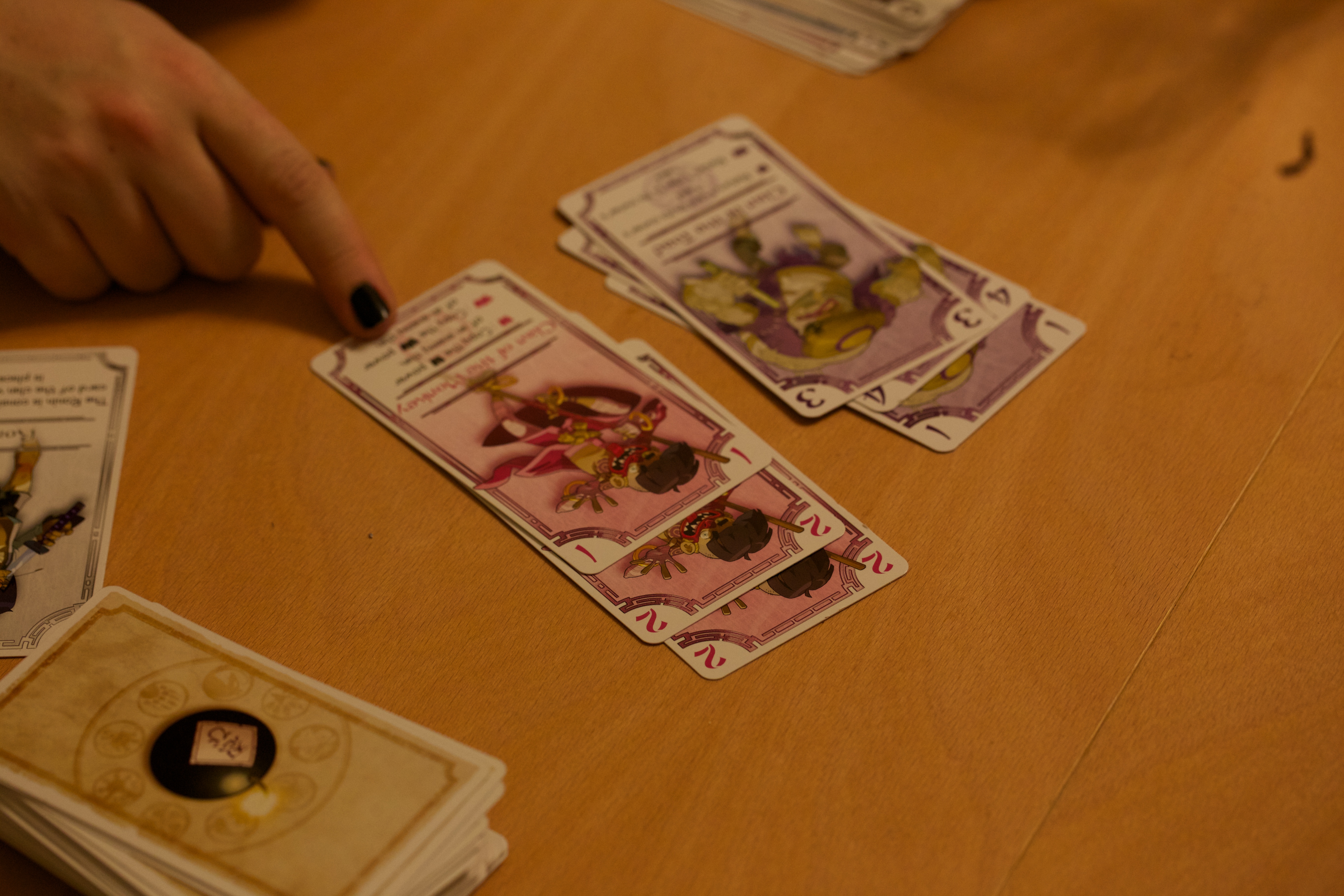
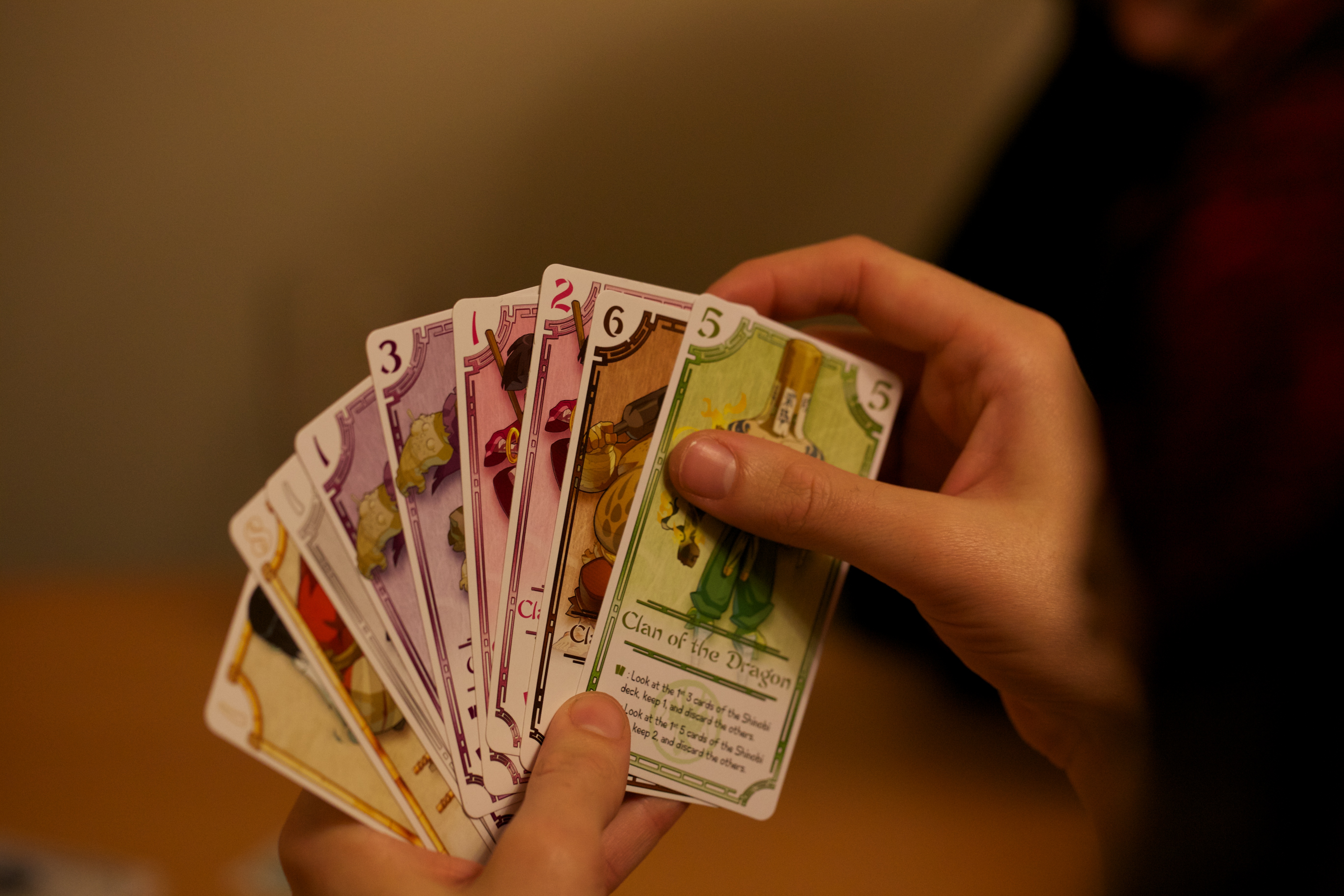
Mechanically it’s a fairly straightforward deck-building card game in which you’re a royal lord (or lady) trying to unite clans of epic fighting ninjas in order to trigger their epic ninja fighting skills so that you may defeat the final demon boss (WAT-AAH!) and place your royal rear upon the Imperial throne. The epic ninja fighting skills fuel conflict in the game as you fuck with other players’ cards, peek through the Jigoku (the discard pile – literally translates as ‘hell’), or copy other clans’ powers. We give it a rating of 7 dicks-in-ear for the irresistible opportunities to knobble each other with these powers. Although some of the clans’ powers are more friendly (pick up some cards, look at some cards, etc) you’ll almost certainly find yourself plotting some nasty moves and stealing an entire hand of cards from someone you sometimes consider to be a friend.

Shinobi10 edit

Shinobi5
Clans!

There are two modes to play in: Grasshopper and Grand Master. In Grasshopper mode you simply play turns until someone has laid four fully-formed clans (WAT-AAH!) on the table. You then tally up the scoring value of each clan on the table and the player with the highest number wins (not necessarily the person who ended the game). Grand Master mode begins the same but after the tally you retain the cards still in your hand (fully-formed clans already on the table get discarded) and receive a number of The Shuriken of Winning depending on your place in the running. You can spend your Shuriken of Winning on cards which will give you bonuses (WAT-AAH!) in the next round, or toward battling the final boss (which could be zombies or creepy old lady-demons or whatever).

You do this for three rounds and then the final showdown happens. The showdown is6D-31- 458 much more anti-climactic than it sounds, as it’s really just a scoring of a the number of shuriken you’ve already put toward fighting the final boss against the (hidden, mysterious) number that they want in order to give you the best possible number of points. There is no epic battle between ninjas and demons, sadly, but interestingly more Shuriken of Winning doesn’t always translate into more winning points.

Shinobi8 edit
Beautiful art

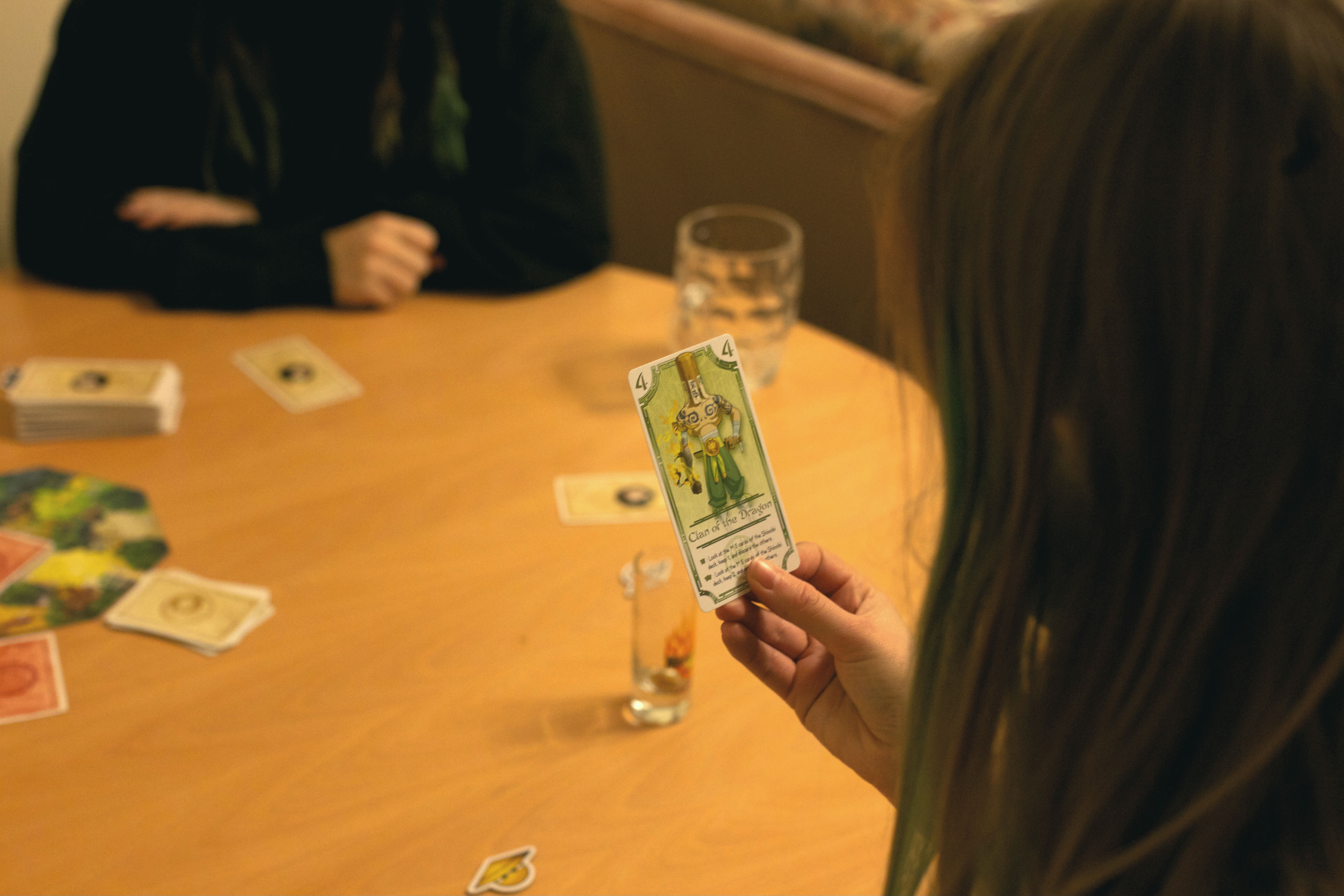
It’s hardly the most complex or rich game in the world, but it is unashamedly fun. It’s the feudal Japanese card game equivalent of a pew-pew video game. Dicks fly everywhere and the art is about as fantastic as you’d expect from the guy who also did Seasons and that most scenic of games, Tokaido. It has a cartoonish feel that is both beautifully detailed and very bold and clean. This perfectly reflects the style of the game – simple, fun, yet with captivating little details. For example the wild cards which can be used to simply make up numbers in a clan are called Ronin – a feudal Japanese term for a samurai without a master or lord. Similarly, the powerful single cards which can be played as one-off additions to a clan are called Yokai6D-31- 462 spirits or supernatural beings present in Japanese folklore. This is exciting if you’re incredibly nerdy and contributes to the immensely satisfying feeling of a well-balanced, well-designed game that just works.  The cards are also taller than you’d expect, which is aesthetically very pleasing. It’s a neat touch.

Price-wise it’s a bargain. For some reason it seems that the more board games cost the more polarising and more rarely-played they become. Everyone will play a round of Coloretto or Hanabi but you actively have to search out friends interested in a game that costs hundreds and takes 6 hours. Twenty quid might not get you meeples of every colour and shape or a giant, detailed board but it will get you a game where even friends whose opinion of pretty much everything is that it’s ‘bullshit’, will sit up halfway through a round and mention how much fun it is.

Lizzy won again. But the real winner is board games.

6D-31- 417
The winner is always board games. And Lizzy.

* She does kind of throw tantrums a little bit. But only when she’s really tired. Or hungry.** Or drunk.

** Before Essen she gave Lizzy a bag of Cadbury’s éclairs, with strict instructions to feed them to her if (when) she got cranky. It was a good strategy.

Image credit and thanks to Dr Photographer

Quantum: Space Dice!

By Lizzy, Bob, and Briony

Number of dicks in ear: 6/10. Dick size will grow in inverse proportion to the size of the map.
Pairs well with: cheap vodka. (It’s what people drink in space.)

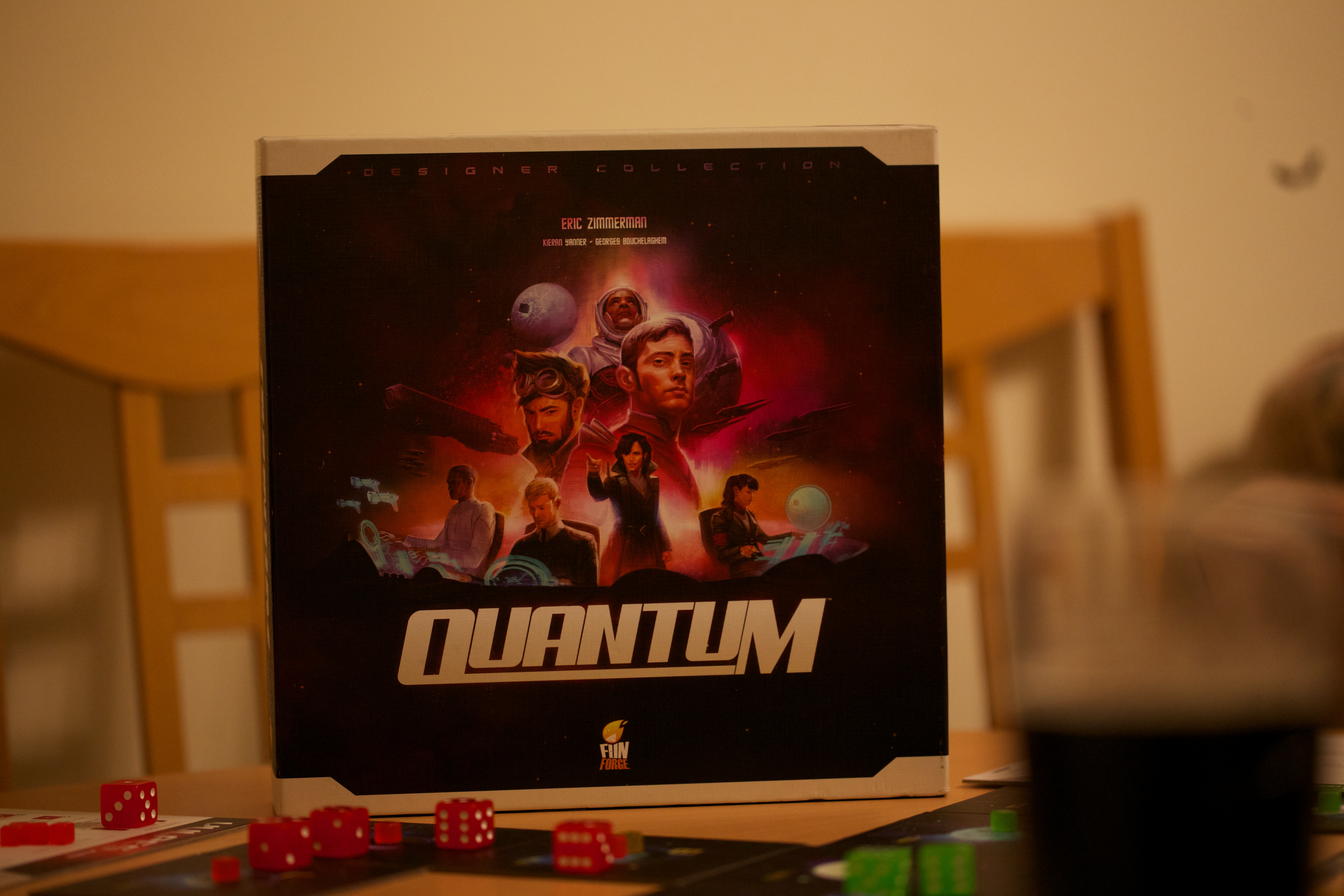
6D-31- 365 Quantum1 Lizzy loves a game where you know who you are. Where you really know what your motivations are and why you’re collecting <Generic Resource!>. Quantum is a game about space, and it does this quite well. It has a space background. You play as a kind of space conquistador, colonising the stars using cubes. Cubes are very important in Quantum, because cubes mean victory and the ownership benevolent leadership of galaxies.

“Which galaxies?” you cry!
Whichever galaxies you like!

Quantum3
‘Which map shall we use?’ ‘The one that looks like a swastika!’ ‘That is absolutely not what a swastika looks like, Bob’

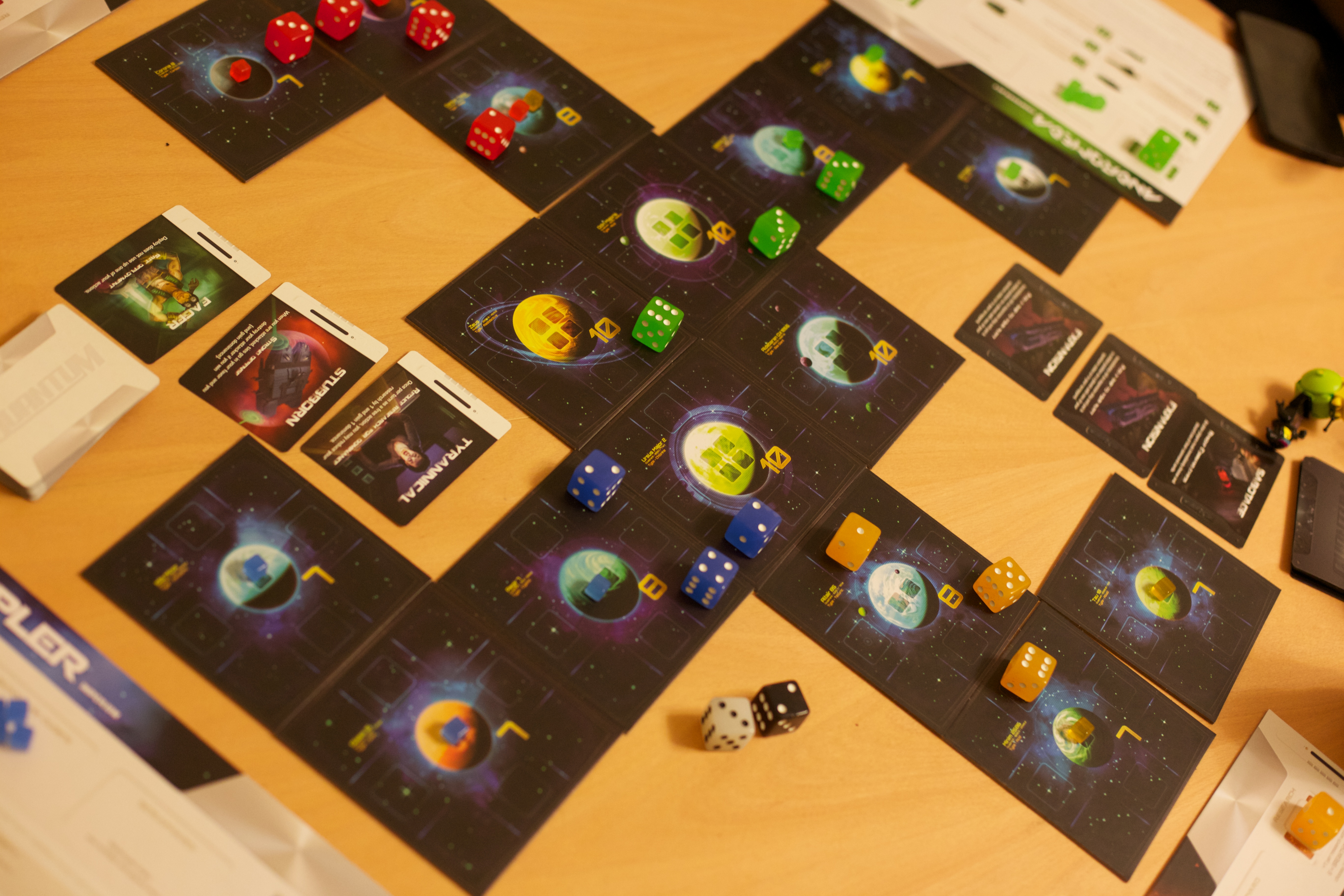
The layout of the map is quite variable; there are several possible galaxies to choose from for each player number, and each has its own name. You can fight over the Outer Reaches, the Barren Empire, Terra Major, Terra Minor.

Even the planets themselves each have a name. Tau 18, Ursus Major 2, you get the idea. They even have lore and geography, if that’s your bag. It’s all very good sci-fi. Points for sci-fi.

Quantum4
Here’s Bob posing for a photo and pretending to attack her own ships. That’s not how the game works. Silly Bob.

For further points, each of your dice are your loyal spaceships and the number on the die represents the kind of ship it is. Even better, there’s some kind of story to the mechanics behind each number! A lower number is a lot slower but better at combat because it’s a bigger ship. A 1-die, for example, is a battlestation, which is the best at fighting but can only move 1 square at a time. A 6-die is a scout, they can zip around like crazy but aren’t too hot behind the weapons. At this point in the game your in-house Bob or Bob-substitute can demonstrate agility by throwing dice around going ‘pew pew’. It’s helpful or something.

As well as the changing planetary layout, gameplay is also affected by cards, which affect the kind of play which your space-conquering race can undertake. After invading landing on a planet you can, as they say in the trade, ‘do a research’ and so learn to do fun stuff like shoot more effectively and fly across the entire galaxy to thrust your dick in your team-mate’s ear.

Quantum7 Quantum2 Quantum6

If you are the kind of person who hates dice combat you might hate this game. But even our friend ‘Dr Hates-Dice’ loves this game! And he hates dice, or any attempt at putting randomness in a game. Briony, of course, is sadly unable to roll dice or dice-shaped objects and so found this game something of a challenge. She also hates dice.

Tons o'dice
Tons o’dice
Space Cards
Space Cards.

In the words of Lizzy it is a game of learning and fun, if you understand how basic maths works. Bob, for her part, is unable to count, making the ‘fun if you know how maths works’ description more of a threat than an incentive. She has, however, played games with Lizzy before and understands that when our dear Liz looks particularly gleeful after rolling a die and buying a research card that no one is safe and… oh god oh god we’re all going to die… why is no one stopping Lizzy… we all know what happens when we don’t stop Lizzy and… oh yep she’s won. And she has the cheek to ask why we don’t trust her in board games.

6D-31- 374
We’re all gonna die when she gets that face on.


Nonetheless, this game doesn’t rub your face in your failure like a misbehaving puppy. If you do badly it’s because you’re bad at very basic counting, strategy, and rolling dice. This is in comparison with games like Terra Mystica where you feel like a failure from round 2 because you haven’t picked up on the very specific and delicate strategy required of your race. Quantum is particularly enjoyable if you bear your position as commander of the fleet in mind when communicating with the enemy. “The OrionRepublic welcomes the puny Kepler Imperium to our planet!” “The Orion Republic denies all knowledge of the weapons fire around Minim 2586. You must have been watching a training exercise.” Also humming ‘Duel of the Fates’ (literally the only good thing in ‘The Phantom Menace’) and the Star Trek theme tune are recommended during manoeuvring and battle.

6D-31- 393
A lonely spaceship contemplates its fate at the edge of the galaxy.

All in all this is a pretty fun game. It’s still Lizzy’s favourite thing to have come out of Essen 2013, well over a year on. Good luck on your colonisation, loyal Space-Dice. May the solar wind be always at your back.

Bob does not take particularly well to losing. Shame it happens so often.

Image and photography credit to Dr. Photographer.

Cthulhu Wars: Indescribably Tentacular

A Review by Bob, Lizzy

Number of dicks in ear: 8 inter-dimensional, squamous dicks/10.
Pairs well with: German beer, anti-psychotic medication.

 Cthulhu1

You may notice that this game review is lacking in high quality Cthulhu Wars photos. That’s because none of us are insanely rich enough to own this game, so we’re relying on Lizzy’s camera from our time at Essen 2014. She hadn’t even realised that the lens was dusty at this point. Sheesh. Some photos have also been professionally recreated in a studio environment. See if you can tell the difference.
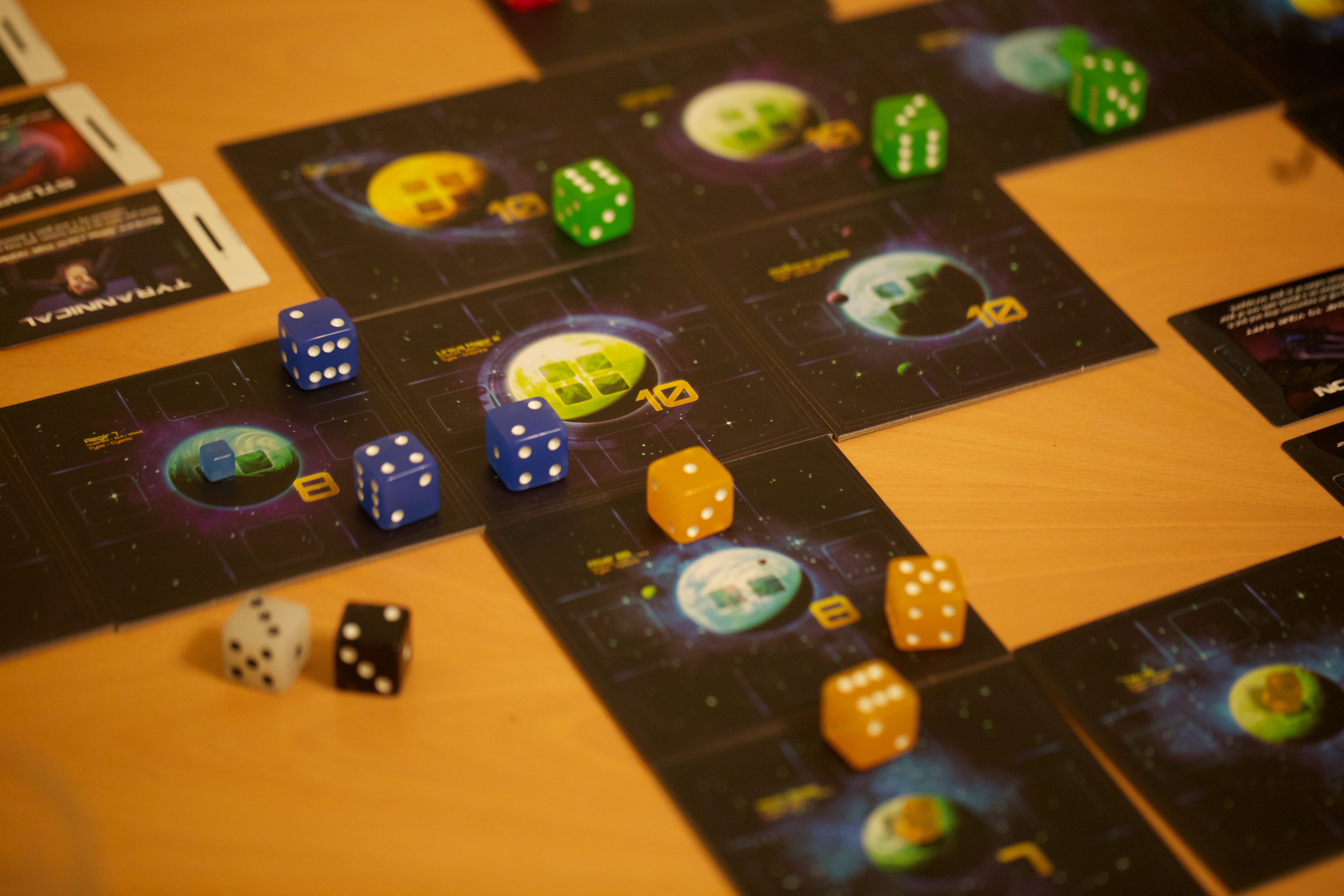
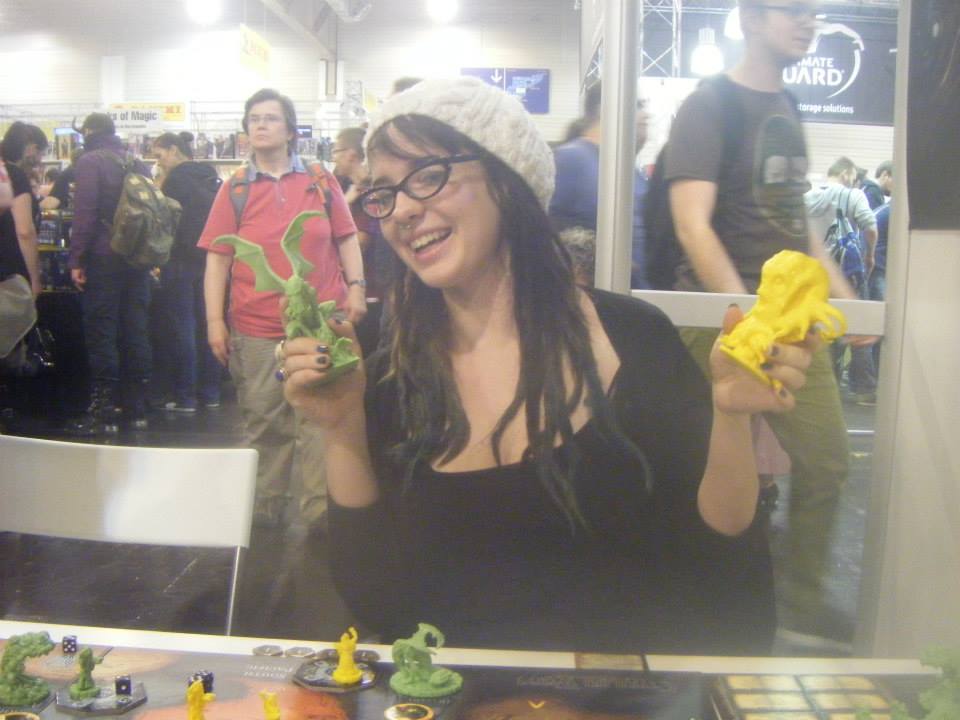
(Not actual game footage. Actors were used to recreate gameplay. Crocheted Cthulhu sold separately. Terms and conditions apply.)

Fun fact: If it weren’t for Sandy Petersen’s Call of Cthulhu role-playing game we wouldn’t be here today. I don’t mean that in an existential sense, just that this blog wouldn’t be here today.

Powerful stuff.
Powerful stuff.

Back in the mists of time of 2011 our friend Emma brought me, Lizzy, and a select few others together to roleplay some eldritch misery, unwittingly creating a gang of powerful lady-nerds.*

It was my first RP experience and I’ve been hooked ever since.

I've got some army guys and some robots. That's pretty sci-fi right guys?
I’ve got some army guys and some robots. That’s pretty sci-fi right?

Now I don’t have much interest in games beyond playing them. I’ve very little idea of which companies make good games and I’m regularly surprised when a game seemingly tailored to my interests appeared (looking at you, A Study in Emerald) so I had no idea that the cool-sounding Cthulhu game being exhibited at Essen 2014 was by the same guy who wrote the original role-play adventure. I wish I could say that the only time I embarrassed myself was when Petersen himself had to explain to me that he did not just jump on the Lovecraft bandwagon, but did to some extent start it. Unfortunately I also proceeded to get ridiculously excited and fan-girlish about the whole thing (to the extent that his wife told me to calm down), and to address him as ‘Sandy’ (to which he did not respond until I sheepishly reverted to ‘Mr. Petersen’).

In my defence it was a very exciting experience, especially when combined with the chocolate-

Cthulhu card game figurine v. blind bag Pony

covered-chocolate-ice-cream stall just around the corner. Petersen was there like a proud, balding Mormon Santa Claus showing off his game, and one of his sons (or possibly grandsons) had the dubious honour of patiently teaching the game to a parade of smelly nerd troupes** (I think we smelled lovely) in a course of fully-booked two hour slots over the four days of convention. By the power of sheer exuberance I even got to beta-test Petersen’s next game, Gods War, which was still in the sharpie-on-cardboard stage of development. Stay tuned for an extra sneak-peek review of that game at the end of this broadcast.

Hmm. Strategy.
Hmm. Strategy.

The game itself is impressive in scale, and bonkers in execution. It was funded through a Kickstarter campaign, and thanks to that can afford to take a stance of ‘Look mate, you’re either in this entirely, or you’re out.’ I can imagine the kind of board games nerds who get off on the fiddly tactile bits of games getting feverish over this baby. There is a $199 price tag for just the core game (expansions are $59 each), with no option for a less-expensive less-artisanal version. It includes 64 incredibly detailed miniatures of Old Gods, monsters, and cultists. If you look closely you can see everything from the relief outline of the death-masks on the tiny cultists’ faces, to the cleft in the King in Yellow’s butt. Even the marker by which you tally your power is a tiny, adorable tentacle. It must be said, though, that there is something a little bit odd about

Better share the tentacle beard.

monsters which are defined as being unknowable, unnameable, indescribable horrors (H.P. Lovecraft was terrible at detail) being cast in plastic to play with. Takes away some of the awe. We didn’t actually say this to Petersen though, as the whole thing was so clearly his beloved baby and I already felt silly.

The game takes place on a board illustrated with an approximate map of the world. This has lead some of our more soft-headed moon-faced friends to think that the game has completely left the realm of Lovecraftian epic fantasy and entered into Risk-style grognard territory. Now

So many dice.
So many dice.

I’m not going to lie, there are dice. A lot of dice. So many dice that you sometimes need two hands to cast them all as part of a mighty god-against-god battle (it’s awesome). And yes, there is strategy involved. But the game isn’t a simple struggle for physical space. Instead, it’s all about power. There are a number of ways to gain power (and yes, taking up more space is one of them), and gaining power will earn you more super-special doom points, by which you may win the game. The faction you play (Cthulhu, Nyarlathotep, Shub-Niggurath, Hastur/The King in Yellow) massively affects how you can most effectively gain and wield power, and is further specialised through your faction-unique spellbooks.

Tyrannids! They're monsters! They'll do!
Tyrannids! They’re monsters! They’ll do!

This is both great as it really absorbs you in the fantasy of the game, but also leads to the big, huge, massive, gaping flaw in the game. Namely, if you do not effectively figure out at least a starting strategy which integrates with your faction’s play style pretty fucking swiftly, then you are utterly screwed within the first two rounds of the game. The rules of the game and structure of a turn are hardly straightforward either, so you might need those two rounds to get a grip on what’s going on. This is something I usually hate in games (Terra Mystica! Why!?), and it does completely unbalance it. In our game, and in friends’, you end up with two players massively in the lead duking it out to be the first to flop their enormous eldritch cock across the board, and two players struggling to get out of their starting zones.

In fact we played this game with Emma (of previously-mentioned Cthulhu GM-ing glory) and she never stood a chance. We were merciless, and with good reason.

It's a warzone.
It’s a warzone.

Way back when, during our time as Cthulhu role-players we were very attached to our characters: Smokey Peterson the jazz musician, Old (insane, phenomenally rich) Trewilliger, Prudence and her gin, coquettish Mabel and… Jeff. Oh, Jeff. The only real good guy in the team. He loved corn, kindness and photography. Jeff!

One day something happened to Jeff that we don’t like to talk about. It had wings.

Then, in Essen 2014, just as Cthulhu Wars was starting, Emma picked up one of her pieces and said “Hey… this is the one that took Jeff!”

Cthulhu3 

And hell did Bob and I avenge our comrade. This also, unfortunately, proved that if one or two people want to gang up on you in the game then there’s not a lot you can do about it. Definitely a whole bouquet of dicks in ear.6D-31- 286

Nonetheless, this game is shamelessly fun. It’s complex but not impossible, with lots of juicy details to get stuck into/drive you into hellish pits of insanity. The rule book  comes with hints and tips toward getting the most out of your Elder God which apparently really helps to solve the balancing problem if you haven’t got a member of the Petersen family handy to keep you on track. Of course this is a moot point because I can’t afford it and this makes me sad.

 PS: Lizzy won.

Extra bonus game review: Petersen’s new epic-style game Gods War!

… It’s the same fucking game.

*This was before she abandoned us to get married and live in the frozen north. Now she makes adorable nerdy crochet guys at justaddcrochet.co.uk

** Don’t get butt-hurt, we were smelly. It was hot in that convention hall, and full of fried foods and bodies.

Sanssouci: Aristocratic Meeples and Fancy Gardens

By Bob and Lizzy

Dicks in ears: 2/10
Pairs well with: Tiny glasses of sherry or gin, fine wines, BBC radio 3’s evening concert.

6D-31- 252

 Here’s a weird little story for you. For a year I lived in Germany, in a hideous Soviet-style concrete block on the edge of a beautiful eighteenth-century baroque palace and gardens. Built as a summer house in the style of the palace of Versailles by Frederick the Great, the villa is a sprawling arrangement of Roman baths, fountains, and glorified sheds covered in filigree. As a further nod to the Frenchness that was sadly popular at the time, the palace’s name, Sanssouci, translates as ‘no worries’.

6D-31- 247Depressed, bored, and fat from a diet consisting predominantly of German pastries, I spent a lot of time strolling around the gardens so I’ll give you a run-down of the highlights. Firstly, the Chinese House. It’s a little bandstand thing covered in statues of the most Western-looking Chinese people you’ve ever seen in your life. Pretty much second only to the Brighton Pavilion in terms of shameless, state-preserved Orientalism. Secondly, Frederick the Great’s grave (and the surrounding graves, which belong to his dogs). Germans absolutely love Freddy, he’s the dude who introduced the exotic potato to the Mutterland (which for Germans is a Big Deal). Initially the locals ate the plant instead of the root and subsequently6D-31- 241 died, but they soon got over that little hiccup and came to develop the delicate stodge-based Prussian cuisine we all enjoy today. They leave potatoes on Fred’s grave instead of flowers. Finally, the mosquitoes. Now I am a fairly well-travelled lady, hell I grew up in Africa; the sight of inch-long blood-engorged mozzies will barely raise an eyebrow. But these things. These fucking things. See, Frederick the Great, in a hilarious Pythonesque twist of history, built his bloody palace on a bloody swamp. The local mosquitoes are tiny and utterly vicious, to the extent that I could barely walk after one particularly ill-advised spring day spent wearing a skirt in the park,* and spent many a summer evening McGuyvering flame throwers out of aerosol deodorants.
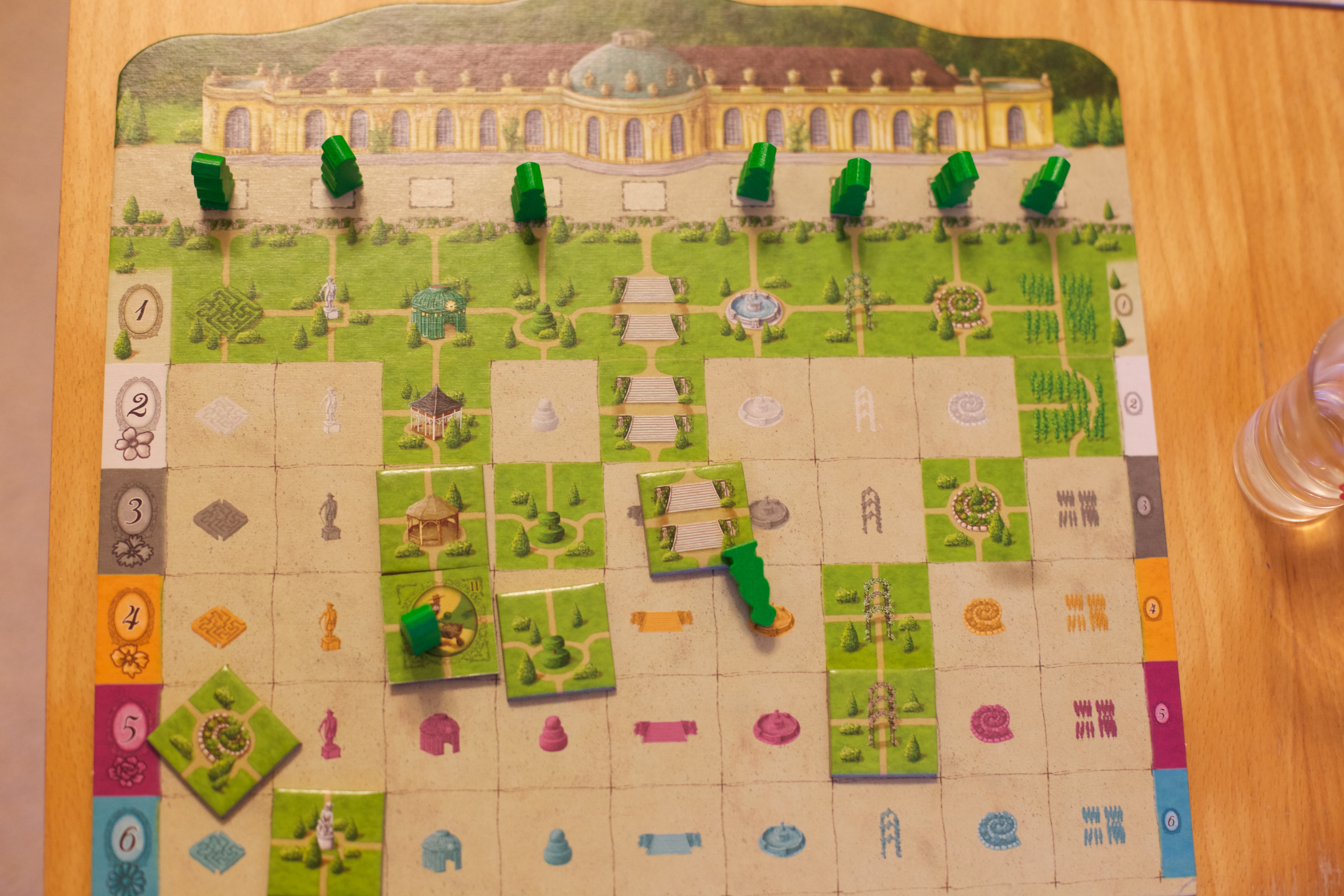

6D-31- 248

ANYWAY, to make a short story unnecessarily long, the moment I saw a game called Sanssouci in a discount pile at this year’s Essen it precipitated such a flood of nostalgia that I knew I had to have it. The blurb, entirely in German and describing a garden-building tile-placement game, did not put me off. Would I like to compete to create beautiful flower beds, scented herbaceous borders, and cooling fountains for aristocrats to enjoy? Hell fucking yeah I would.

6D-31- 237

The instructions were also in German, and it became a point of pride for me to be able to understand and play the game without looking up the translation. As a result the first game, played some time later with Lizzy over tiny 6D-31- 243aristocratic glasses of  sherry (naturally), was a little… bumpy. We muddled through fairly successfully in the end, thanks to the game’s copiousillustrated rules examples, and Lizzy’s understanding of how a game should work. (“Bob! Do you think maybe the different sets of coloured cards might be for different players? Wouldn’t that be a neat idea Bob?”) Later, I looked up an English translation and you’ll all be pleased to know I got it mostly almost right. Undergraduate degree totally not wasted.
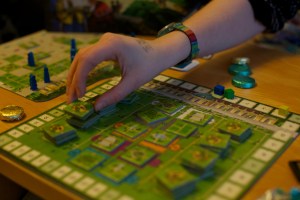
6D-31- 227
Ugh. The rabble.

The game is Tokaido-esque in its chilled-outness, if not nearly as pretty. It does have adorable aristocratic meeples with tiny aristocratic meeple hats, which is a point in its favour, and it’s almost as simple as Tokaido. Each player has an empty garden grid in front of them, and in a turn will play a card and pick a tile to place in their garden. One of their noble meeples may then go for a lovely little walk around the garden to score points. Gardens gain points for their size (longer walks for the aristocrats) as well as their layout (you have a full set of pavilions? Spectacular). If you are unable to play a garden feature tile you may play a gardener tile. These do not contribute to your garden, but may bridge two garden tiles. This means that an aristocrat can walk across a gardener tile to reach the inviting vineyard tile that lies beyond. One cannot stay on a gardener tile because, let’s face it, the land workers are plebs and not to be associated with.

We’ve decided to give the game a two-dicks-in-ear rating because you need to pick up your 6D-31- 221gardening tiles from a communal tile-pool. Particularly savvy estate-managers can get a feel for what others are trying to collect and nab the exact water-fountain they need right before they get the chance. Of course, it’s far more likely that most dickery will be accidental and you will unwittingly and unjustly incur Bob’s wrath for the rest of the game anyway, through no fault of your own. I just wanted to extend my vineyard, is that too much to ask?
This game has some good roleplaying potential, particularly to the extent that you enjoy6D-31- 232
pretending to be snobby aristocrats. One recommends pretending to talk to the other aristocrats as you walk you meeples through the garden and sip on your generous helpings of sherry. “Lady Snobbington! I didn’t expect to see you here by the shrubberies today. Have you seen the new bandstand? Splendid isn’t it. *shlurp*”

It’s a fun little game, with decent replayability thanks to its included expansions. I also found it quite absorbing, as the garden grids approximately match the Orangerie garden layout at Sanssouci. If you like your games particularly action-packed or combative then I’d give it a miss though. It’s more like a programme of rehabilitation for combat game addicts, who need to be supervised with the secateurs when they’re trimming the ornamental rose bushes in case they get twitchy.

6D-31- 238

*This episode even caused horrible bullseye-shaped rashes to appear on my legs. The local German docs were less than sympathetic to my panicked enquiry regarding Lyme disease, and told me to stop being an idiot and wear trousers next time.

Agricola: The Original Misery Farm

By Briony

Dicks in ears rating: 3/10
Pairs well with: An English cider

I play board games pretty frequently, but I’ve so far managed to avoid Agricola. I haven’t actively avoided it, but at the same time I haven’t actively sought it out either as I’ve heard some pretty polarised reviews. If there’s one thing I know, it’s that board gamers have strong opinions. For those of you who don’t know, Agricola is a worker placement board game. 6D-31- 172The description on boardgamegeek states ‘you’re a farmer in a wooden shack with your spouse and little else. On a turn, you get to take only two actions, one for you and one for the spouse, from all the possibilities you’ll find on a farm: collecting clay, wood, or stone; building fences; and so on.’

So tonight is the night, and I have my first beer. This post will be a running commentary of my thoughts, feelings and reflections whilst playing it for the first time. Side note – don’t read this if you’re interested in an actual synopsis of the rules of the game.

6D-31- 171
Bob: Unsure
  • Setting the things up. As usual this involved making pretty piles of meeples that will almost immediately be destroyed. The game has 6 stages, with a harvest at the end of each.
  • Stage 1 – There are an awful lot of pieces, and 6D-31- 183unfortunately they all seem to be pretty important to any overall strategy. Beginning with a set amount of jobs was a good way to ease into the mechanics, in much the same way as Caylus. I got the immediate suspicion that being relaxed into the game would screw you over simply for feeling relaxed at some point, especially as one new job is added per round.
  • As I’m playing with three people who are all veterans, I’ve decided it’s a good idea to get a gauge on their individual strategies. So far Pat’s is mainly starving his family. Pete’s is actively farming his family instead of animals, with an initial single vegetable from his one field. Simon’s was to build one giant pasture and then knock over his entire board by accident.6D-31- 187
  • The first harvest has come! When these occur you need to have two food for every one member of your family (starting with two) or risk a lot of minus points. In addition, some other fiddly stuff happens with resources that I won’t go into. Fortunately, my family survived thanks to some measly and hastily ploughed corn. I immediately invested in some more fields for grain, and some clay for a badass oven that converted 1 grain to 5 food. Pat’s family is still starving. Pete is building more houses, which might end up being a sky-rise complex at the rate he’s enhancing them. Simon is farming sheep.

    6D-31- 193
    Setting things on fire.
  • Stage 2 – I’d so far avoided the many cards I was given. Probably not wise. They required too much reading at the beginning to bother with until I needed them. I took a chance and played one that seemed the most beneficial, seen as everyone seemed to be stocking up on wood, because it gave me the ability to build fences without any wood. I put a little sheep in there, he looks pretty happy.
  •  I got another sheep. It’s been a good day. Added bonus of extra sheep next harvest, and I’ve got a lot of food for the family. Now to expand some pastures and get in on some other livestock. I’m aware hard times are coming that I’m probably not equipped to deal with, having never played the game before, but so far it’s pleasant and I remain optimistic. I’m wondering whether I should have used my cards more in conjunction with the game, I’ve
    resolved to play another next round.
  • The harvest has come again. Panicked conversations occur:
    ‘Right. Fuck. I’d forgotten I didn’t have any food. Can my family eat wood?’

    What did you just say to me you little bitch?
    What did you just say to me you little bitch?

    ‘It’s ok we can eat the house cow. Kids, go kill the house cow.’

  • ‘I could get some food… but I could also get some fences.’
    ‘But you don’t have any food…’
    ‘Yeah you’re right, fences it is.’
  •  Stage 3 – My sheep are at capacity, so it’s time to build a pasture for wild boar (since I just played an occupation card of ‘Boar master: master of boars’. This is my own made up title, I preferred it to the original). Expanding more occurred to me earlier in the game, but being in the situation where I knew absolutely nothing, wasn’t able to form a sensible strategy using previous knowledge, or know whether doing a little bit of each strategy would work. So I decided to be slow and sensible, and simply do one thing at a time to a decent level while selecting only a handful of things to develop. Consequently my family are still basically living in a swamp with a couple of stones thrown in. But hey, now I have a lot of pasture and grain.
  • Harvest. For fuck’s sake, I have too many sheep and not enough everything else. The free pen is too small for any more sheep, even with a barn, so I have acquired a house sheep. I’m fairly certain it’s going to smell. Luckily I’m pretty comfortable with having to plan out actions in advance even if I now have a sheep all up in my shit. I’m not losing faith though; planning for misery in advance is something board games teach well, Caylus, Puerto Rico and Year of the Dragon are three of my favourite merciless epics. The other players are continuing to reap misery.
  • Stage 4 – We’re all now doing something which we’ve convinced ourselves is a strategy. It’s mainly poor decisions, hope and miscalculations. But nonetheless we’re going strong. Pete and I have more pastures, Simon has more livestock. Pat has realised he doesn’t have any food again, so the remaining sheep will have to be sacrificed.
  • Harvest. I say harvest in the loosest sense of the word: in the sense where actively burning your livestock in a resource pile constitutes a meagre amount of food and there is no joy for your family. Fortunately my oven and grain strategy is working excellently for food. My family is living off of bread, and bread alone. It’s a shame about the whole collecting victory points thing. I’ve decided to go for that next stage.

    6D-31- 191
    Yeah, that sounds about right.
  • Stage 5 – Victory points are hard. The effect of having few points for what seems like an awful lot of effort you’re investing in your farm is disconcerting. I can’t help but feel it was designed to do exactly that. Not only are we now silently adding up our current points in preparation for the final stage, we’re also cursing at our inanimate objects because we ourselves didn’t have the foresight to improve them. Pat has now gone heavily into farming, mainly as a result of being annoyed at the everything in his empty farm. Pete remains the group troll, taking all the resources we want but having no livestock to invest in. Simon has merged all of the livestock into one giant dystopian pen (an ability granted by one of his cards), in which the animals have developed some sort of rudimentary government.
  • Stage 6 – Honestly stage 6 is letting me down. With only one round to scrape together as many points as possible, my fellow players have neglected to tell me vital scoring rules that are definitely going to fuck me over at the end. I really wish someone had told me I’d get minus points if I didn’t have any of one resource type. I have neglected farming vegetables the whole time, because I had shit tonnes of grain. I also wish I’d known that space efficiency on your board/farm doesn’t get you anywhere, unlike in other worker placement games such as Puerto Rico or Terra Mystica. I’d intentionally used the least amount of board for the things I was doing – but it turns out leaving blank squares will give me minus points.
  • End of the game – Obviously as my first run through I hadn’t been able to win as most of my time was spent trying to get to grip with the rules and to understand the game a little better. Being able to plan your next moves ahead with the ability to adapt to other players ruining your strategy is a great skill to have, and certainly probably stopped my family from dying.

    Briony: The hair of defeat.
    Briony: The hair of defeat.

I actually quite enjoy the task of resource collecting to be able to play cards or perform tasks in games, and I think Agricola did that very well. The jobs built up well throughout, and the resources restocking supported that. I really like the very simple mechanic of having two livestock in one pasture, and them reproducing as part of the harvest. Not only is it interesting to factor in to any strategies, it makes you feel like your farm is actually functioning. You’re being the farmer, channelling that farmer knowledge, successfully doing agriculture (or not, as we’ve proved). I feel like the point scoring is pretty harsh, especially with negative scoring. I also felt a bit stranded as there was no real way to do damage limitation. The resolution to that is simply to play the game better next time. I felt that having a pen with a barn and fences and 8 wild boar deserved more than 4 points, especially in comparison to earning 2 points for the house you begin the game with.

“The only time I enjoyed this game we were playing it wrong. This is misery farming.” – Pat, 2014.

One thing I wasn’t totally convinced about was the effectiveness of the cards. Sure, it’s handy to be able to play something good you’ve got and tailor your strategy to maybe a few key abilities. However, I think it may have been better to have a mechanic to pick up a card at random, and to only introduce them at certain stages of the game. In fact much like the purple ‘victory’ cards in the last age of 7 Wonders. (Of course that can backfire horribly, forcing players into strategies completely at odds with their original aims a la Twilight Imperium -Bob)

Overall I enjoyed the game, and I’m convinced that a second round playing will seal that opinion. Having my friends in just as much misery and sticky predicaments as myself was perversely amusing, and the game definitely didn’t allow one or two players to be riding free of worry. You’re all in this farming malarkey together.

Briony: Wah.
Briony: Agriculture expert.