Brutus rating: 4 daggers in the back out of 10
Pairs well with: Bavarian beer, some sort of spirit in a flask that can be carried around while toiling in the German forest.


Glass Road is a self-proclaimed ‘celebration of the 700-year-old tradition of glass-making in the Bavarian Forest’.* Just hearing the rules being read can make someone on the other side of the room sit up and ask ‘Are you playing Agricola?’. That’s right kids, it’s an Uwe Rosenberg game! For those that don’t know, this guy is arguably the king of European board games. His other offerings include Agricola and Le Havre, a game Briony has owned for more than a year and never played. It is said just looking at the rules booklet can cure insomnia. If you’ve any experience with European board games generally, and Rosenberg’s games in particular, you might reasonably expect this one to be heavy on the worker-placement, fairly abstract, and deeply German. Surprisingly, it’s only one of those things, and even then not as badly as some others**. It’s not even hideously long or punishing, and doesn’t make you curl up in a corner after screwing up your 3 hour long strategy in one single turn.
Let’s take a step back and tell a story. It’s the beautiful tale of why this game makes sense on both a conceptual and mechanical level, and is nerdily satisfying in the same way that all good game-lore is satisfying. Imagine you’re a rural baron in pre-Industrial Germany. You have a fair bit of land, though a lot of it is green and covered in trees. Lizzy informs us that these are called ‘forests’. You also have lots of extremely hard-working peasants who are happy to do your bidding. They’re invisible, but they’re there, toiling in the harsh German sunshine. For some reason you also have a glassworks and a brickworks. This is a bit odd because you don’t have any of the raw materials to make glass and brick yet, but just go with it. I’m sure you’ll find some sand and mud soon enough.
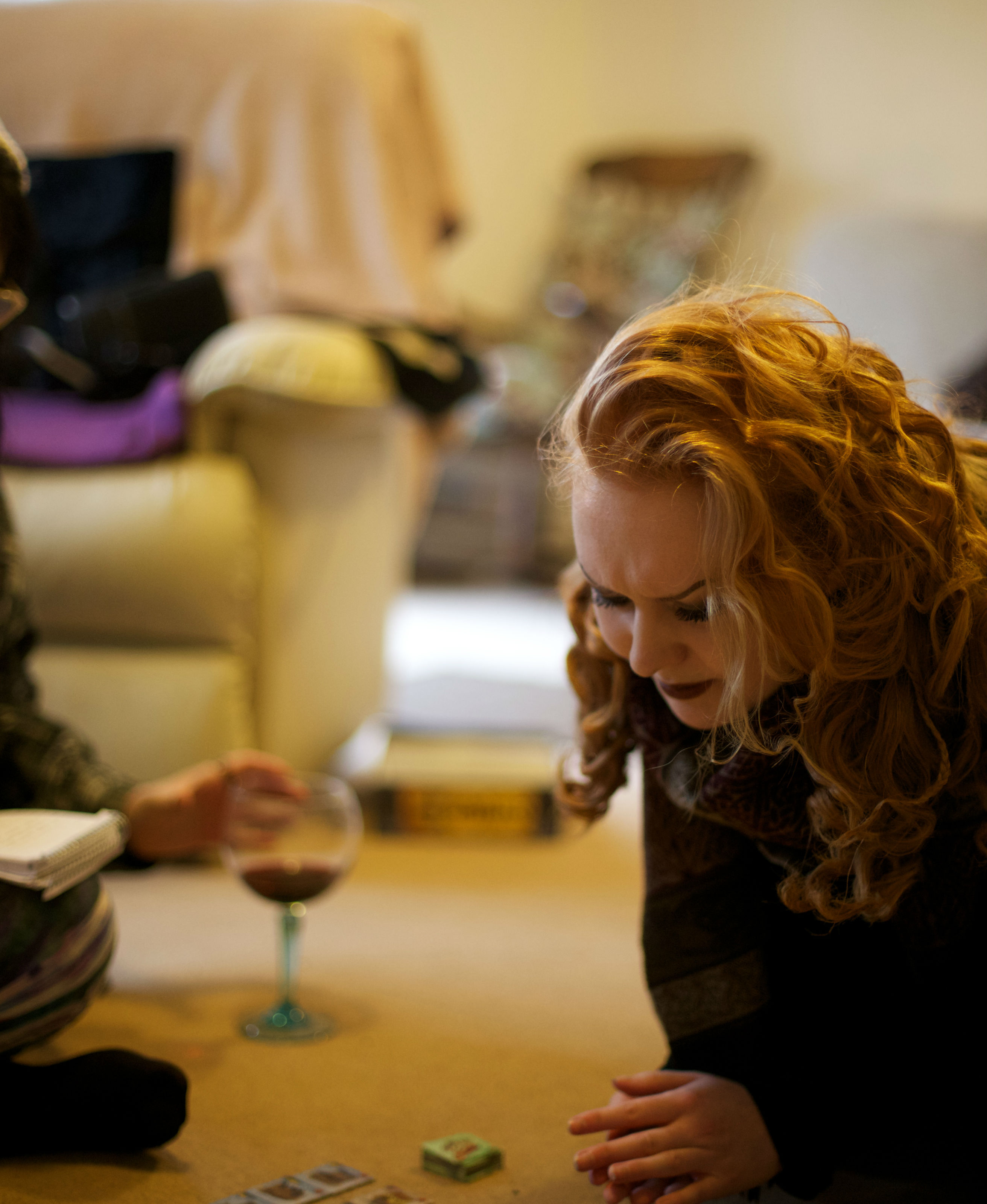
Your neighbourhood barons seem to be making a lot of money off this whole ‘production’ trend, so you decide to jump on board. You hire experts in the fields of farming and food production, irrigation, building, and quarrying to help you turn your land into useable raw materials. You can even get on board with a local feudal lord who has some excellent architects on exclusive retainer (‘The feudal lord is suitably fat. That’s good’ – Briony). Your invisible hordes of hard-working peasants, as soon as they’re given sufficient food and resources, immediately set to it in the glass- and brickworks and before you know it you’ve got some luxury items. These you invest into building factories, luxury second homes, and highly-efficient farming conglomerates. Eventually the buildings and luxury items earn you a bunch of cash moneys and then the game ends. Whoever has the most cash money at the end of the game wins. In this it’s very much like real life, and also extremely like Puerto Rico.
There are, of course, some complicating factors. If your neighbouring barons also want the use of the expert artisans then you will have to split the amount of work they can do. If you hack and burn all your forests to build farms there will be no pristine land to place a successful hunting lodge. If you accidentally over-feed your workers they’ll continue to produce glass and brick even when what you really wanted were the raw materials they were sitting on. Briony has a degree in geography and says that this is sort of how rocks and stuff work: cool stuff is usually underneath other more boring stuff, and it’s a shame medieval peasants didn’t know about taking core samples.
 This game is actually kind of adorable and well-designed (though it is, according to Briony, geographically inaccurate). Some of the little resource tiles have unique bits of illustration, and spotting them is a treat. Not gonna lie, it has some haters, who seem to dislike it for the same unusual mechanic that other people love. That is, the big individual cardboard dials that tally
 your basic resources (coal, food, etc.) and determine when they get used up and turned into the more luxurious brick and glass. Tzolk’in lovers will probably have some familiarity with this from that game’s corn-and-worker gear machines, while Caylus players will enjoy the familiar feeling of not having tallied their resources properly and fucking up their entire turn. Some people blame this on the game rather than their own fuzzy-minded planning, but that’s on them. A more reasonable criticism of Glass Road is that it has no easy or clear way to tally point-scoring. There’s just an awful lot of counting at the end of the game, again a little bit like fuzzy-strategies during Puerto Rico.
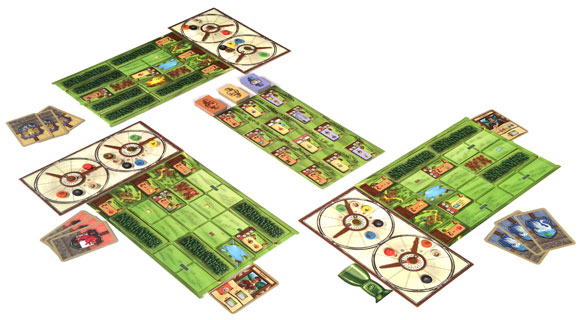
At the start of the game it’s pretty difficult to know what you’re trying to do. However, like most worker-placement games, collecting resources is usually a good start. Each player begins by selecting 5 of the 15 cards which represent your agriculture/industry specialists (a water carrier, a slash-and-burn farmer, a sand-quarrier (is that a thing?) etc.). On playing these experts you will be able to transform the cardboard tiles representing your land (initially representing such useless things as ‘trees’, and ‘lakes’) into resources of charcoal, food, sand, and water. Briony begins by selecting 5 cards more or less at random and plays a fish farmer. Unfortunately she’s apparently either very good or very bad at determining a useful specialist to hire, as both Lizzy and Gord (today’s Generic White Male Gaming Buddy) reveal that they also wish to hire the fish farmer. This means they only get half the use out of their fishing expert. The fish farmer, being a dick, doesn’t like sign a contract of exclusivity saying he’ll finish one job before starting another; he just does two half-assed jobs at the same time. Again, this is much like real life.
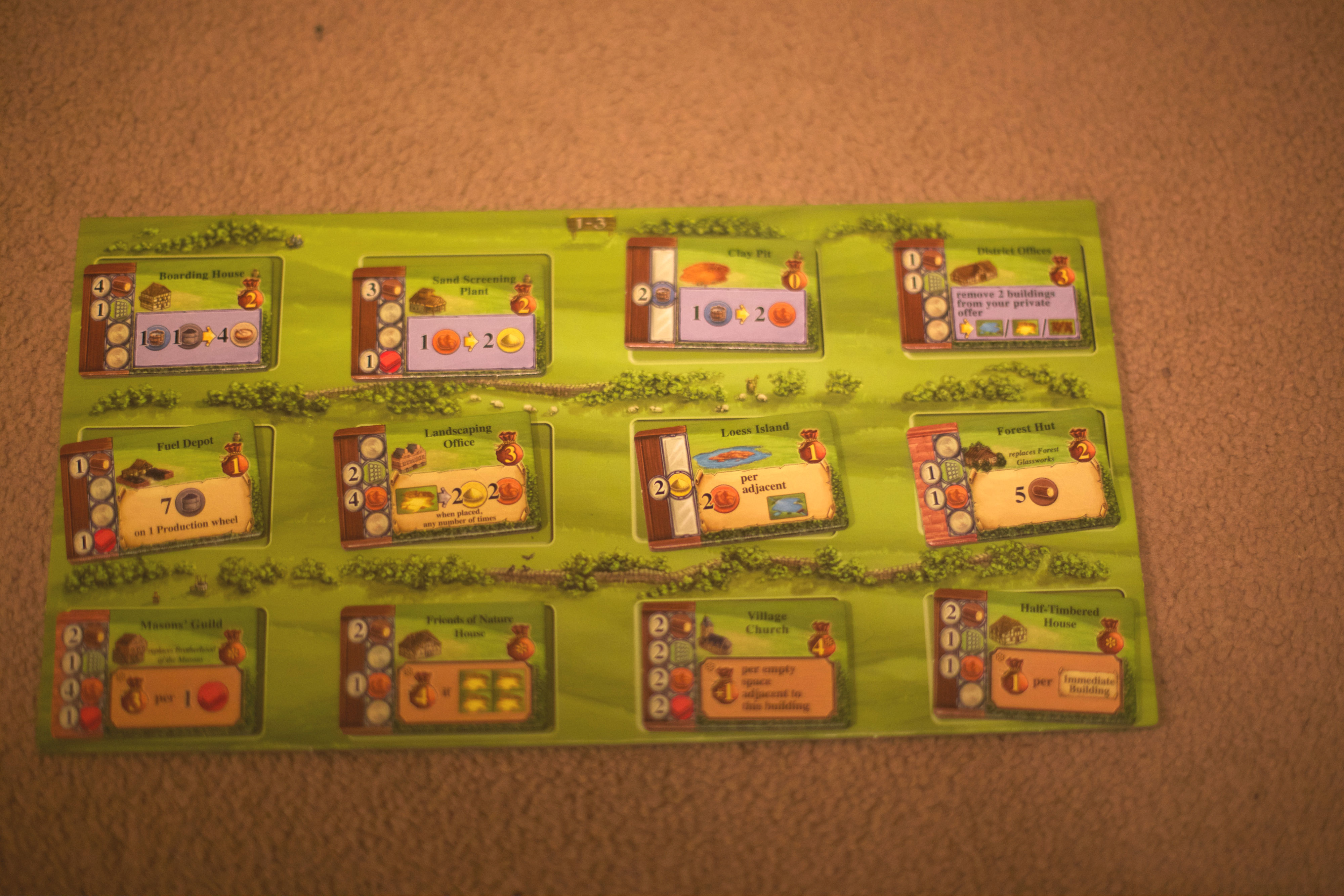 Once the great cardboard dials of industry have turned, you may use the product of your workers’ labour to further your cause as a budding capitalist. Buildings have unique effects on gameplay, which can be long-term, such as upgrading your glass factory; one-shot, such as generating a wad of cash; or end-game, giving bonus points with the caveat of certain accomplishments like ‘not turning all your lakes into factory run-off’ or ‘flattening vast swathes of land into sandy Depression-era dustbowl wastes’. Which buildings are more useful and desireable becomes clear as the game progresses. Once Briony and Gord had gotten the hang of their first game she became quite adept at snagging all the buildings that Lizzy wanted.

This game requires flexibility as well as forward-planning. A perfectly-devised strategy is likely to go awry as there’s no way to be sure of which buildings will be available to play, or which specialists you’ll have to share with your opponents. This is why Bob loves this game. She has a lot of very clever, strategically-minded friends who can logic out the best path through a game like a shark swimming through custard. Bob has a slightly more… lateral (ass-backwards) approach, picking up whatever strategy looks best at the time and throwing her toys out of the pram when it inevitably goes horribly wrong (we don’t talk about Black Fleet. So many little cubes were lost that day…). Somehow this really works for Glass Road. Unfortunately, Bob was busy cleaning up gaming-snack detritus and sat out this game.
In conclusion, it’s a nicely designed game, with just the right of in-game mechanics. It’s themed well, and has multiple strategies that my lead to victory that keeps intense direct competition to a minimum. The dials, ever becoming more popular in modern board games, certainly give a new dimension to resource collection. We recommend it highly. Also Lizzy wins again.
*Fun fact, you can totally go to Germany and tour the black forest’s monuments to the real glass road. There are glass museums and craft workshops and everything.
**The most unashamedly German board game is quite possibly Glück Auf (and then only until someone with a name like Rosenmüllentheimermassbergsohn invents a game called ‘Strategic Worker Placement in an Industrial or Agricultural Setting’***). It’s set in the Industrial Revolution-era Ruhrgebiet (basically the Black Country of Germany) and is about coal mining profits. The title is traditional German pit-lingo for ‘good luck’.
***’Strategische Arbeitereinstellung in einem Industrie- oder Landwirtschaftsszenario’. Catchy, no?
 The description on
 unfortunately they all seem to be pretty important to any overall strategy. Beginning with a set amount of jobs was a good way to ease into the mechanics, in much the same way as Caylus. I got the immediate suspicion that being relaxed into the game would screw you over simply for feeling relaxed at some point, especially as one new job is added per round.


 Misery Farming